How a four-cylinder designed to be bigger than BMW asked for grew into two straight-six families and a V8, and what each engine did in road cars, race cars and rivals' cars.
BMW's M10 was an inline-four built from 1962 to 1988, the M20 and M30 were straight-sixes built from 1977 to 1993 and 1968 to 1995, and the M62 was a V8 built from 1995 to 2005. The S62 is the M version of the V8, used in the E39 M5 and Z8.
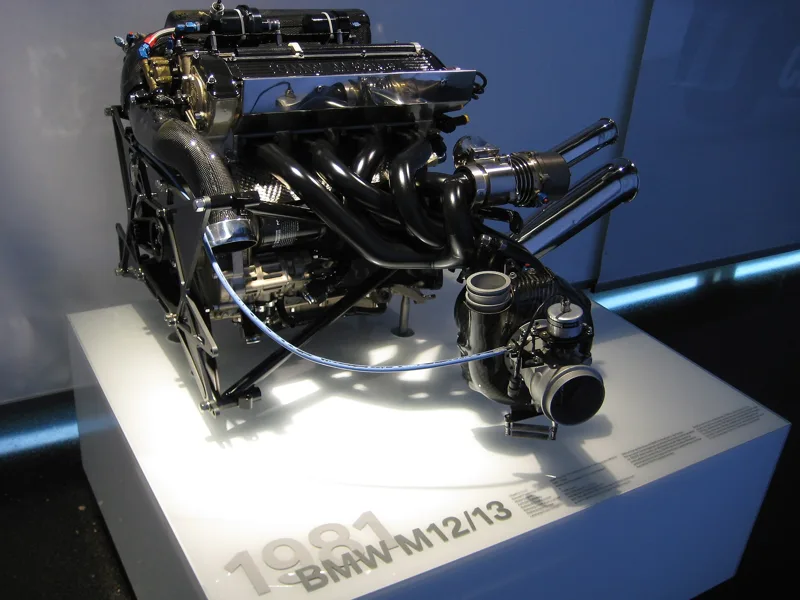
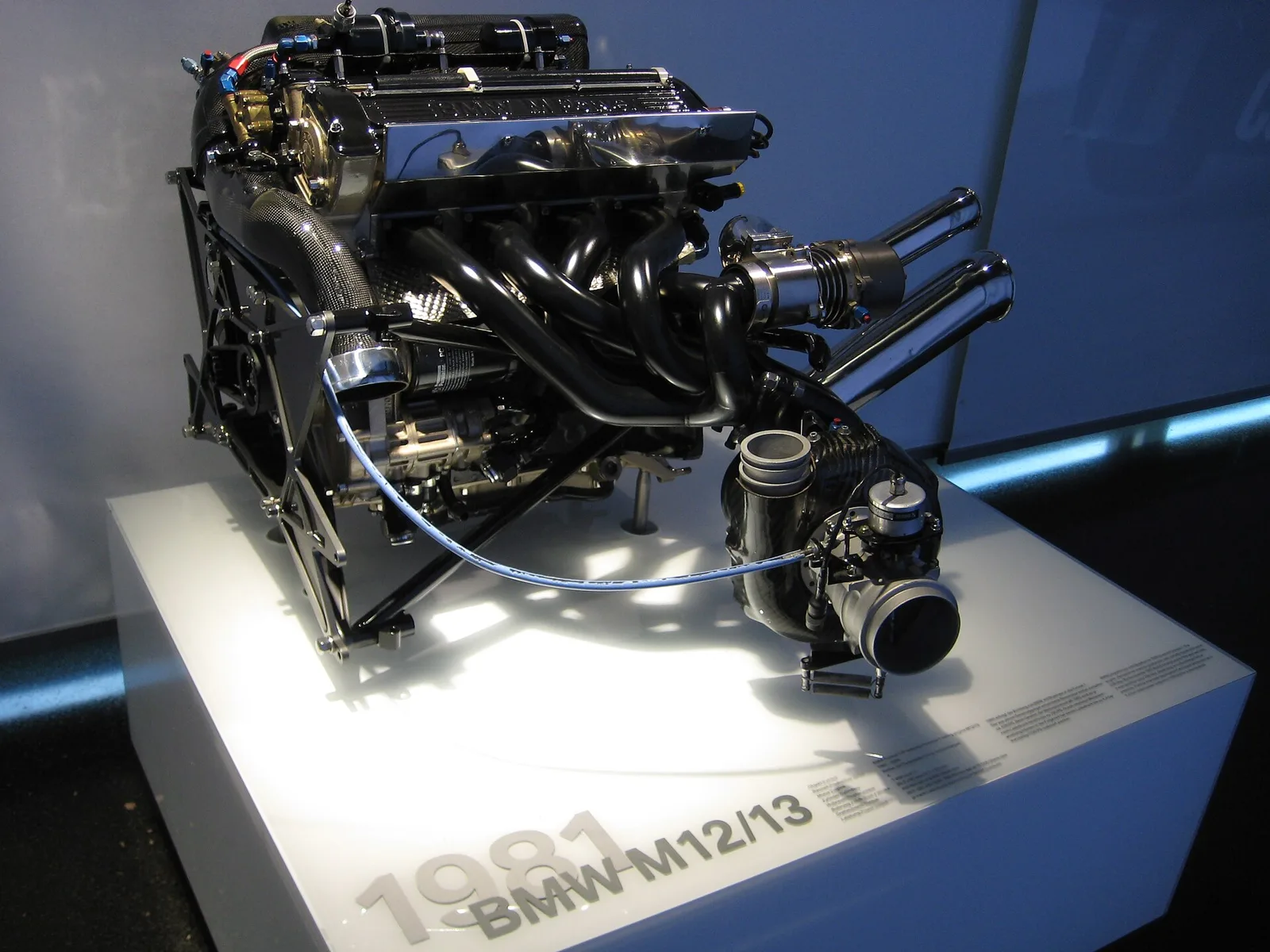
The cast-iron block that went under the BMW 1500 in 1962 later fathered a Formula One turbo said to make up to 1,400 PS in qualifying trim, and it supplied the foundation for the engine of the E30 M3. That engine was the M10, and together with the M20 and M30 straight-sixes and the M62 V8 it spans more than four decades of BMW production, from 1962 to 2005.
Where did the BMW M10 come from?
The M10 was a single-overhead-cam four-cylinder petrol engine, built from February 1962 to July 1988. It was BMW's first four-cylinder since the 309 ended production in 1936, and it arrived in the New Class sedans. More than 3.5 million were built in 26 years.
Baron Alex von Falkenhausen, an engineer and racing driver, designed it in the late 1950s. BMW asked him for a 1.3-litre (79 cu in) engine, but he felt that size would not be enough for the company's future and persuaded management to set a minimum of 1.5 litres (92 cu in), with a design that could grow to 2.0 litres (122 cu in). The M10 appeared in the 1500 at the Frankfurt show in September 1961, and customers could buy it from February 1962.
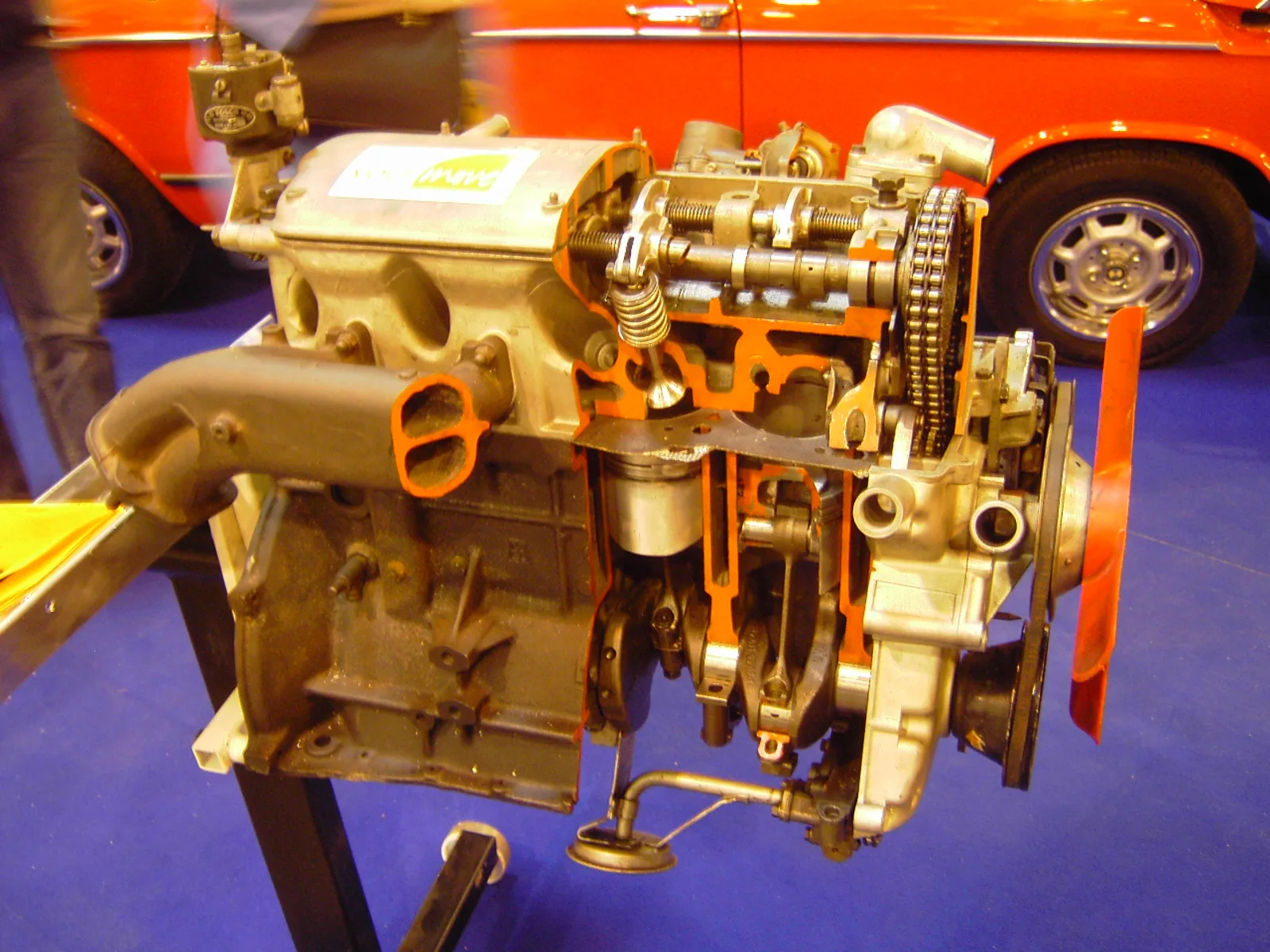
Its layout stayed constant for decades. The block is cast iron with a closed deck and bores cast together as siamesed pairs, and the cross-flow head is aluminium, with domed (hemispherical) chambers and a pair of valves per cylinder. Rocker arms with manual adjustment, a forged crank running on five main bearings and a camshaft driven by chain complete the picture. BMW canted the engine 30 degrees to one side to lower the car's centre of gravity. The first version had an 82 mm bore and 71 mm stroke, displaced 1,499 cc and made 59 kW (80 PS; 79 hp).
One iron block fathered a Formula One turbo and the heart of the E30 M3.
How did the M10 get its name?
At first not very tidily. The original engine was the M115, the last two digits standing for 1.5 litres, and its relatives carried codes starting with M1 followed by digits tied to displacement. In 1975 the family became the M10, and in 1980 it received the standard BMW code M10B18, in which B stands for Benzin, the German word for petrol, and 18 reflected the 1.8-litre size.
Everything in the family has since been called an M10, including the early M115.
What did the M10 power?
The range covered five displacements. The 1,499 cc engine made 55 to 60 kW in the 1500. The 1,573 cc version powered the 1600 and, in twin-carburettor form, the 1600 ti with 77 kW (105 PS). The 1,766 cc and 1,773 cc engines went into the 1800 family, with the 1800tiSA reaching 96 kW (130 PS) on twin Weber carburettors, and the 1,990 cc engine drove the 2000 and 2002 models.
Fuel injection arrived with the M15, using Kugelfischer mechanical injection to make 96 kW (130 PS; 128 hp) in the 2002tii. The M31 added a KKK turbocharger at 7 psi to produce 125 kW (170 PS) in the 2002 turbo. Later, in the 1980s, the M10 powered everything from the E30 316 and 318i to the E28 518i, with the 318i making 77 kW (105 PS) on Bosch L-Jetronic injection.
BMW began phasing the engine out in 1987 with the introduction of the M40, and the last carbureted E30 316 to use the M10 was built in July 1988. The block went on after that in other roles. The turbocharged M12 used in Formula One was based on it, and so was the S14 in the E30 M3.
Why did BMW build the M20?
BMW needed a straight-six to fill the gap between the M10 four and the M30 six. By the 1970s the M30, though turbine-smooth, was too large and heavy for the 3 Series engine bay, while the M10 grew buzzy and unrefined at larger sizes, because 2.0 litres is a typical upper limit for a four if it is to stay refined.
A 2.0-litre six promised the smoothness of an inline-six while sidestepping European displacement taxes, and it could be developed to meet the tightening emissions rules of the 1970s and 1980s. BMW showed the M20 at the 1977 IAA in two forms: a 2.0-litre with a Solex 4A1 carburettor making 90 kW and a 2.3-litre with Bosch K-Jetronic injection making 105 kW. Both used an 80 mm bore. In 1982 the bore grew to 84 mm, leading to the 2.5 and 2.7-litre versions.
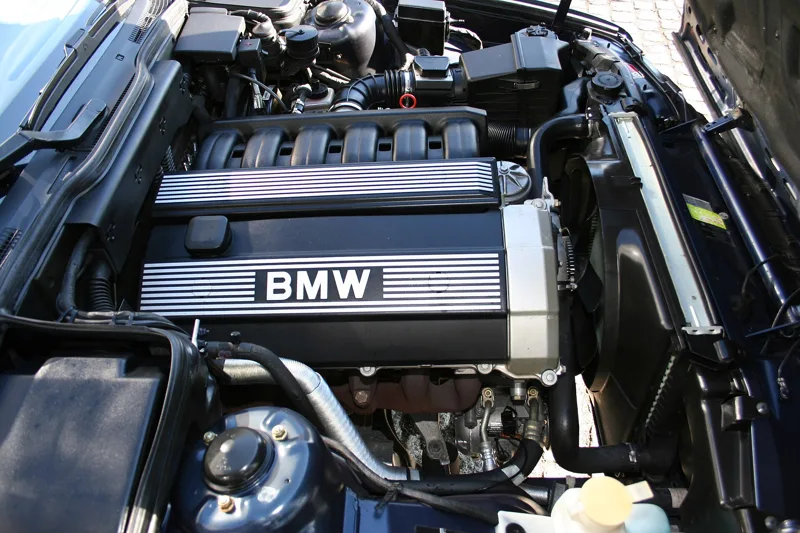
The M20 shares the iron closed-deck block, cross-flow aluminium head and SOHC two-valve layout of the M10 and M30, but it differs in three ways. A timing belt replaced the chain to cut noise and cost, bore spacing shrank from 100 mm to 91 mm to save length and weight, and the engine leaned 20 degrees instead of 30, so it sat more upright. It was built from 1977 to 1993, used in the E12 and E28 5 Series, the E21 and E30 3 Series and the E34 5 Series, and the last ones went into E30 touring and convertible models in April 1993. The M20 also formed the basis for the M21 diesel and is loosely related to the M70 V12.
Which M20 variants mattered?
The 2.0-litre M20B20 displaced 1,991 cc and made its debut with a four-barrel carburettor, a 9.2:1 compression ratio and a 6,400 rpm redline. It became fuel-injected in 1981 with K-Jetronic, making 92 kW (123 hp), moved to LE-Jetronic in 1982 and gained Motronic management and a catalytic converter in 1987. BMW did not sell it in the United States, though Canadian 320i models had it.
The M20B23 followed in March 1978. With a longer 76.8 mm stroke it displaced 2,316 cc and made 105 kW (143 PS; 141 hp). The M20B25 replaced it in 1985 with 2,494 cc, an upgraded head and Motronic 1.1, rated at 126 kW (171 PS; 169 hp) before catalytic converters. A catalysed version from 1987 made 125 kW (170 PS; 168 hp) despite a lower compression ratio.
The oddest was the M20B27, the eta engine of the 325e. It was designed for efficiency and low-rev torque, an unusual aim for a BMW six, with an 81 mm stroke, 2,693 cc and a rev limit of just 4,800 rpm. It produced 92 kW (123 hp), with 240 N m (177 lb ft) arriving at 3,250 rpm. BMW developed it with the American market in mind, because its US fleet average fuel economy was at risk by 1984. The first car to use it was the US-market 528e in 1982. A South African version for Group N racing used Alpina parts to make 145 kW (194 hp) in the E30 325iS.
What was the BMW M30?
The M30 was a SOHC straight-six built from 1968 to 1995. At 27 years it was BMW's longest-produced engine. The 2500 and 2800 saloons and the 2800 CS coupe were its first homes, with 2,494 cc and 2,788 cc engines, and the largest, at 3,430 cc, was sometimes badged as a 3.5.
It was developed from the M10, sharing the 30-degree slant, the cross-flow head, the chain-driven camshaft and the iron block with aluminium head. After the smaller M20 arrived, the M30 picked up nicknames, the Big Six and the Senior Six. Before the M70 V12 of 1987 it was BMW's largest and most powerful regular production engine, and Ward's put it on its list of Top Engines of the 20th Century. Production began to wind down after the M50 arrived in 1990.
Early engines carried the codes M06 and M68, and every version took the M30 prefix from 1981. Hot versions included the 3.0 CSi of 1971, the first fuel-injected M30, with Bosch D-Jetronic and up to 147 kW (200 PS; 197 bhp). The 3,210 cc M30B32 was badged as a 3.3 on cars like the 633i and 733i, and the 1979 732i was BMW's first use of Bosch Motronic. The M30B34 made 160 kW (218 PS; 215 hp) in Europe, while cars for North America and Japan, with an 8.0:1 compression ratio, got 136 kW (185 PS; 182 hp). The largest, the M30B35, made 155 kW (211 PS; 208 hp).
How did the M30 go turbo and racing?
The M102, built from 1980 to 1982, was BMW's first turbocharged six-cylinder, an intercooled KKK unit running 9 psi (0.62 bar) and making 188 kW (256 PS; 252 bhp) in the E23 745i. It was not offered in right-hand drive, so the South African 745i got the naturally aspirated M88 instead.
The M106 replaced it from 1982 to 1986 with 3,430 cc and Motronic, giving a similar peak output of about 185 kW at lower rpm, with boost reduced to 6 psi (0.41 bar). BMW's next turbocharged petrol engine was the N54 of 2006.
Alpina's B10 Biturbo took the idea furthest. With two turbochargers and forged pistons it made 265 kW (360 PS; 355 bhp), which made it the fastest sedan in the world, and BMW sent the last 50 M30 blocks to Alpina for the final cars. In racing, the M30 block powered E9 CSL and E24 coupes in the European Touring Car Championship through the 1970s and into the mid-1980s, and the high-performance M49 and M88 engines were based on it.
What was the BMW M62?
The M62 was a naturally aspirated V8 built from 1995 to 2005, succeeding the M60. It has an aluminium block and heads, four valves per cylinder with double overhead camshafts, and a single-row timing chain. Most engines used the Alusil block, which integrates silicon through the aluminium so that liners are not needed, though some early ones had a Nikasil coating instead.
Inside, it uses fracture-split forged connecting rods and hypereutectic pistons, and Bosch Motronic 5.2 control. A 1998 Technical Update brought variable valve timing on the intake camshafts, electronic throttle control and Motronic ME7.2, creating the M62TU variants. The line-up included the M62B35 and M62B44 and their TU successors, up to the M62TUB46 with a 93 mm bore and 85 mm stroke.
Which cars used the M62?
| Version | Used in |
|---|---|
| M62B35 | 1996 to 1998 E39 535i and E38 735i |
| M62B44 | E39 540i, E38 740i and E31 840Ci |
| M62TUB44 | E39 540i, E38 740i, X5 4.4i, Morgan Aero 8, 2002 to 2005 Range Rover |
| M62TUB46 | Alpina B10 V8, Morgan Aero 8 GTN, X5 4.6is |
| Cosworth twin-turbo M62B44 | 1998 to 2000 Bentley Arnage Green Label, 260 kW (349 hp) |
In the United States the TU version of the M62B44 made 216 kW (290 hp), while European outputs for the TUB35 were 175 kW (235 hp) in the E38 and 180 kW (241 hp) in the E39. Alpina developed the F3, F4 and F5 engines from the M62B44, moving through a 93 mm bore, then variable valve timing and an electronic throttle, then an 89 mm stroke for the B10 V8S and Roadster V8. Racing Dynamics built the R52, with a billet crankshaft, 11.3:1 compression and a 7,200 rpm redline.
How does the S62 differ from the M62?
The S62 is the BMW M version, fitted to the E39 M5 and the Z8 and also to the Ascari KZ1 and A10. It was BMW's first V8 with double-VANOS, variable timing on both the intake and exhaust camshafts.
Output peaks at 294 kW (400 PS; 394 hp) when the engine turns 6,600 rpm, with 500 N m (369 lb ft) available at 3,800 rpm, and the redline is 7,000 rpm. The 94 mm bore and 89 mm stroke give 4,941 cc, against 4,398 cc for the largest M62 of the time. It also has eight individual throttle bodies with driver-selectable normal and sport response, an 11.0:1 compression ratio against 10.0:1, a double-row timing chain, hollow camshafts and a semi-dry sump with two extra scavenge pumps for hard cornering. Like the M62 it is aluminium throughout, and it was assembled at Dingolfing.
How do the four engine families compare?
| Engine | Layout | Built | Valve gear | Cam drive |
|---|---|---|---|---|
| M10 | Inline-four, 1.5 to 2.0 litres | 1962 to 1988 | SOHC, two valves per cylinder | Chain |
| M20 | Straight-six, 2.0 to 2.7 litres | 1977 to 1993 | SOHC, two valves per cylinder | Belt |
| M30 | Straight-six, 2,494 to 3,430 cc | 1968 to 1995 | SOHC, two valves per cylinder | Chain |
| M62 | V8, naturally aspirated | 1995 to 2005 | DOHC, four valves per cylinder | Single-row chain |