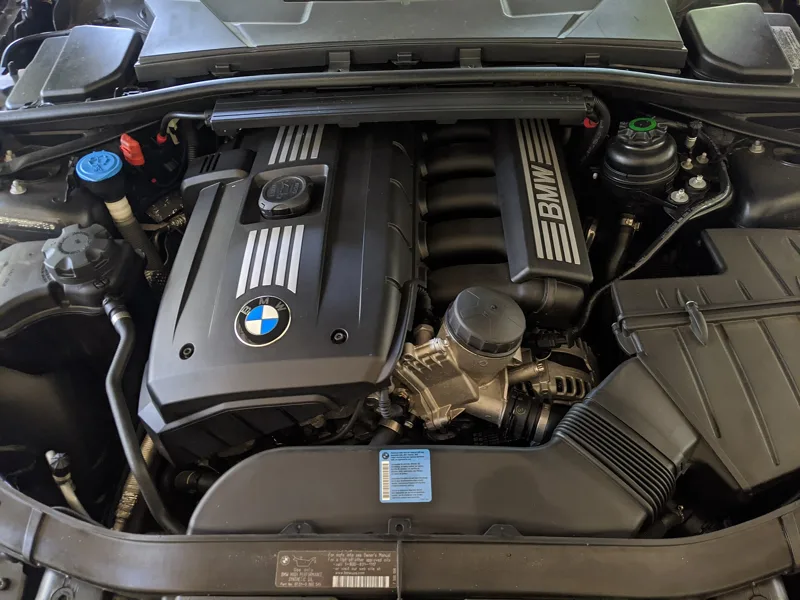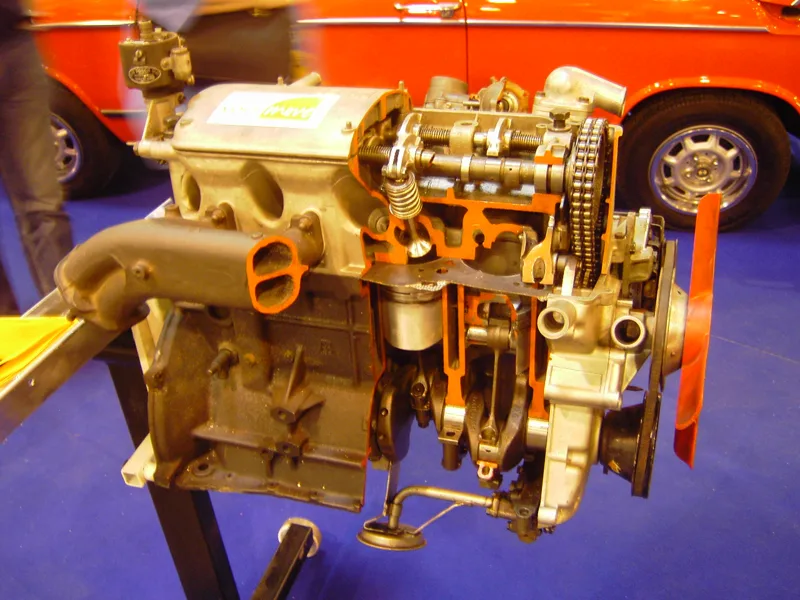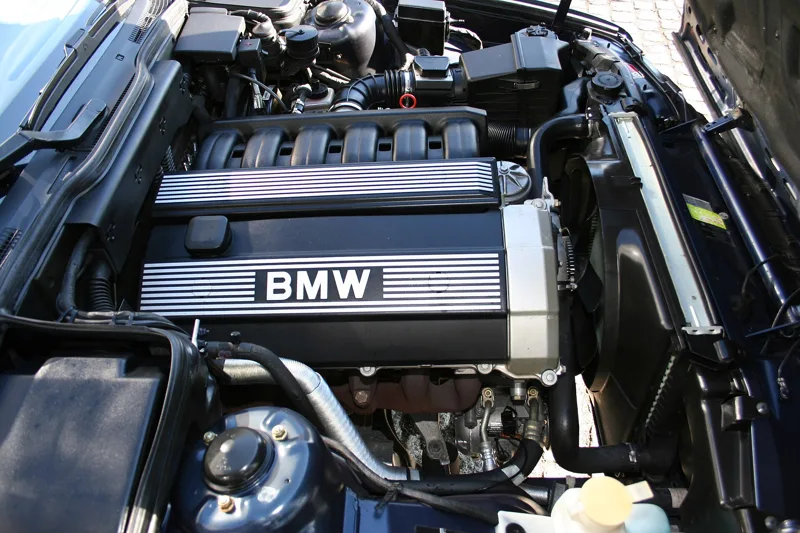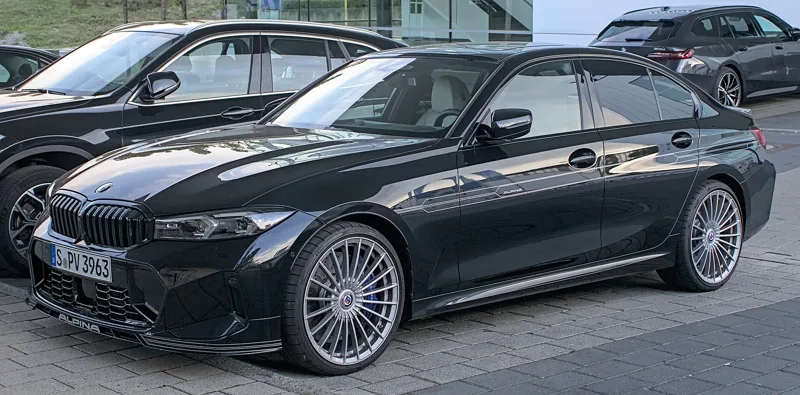
A naturally aspirated V8 that won engine awards, a twin-turbo V8 with its turbos inside the V and a four-cylinder used from MINI to Toyota.
The N62 was BMW's naturally aspirated V8 of 2001 to 2010. The N63 is the twin-turbo V8 that replaced it in 2008, with its turbochargers inside the V. The B48 is a turbocharged inline-four that replaced the N20 and has been built since 2014.
BMW's N63 was the first production car engine in the world to put its turbochargers inside the V of a V8, and it is also an engine that has been widely noted for mechanical issues and several recalls. It replaced a very different V8, the naturally aspirated N62, which won International Engine of the Year in 2002. Alongside both, since 2014, has run the B48, a turbocharged four-cylinder that has ended up in everything from a MINI to a Toyota.
Three BMW engines, three different philosophies.
What is the BMW N62 engine?
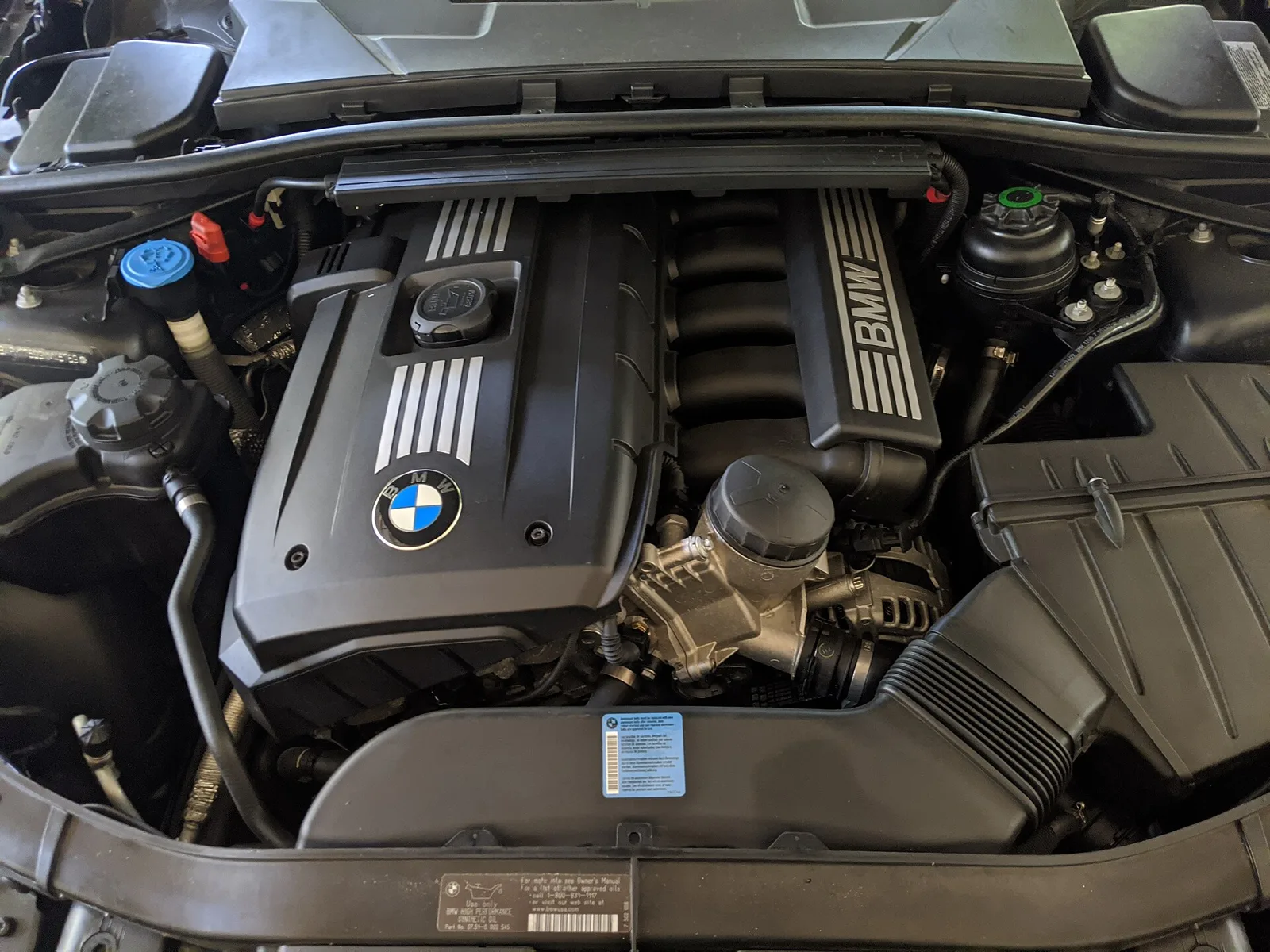
BMW fitted the N62, a petrol V8 with no turbocharging, to its cars from 2001 to 2010, and Morgan carried on building the Aero with it in small numbers until 2019. Two firsts defined it: a continuously variable intake manifold that was new to the world, and variable valve lift, called Valvetronic, which it brought to a BMW V8 for the first time.
There was no M version of the N62, unlike the engine before it and the one after it. It did win the 2002 International Engine of the Year award, along with the Best New Engine and Above 4-litre categories.
BMW did not simply evolve the older M60 and M62 line. The N62 was a clean sheet design. The 4.4-litre version had a bore of 92 mm (3.6 in) and a stroke of 82.7 mm (3.26 in), for 4,398 cc, with double overhead camshafts, four valves per cylinder and an aluminium block and head. Variable valve timing on both the intake and exhaust camshafts, called double VANOS, set it apart from the M62, which varied only the intake cams. Its connecting rods were forged from powdered metal and split at an offset fracture, and the redline was 6500 rpm.
How Valvetronic works on the N62
In a normal petrol engine a throttle valve restricts the air going in, which wastes energy as the engine sucks against it. Valvetronic does the job another way: it changes how far the intake valves open, from barely open to just under a centimetre on the N62, and that lift controls the airflow in normal driving. The engine still has a throttle body, but it is used only in an emergency if Valvetronic fails, for some cold starts and to keep a set amount of vacuum in the intake at low load, such as cruising or idling.
The variable-length intake
That intake, known as DIVA, was unique to the N62B44 among production engines. Think of an intake as a trombone: long pipes help torque at low revs, short pipes help power at high revs. On the N62 the path begins to shorten at 3,500 rpm and keeps shortening until it is at its shortest at the redline. The aim is a broader torque curve and more peak power.
The N63 was the first production engine in the world with its turbochargers inside the V.
Which engines and cars did the BMW N62 cover?
The N62 came in four sizes: a 3.6-litre, a 4,000 cc, a 4.4-litre and a 4.8-litre. The smaller engines went into the 7 Series and 5 Series, while the largest powered the 550i, 650i, 750i and X5 4.8i, and also sports cars from Morgan and Wiesmann.
- N62B36: bore 84 mm (3.3 in), stroke 81.2 mm (3.2 in), giving 3,600 cc (219.7 cu in). Peak power was 200 kW (270 hp), reached at 6,200 rpm; torque peaked at 360 N.m (270 lb.ft) when the engine hit 4,250 rpm. It went into the 735i and 735Li from 2001 to 2005.
- N62B40: a stroke of 84.1 mm (3.3 in) and an 87 mm (3.4 in) bore on a 4,000 cc (244.1 cu in) block. It made 225 kW (302 hp) at 6,300 rpm, with 390 N.m (290 lb.ft) on tap from 3,500 rpm. A TU variant that replaced the 3.6, it powered the 540i from 2005 to 2010 and the 740i and 740Li from 2005 to 2008.
- N62B44: 4,398 cc (268.4 cu in) and 245 kW (329 hp) at 6,100 rpm, plus a torque peak of 450 N.m (330 lb.ft) by 3,600 rpm. The X5 4.4i was rated lower, at 235 kW (315 hp) and 440 N.m (325 lb.ft). It appeared in the 745i, 545i, 645Ci, X5 4.4i and the Morgan Aero 8 Series 2 and Series 3.
- N62B48: the biggest of the family, at 4,799 cc (292.9 cu in) from a 93 mm (3.7 in) bore and 88.3 mm (3.5 in) stroke. Outputs were 261 kW in the X5 4.8i, 265 kW in the X5 4.8iS and Wiesmann, and 270 kW in the 550i, 650i, 750i and later Morgan Aero models.
The 4.8-litre engine appeared first in the X5 4.8is. Its longer stroke needed a deeper oil pan, and the change was applied to all N62 engines from October 2003, along with more conventional non-offset connecting rods. From model year 2005 the engine evolved into the N62TU, and the 4.8 replaced the 4.4. The TU brought different exhaust manifolds, better catalytic converters, new sensors and engine management, and swapped the DIVA manifold for a two-stage DISA design. Secondary air injection ports were removed, and valve stem diameter shrank from 6 mm to 5 mm.
Alpina made its own version, the H1, using the N62B44 block with a forged Alpina crankshaft, high-strength Mahle pistons and an ASA centrifugal supercharger. It had a redline of 6,200 rpm and produced 368 kW in the Alpina B5, B6 and B7, rising to 390 kW in the B5 S and B6 S from 2007 to 2010.
What is the BMW N63 engine?
The BMW N63 is a twin-turbocharged petrol V8 that has been in production since 2008. It replaced the N62 and was first used in the 2008 X6 xDrive50i. It is BMW's first turbocharged petrol V8, and the first V8 from the company to use direct injection.
The signature feature is the hot-vee layout. On a traditional V8 the intake sits inside the V and the exhaust manifolds are on the outside. The N63 reverses that: the exhaust manifolds and turbochargers sit between the cylinder banks and the intake manifolds are on the outside. The layout narrows the engine and shortens the path that exhaust gas travels from the valves to the turbochargers, so the turbos get hot gas quickly. Air-to-water intercoolers are fitted, which improves throttle response.
The original N63 and S63 did without Valvetronic, as the N54B30 had, because the benefit of cutting intake vacuum matters less in a turbocharged engine. Turbocharging also meant no variable-length intake manifold. The engine uses an 89 mm (3.50 in) bore and an 88.3 mm (3.48 in) stroke, except in the Chinese market, where an 80 mm (3.15 in) stroke is used.
How the N63 changed over the years
BMW applied three Technical Updates. In 2012 the N63TU (N63B44O1) added Valvetronic, plus revised turbochargers, no blowoff valve, lighter pistons, forged connecting rods and crankshaft, a valve cover oil catch and return system, new valve stem seals, a revised fuel system and a second coolant pump. The power gain was 31 kW (42 hp; 42 PS) and 50 N.m (37 lb.ft), on top of the original 300 kW (402 hp; 408 PS) and 600 N.m (443 lb.ft).
The second update came in 2016 with the N63TU2 (N63B44O2): twin-scroll turbochargers, a peak torque band that was 200 rpm wider, and the oil and coolant heat exchanger moved into the V. A third update in 2018 produced two variants. The N63B44M3 got better thermal shielding for the crankcase and cylinder head and a new ignition system. The N63B44T3 received higher-pressure injectors, bigger twin-scroll turbos, a redesigned intake manifold and a radiator placed upstream of the intercooling.
Chinese buyers received a smaller N63B40A with the shorter 80 mm stroke, giving 3,982 cc (243.0 cu in). It was fitted to the 650i with 300 kW (402 hp; 408 PS), the facelifted 750i and 750Li with 331 kW (444 hp; 450 PS), and to the facelifted X5 50i and X6 50i.
What are the common BMW N63 problems?
The N63 has been widely noted for its mechanical issues and has undergone several recalls. BMW North America announced a voluntary Customer Care Package in December 2014. It dealt with stretching timing chains, fuel injectors, airflow sensors, crankcase vent lines, the battery, the vacuum pump and the low pressure fuel sensor, and it shortened or changed the oil service interval.
In 2019 the United States regulator NHTSA addressed the multitude of issues with N63 engines, with various class action lawsuits under way. A mass recall over valve seal issues inherent in the N63 line was never officially declared. The 2012 update introduced new valve stem seals, one of its listed changes.
Where did the S63, P63 and Alpina versions of the N63 go?
The S63 is the BMW M version, first seen in the X6 M and used in the M5 from 2011 to 2023. The P63 is the BMW Motorsport version, debuted in the M8 GTE. Alpina also used the N63 in the B5, B6, B7 and B8.
The S63 has two twin-scroll turbochargers and a pulse-tuned, cross-engine exhaust manifold to keep exhaust pulses flowing to the turbos at every 180 degrees of rotation. The first updated version, the S63B44T0 on the F10 M5, was the first BMW M engine to use Valvetronic. Its compression ratio rose to 10:1 from 9.3:1, boost went from 1.3 bar to 1.5 bar and the rev limit rose from 6800 rpm to 7200 rpm. The same engine went into the M6 and M6 Gran Coupe.
The S63B44T2 first appeared in the 2015 X5 M and X6 M, and the S63B44T4 in the 2018 M5. The T4 went on to the M5 Competition, the 2021 M5 CS, the M8 and M8 Competition from 2019 to 2026, and the F95 X5 M and F96 X6 M from 2020 to 2023. Standard N63B44T3 engines reached the M850i, 750i, M550i, X5 M50i, X6 M50i and X7 M50i, as well as the Alpina XB7, the Alpina B8 Gran Coupe and, in 2022 and 2023, the Range Rover and Range Rover Sport.
Alpina hand-assembled its version of the N63 at its plant in Buchloe before sending it to the BMW production line. It received Valvetronic from the 2013 model year, like every other N63. Cars included the B7 Bi-Turbo from 2009, the B5 Bi-Turbo from 2010, the B6 Bi-Turbo from 2011 and, later, the B7 on the G12 7 Series, the B5 on the G30 and G31 5 Series until 2024, and the B8 on the G16 8 Series from 2021 to 2025. The later Alpina engine, coded N63M30A, evolved into the N63B44T3 type, which also went into the BMW F93 M8 Competition.
What is the BMW B48 engine?
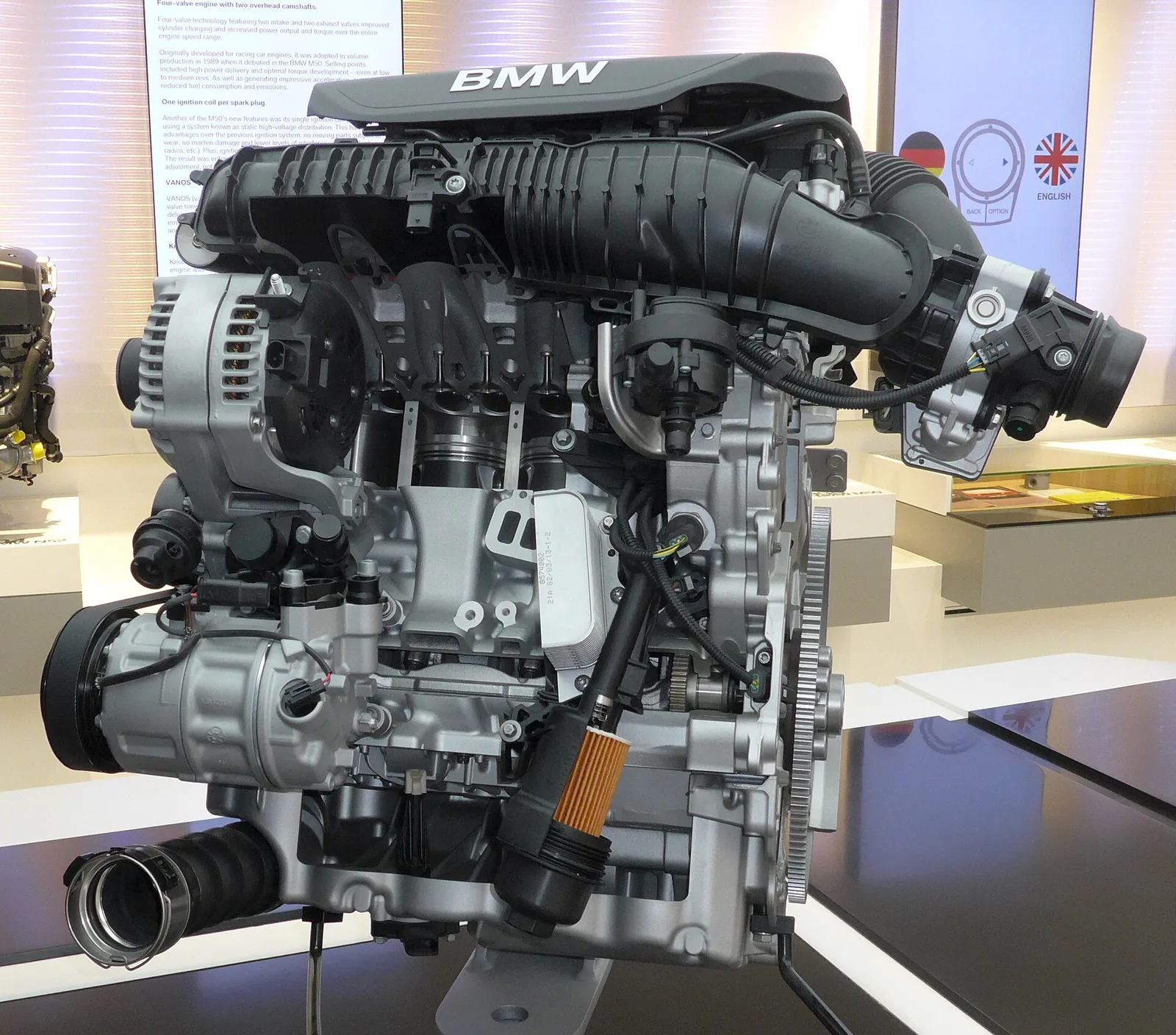
The B48 is a turbocharged four-cylinder petrol engine, set in a row, that took over from the N20 and has been built since 2014. The F56 MINI Hatch was its first home, and BMW's own models have used it since 2015.
It belongs to a modular family built around 500 cc (30.5 cu in) per cylinder: the three-cylinder B38 and B37, the four-cylinder B48 and B47, and the six-cylinder B58 and B57. The B46 is a SULEV (super ultra low emissions) version for the United States and other places with tough emissions limits. Apart from minor differences, mainly in emissions hardware, the B46 and B48 are essentially identical in performance and reliability.
Compared with the N20, the B48 uses a more undersquare design, in which the stroke is longer than the bore, and a closed-deck block. As with the N20, the block and head are aluminium, and the engine keeps a twin-scroll turbocharger, direct injection, Valvetronic and double VANOS.
The 2018 Technical Update
BMW revised the engine in 2018 as the B48TU. The changes included a new one-part timing chain in place of the two-part chain, a cooling circuit of its own for the head and another for the crankcase, and forged connecting rods. The crankshaft became 1 kg (2.03 lb) lighter because of lighter materials and different machining. The fuel system also gained a Bosch HDP6 high pressure pump and HDEV6 injectors that borrow from the P48 Turbo Engine.
How much power does the BMW B48 make?
The B48 comes in at least fifteen power outputs, from 115 kW to 233 kW. The 135 kW version is found in the 320i, 520i, X3 xDrive20i and a long list of other BMW models.
- 115 kW: the G20 318i from 2020 and the G42 218i from 2022.
- 125 kW: models sold in Turkey and Tunisia, such as the G20 320i and G30 520i.
- 135 kW: the 320i (F30), 120i (F20), 520i (G30) and X3 xDrive20i (G01). The 330e and 530e combine this engine with an electric motor for 185 kW (248 hp) and 420 N.m (310 lb.ft).
- 145 kW: the F56 MINI Cooper S, the Z4 sDrive20i and the Toyota Supra in Japanese SZ trim. In the MINI, a temporary overboost adds 20 N.m (15 lb.ft) to reach 300 N.m (221 lb.ft).
- 170 kW: the MINI John Cooper Works Hardtop and Cabrio with 320 Nm, and the Clubman and Countryman ALL4 with 350 Nm, along with the 225i Active Tourer and the X1 25i.
- 185 kW: the 330i, 230i, 430i and 530i, together with the X3 xDrive30i and the plug-in hybrid X3 xDrive30e.
- 190 kW: the G11 730i, the G32 630i, the Z4 sDrive30i, the Toyota Supra and the Morgan Plus Four. The 740e xDrive adds an 82 kW electric motor for a total of 240 kW.
- 225 kW: introduced in May 2019, with a reinforced crankshaft and larger main bearings, new pistons with a lower 9.5:1 compression ratio, a larger turbocharger and a reworked intake. It powers the M135i xDrive, M235i xDrive Gran Coupe, X2 M35i and the MINI John Cooper Works GP.
- 233 kW: the 2025 M135 xDrive, M235 xDrive Gran Coupe and the X1 and X2 M35i. In the EU, BMW has had to cut the power to 300 hp under new emissions rules, while in the United States it rises to 312 hp.
How do the BMW N62, N63 and B48 compare?
| Detail | BMW N62 | BMW N63 | BMW B48 |
|---|---|---|---|
| Layout | V8 | V8, hot-vee | Inline-four |
| Aspiration | Naturally aspirated | Twin turbo | Single twin-scroll turbo |
| Production | 2001 to 2010, Morgan Aero until 2019 | 2008 to present | 2014 to present |
| Valvetronic | Yes, from the start | Added in the 2012 update | Yes |
| Injection | No direct injection | Direct, BMW's first V8 with it | Direct |
| Capacity | 3,600 to 4,799 cc | 3,982 cc in China; B44 variants with 89 mm bore, 88.3 mm stroke | 500 cc per cylinder |
| Typical output | 200 to 270 kW | 300 kW at launch | 115 to 233 kW |
| M version | None | S63 | None listed |
What is still in production?
The N63 is listed as still in production, and N63-based engines are listed in cars through 2026, among them the M8 and the Alpina B8 Gran Coupe. The B48 is also still being built, with new 233 kW versions arriving for 2025.
The N62 ended its run in BMW cars in 2010, although the Morgan Aero kept it in small-scale production until 2019. Production dates for the Z4 and the Supra, both B48-powered, run to 2026.