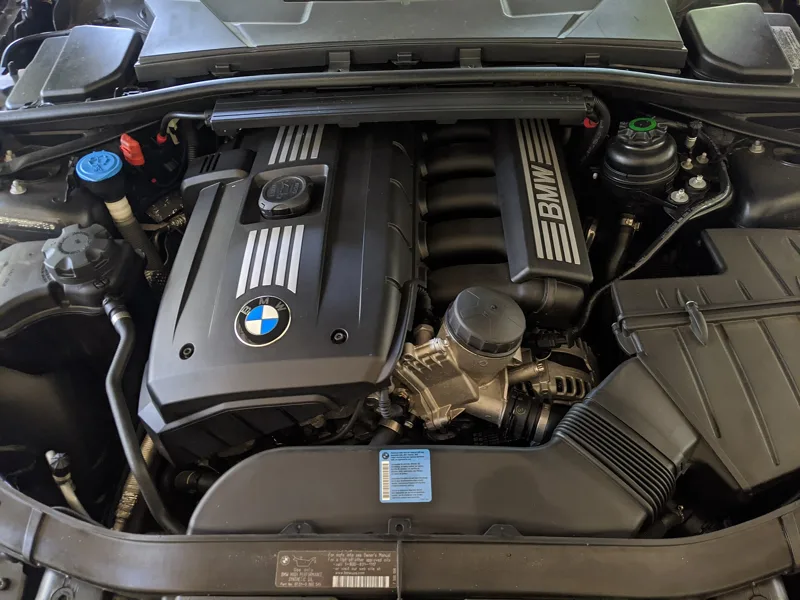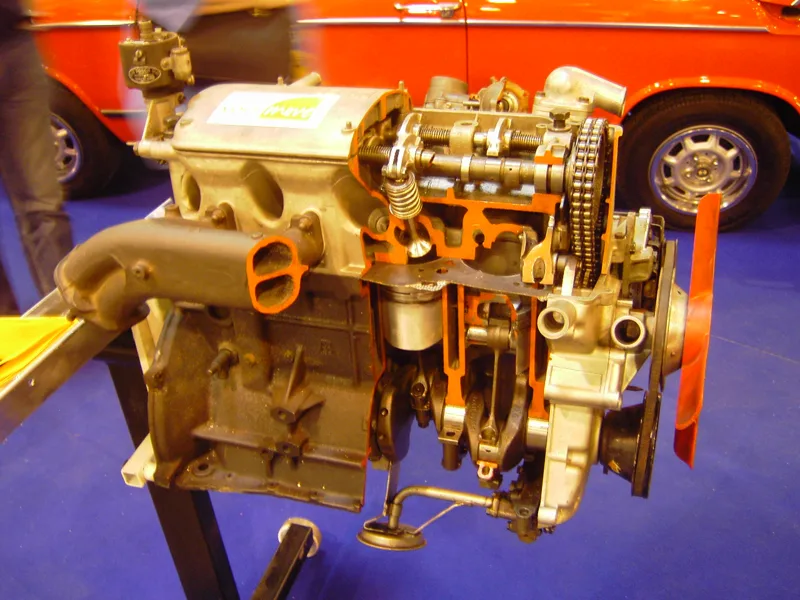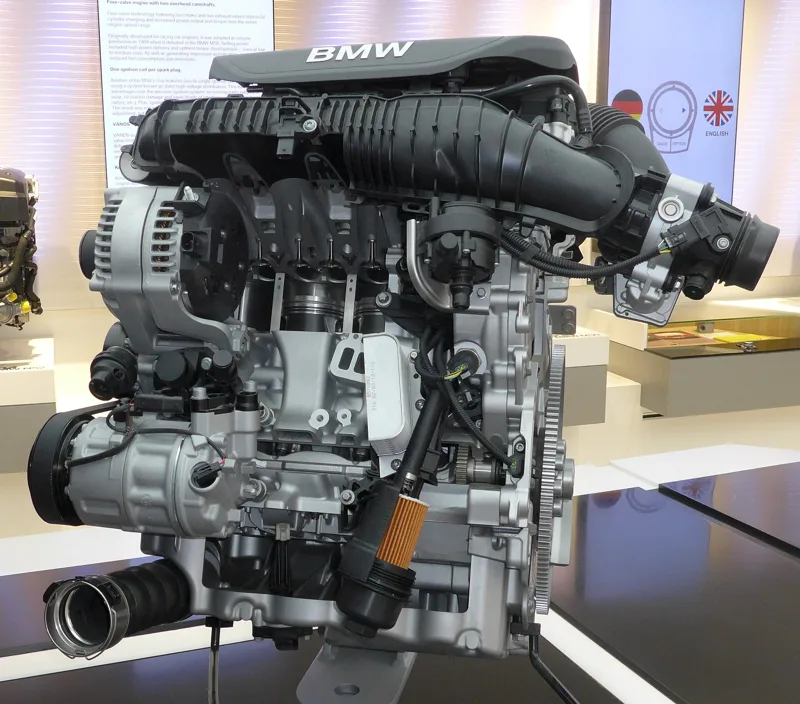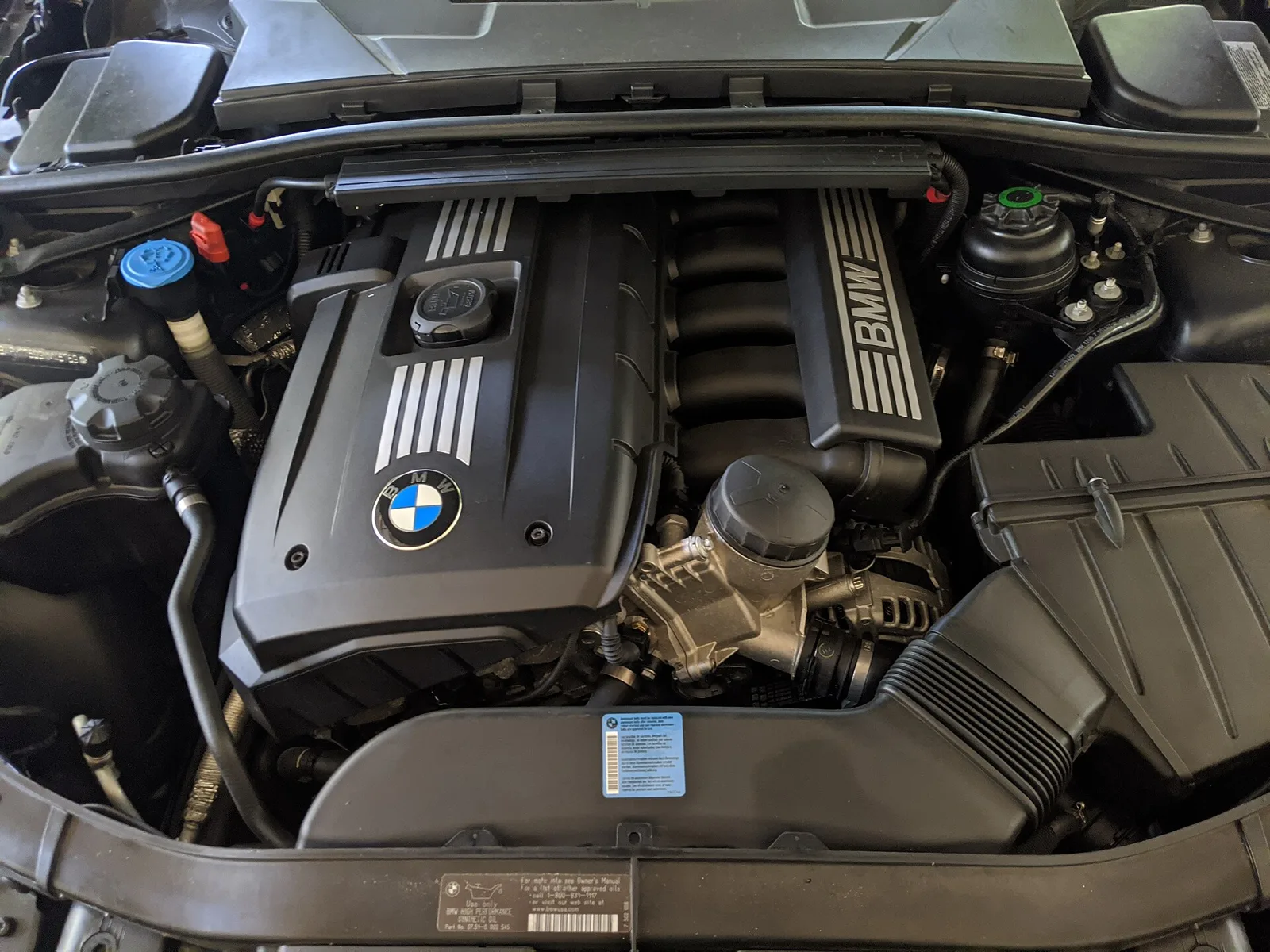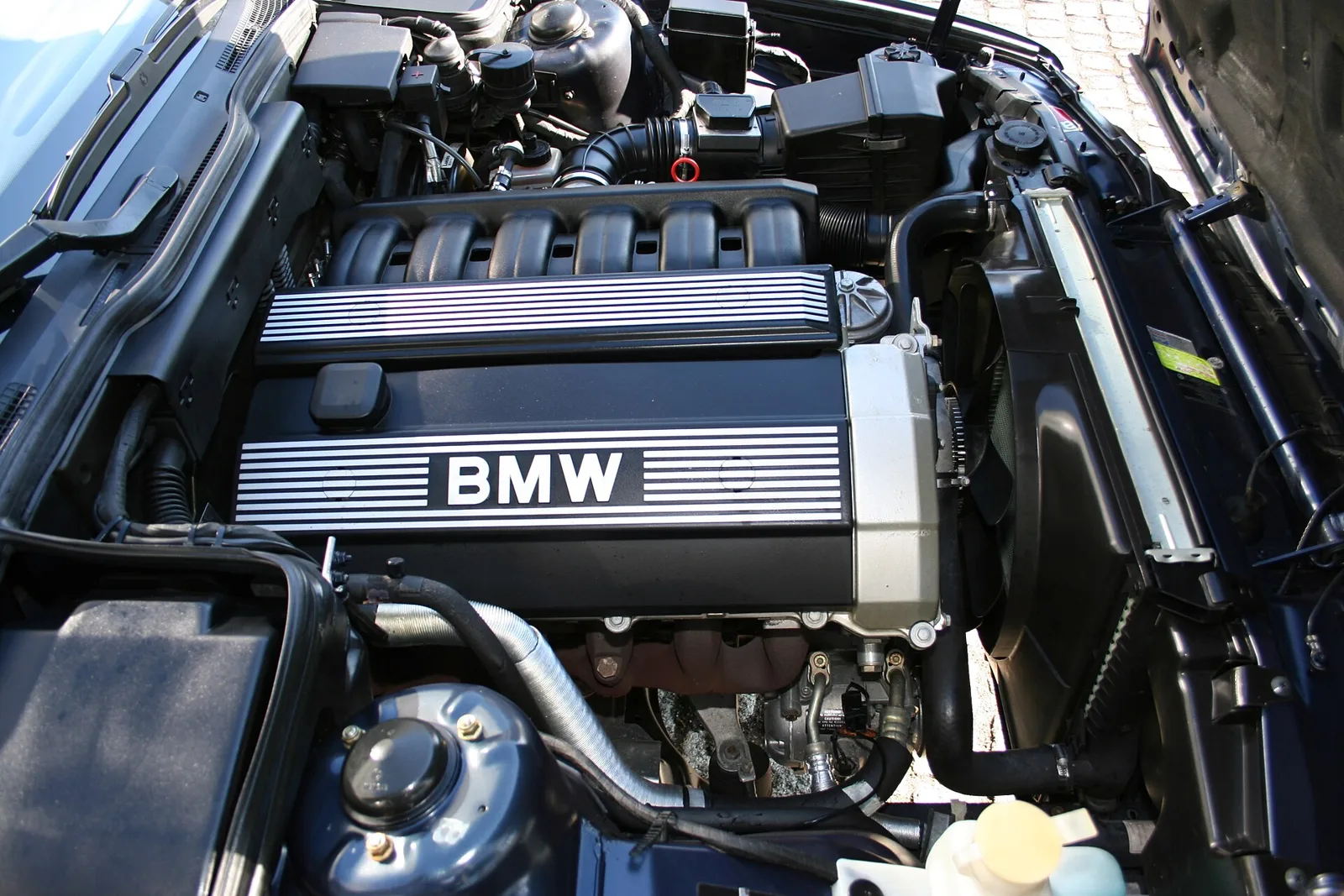
From the iron-block M50 of 1990 to the seven-year M54, with the S50, S52 and S54 M-car cousins and the sulphur problem in between.
BMW's M50, M52 and M54 are DOHC straight-sixes built from 1990 to 2006. The M50 had an iron block, the M50TU added VANOS in 1992, the M52 moved most markets to aluminium, and the M54 grew to 3.0 litres with double-VANOS. S50, S52 and S54 versions powered the M3.
The engine in the American E36 M3 exists because BMW club members wrote letters. The E30 M3 had sold poorly in the United States, BMW of North America was ready to retire the M brand there, and a members' campaign changed that decision and produced a special engine called the S50B30US.
That detour sits inside a larger story, the evolution of BMW's M50, M52 and M54 straight-sixes across the 1990s and 2000s. Between them they brought variable valve timing to BMW, moved the company from iron blocks to aluminium, ran headlong into a fuel-sulphur problem, and formed the base for the S50, S52 and S54 engines of the M cars.
BMW M50: the six that merged two old ones
The M50 is a DOHC straight-six petrol engine built from 1990 to 1996. It first appeared in the E34 520i and 525i and the new E36 320i and 325i, replacing the M20. Its role in BMW history is pivotal, because it gradually took over from both the small M20 Little-Six and the big M30 Big-Six, mixing the best of each into a more modern, electronically integrated package.
The M50 is based on the M20 but gained a twin-cam valvetrain with four valves for each cylinder, plus a redesigned block. The block is taller than the M20's and carries oil passages that feed the cams directly, while lighter pistons offset the extra weight. From the M30 it borrowed chain drive in place of the M20's belt, and a crankshaft-driven oil pump. The new head carried one ignition coil per plug, a knock sensor and a freer-breathing intake manifold. It uses multi-point electronic fuel injection, an iron block and an aluminium alloy head.
The sump sits at the front in the E34 5 Series and at the rear in the E36 3 Series. Enthusiasts like the iron block, healthy output and simple design, which make the M50 a popular basis for tuning, forced induction and engine swaps.
Its electronics are modest. A Bosch Motronic 3.1 system introduced OBD-I compliance through a 20-pin connector under the bonnet that is electrically the same as a standard OBD-I port, so a passive cable is enough to connect modern diagnostic tools. No M50 had the CANBUS communication protocol, which only arrived with the M52, so each piece of engine data is read on its own line.
The engine in the American E36 M3 exists because BMW club members wrote letters.
M50 versions
The 1,991 cc M50B20 arrived with the 1990 520i. Its cylinders measure 80 mm (3.15 in) across by 66 mm (2.60 in) of travel, and it makes 110 kW (150 PS; 148 hp) on a 10.5:1 compression ratio. It also went into the 1991 to 1995 E36 320i.
The 2,494 cc M50B25 came with the 1990 525i and 525ix. Cylinder dimensions are 84 mm (3.31 in) by 75 mm (2.95 in), and the output is 141 kW (192 PS; 189 hp) at 6,000 rpm. Torque is 245 N.m (181 lb ft), reached at 4,700 rpm, from a 10.0:1 compression ratio. The E36 325i and 325is used it too.
The M50TU and the debut of VANOS
To meet the new Euro 1 emissions standard, BMW replaced the M50 in September 1992 with the M50TU, the TU standing for technical update. The big change was Variable Valve Timing on the inlet camshaft, which BMW calls VANOS, the first in any BMW engine. It lowered fuel consumption and flattened the torque curve, which gave marginally faster acceleration and better response.
The head was redesigned to carry the electronically controlled, hydraulically actuated VANOS solenoid, which gives it a distinctive bump on one side. A Motronic 3.3 management system was added. The M50 and M50TU are extremely similar, with most parts interchangeable, and the initial M52 design is much like the M50TU. The M50TU is also the last non-M BMW engine with a cast-iron block for worldwide use, which is why enthusiasts prize it as a block that resists warping under forced induction.
Pistons were changed to take longer connecting rods and a raised wristpin, which cut friction against the cylinder walls and weight, and the valve springs became shorter and conical. VANOS worked so well that it spread: the first V8 to get it was the M62TU, and the first four-cylinder was the N42 in 2001. This first VANOS acts on one camshaft and is binary, either on or off, unlike the continuously adjustable dual systems that arrived with the M52TU and the worldwide S50B32.
TU versions covered the M50B20TU, with 110 kW (150 PS; 148 hp) at 5,900 rpm and an 11.0:1 compression ratio, and the M50B25TU, with 141 kW (192 PS; 189 hp) at 5,900 rpm and a 10.5:1 ratio. The M50B24TU, a 2,394 cc engine with a 72 mm (2.83 in) stroke and 138 kW (188 PS; 185 hp), was sold in Thailand and Oceanian markets. In 1993 BMW Individual built a single E34 530iX called the Enduro Touring, with an enlarged M50B25TU making 181 kW (246 PS; 243 hp) and 316 N.m (233 lb ft).
S50: the M3 engine and the American compromise
The S50 is the M50's high-performance sibling, used in the E36 M3 and the worldwide Z3 M, and it replaced the four-cylinder S14 of the E30 M3. It keeps an iron block, an aluminium head and four valves per cylinder. The worldwide S50B30 makes 210 kW (286 PS; 282 hp) from cylinders of 86 mm (3.39 in) by 85.8 mm (3.38 in) and a 10.8:1 compression ratio, with a 7,200 rpm redline, an individual throttle body for each cylinder and single-VANOS.
The American version came from sales figures. The E30 M3 was a business failure in the United States, with just over 5,000 sold, against just under 350,000 for the 325i. BMW of North America planned to retire the M brand there, and with it any E36 M3. Bob Roehmer, who edited for the BMW Car Club of America, urged its members to write to the company, and many promised to buy an E36 M3 should it arrive at a fair price. Erik Wensberg, the manager of the M brand in North America, answered by swapping the European S50 for an M50 variant tuned by BMW M, the S50B30US. It was a 2,990 cc engine making 179 kW (243 PS; 240 hp) and found only in American E36 M3s of 1994 and 1995.
Special versions followed. In 1994 BMW Australia and Frank Gardner Racing built the M3-R as a limited homologation special for the Australian GT Production Car Championship: 240 kW (326 PS; 322 hp), fifteen made, four used on track and eleven sold. A 220 kW (299 PS; 295 hp) S50B30GT powered the M3 GT. In 1995 the S50B32 took over worldwide, with 236 kW (321 PS; 316 hp), 3.2 L displacement, an 11.3:1 compression ratio and a 7,600 rpm redline. It was the first engine with Dual-VANOS.
BMW M52: aluminium and a new era of electronics
The M52 was produced from 1994 to 2000. It debuted in the E36 320i and E39 520i, taking over from the M50, and gave way to the M54 in late 2000. The M52 and its S52 variant earned a place on Ward's 10 Best Engines for four years, 1997 to 2000.
Most markets got an aluminium block in place of the M50's cast iron. The US and Canada kept iron, except for the Z3. The largest M52 grew to 2.8 L from the M50's 2.5 L, and it used single-VANOS on the intake camshaft, as the later M50TU did, with a redline still at 6,500 rpm. The 2.5L and 2.8L engines were detuned slightly to meet Euro 2, though the 2.0L stayed the same, and the M52 produced equal peak torque earlier than the M50.
All M52s are OBD-II compliant thanks to a Siemens MS41 management system, and they keep the large 20-pin connector from the M50. Owners commonly swap the M52's inlet manifold for the freer-flowing runners of the M50. The block and head are essentially identical, so the swap is a bolt-on job.
The main models were the M52B20, 1,991 cc with an 11.0:1 compression ratio; the M52B25, 2,494 cc with 125 kW (170 PS; 168 hp) and a 10.5:1 ratio; and the M52B28, 2,793 cc with 142 kW (193 PS; 190 hp) and a 10.2:1 ratio. The M52B28 also found its way into the Land Rover Defender in South Africa.
The Nikasil problem
The aluminium M52 drew criticism in markets with high sulphur levels in petrol during the late 1990s. Sulphur attacks Nikasil, and many early M52 and M60 engines suffered premature bore-liner wear. Countries with high-sulphur fuel, such as the United States, got an iron-block M52, except the aluminium M52B28 in the Z3, so most M52s there never suffered the problem. The S52 was designed with an iron block for the same reason. Once Nikasil was identified as the cause, cast-iron cylinder sleeves replaced it from 1998, and the M52TU was designed with iron sleeves from the start.
M52TU: the update that became the M54 template
The M52TU arrived with the E46 in 1998. Despite the M52 label, its head and block are nearly the same as the later M54's, and most parts swap between the two. It uses an aluminium block with iron sleeves, a hybrid fly-by-wire throttle body with a mechanical linkage as backup, and revised coolant passages that let the head be cooled independently of the block. The cooling circuit was reworked with push-fit hoses, and a dual-length intake manifold called DISA joined the package.
The M52TU also took the double-VANOS first seen on the S50, adding variable timing to the exhaust camshaft for better economy and a linear torque curve that gave more at low revs. Double VANOS, DISA and the same detuning, now handled by a Siemens MS42 management system, let it meet Euro 3 standards. That detuning was reversed with the M54.
BMW M54: the same block with a longer stroke
The M54 is a naturally aspirated DOHC straight-six built from 2000 to 2006. It launched in the E53 X5 as the M52's replacement, and the N52 began phasing it out after 2004. Ward's 10 Best Engines listed it from 2001 to 2003.
Block and head are almost identical to the M52TU, with aluminium castings, iron liners, double-VANOS, DISA and an electronically controlled thermostat, and a 6,500 rpm redline. The differences lie elsewhere: a fuel system without a return line, a throttle that is wholly electronic with no mechanical backup, Siemens MS43 management and a revised intake manifold. The largest version grew from 2.8 L to 3.0 L, or 2,979 cc, by lengthening the stroke to 89.6 mm (3.53 in). No technical update was ever produced, so the specifications stayed the same through a seven-year run.
The M54B22 (2,171 cc) made 125 kW (168 hp) at 6,100 rpm and 210 N.m (155 lb ft), with a 10.8:1 compression ratio. The M54B25 (2,494 cc) offered 141 kW (189 hp) at 6,000 rpm, 245 N.m (181 lb ft) of torque and a 10.5:1 ratio. The 2,979 cc M54B30, the best known, came with 170 kW (228 hp) at 5,900 rpm, 300 N.m (221 lb ft) and 10.2:1, and it was on the Ward's list from 2001 to 2003. North America also got a ZHP version of the M54B30, with different camshafts and reprogrammed management, making 175 kW (235 hp) and revving to 6,800 rpm.
M50, M52 and M54 compared
| Feature | M50 | M52 | M54 |
|---|---|---|---|
| Production | 1990 to 1996 | 1994 to 2000 | 2000 to 2006 |
| Block | Cast iron | Aluminium (iron in US and Canada) | Aluminium with iron liners |
| Variable valve timing | None; single-VANOS from the M50TU in 1992 | Single-VANOS; double-VANOS from the M52TU in 1998 | Double-VANOS |
| Largest displacement | 2,494 cc | 2,793 cc | 2,979 cc |
| Engine diagnostics | OBD-I | OBD-II | OBD-II |
| High-performance version | S50 | S52 | S54 |
S52 and S54: the M siblings
The S52 is a higher-performance M52 that replaced the S50B30US in the 1996 to 1999 North American E36 M3. It is less powerful than the worldwide S50, losing double-VANOS in favour of single-VANOS, and shares an iron block and head with the standard North American M52. Cylinder dimensions of 86.4 mm (3.4 in) by 89.6 mm (3.5 in) give 3,152 cc, and the compression ratio is 10.5:1. It makes 240 hp (179 kW; 243 PS) at 6,000 rpm, its torque of 320 N.m (240 lb ft) peaks at 3,800 rpm, and the redline is 7,000 rpm. In 1999 Alpina enlarged it to 3.3L for the E5/1, making 209 kW (284 PS; 280 hp).
The S54 was marketed as the M54's equivalent, but is really an evolution of the S50 that has little hardware in common with the M54. It has the S50's cast-iron block and an 8,000 rpm redline. Against the S50 it has an 87 mm (3.43 in) bore giving 3,246 cc, revised camshafts, finger-follower valve actuation, a compression ratio raised from 11.3:1 to 11.5:1, electronic throttle control and a scavenging oil pump to avoid oil starvation in corners.
In the E46 M3 the S54 delivers 252 kW (343 PS; 338 hp) at 7,900 rpm, with 365 N.m (269 lb ft) arriving lower down at 4,900 rpm, and 248 kW (333 hp) in North American cars. The M3 CSL's S54B32HP, with a carbon-fibre intake, revised camshafts and a lightweight exhaust manifold, makes 265 kW (360 hp) and 370 N.m (273 lb ft).
What followed the M54 and the S54
The M54 was phased out after the N52 arrived in 2004. The S54 has no direct successor: the E90, E92 and E93 M3 that followed used the S65 V8 instead.