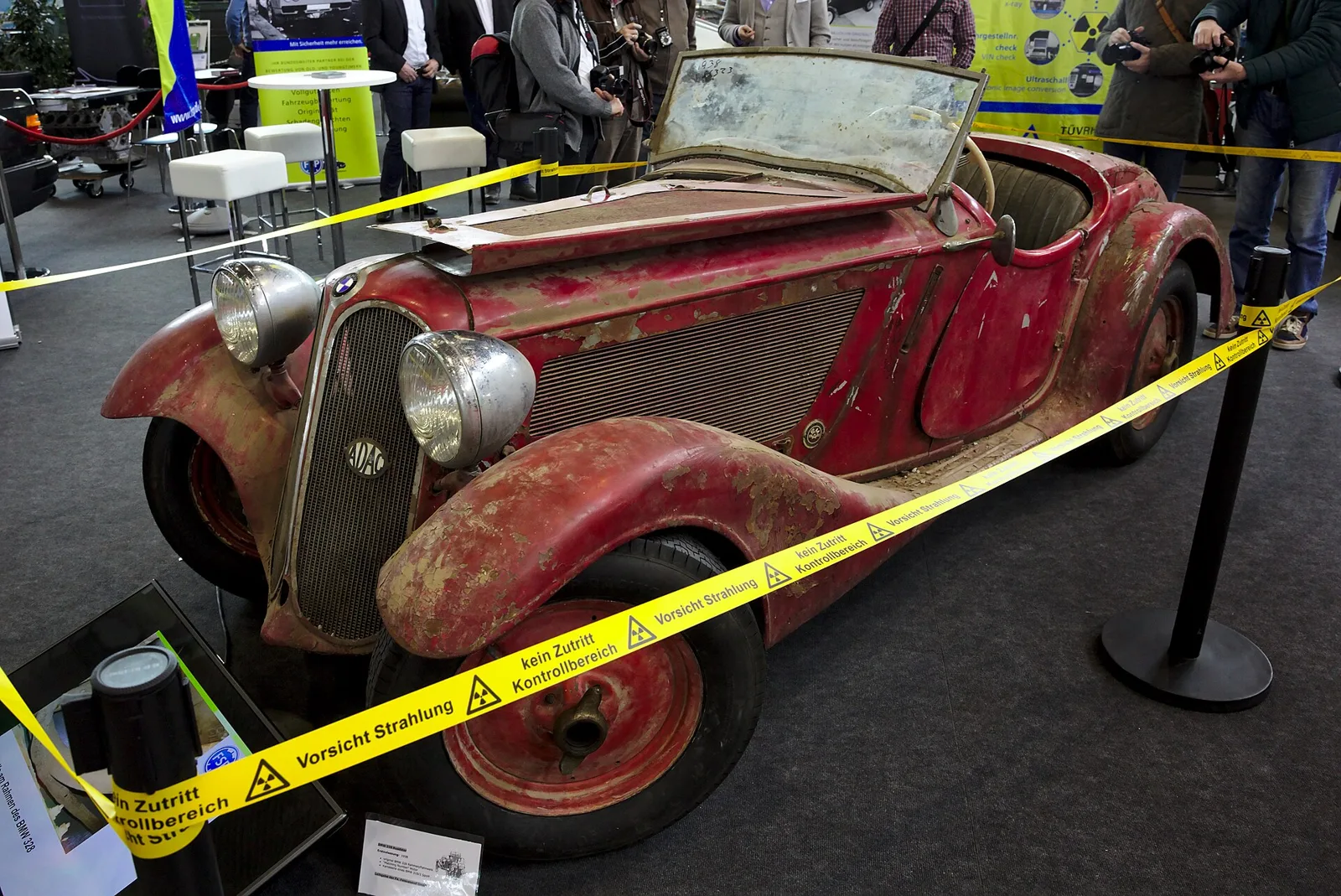
From a Ferrari in a French farm collection to a lost Shelby prototype in a storage unit, what makes a barn find valuable, and what a buyer needs to weigh before bidding.
Barn finds are old vehicles, most often rare and valuable cars, brought back into view after years of storage in poor condition. Collectors prize them for rarity and history, and prices can be huge: a Ferrari California Spyder from a French farm hoard made 15.9 million euros at auction in 2015.
In 2014, 60 derelict cars were discovered together on a farm in Western France. Among them sat a Ferrari California Spyder once owned by Alain Delon, and when it went to auction in 2015 it sold for 15.9 million euros. Dust, damp and decades of neglect had not dented its price in the slightest.
That is the barn find at its most extreme.
What exactly counts as a barn find?
The term describes a classic car, aircraft or motorcycle that turns up after long years in storage, usually in poor condition. The name comes from the places such machines tend to be found: barns, sheds, carports and other outbuildings. In practice the label is kept for vehicles that are rare and valuable, which is why collectors care about them despite their state.
That last point matters. A rusting hatchback abandoned in a field is simply an old car. A barn find, in the collector sense, is one that people would travel to see because of what it is, not how it looks. Rarity, history and the chance to bring something back from the dead do the work that paint and chrome cannot.
The word is not confined to cars. In 1952, the founder of the Old Rhinebeck Aerodrome, Cole Palen, was given the remains of a 1910-vintage Bleriot XI that had lain in a junkyard for decades. That aircraft, registered N60094, is now the second-oldest in the world still able to fly. A Grumman F8F Bearcat fighter was found derelict beside a runway by Lyle Shelton, who rebuilt it with parts from other aircraft and then modified it into the racer known as Rare Bear, which competed at the Reno Air Races.
A ruined Ferrari out-sold a perfect one, because the damage was part of the car's own story.
Where have the most famous barn finds turned up?
Discoveries have surfaced in farms, garages, rental storage units and long-forgotten private collections on several continents. The biggest by number was the French farm hoard of 2014, but a single missing prototype in California and a sale of 230 cars in the Netherlands show how varied the stories can be.
The French farm hoard
The 60 cars from Western France read like a roll-call of pre-war and post-war prestige. Beside the Delon Ferrari were several Talbot Lago T26 models, one of which had belonged to King Farouk of Egypt, and machines from Delage, Delahaye, Panhard-Levassor, Hispano-Suiza and Bugatti. The California Spyder's 15.9 million euros at the 2015 auction remains the headline figure.
The lost Shelby prototype
The very first Shelby Daytona prototype, chassis number CSX2287, was believed lost in the middle of the 1970s. It resurfaced in 2001 inside a rental storage unit in California. Ownership was then fought over in court, with the car estimated at 4 million US dollars at the time. It has since been repaired and restored, and it is now on show at the Simeone Foundation Automotive Museum in Philadelphia.
Texas and the Netherlands
In 2015, five vehicles that had sat since the 1970s in an Austin, Texas barn went under the hammer. They included a 1908 REO Model G, a 1923 Milburn Electric Model 27L and three Cadillacs from the years 1932 to 1938, a reminder that an early electric car was among the things quietly waiting in the dark. Then, from 19 May to 7 June 2023, a collection of 230 cars was auctioned in the Netherlands, a sale spread over almost three weeks.
Why does a wreck sell for more than a restored car?
Because condition is only one part of value, and in a rare car it is not always the biggest. A 1967 Ferrari 330 GTS spider that had suffered an engine fire in 1969 and then sat in a garage for 44 years sold for US$2.1 million in January 2014. That was more than a fully restored example fetched the year before.
Think of a damaged but genuine antique with its original finish. A repainted copy may look better on the day, yet the untouched piece carries something a restorer cannot supply: proof. Buyers who know the market are paying for that authenticity, and for a car that cannot be made again.
Scarcity pushes in the same direction. Cars built in small numbers tend to be worth more, although they can also be harder to keep running. Others were built in such quantity that prices have stayed modest whatever their state. Some models were popular as raw material for hot rods, so untouched survivors can be rarer than production figures suggest. For serious investment collectors, original unmodified cars hold a steadier price than altered ones.
Should a barn find be restored or left alone?
For years the answer was restoration, and plenty of it. Found cars were commonly taken back to a condition close to new. The current trend runs the other way: treat the car gently, avoid work that wipes out its history, and value any original features it still carries, even in poor shape. In some cases an intense restoration can actually lower the price.
The contrast with the show-field is striking. At a Concours d'Elegance, trained judges rate every component, and only cars judged perfect or very nearly so are considered for the trophy classes. The competition can push owners to restore a car beyond mint, meaning beyond the state in which it left the factory, with upholstery, paint, plating and mechanical work done to a standard the factory never reached.
Classic classes at such events lean harder on originality. The aim is a car in the same condition as when it left the production line, or better, with no modifications unless they are original, and with parts correct for the exact year and model. Even a component from the same type of car but another model year or trim is not allowed. Accessories from the manufacturer's own range are fine, and some competitions admit period-correct aftermarket equipment.
The choice facing a new owner is therefore a question of what the car is for. A museum piece, a show winner and a driver each reward a different amount of work. Cars have even lost points at shows for fitted seat belts, a change that makes sense on the road and counts against originality in the judging tent.
How do collectors grade the condition of a classic?
Two linked systems are used in the United States: a six-step category scale and a points scale that runs from 40 to 100, with three further grades below that for cars in need of serious work. Perfect cars score highest, and most barn finds land in the lowest grades.
| Grade | Points | What it means |
|---|---|---|
| I, Perfect | 90 to 100 | As good as or better than the day it was produced |
| II, Excellent | 80 to 89 | Excellent original or superior restoration, near-flawless |
| III, Fine | 70 to 79 | Older restoration or original with minimal wear; show quality |
| IV, Very good | 60 to 69 | Complete original or older restoration; a well-kept daily driver |
| V, Good | 50 to 59 | Shows wear and needs minor work, no major flaws |
| VI, Driver | 40 to 49 | A car in usable everyday condition |
| Restorable | 30 to 39 | Needs work on engine, body, interior or chassis; should be more or less complete |
| Partial | 20 to 29 | Extensive restoration with many parts and a lot of labour |
| Parts car | 10 to 19 | Inoperative donor; full restoration usually not feasible unless the car is very rare |
The grades are guides rather than law, but they show where a found car begins. Most barn finds sit in the bottom three rows, and the lowest of them is a warning: unless the car is exceptionally rare, rebuilding a parts car is generally not considered realistic.
How old does a car need to be to count as a classic?
There is no universal answer. A classic is often described as a car 25 years or older, but the figure shifts by jurisdiction, club and insurer, and age is never the only test. Historical significance, rarity and condition count too, and any car can become a classic if it has dedicated owners who treat it as one.
The rules differ sharply from place to place, and they decide what a found car can legally do once it is back on the road.
- Australia: two registration categories exist, the Historic Vehicles Scheme and the Classic Vehicle Scheme. Owners usually avoid the standard registration fee, but use of the car is capped at a fixed allowance in each registration period. Many Falcons, Valiants, Holdens, Toranas and Commodores sit on the registers, though it is not uncommon for such cars to end up on full registration.
- United Kingdom: no fixed definition, but cars over 40 years old are exempt from annual road tax and from the yearly MOT test, provided no substantial changes have been made. For company tax, HM Revenue and Customs treats a classic as a car over 15 years old with a value above 15,000 pounds.
- Germany: a vehicle first registered 30 or more years ago may qualify for an Oldtimer plate with a flat tax of 190 euros a year. The car must be largely original, and period-appropriate changes within 10 years either side of first registration are tolerated, as are safety and emissions upgrades.
- Canada: one club body recognises vehicles of 25 years and older, another counts cars from 20 years. Imported classics carry a 2.5% duty, which is waived for vehicles 25 years old or older.
- United States: antique status typically covers cars from 1915 and earlier, while owners loosely apply classic to anything over 20 years old. Maryland uses 20 years and no substantial alteration; West Virginia asks for at least 25 years.
The clubs set their own lines as well. The Classic Car Club of America lists unmodified fine or distinctive cars built from 1915 to 1948, and rarely admits a new type. The Antique Automobile Club of America recognises vehicles of 25 years or more. In the narrowest usage, vintage means a car from 1919 to 1930. At the other end, modern classics are generally 15 to 25 years old, though some bodies refuse to accept them.
What can go wrong when you buy a forgotten car?
Quite a lot, and not all of it is mechanical. Paperwork, safety, emissions and ownership can each cause trouble, and several of them can cost more than the car. A buyer is wise to treat the story that comes with a car as something to verify rather than something to admire.
Provenance fraud is the best known. Owners have falsified documents and serial numbers to give a car a livelier history, and values have been knowingly inflated. Both were referred to in court proceedings involving JD Classics, a well-known British dealer that collapsed in 2018. Ownership disputes are another danger: the lost Shelby prototype was the subject of legal battles before it reached its museum.
Safety is the obvious technical issue. Classic cars often lack seat belts, crumple zones and rollover protection. A 2009 crash test by the Insurance Institute for Highway Safety drove a 2009 Chevrolet Malibu into a 1959 Chevrolet Bel Air in an offset frontal crash, and the result showed how far rigid passenger cells and crumple zones have moved on from the X-frame design of the 1950s. Front-wheel braking and hydraulic brakes only began to appear in the 1920s and 1930s.
Fixing that is not simple. Cars built before the late 1960s generally had no readily available reinforced mounting points for belts, so proper installation means locating strong attachment points and reinforcing them. Modern tyres are often wider and lower in profile than the originals, which can foul suspension parts and damage sidewalls, and extra grip means heavier steering on cars without power assistance. Brake upgrades, such as swapping drums for discs or adding a vacuum servo, are a popular and effective improvement.
Emissions are the last hurdle. A classic is built to the standard of its production year, so it may be refused entry to cities with low emission zones.
How do you value and insure a found car?
Valuation is hard because so many things move the number: age, condition, rarity, modifications, history and mileage, plus body type, drivetrain and engine size. Services now publish baseline prices for different conditions, along with trends and forecasts, which gives buyers a way to check a seller's claims.
Because values vary so widely, most insurers offer Agreed Value cover for classics. Owner and insurer settle on the car's worth at the start, and that sum is what the owner receives after a total loss. It differs from the Actual Cash Value approach in ordinary motor insurance, which works out the figure only after a loss or theft has happened. In Britain, insurers also decide what counts as a modern classic, and they usually limit such cars to recreational use with restricted mileage.
Should you buy a barn find?
That depends on what you want from it. A car that needs little work costs more up front; one that needs a lot is cheaper to buy but often costs more in the long run, and the owner's own restoration experience plays a large part. Most collectors do it as a hobby, and the comedian and collector Jay Leno has said that any car becomes a collector car if somebody collects it.
For someone treating a car as an investment, the bar is higher. Serious investors look for rare or exotic cars, need real expertise, and have to budget for storage and maintenance. Short-term buyers must find a car whose market value is expected to rise soon, while long-term holders look for qualities that other collectors will also prize. A found car with original features, a documented history and a clean ownership trail fits that description better than one with a cloudy past.
Practical questions come first for a driver. Will the car be registered under a historic scheme with limits on use? Can it be made safe with belts, brakes and tyres without destroying what makes it special? Does the budget cover a car that may be in the Restorable or Partial grades? Each answer changes the price a sensible buyer should pay.
Where this goes next
The definition of a classic is still moving. The rolling 25-year rule used by several clubs means that new cars become eligible each year, and modern classics from 15 to 25 years old are already recognised by some insurers and some groups, even where others are not yet convinced. Valuation services that publish market trends and forecasts are making the whole field easier to read.

_1X7A7859.jpg)