A straight-four series with VVT-i that ran from the 1997 Prius hybrid engine to a TRD turbo kit, a CNG van unit and a Great Wall copy.
The Toyota NZ family is a straight-four series with aluminium open deck blocks, DOHC heads and VVT-i. It ran from the 1NZ-FXE hybrid of 1997 to the 1NZ-FE Turbo and the 2NZ-FE, and Great Wall Motor later built its own GW4G engines from the same design.
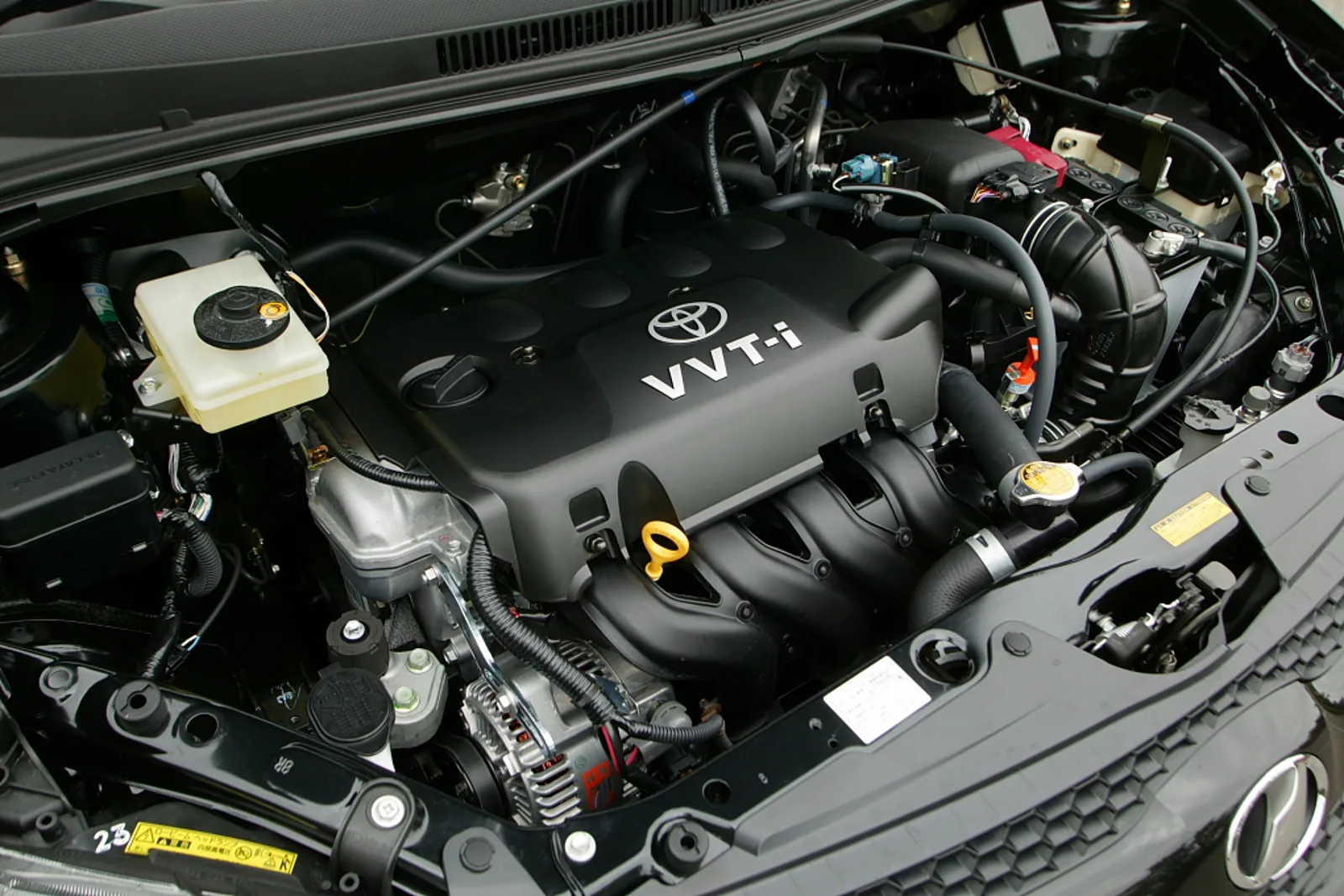
The Toyota NZ family is a series of straight-four piston engines with aluminium open deck blocks, DOHC cylinder heads, sequential multipoint injection and four valves per cylinder. VVT-i appears across the range, from hybrids to turbo and gas-fuelled versions.
What is the Toyota NZ family?
The NZ series uses aluminium open deck blocks and DOHC cylinder heads. It also uses sequential multipoint fuel injection and has four valves per cylinder with VVT-i. Those features gave it a modern layout that could be tuned for hybrid, naturally aspirated, turbocharged and gas-fuelled versions.
The 1NZ and 2NZ codes sit under the same umbrella, and the letters after them mark the variant, such as FXE for the hybrid, FE for the conventional petrol and FNE for CNG.
The engines were produced in several countries. Toyota's Kamigo Plant in Toyota, Aichi, Japan built them, Siam Toyota Manufacturing in Chonburi, Thailand built the 1NZ-FE for the Yaris and Vios, and Indus Motor Company in Karachi, Pakistan built the 2NZ-FE for the Corolla.
A four-cylinder family that moved from a hybrid's Atkinson cycle to a turbo kit and a Chinese derivative, all on one basic design.
Where were the NZ engines built?
Production was spread across Japan, Thailand and Pakistan, so the same engine family served very different markets. The Thai plant handled the small car versions, while the Pakistani plant focused on the Corolla's 2NZ-FE. Japan remained the home of the wider range, including the hybrid engines.
From late 2003 the Japanese-market 1NZ-FE received a new cylinder head. That head later formed the basis of the post-2006 1NZ-FE Turbo and the LPG-hybrid 1NZ-FXP, so one change carried through several versions.
How did the 1NZ-FXE hybrid engine work?
The 1NZ-FXE is a 1.5 litre hybrid of 1,497 cc, with 75 mm bore by 84.7 mm stroke. It used forged steel connecting rods and an aluminium intake manifold, and its physical compression ratio of 13.0:1 was combined with a delayed inlet valve closing.
The delayed closing gave an effective compression ratio of 9.5:1. The engine therefore had a greater effective expansion than compression, which made it a simulated Atkinson cycle rather than a conventional Otto cycle. That reduced cylinder charge cut torque and power, but it raised efficiency, which suited a hybrid car.
The Hybrid Synergy Drive could cover peak torque and power demands with its electric motor and battery. The engine was originally rated at 58 PS (43 kW) at 4000 rpm, with 102 Nm of torque. Peak thermal efficiency was about 37 percent.
A 2000 update lifted output to 72 PS (53 kW) at 4500 rpm, and the second generation Prius reached 77 PS (57 kW) at 5000 rpm. The 2011 version dropped belt-driven accessories in favour of an electric water pump and added exhaust gas recirculation, with a physical compression ratio of 13.4:1.
Which awards did the 1NZ-FXE win?
The 1NZ-FXE, paired with the Hybrid Synergy Drive in the Toyota Prius, collected a string of engine prizes. The list includes Best Eco-friendly in 2000 and 2001, Best Fuel Economy in 2005 and 2006, and Best 1.4-litre to 1.8-litre in 2005 and 2006.
Those awards reflected how the engine balanced efficiency with a small displacement. The engine was discontinued for international markets in 2020 and replaced by the M15A-FXE, but it remained in use in Japan in the Toyota Probox and the Mazda Familia.
How did the 1NZ-FE develop?
The 1NZ-FE is a 1.5 litre conventional Otto-cycle variant of the 1NZ-FXE, with VVT-i on the intake cam. It kept the same bore and stroke, but its compression ratio was lowered to 10.5:1. Output was 98 to 110 PS (72 to 81 kW) at 6000 rpm, and torque ran from 127 to 143 Nm.
The engine was introduced to replace the 5A-FE and 5E-FE 1.5 litre units. Its block was found in many Toyota models assembled in Japan and other Asian countries, which made it a workhorse for the brand's small cars.
A major cylinder head revision arrived in September 2003 for the Japanese market, first in the front-wheel drive XP80 Sienta. The new head used roller rocker arms and hydraulic lash adjusters, and the valve angle was reduced from 33 to 21 degrees, along with a later opening thermostat.
A 2012 update raised the compression ratio to 11.0:1 and replaced the four-speed automatic with a CVT designed for the reworked engine. The engine was discontinued in Europe in 2005, and the Dual VVT-i 2NR-FE took over in emerging markets from 2016.
Which models used the 1NZ-FE?
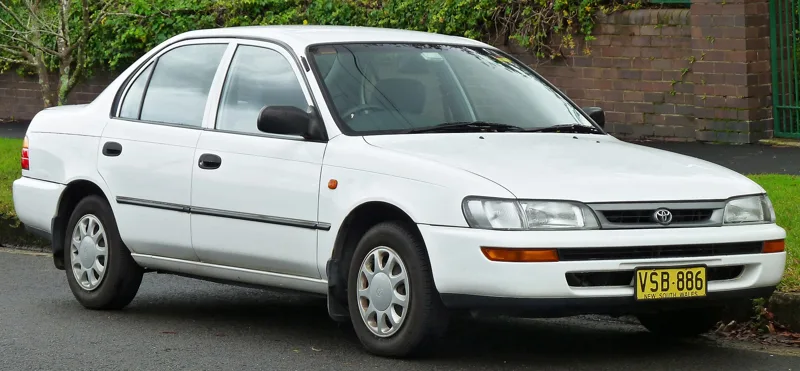
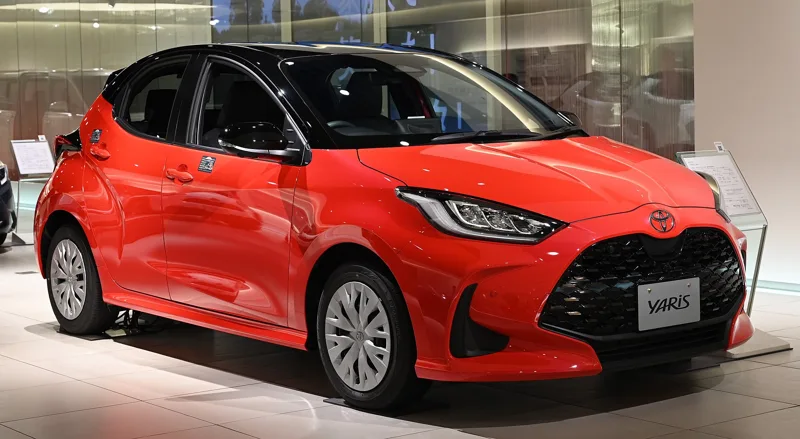
The 1NZ-FE powered a wide range of Toyota's small cars. Those included the Allion and Premio, the Corolla Axio and Fielder, the Vitz and Yaris, the Ractis, the Sienta and the Vios, with the Probox van among them. Many were sold in Japan, while others went to Asian markets where the same block was assembled.
Several special-interest models were built on the same platform. The Mitsuoka Galue, Nouera and Ryugi used Corolla bases, and the Tommykaira Baby Gang and ist were tuned versions of Toyota's small cars. The WiLL Cypha and WiLL VS also carried the engine in their own compact bodies.
The revised 2003 engine was also offered in limited markets such as Hong Kong, Macau and New Zealand. In Europe the original 1NZ-FE was discontinued in 2005 without a direct replacement, which shows how markets could differ in their choice of engine even when the block was the same.
What transmissions did the NZ family use?
The NZ engines were paired with manual, automatic and continuously variable transmissions, and the hybrid versions used an electronic CVT. Codes such as C50, U340E and K310 identify the unit fitted to each car, and they differ by market and drive layout.
The 1NZ-FE used five-speed manual gearboxes including the C50, C50F for all-wheel drive, C51, C54, C56, C150 and C154. The four-speed automatics were the U340E and U340F, the all-wheel drive version, which were used between 2000 and 2014.
The CVT options were the K210, used from 2003 to 2015 in the Ractis, Sienta and Vitz, along with the K310, the K310F for all-wheel drive, and the K312 from 2012. The 2NZ-FE used its own set of manual and automatic units, including the U441E and U441F for all-wheel drive.
The 1NZ-FXE hybrid's transmissions were P110 for 1997 to 2000, P111 for 2000 to 2003, P112 for 2003 to 2009 and P510 from 2011. The turbo versions usually used the C56 five-speed manual, with the Corolla Axio and Fielder GT using the C51.
How do the NZ variants compare?
| Engine | Years | Displacement | Headline output |
|---|---|---|---|
| 1NZ-FXE hybrid | 1997 onwards | 1.5 L (1,497 cc) | 58 PS (43 kW) originally, 77 PS (57 kW) later |
| 1NZ-FE | 1999 onwards | 1.5 L (1,497 cc) | 98 to 110 PS (72 to 81 kW) |
| 1NZ-FNE CNG | 2003 to 2014 | 1.5 L (1,497 cc) | 92 PS (68 kW) |
| 1NZ-FE Turbo | 2003 to 2013 | 1.5 L (1,497 cc) | 143 to 152 PS (105 to 112 kW) |
| 2NZ-FE | 1999 to 2020 | 1.3 L (1,298 cc) | 86 to 88 PS (63 to 65 kW) |
| 1NZ-FXP LPG hybrid | 2017 onwards | 1.5 L (1,497 cc) | 74 PS (54 kW) |
What was the 1NZ-FNE CNG engine?
The 1NZ-FNE was a compressed natural gas version of the 1NZ-FE. It was introduced in April 2003 and built exclusively for the first generation Probox van until 2014. It had a 12.0:1 compression ratio and produced 92 PS (68 kW) at 6000 rpm.
The CNG engine was only combined with a single four-speed U340E automatic transmission.
What made the 1NZ-FE Turbo special?
The 1NZ-FE Turbo, unofficially called the 1NZ-FTE or 1NZ-FET, was a 1.5 litre turbocharged variant with an air-to-air intercooler and an IHI RHF4 turbocharger. It delivered 63.7 kPa of boost, which is 0.6 bar or 9.2 psi, and retained the 10.5:1 compression ratio of the naturally aspirated engine.
The turbo kits were developed by Toyota Racing Development rather than created in-house by Toyota, and they were bolted onto the standard engine block. Output depended on the model, reaching 143 to 152 PS (105 to 112 kW) at 6000 rpm, while torque of 196 to 206 Nm arrived between 4000 and 4800 rpm.
The kit was first sold in May 2003 for the NCP13 Vitz RS. In January 2004 TRD launched a conversion programme for the bB, ist and Vitz RS owners, and the programme ended in July 2007 with the discontinuation of the XP60 ist. The final application was the Vitz GRMN Turbo in August 2013.
How did the 2NZ-FE fit into the family?
The 2NZ-FE was a 1.3 litre version with 75 mm bore by 73.5 mm stroke, and a compression ratio of 10.5:1. It produced 86 to 88 PS (63 to 65 kW) at 6000 rpm, and it looked identical to the 1NZ-FE apart from its intake manifold mark.
In regions with leaded petrol the 2NZ-FE was built without VVT-i, giving 81 PS (60 kW). In 2000 the engine took top honours in the 1-litre to 1.4-litre class of the Engine of the Year contest, and it followed the 2E and 4E-FE 1.3 litre engines.
The 2NZ-FE was last used in Australasia and Pakistan and ended in the first half of 2020. In China it had taken over from the 2SZ-FE in XP90 Vios and Yaris models from 2008.
How did Great Wall Motor use the NZ design?
In May 2008 the Chinese maker Great Wall Motor introduced 1.3 and 1.5 litre engines, codenamed GW4G13 and GW4G15. Their codes look like Mitsubishi's, but the two families are unrelated, and the Great Wall units were derived from the NZ design.
The NZ engines use a timing chain, while the Mitsubishi engines use a less durable timing belt, which is one of the differences between them. The GW4G1x engines matched the NZ bore and stroke and displacement, and they used interchangeable parts.
Great Wall later added turbocharged and hybrid versions. The GW4G15T arrived in 2011, followed by the GW4G15B in 2012 and the GW4G15F, which met China's National V emission standard, and later the GW4G15K, GW4G15M and GW4G15H hybrid.