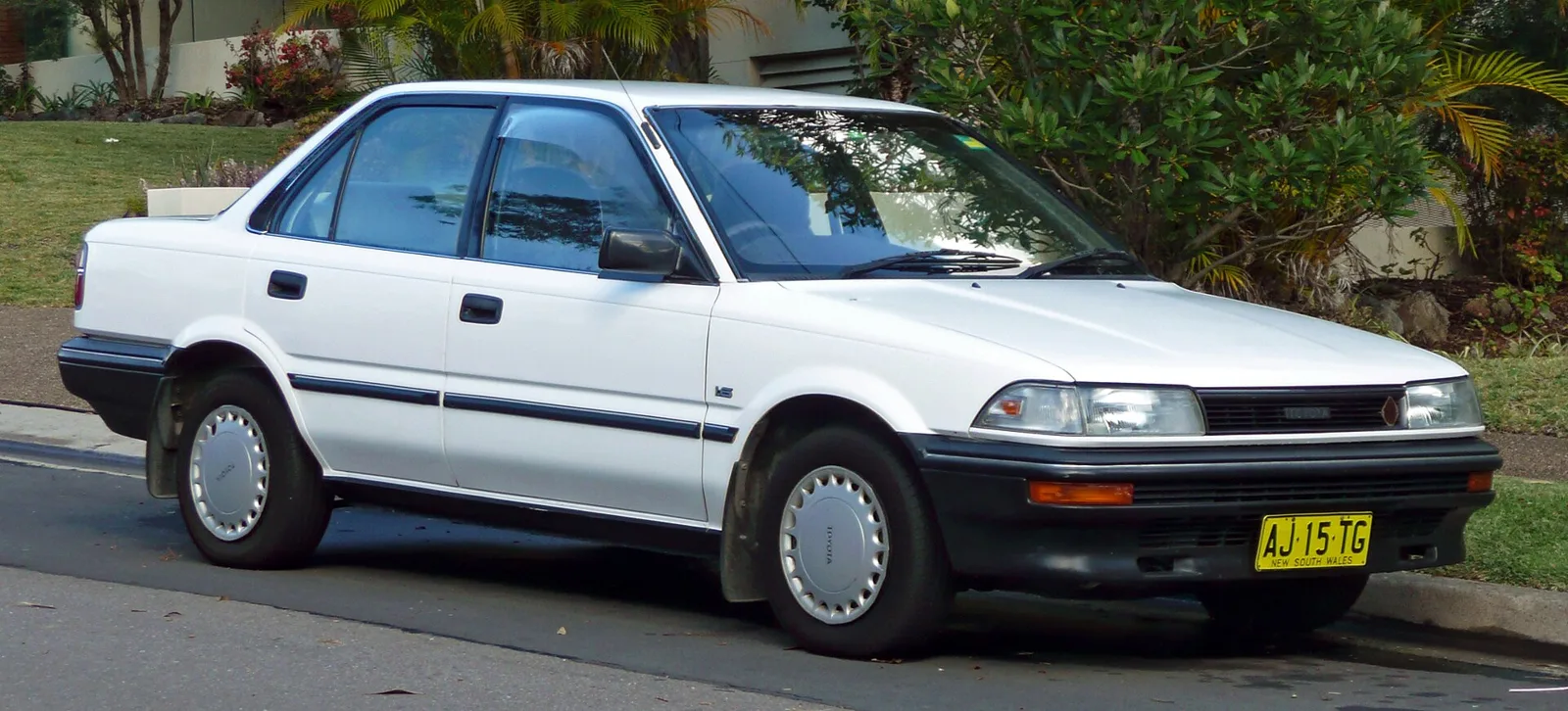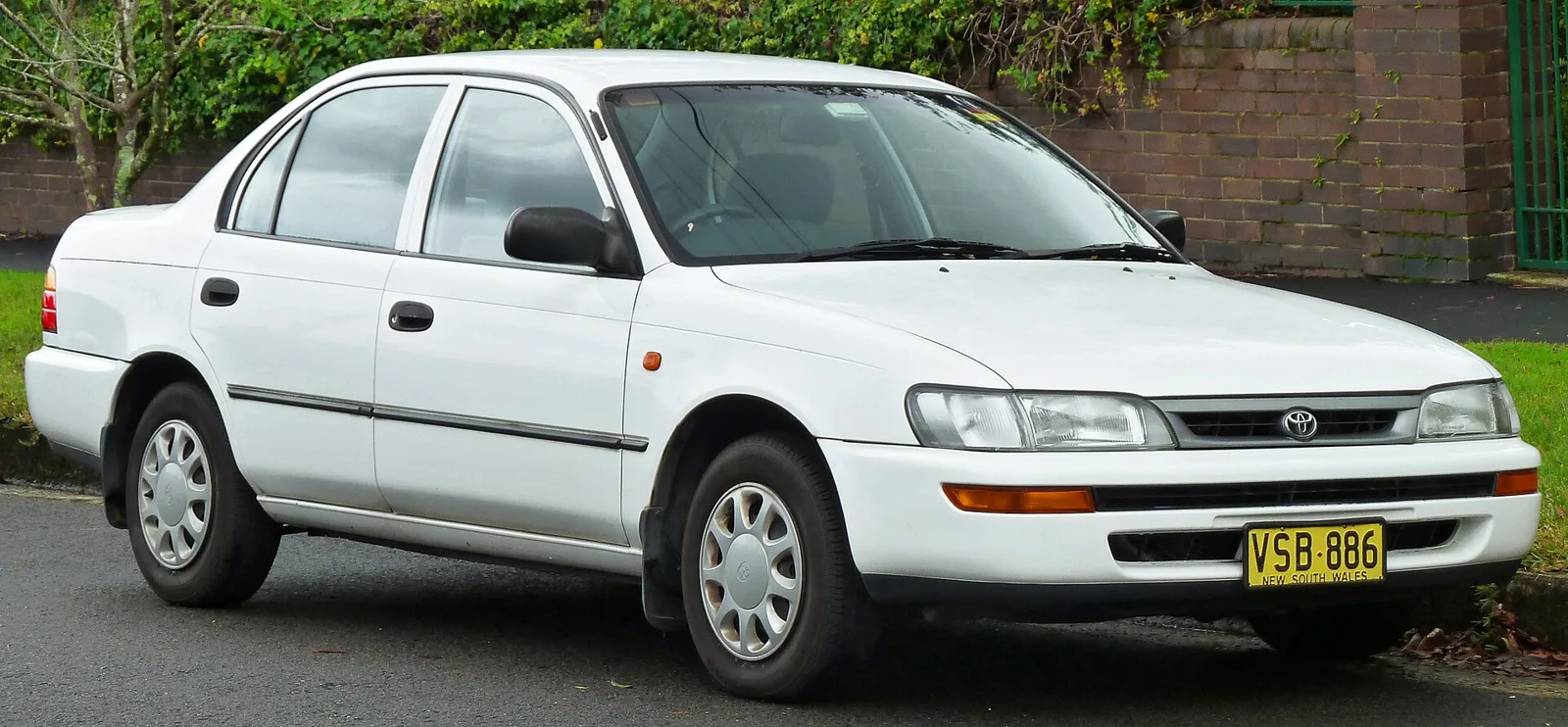
A bigger, heavier and more aerodynamic Corolla with a 'mini-Lexus' ambition, a 1.6 that powered Asia and a best-selling run in North America that carried the nameplate to the top of the sales charts.
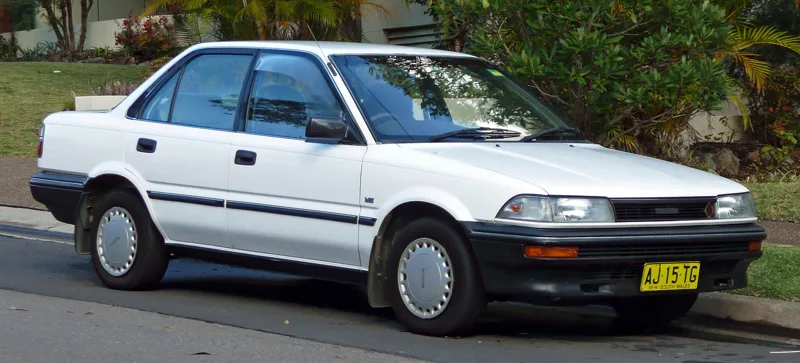
The Toyota Corolla E100 was the seventh-generation Corolla, sold from 1991 in Japan and from 1993 in North America. It was larger than its predecessor, with a 2,465 mm wheelbase, and by the end of 1997 it had made the Corolla the best-selling nameplate in automotive history.
The E100 was the seventh generation of Corolla sold by Toyota, and it was a heavier, roomier and slipperier car than the one it replaced. Introduced in Japan in 1991 with a 2,465 mm (97.0 in) wheelbase, it placed the Corolla in the compact class and later became one of the best-selling cars ever made.
What was the Toyota Corolla E100?
The E100 was the seventh-generation Corolla, and it was sold across Japan, Asia, Europe, North America and Australasia over most of the 1990s. Its 2,465 mm (97.0 in) wheelbase took the Corolla into the compact size class that the Corona and Camry had once occupied.
In Japan the Sprinter and Levin models were equivalents of the Corolla, and they were exclusive to Toyota Vista Store dealerships. The Sprinter Trueno matched the Corolla Levin, so the family covered several sales channels at once.
The E100 was also a model that changed the way Toyota thought about the Corolla. It was no longer just a cheap family car, and the new design aimed at a sharper and more solid image.
A bigger Corolla with a mini-Lexus ambition, built on a platform that carried the nameplate to the top of the sales charts.
Why did Toyota make the E100 bigger?
The development of the seventh-generation Corolla was led by chief engineer Akihiko Saito. The wheelbase was increased, and the new car received a wider track than the 90-series it replaced, which gave it a more planted stance on the road.
Saito's stated goal was to make a mini-Lexus, building on the success of Toyota's flagship range. The solid styling reflected that ambition, and it gave the Corolla a look that was more serious than the cars that had preceded it.
The result was a car that was larger, heavier and visually more aerodynamic than the model it replaced. Each change worked towards a more substantial feel without moving the Corolla out of the family car market in most countries.
How aerodynamic was the E100 body?
The sedan and hatchback had a drag coefficient of Cd=0.33, while the liftback managed Cd=0.30 and the wagon and van reached Cd=0.36. Those figures showed how the body shape varied between versions, with the liftback the most slippery of the range.
The model used fewer body panels than its predecessor, which increased strength, lowered cost and reduced gaps between the panels. The panel changes also gave a cleaner appearance and lower wind resistance, which helped the shape work better at speed.
The headlights moved from glass to polycarbonate, and almost 90 percent of the bodyshell was made from galvanised steel. The predecessor had used about 60 percent galvanised steel, so the E100 was a clear step forward in corrosion protection and structural rigidity.
What body styles did the E100 offer in Japan?
The Japanese range included the three-door Corolla FX hatchback, the four-door sedan and the five-door station wagon, together with a light van. The two-door Corolla Levin coupe also returned in this generation, giving the range a sporting option.
A 4WD variant of the sedan and station wagon was available, with a 1.6 litre petrol or a 2.0 litre diesel engine. The Corolla Ceres and Sprinter Marino, both four-door pillared hardtops, were launched in 1992, and they used the chassis and most of the engines of the standard cars.
Sedans and hatchbacks introduced in June 1991 lasted until the E110 arrived in May 1995. The wagons and the related van continued alongside the newer models, and they remained in production in Japan for longer than the mainstream cars.
Passenger wagons came in G-Touring, L-Touring and high-performance BZ-Touring guises. The Business Wagon and the Van were stripped-out models with leaf-sprung solid axles at the rear, and the Business Wagon was renamed the Corolla Assista Wagon in 2000.
What was the TRD2000 Corolla?
The TRD2000 was a special edition launched by Toyota Racing Development in October 1994 for the Japanese market. It was based on the GT sedan, converted to replicate the 1994 Corolla JTCC race car, with a naturally-aspirated 2.0 L 3S-GE producing 180 PS (132 kW).
The TRD2000 used a new 5-speed S54 manual gearbox, a heavy-duty clutch, a mechanical limited-slip differential and a quickshifter. It also had 15-inch TRD Type-FT wheels, TRD brakes, new suspension lowered by 20 mm, a small spoiler on the boot and stainless steel dual exhausts.
Only white examples were offered, with Konig Prinz P200 bucket seats and a TRD steering wheel. Initially 99 cars were planned, but only 10 were sold, because the price was higher than that of the contemporary Celica GT-Four.
How did the E100 sell in North America?
In North America the Corolla was new for the 1993 model year, with different headlights, a new grille and extended bumpers. The base model used the second-generation 1.6-litre 4A-FE with straighter intake tracts, while the DX, LE and wagon used the 1.8-litre 7A-FE.
Early 7A-FE units from 1993 and 1994 produced 86 kW (115 hp), while later examples were tuned to 78 kW (105 hp) by changes to the intake shape. Every model had fully independent suspension, front disc brakes and rear drum brakes.
The LE was the Luxury Edition with sporty front seats, and in the US it was available only with an automatic transmission. The Corolla coupe was replaced by the smaller Paseo, and the wagons were built at the Takaoka plant in Japan.
A facelift for the 1996 model year brought bright red tail lights to the DX and new wheel covers. In 1997 the DX wagon was dropped, and a value-priced Classic Edition CE sedan took its place with power windows, air conditioning and a four-speaker stereo.
That same year all US Corollas were made in North America for the first time, at NUMMI in Fremont and at TMMC in Canada. Lifetime sales had by then passed those of the Volkswagen Beetle, which made the Corolla the top-selling nameplate of all time.
How did the E100 sell in Europe?
The five-door Sprinter was sold as the Corolla Sprinter in some European markets and as the Corolla liftback in others. The three and five-door hatchbacks took the lion's share of Corolla sales in Europe, where they were the most popular and most closely contested segment.
Europe received mostly normal specification hatchbacks, with the trims Base, XLi and GLi. A few rare models had the 1.8 litre 7A-FE, including the 1.8 GXi three-door in the UK and the 1.8 XLi 4WD estate in certain markets.
British sales began in August 1992, with 1.3 and 1.6 petrol engines at first. The 2.0 diesel joined in March 1993, along with the mildly sporty 1.8 GXi, which was badged 1.8 GTi across most of mainland Europe. The GXi claimed 120 PS (88 kW; 118 hp), and the lineup was revised again in August 1995 with the Sportif, GS, CD, Si and CDX.
The diesel sold strongly in Belgium and the Netherlands, where tax rules favoured diesel cars and there were no laws hindering Japanese imports. It was offered only with the spartan XL equipment level, and while slow with heavy steering it was competitive with similar European cars of the period.
Germany provided some of the clearest evidence of the car's reliability. In 1995 a reliability survey run by the German Automobile Association (ADAC) placed the Corolla top of the small family class, with 5.3 breakdowns per 1000 cars at four years and 10.1 at six years.
For comparison, four-year-old Volkswagen Golfs logged 12.0 breakdowns per 1000 cars, and six-year-old examples logged 21.8. The weakest performer in the class was the Fiat Tipo, which recorded 38.3 and 44.0 respectively.
What engines did the E100 use?
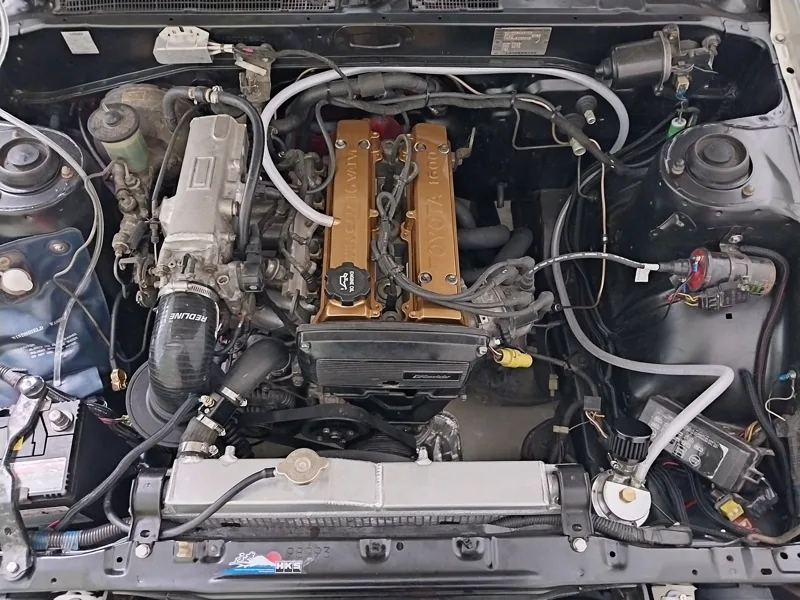
The Japanese range used the 1.3 litre 4E-FE, the 1.5 litre 5A-FE, the 1.6 litre 4A-FE and the 2.0 litre diesel 2C, depending on body and trim.
Japanese manual transaxles included the C50, C51, C52 and C56 units, and automatic transaxles ranged from the A240L to the A241H four-wheel-drive unit. The EE101 sedan and hatchback carried the 1.3 litre 4E-FE, while the AE101 combined the 1.6 litre with sedan, FX hatchback and BZ-Touring wagon bodies.
The 1.6 litre 4A-FE appeared across many markets. In Europe the 1.8 litre 7A-FE was reserved for a small number of models, and the 2.0 litre 2C diesel was the only diesel offered there.
How did the E100 do in Asia?
In the Philippines the E100 was nicknamed 'Big Body'. Three variants were sold: the XL, XE and GLi. The XL and XE used the 1.3 litre carbureted 2E engine, while the GLi received the 1.6 litre fuel-injected 4A-FE.
The Philippine 1.6 was the first in the country to fit 14-inch (360 mm) alloy wheels in 1992. Other pioneering features that followed were rear seatbelts, front cup holders in late 1994 and a driver's airbag in late 1995, with ABS coming in the later years.
In Thailand the model was nicknamed '3 Ovals' or Sam Huang, after its first use of the current Toyota logo. The car launched in March 1992 with four variants, and the LX Limited was imported from Japan and limited to 1,000 units.
Thailand was the last market to use carbureted engines on this generation. Only fuel-injected engines were offered from the facelifted model, which launched in June 1994.
In Indonesia the sedan was the 'Great Corolla', and in Malaysia it was called the Corolla SEG 100. Hong Kong sold the 1.3 XLi, the 1.5 GLi sedan, the wagon and the Levin 1.5 SJ coupe.
What was the E100 in Australia and New Zealand?
New Zealand assembly began in late 1992 at Toyota's Thames factory, with 1.3-litre XL and 1.6-litre GL, GS and GLX trims. Bodystyles were the sedan, five-door hatchback, liftback and wagon, along with a two-seater van version of the 1.3 hatchback.
The fuel-injected 1.6 produced 81 kW (110 PS). Period testers noted its lack of low-end power, which led to the later arrival of a torquier 1.8 litre engine. Chris Amon, the former Formula One driver, had been allowed to adjust the suspension settings, so the locally built cars had a thicker rear swaybar than the Japanese imports.
In 1994 the E100 became the first Toyota model built at the new Altona plant in Melbourne. The Corolla had been built at Port Melbourne from 1968 until 1993, and the Altona cars came as a hatchback (Seca) and sedan.
Australian trims included the 1.6 CSi base model, the CSX, the Conquest, the sporty RV hatchback and the top-of-the-range Ultima sedan. Production of the E100 in Australia ended in 1999, when Toyota Australia returned to Japanese imports.
How did the E100 hold up in crash testing?
In May 2017 ANCAP ran a head-on crash test between a 1998 E100 Seca and a 2017 E180 Auris and Corolla. The E100 scored 0.40 out of a possible 16 points, which made the safety improvement of the newer car plain.
That result was a useful reminder of how far safety standards moved in under two decades. The E100 had been a mainstream family car in its day, but the test underlined how much crash protection had improved since its launch.
What are the Toyota Corolla E100 specifications?
| Specification | Detail |
|---|---|
| Generation | Seventh-generation Corolla |
| Wheelbase | 2,465 mm (97.0 in) |
| Japan sedan and hatchback launch | June 1991 |
| Sedan and hatchback drag | Cd=0.33; liftback Cd=0.30; wagon and van Cd=0.36 |
| Galvanised steel share | Almost 90 percent, up from about 60 percent |
| North American debut | 1993 model year |
| North American engines | 1.6 4A-FE base; 1.8 7A-FE for DX, LE and wagon |
| 7A-FE power, 1993 and 1994 | 86 kW (115 hp) |
| TRD2000 engine | 2.0 L 3S-GE, 180 PS (132 kW) |
| TRD2000 production | 99 planned; 10 sold |
| UK GXi power | 120 PS (88 kW; 118 hp) |
| New Zealand 1.6 | 81 kW (110 PS), fuel-injected |
| ANCAP 2017 score | 0.40 out of 16 points |