Siamesed-cylinder fours from 1.3 to 1.8 litres, running from the economical 1A to the high-revving 4A-GE and the supercharged 4A-GZE.
Built from 1978 to 2006 in sizes from 1.3 to 1.8 litres, the A-series ran from the economical 1A, through the fuel-injected 4A-FE, to the 4A-GE twin cam and the supercharged 4A-GZE. Its siamesed cylinders kept each engine compact.
The Toyota A-series is a family of inline-four engines from 1.3 to 1.8 litres, built by Toyota from the late 1970s. Cast iron blocks with aluminium cylinder heads and siamesed cylinders kept the engines short, and the family ran from the economical 1A up to the high-revving 4A-GE twin cam.
Why was the A-series developed?
Toyota began the A-series in the late 1970s to replace the K engine in the Tercel. The goals were good fuel efficiency and performance with low emissions, and siamesed cylinders kept the engine as short as possible, which mattered in a small car.
The family includes one of the first Japanese mass-production DOHC four-valve engines, the 4A-GE, and a later version of that engine was one of the first production engines to run five valves per cylinder. Toyota joint venture partner Tianjin FAW Xiali later produced the 1.3 litre 8A and resumed production of the 5A in 2007, so the family continued in China.
One siamesed-cylinder four family, from a 1.5 litre 1A to the 4A-GE and supercharged 4A-GZE that enthusiasts still tune today.
How did the 1A and 2A start the series?
The 1A was a 1.5 litre engine built between 1978 and 1980, with a single twin-barrel carburettor and a belt-driven eight-valve SOHC layout. It used Toyota's Turbulence Generating Pot to meet Japanese emissions limits with only a two-way oxidation catalyst. At 550 mm long, it was compact for its class.
The 1A-U, fitted with Toyota's two-way catalyst, delivered 80 PS (59 kW; 79 hp) at 5,600 rpm, and its torque of 11.5 kg-m (113 N m) arrived at 3,600 rpm, with compression of 9.0:1. It was used in the AL10 Tercel and Corsa in Japan only.
The 2A followed from 1979 to 1989 as a 1.3 litre. Later AL20 Tercels had different valve and timing belt covers, an automatic choke and a controlled hot air intake, and their combustion chambers were reworked for economy and emissions. The 2A-U used the TTC-C catalytic converter and made 75 PS (55 kW; 74 hp) at 6,000 rpm.
What did the 3A and basic 4A engines offer?
The 3A was a 1.5 litre SOHC engine built from 1979 to 1989, and it dropped the Turbulence Generating Pot of the 1A. Its European version produced 71 PS (52 kW; 70 hp) at 5,600 rpm, while the 3A-HU high-compression variant reached 86 PS (63 kW; 85 hp) at 6,000 rpm.
The 3A-SU was a twin-carburettor swirl-intake version introduced in Japan in August 1984. It carried two variable-venturi carburettors, which Toyota wanted to test at home before wider use. Its output of 90 PS (66 kW; 89 hp) at 6,000 rpm was the highest figure in the 3A group.
The 4A was a 1,587 cc engine built from 1980 to 2002. Its 81 mm bore and 77 mm stroke gave an over-square layout that favoured high engine speeds. Versions ranged from the basic 8-valve SOHC carburettor engine to 20-valve DOHC units, and output stretched from 52 kW (71 PS; 70 hp) in the California-spec 4A-C to 125 kW (170 PS; 168 hp) in the supercharged 4A-GZE.
How did High-Mecha Twin Cam work on the 4A-F?
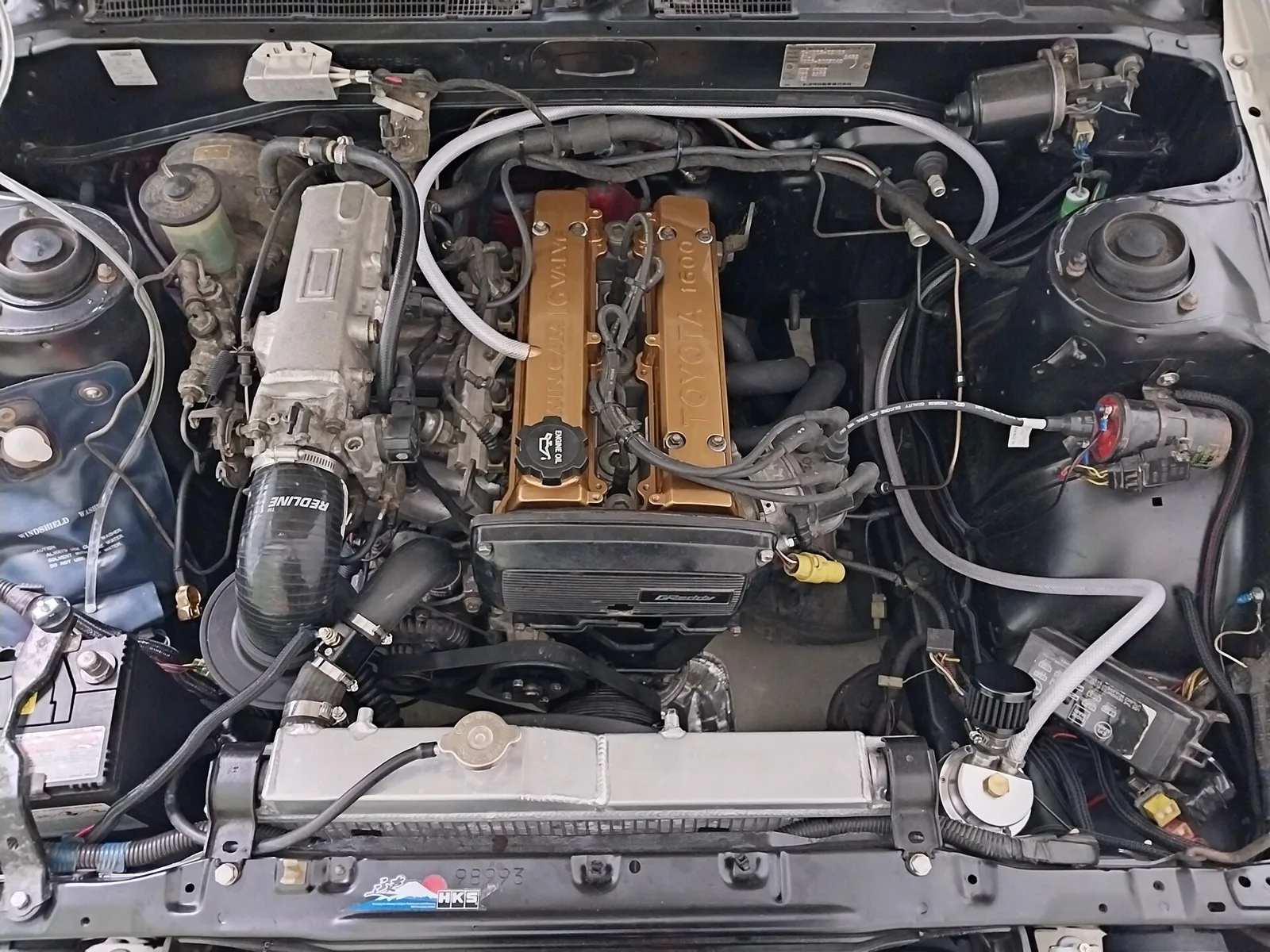
The 4A-F was a narrow-valve DOHC 16-valve carburettor engine built from 1987 to 1990. Its timing belt drove the exhaust camshaft, and the exhaust cam then drove the inlet cam through scissor gears. Toyota called this High-Mecha Twin Cam, and enthusiasts unofficially knew it as the slave-cam system.
The 4A-F made 70 kW (94 hp) at 6,000 rpm, while torque reached 13.8 kg-m (135 N m) at 3,600 rpm. Compression stood at 9.5:1 for EU specification. It had an aluminium head with centred spark plugs and pent-roof combustion chambers, plus a fully counterweighted five-journal crankshaft. A dual Weber carburettor version was built for a limited Thai edition of the AE92 Corolla Sporty in 1988, converted by TRD Thailand, and it produced 78 kW (105 hp) at 6,000 rpm.
The fuel-injected 4A-FE, built from 1987 to 2001, was designed with fuel economy in mind. Its three generations can be told apart by their shapes. The first had a plate reading 16 valve EFI, the second had injectors in the manifold runners, and the third was built only for Asian markets.
The 4A-FE was rated at 76 kW (102 hp; 103 PS) in North America, 105 PS (77 kW; 104 hp) in Europe and 115 PS (85 kW; 113 hp) in Asia. Compared with the 4A-GE it had about 10 per cent less power. Its shrouded valves, cast crankshaft and restrictive intake were tuned for economy and torque rather than peak output.
What made the 4A-GE a favourite?
The 4A-GE was a high-performance twin-cam four built from May 1983 to 1991 as a 16-valve engine, with 20-valve versions following until 2000. It remains a popular choice for engine swaps into older Toyotas, and new performance parts are still sold because the engine has such a strong following.
The first generation, known as the Blue Top, had an all-iron block that weighed 123 kg (271 lb), a reduction of fifteen per cent on the 2T-GEU. Toyota set the valves at a wide 50 degree angle, thought at the time to be ideal for power, and the T-VIS system with dual intake runners improved low-speed torque.
North American cars made 112 hp (84 kW; 114 PS) with this first generation, and the Japanese version was rated at 130 PS (96 kW; 128 hp) gross. The second generation, from June 1987, added larger connecting-rod bearings and extra block ribs. The third generation, the Red Top, used smaller ports, a single-runner manifold and a compression ratio of 10.3:1.
Output rose across the generations. The third-generation North American car made 132 PS (97 kW; 130 hp), and the fourth-generation Silver Top, with five valves per cylinder, gave 160 PS (118 kW; 158 hp) at 7,400 rpm. The fifth-generation Black Top, built from 1995 to 2000, made 165 PS (121 kW; 163 hp) at 7,800 rpm with a compression ratio of 11:1.
What changed in the 20-valve 4A-GE?
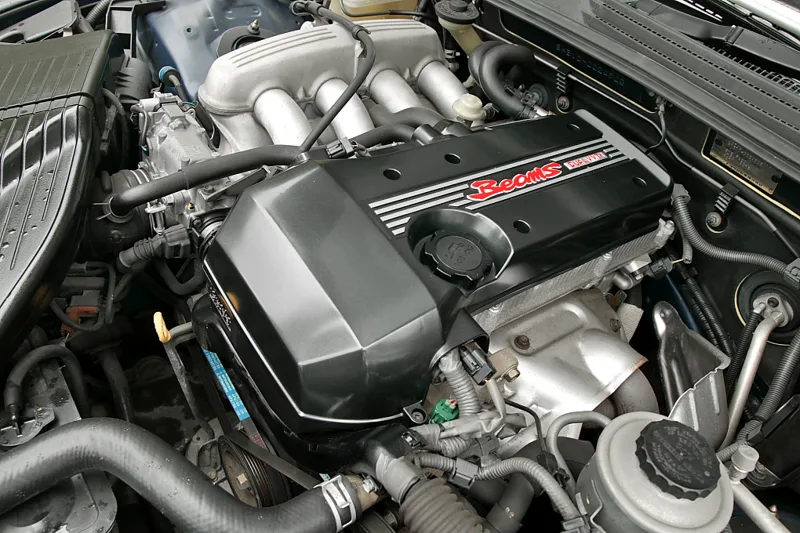
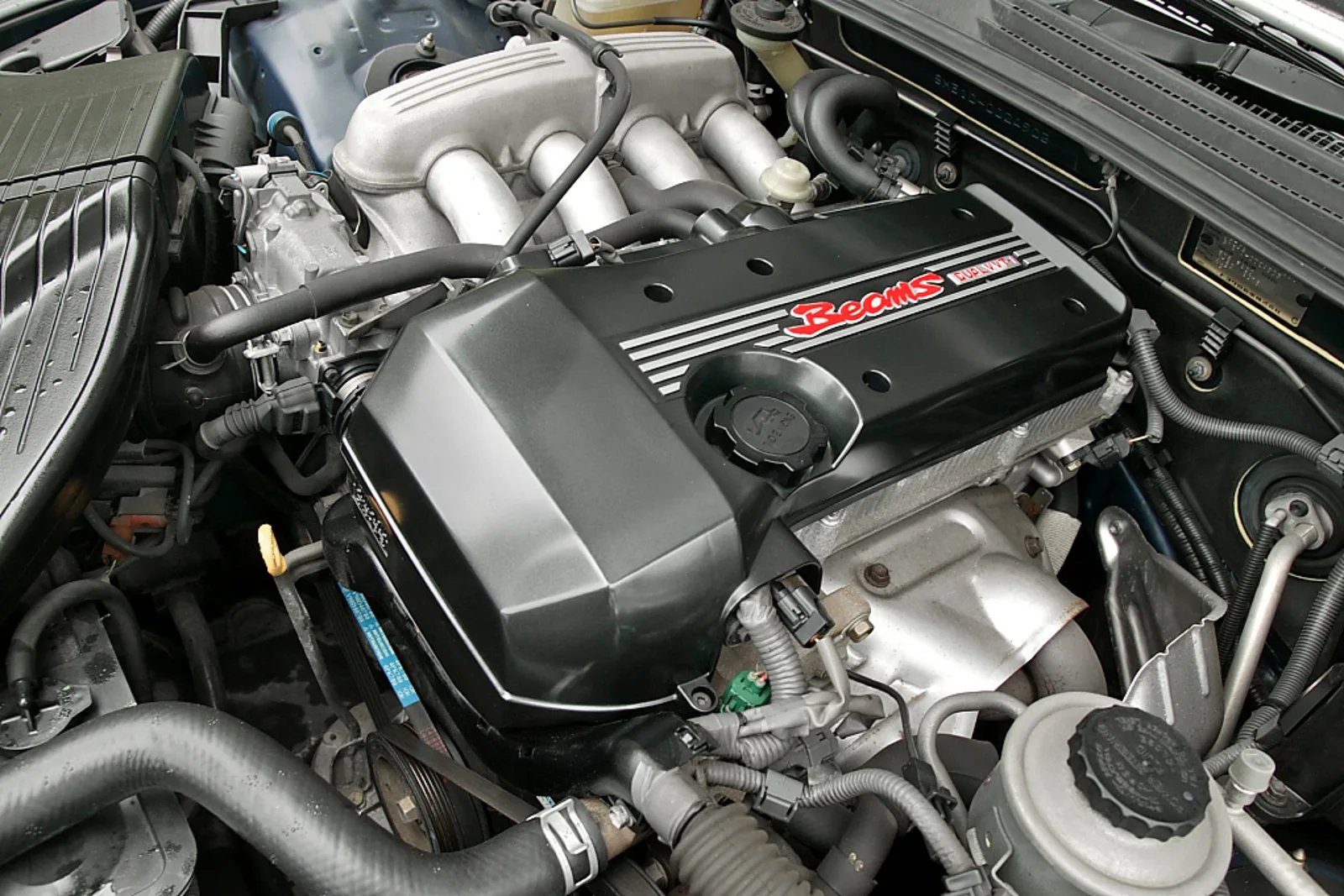
The fourth-generation 4A-GE had five valves per cylinder and a completely new cylinder head, with Toyota's variable valve timing on the intake cam and a compression ratio of 10.5:1. Its silver cam covers earned it the nickname Silver Top, and it was built from 1991 to 1995.
The fifth-generation Black Top ran from 1995 to 2000 and was the final 4A-GE. It had a larger plenum, a lighter flywheel and lighter connecting rods, a MAP sensor in place of the airflow meter, and throttle bodies enlarged from 43 to 45 mm. Enthusiasts favour it as an easy power upgrade for early Corollas, particularly in the drift scene.
Some people have said the 20-valve figures are inflated. That view is linked to running the engines on fuel below 100 RON, the Japanese premium standard, which both 20-valve engines need.
How did the supercharged 4A-GZE work?
The 4A-GZE was a supercharged version of the 4A-GE, built in three forms between August 1986 and 1995. All three used forged and ceramic-coated pistons, a Roots-type SC12 supercharger and a stronger seven-rib block.
The first generation ran 8 psi (0.55 bar) of peak manifold pressure, with an 8.0:1 compression ratio and 145 PS (107 kW; 143 hp) at 6,400 rpm. The second generation raised boost to 10 psi (0.69 bar), with 8.9:1 compression and 165 PS (121 kW; 163 hp). The third kept the four-valve head but added the smallport cylinder head and piston skirt oil jets, reaching 170 PS (125 kW; 168 hp).
The supercharged engine appeared in the 1986 AW11 MR2 and later in the AE92 Corolla and Sprinter. Its popularity with turbo conversions comes from its design, since many of its parts can handle the extra boost without modification.
How did the 5A and 8A engines compare?
The 5A was a 1.5 litre (1,498 cc) four with a 78.7 mm bore and a 77 mm stroke, built from 1987 to 2006. Its carburettor version made 85 PS (63 kW; 84 hp) at 6,000 rpm, and its 1987 fuel-injected version made 105 PS (77 kW; 104 hp) at 6,000 rpm.
The 5A-FHE, an EFI-S version, produced up to 120 PS (88 kW; 118 hp) with a slightly larger throttle and different cam profiles. Tianjin FAW Xiali later built the 5A-FE as the 5A+ for its Vela and Weizhi subcompacts, where it made 100 PS (74 kW; 99 hp) at 6,000 rpm.
The 8A was a 1.3 litre built from 1990 to 2006 by Tianjin FAW Xiali for Daihatsu and Toyota-based subcompacts. It shared the 5A's 78.7 mm bore but had a shorter 69 mm stroke, and it made 64 kW (86 hp; 87 PS) at 6,000 rpm with 9.3:1 compression.
How did the 6A and 7A fill the gaps?
The 6A-FC was the only 1.4 litre member of the A-series, built from 1989 to 1992 and mainly fitted to Australian and European market Corollas. It used a narrow-valve DOHC layout with the High-Mecha Twin Cam system and made 60 kW (80 hp; 82 PS).
The 7A was a 1,762 cc engine with an 81 mm bore and an 85.5 mm stroke, produced from 1990 to 2002. The 7A-FE was the largest production A-series engine, a non-interference design that used the 4A-FE's High-Mecha Twin Cam concept. Its most common United States application was the 1993 to 1997 Corolla.
North American versions were rated at 82 kW (110 hp; 112 PS) at 5,600 rpm, falling to 78 kW (105 hp; 106 PS) at 5,200 rpm for 1996 and 1997. The strongest naturally aspirated version, sold in Indonesia and Russia, made 120 PS (88 kW; 118 hp) at 6,000 rpm.
In Australia the AE112 Corolla Sportivo had a turbocharged and intercooled 7A-FE, created as a conversion rather than a ground-up turbo design. Its 115 kW (154 hp; 156 PS) at 5,600 rpm came from an IHI RHF4B turbocharger running 0.55 bar of boost, and only 110 Corolla Sportivos were built.
Which cars used the A-series engines?
The A-series powered Corollas, Sprinters, Carinas, Coronas, Celicas, Tercels and the MR2, along with a range of Asian and European models. The table lists the main variants, their capacities, published output and sample applications.
| Variant | Capacity | Valvetrain | Published output | Example applications |
|---|---|---|---|---|
| 1A-U | 1.5 L | SOHC 8-valve | 80 PS (59 kW; 79 hp) at 5,600 rpm | AL10 Tercel and Corsa (Japan) |
| 2A-U | 1.3 L | SOHC 8-valve | 75 PS (55 kW; 74 hp) at 6,000 rpm | AE80 Corolla, AL20 Tercel (Japan) |
| 3A-HU | 1.5 L | SOHC 8-valve | 86 PS (63 kW; 85 hp) at 6,000 rpm | AL21 Corolla II, Corsa, Tercel (Japan) |
| 4A-C | 1.6 L (1,587 cc) | SOHC 8-valve | 55 kW (74 hp; 75 PS) at 5,200 rpm | Corolla (North America), Chevrolet Nova |
| 4A-FE | 1.6 L (1,587 cc) | DOHC 16-valve | 76 kW (102 hp; 103 PS) at 5,800 rpm | Corolla AE92 and AE101, Carina |
| 4A-GE | 1.6 L (1,587 cc) | DOHC 16-valve | 130 PS (96 kW; 128 hp) gross, first generation, Japan | AE86 Corolla Levin, Sprinter Trueno, AW11 MR2 |
| 4A-GE Black Top | 1.6 L (1,587 cc) | DOHC 20-valve | 165 PS (121 kW; 163 hp) at 7,800 rpm | Corolla Levin coupe, Sprinter Trueno coupe (Japan) |
| 4A-GZE | 1.6 L, supercharged | DOHC 16-valve | 170 PS (125 kW; 168 hp), third generation | AE101 Corolla and Sprinter (Japan) |
| 5A-FE | 1.5 L (1,498 cc) | DOHC 16-valve | 105 PS (77 kW; 104 hp) at 6,000 rpm, 1987 | Corolla AE91, Carina |
| 7A-FE | 1.8 L (1,762 cc) | DOHC 16-valve | 82 kW (110 hp; 112 PS) at 5,600 rpm | Corolla AE102, Corolla Prizm |
| 8A-FE | 1.3 L (1,342 cc) | DOHC 16-valve | 64 kW (86 hp; 87 PS) at 6,000 rpm | Xiali Vela, Haima CA7130 |
Why does the A-series still matter?
The A-series matters because it was the engine behind Toyota's economy cars and a generation of enthusiast favourites. From the cheap 1A to the 4A-GE and the supercharged 4A-GZE, the family covered efficiency, performance and emissions within one design lineage.
Its later life is especially strong in China, where Tianjin FAW Xiali continued the 5A and 8A versions for its own small cars. The 4A-GE's popularity for engine swaps keeps it alive in tuning circles and among owners of older Toyotas.
The record is also a history of trade-offs. Economy-focused versions such as the 4A-FE gave up some power to gain efficiency, while the 4A-GE and 4A-GZE traded simplicity for output. One basic engine could be pointed in very different directions, and the family shows that clearly.