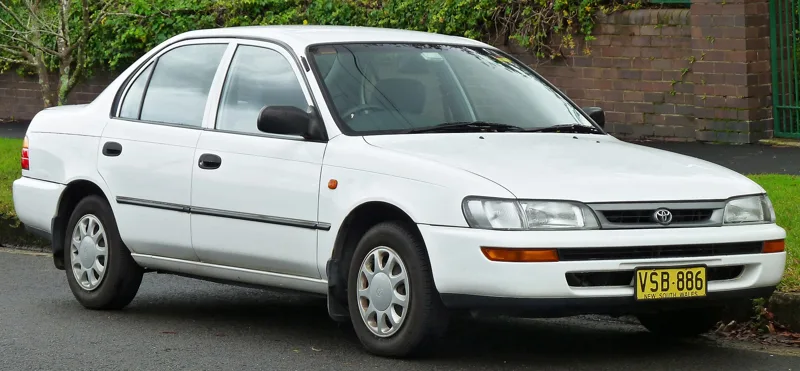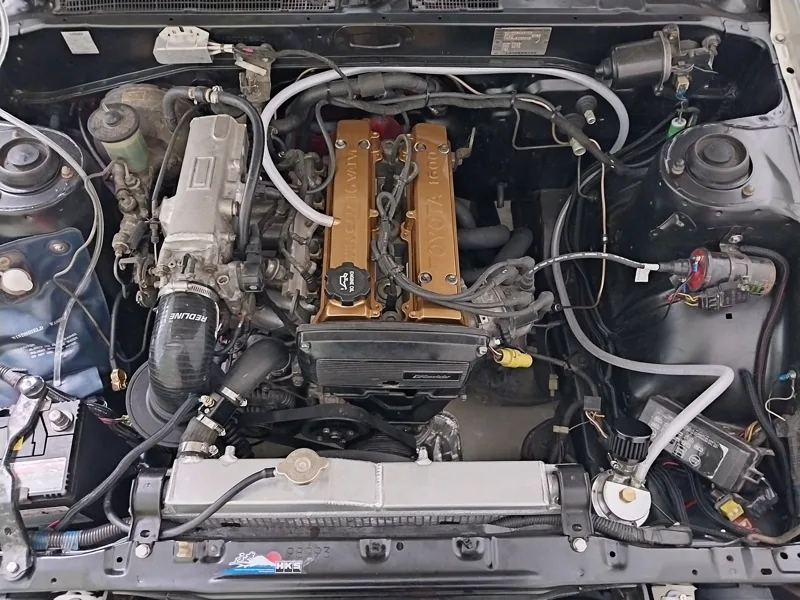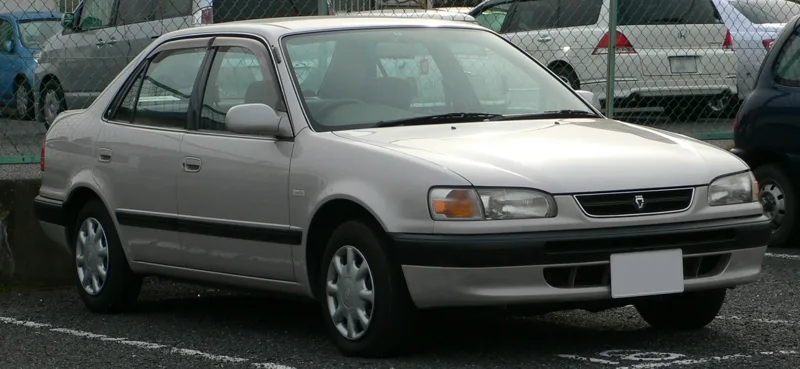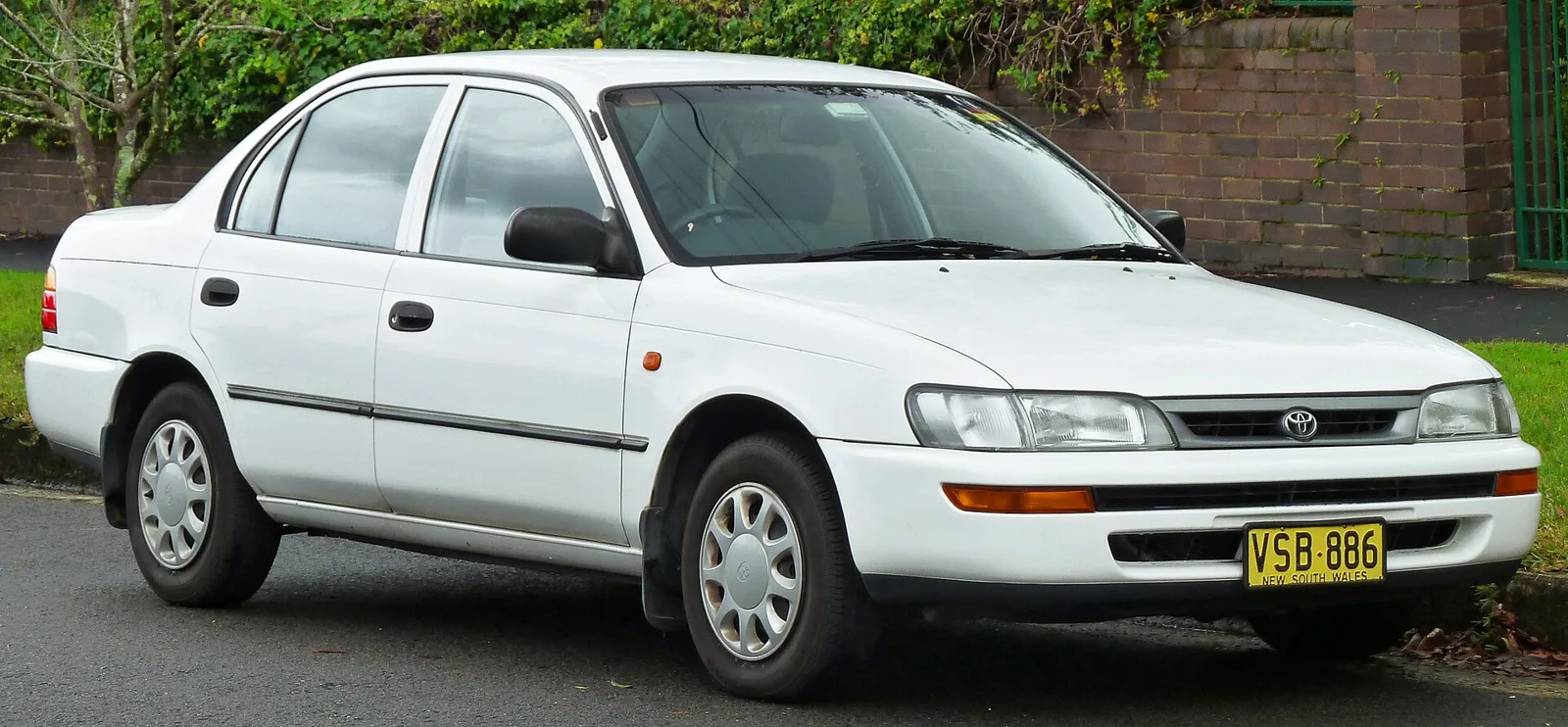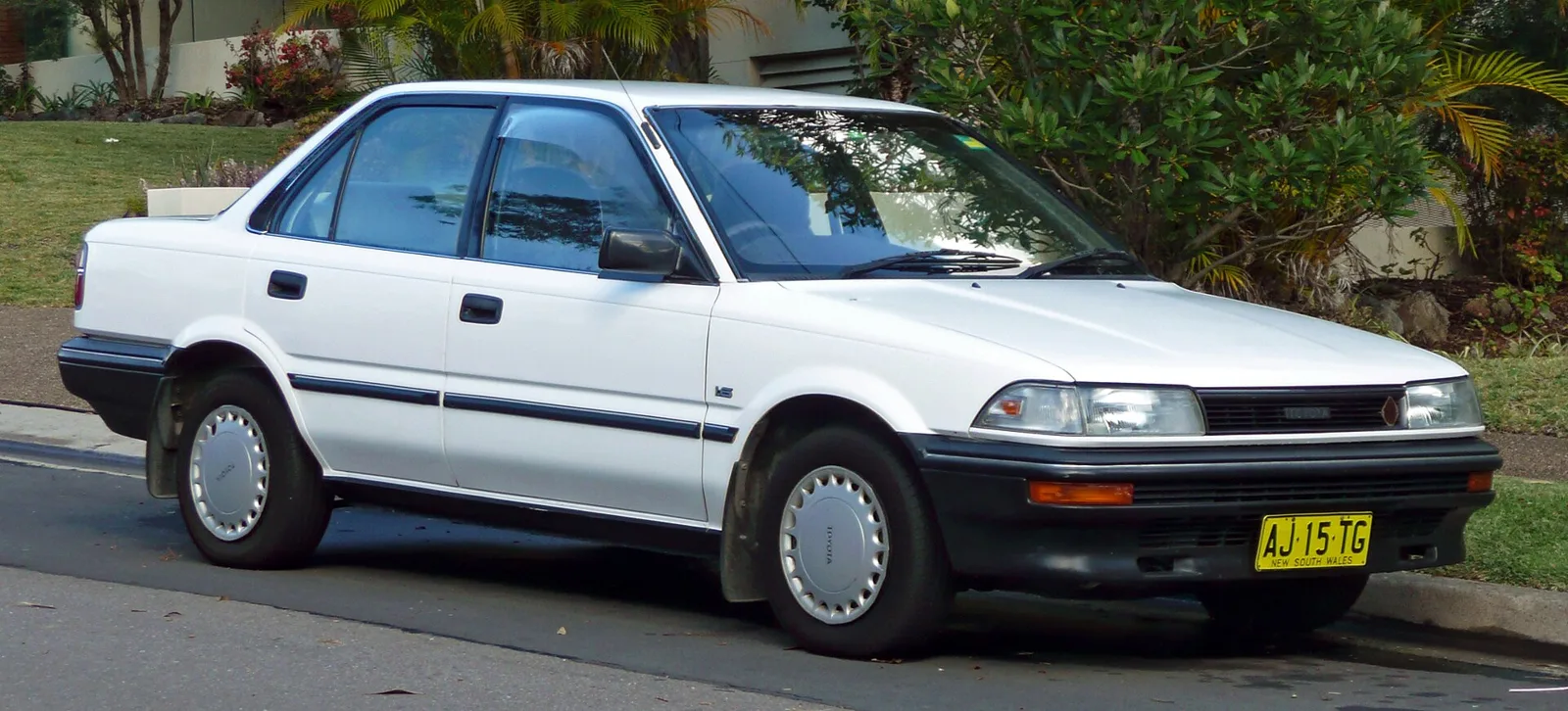
The last subcompact Corolla, the first all front-drive Corolla, a supercharged Levin and a Holden Nova twin that outlived its own generation in Australia.
Toyota's sixth-generation Corolla, the E90 was the final subcompact in the nameplate and the first with only front or all-wheel drive. Through GM joint ventures and South African badging it also appeared as the Geo Prizm, Holden Nova and Conquest.
Toyota's Corolla E90 arrived in 1987 as the sixth Corolla generation, sold from the 1988 model year. It was the last subcompact in the range and the first to offer only front-wheel or all-wheel drive, which ended the rear-drive performance option that earlier cars had offered.
What was the Toyota Corolla E90?
The E90 was sold across Japan, Asia, Europe, Australia, North America and South Africa, and it carried a different name in several of those places. Export trims were Base, XL, GL, SE and SE Limited, and the high-performance models used the 4A-GE engine.
Two joint ventures with General Motors created cousins of the car. Those E90 variants had minor cosmetic changes and were sold as the Geo Prizm in the United States and the Holden Nova in Australia, which kept the Corolla's mechanical base in other badges.
Production for the Japanese market was mostly replaced in June 1991, but export production carried on into 1992. Holden production in Australia lasted until mid 1994.
A subcompact Corolla that went front-drive for good, and a supercharged coupe that kept the sporting spirit alive.
Why was the E90 the last subcompact Corolla?
The E90 was the last generation of Corolla to be classed as a subcompact car. Later generations grew into a bigger class, so the E90 closed a chapter in which the Corolla was a small, economical family car.
The move to front-wheel drive or all-wheel drive only was equally significant. Earlier Corollas had offered a rear-drive performance option, but the E90 dropped that choice, and the front-drive layout became the basis of the range.
The all-wheel drive Sprinter Carib wagon relied on a coil-sprung beam axle at the rear, whereas every other version used struts.
Which engines did the Japanese E90 use?
The Japanese range covered engines from a 1.3 litre to a 1.6 litre, with a 2.0 litre diesel for the all-wheel drive sedan. The 1.3-litre sedan had a four-speed manual or a three-speed automatic, and later all 1.3-litre engines had five speeds.
The Full-Time All-Trac sedan used the 1.6-litre 4A-F from its introduction in October 1987. The manual version had a manually locking centre differential, while the automatics used a hydraulically operated limited slip unit known as Hymatic.
Petrol engines included the 2E at 1.3 litres with 12 valves and 73 PS (54 kW), the 3E at 1.45 litres with 79 PS (58 kW) and the 5A-F at 1.5 litres with 85 PS (63 kW). The 5A-FE rose to 94 PS (69 kW) with electronic fuel injection, and the 5A-FHE reached 105 PS (77 kW).
The 1.6-litre 4A-FE produced 100 PS (74 kW), while the 4A-GE with its wide valve angle made 120 PS (88 kW) and later 140 PS (103 kW) after the facelift. The 4A-GZE supercharged unit produced 145 PS (107 kW), rising to 165 PS (121 kW) after the 1989 facelift.
The diesels were the 1C-II at 64 PS (47 kW), the 1C-III at 67 PS (49 kW) and the 2C-III at 73 PS (54 kW). The 2C was used in the four-wheel-drive diesel sedan introduced in May 1989.
What made the supercharged Levin and Trueno special?
The AE92 Levin and Trueno were fitted with a supercharged engine that used an SC12 Roots-type supercharger and a top-mounted intercooler. Cool air reached the intercooler through a scoop on the bonnet.
The supercharged engine produced 206 N m (152 lb ft) at 4400 rpm. The naturally aspirated 4A-GE made 136 N m (100 lb ft) at 4,800 rpm, so the supercharger raised torque considerably.
The 4A-GE carried the sporting image of the range into the GT models, and the supercharged cars reinforced that image.
How did the E90 differ across Asia?
Asian market Corollas originally came with four-door sedan or five-door liftback bodywork. Engines were the 12-valve 2E at 72 PS (53 kW) or the twin-cam 4A-F at 94 PS (69 kW), all of them carburettor units without catalysts.
The GT variant had disc brakes on all wheels, extra gauges including a volt meter and an oil pressure gauge, performance suspension and the 4A-GE with 142 PS (104 kW). It was the sporting top of the Asian range.
In the Philippines the car was nicknamed the Small Body, and it arrived in March 1989 with XL, XE and GL trims. The GL had the 1.6-litre 4A-F, a rear anti-roll bar and 60/40 fold-down seats, which set it apart from the 1.3-litre cars.
Indonesia assembled the car locally from 1988 to 1992, marketed as the Corolla Twincam with SE, SE Limited and GTi trims. Thailand nicknamed it the Doraemon after the cartoon character, and the Thai launch came in June 1988 with XL, GL, SE, SE Limited and Sporty variants.
The Thai Sporty ran a 1.6 with twin Weber carburettors producing 106 PS (78 kW), and the GTi replaced it in April 1989 with the fuel-injected 4A-GE. In Pakistan the E90 came in as a completely built unit from 1988 to May 1993, when Indus Motor began assembling the next generation.
Why did Toyota and Holden share the Corolla?
UAAI, a joint venture between Toyota and Holden, was set up in December 1988 to build and sell the Corolla as the Holden Nova. The deal spanned the E90 and the E100 that followed it.
The Australian engine line-up had the 4A-F at 71 kW (95 hp), the 4A-FE at 76 kW (102 hp) and the 4A-GE at 101 kW (135 hp). A carbureted 6A-FC of 1.4 litres produced 60 kW (81 hp), while the 1.8-litre 7A-FE made 86 kW (115 hp) in the Seca models.
The Corolla liftback was called the Seca in Australia. The 4x4 wagon arrived in mid-1988, followed by the hatchback and sedan in mid-1989, and the series 2 facelift models were released in October 1991.
How did the E90 hatchback fare in Europe?
The European Corolla came as a four-door sedan, a three- or five-door hatchback and a regular wagon. The five-door liftback used the Japanese Sprinter Cielo body in its entirety, and it was available with the small 1.3-litre engine in Europe.
Toyota started with the sedan and derived the hatchback from it, rather than adding a trunk to a hatchback as some rivals did. The result was a truncated body with minimal trunk space of 281 L (9.9 cu ft), which was only a fraction more than the Citroen AX.
Competitors offered more room. The Kadett and Fiat Tipo had 390 L (13.8 cu ft) and 345 L (12.2 cu ft) of trunk space respectively, and the hatchback suffered from being something of a design afterthought.
The European engine line-up grew over time. From August 1989 a fuel-injected and catalysed 1.3 became available in some markets, and a fuel-injected version of the narrow-angle 1.6 with 15 horsepower more than the carburettor unit was added mid-life.
How did the diesel and GTi sell in Europe?
The diesel sold substantially in Belgium and the Netherlands, where tax rules favoured diesels and there were no laws hindering Japanese imports. In Europe it was offered only in the spartan XL equipment level, and its power rose by three horsepower in late summer 1989.
The GTi used the 4A-GE, and from late 1989 the big-port T-VIS version gave way to a non-T-VIS small-port unit. For UK cars without catalytic converters the power went from 124 to 129 bhp (92 to 96 kW), and the catalysed version produced 116 PS (85 kW; 114 hp) at 6,600 rpm.
In Sweden the liftback GTi was sold as the Corolla CS, from May 1991, with a 125 PS (92 kW) version of the 4A-GE.
How did the E90 sell in North America?
North American cars went on sale for the 1988 model year, and the sedans were assembled by NUMMI and the Cambridge plant in Ontario, Canada, and the two plants made 279,000 units of the sedan, within a generation that totalled 4.5 million cars.
NUMMI had previously built the E80 Corolla FX hatchback, but that model never sold well in the United States, so Toyota switched the plant to the sedan. The North American models moved away from the boxy styling of the previous generation, with longer bumpers and small red conspicuity lights on the rear quarter panels.
A 25th anniversary special edition arrived in 1990 to mark the Corolla line's first quarter century. Minor changes for 1991 brought the modern Toyota emblem to the grille, all-red taillights and new hubcaps for the DX.
The Corolla Sport coupe with retractable headlights shared its underpinnings with the Sprinter Trueno. Its GT-S used the 4A-GE, which was revised in 1990 with higher compression and smaller intake ports. Power rose from 86 kW (115 hp) to 101 kW (135 hp), giving the coupe real performance.
The four-wheel-drive All-Trac wagon sold from 1988 to 1992 with bodywork different from the other Corollas. The Corolla 4WD sedan was produced in very small numbers and was distinguished from the front-drive car mainly by its tyre size.
What was the E90 like in South Africa?
South Africa sold only two body styles. The five-door hatchback was marketed as the Toyota Conquest, and the four-door sedan kept the Corolla badge. Production began in October 1988, with a 1.3 litre 2E producing 53 kW (72 hp) and a 1.6 litre 4A-F producing 70 kW (95 hp).
The GLi Twin Cam sedan and the RSi hatchback used the 4A-GE, with 100 kW (136 hp). The panel van was called the Conquest Carri, which was later simply known as the Toyota Carri from 2000.
In October 1996 an entry-level model called the Conquest Tazz appeared, with a very low equipment level. It was later renamed the Toyota Tazz in October 2000, and it was built until July 2006, which is well beyond the usual life of a generation.
What are the Corolla E90 specifications?
| Specification | Detail |
|---|---|
| Introduced | 1987 for the 1988 model year |
| Drive layout | Front-wheel drive or all-wheel drive only |
| Japanese 2E engine | 1.3 litre, 12-valve, 73 PS (54 kW) |
| Japanese 4A-GE engine | 1.6 litre, 120 PS (88 kW), 140 PS (103 kW) after facelift |
| Supercharged Levin torque | 206 N m (152 lb ft) at 4400 rpm |
| Australian 7A-FE | 1.8 litre, 86 kW (115 hp) |
| European hatchback trunk | 281 L (9.9 cu ft) |
| GTi power, catalysed | 116 PS (85 kW; 114 hp) at 6,600 rpm |
| North American production | 279,000 units from NUMMI and Cambridge |
| GT-S power, 1990 and 1991 | 101 kW (135 hp) |
| South African 1.6 | 70 kW (95 hp), 4A-F |