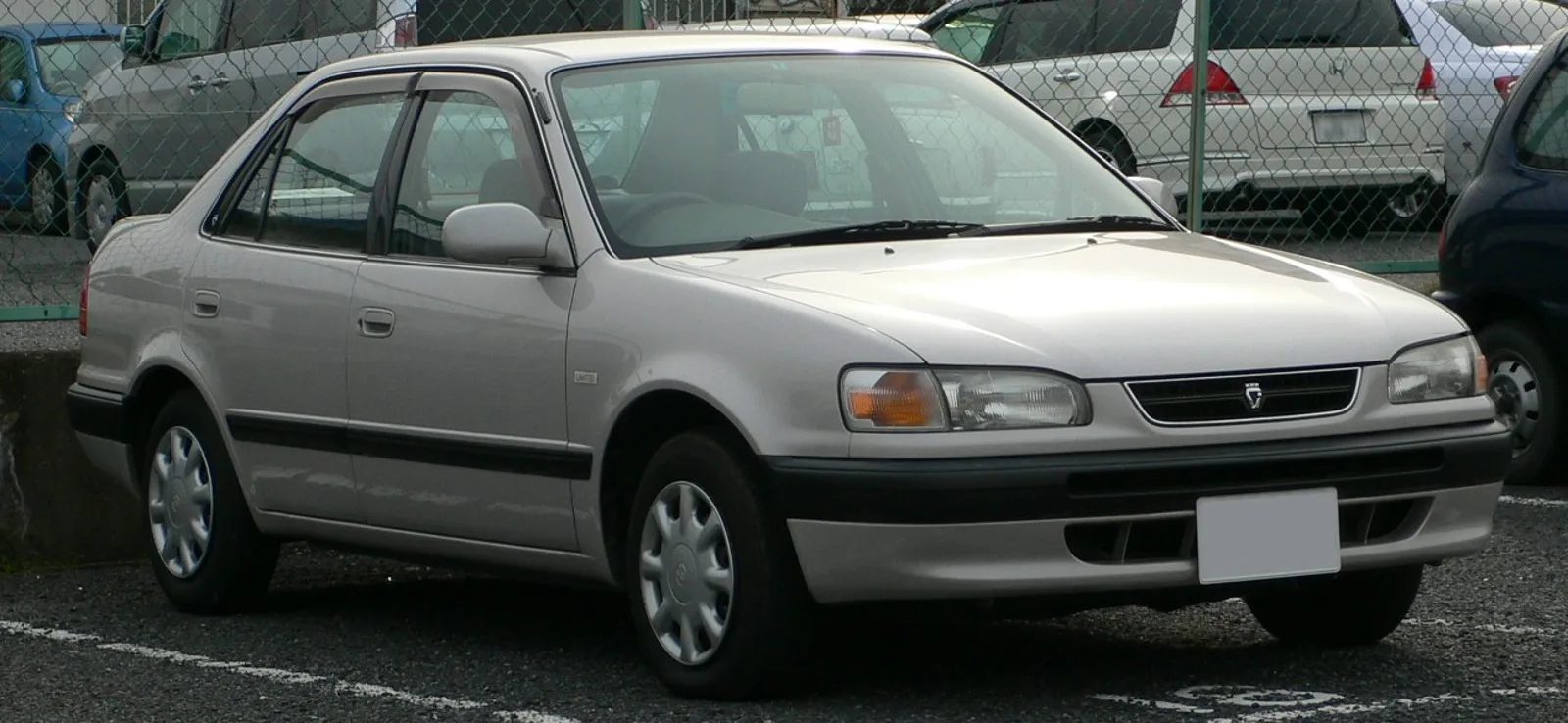
Launched in 1995 during Japan's Lost Decade on a largely carried-over platform, the E110 sold across Asia, Europe, Oceania and North America.
Toyota's E110 was the eighth-generation Corolla, introduced in 1995 on a largely carried-over platform. It sold in Japan, Southeast Asia, Europe, Oceania and North America, with market-specific engines from 1.3 litres to a 2.2-litre diesel.
The Toyota Corolla E110 was the eighth generation of the Corolla nameplate. It reached showrooms in May 1995 with much of its predecessor's platform, and some models kept the old doors, a choice driven by the economic slump Japan called the Lost Decade. Its engineering was carried over for that reason, yet the car found buyers across Asia, Europe, Oceania and North America.
When did the eighth-generation Corolla arrive?
Toyota introduced the E110 in May 1995 and told its Corolla development chief, Takayasu Honda, to economise. That pressure explains the carry-over engineering, which kept costs down while the Japanese economy stalled.
For mainstream buyers there were Base, XLi, GLi and SE-G trims. Japan was the last home of a Corolla with a Sprinter twin and the Levin sports upgrade, although hatchbacks and liftbacks were never sold there.
An eighth-generation Corolla engineered under recession-era cost pressure that still found buyers from Singapore to the UK.
What was the Japanese E110 range?
Japanese E110s ranged from a 1.3-litre 4E-FE with 88 PS (65 kW) to the 1.6-litre 4A-GE, a 20-valve unit making 165 PS (121 kW). Two diesels, a 2.0-litre and a 2.2-litre, rounded out the list.
Japanese cars got small changes in April 1997, including fresh nose, tail and interior styling. The rear panel was redesigned, so the trunk and tail lights do not interchange between old and facelift cars. The E120 took over in Japan in 2000.
The Sprinter Carib wagon matched the European Corolla wagon and was sold only in Japan as a Sprinter. The Sprinter, sold only through Toyota Auto Store dealers, was renamed the Allex and turned from a sedan into a five-door hatchback.
The previous generation's wagons and vans kept selling beside the new car, with touring wagons continuing until 2000 and the vans and Assista wagon until 2002.
How did the Indonesian and Malaysian Corollas differ?
In Indonesia the E110 launched in December 1995 with XLi, SE-G and S-Cruise grades, every car using the 1.6-litre 4A-FE. The SE-G and S-Cruise came with a driver's airbag as standard, the first compact cars in Indonesia to offer that protection.
A facelift in March 1998 brought a 1.8-litre 7A-FE engine and new front and rear panels with an upgraded interior. The SE-G also gained standard ABS and a passenger airbag.
On Batam, where used Singaporean imports are popular, the GLi E110 is one of the commonest models in the private car and taxi trade. Most cars there are facelifted North American, Japanese or Asian models, with a few pre-facelift 1995 cars.
Malaysia offered the E110 from February 1996 in two grades, GLi and SE-G, both with the 4A-FE 1.6-litre engine and airbags as standard. Some 7,330 Corollas were built there in 1996. Malaysia's April 1998 facelift kept the SE-G and GLi and added the 1.8-litre Hi-Torq 7A-FE, with ABS standard on the SE-G.
Why was the Philippine Corolla called Baby Altis?
The Philippine E110, nicknamed Love Life or Baby Altis, launched in December 1997 in XL, XE and GLi grades. The GLi was the top model, with a 1.6-litre 4A-FE, power windows and locks, a Red Mica paint option and a keyless security system.
The XE added dual airbags, 14-inch alloys and a Fujitsu Ten four-channel audio unit, but only with a five-speed manual. The XL was the cheapest car at launch, with a two-spoke wheel, wind-up windows and 13-inch steel wheels.
A special TOM'S Toyota Corolla Turbo, based on the GLi, was sold through dealers in 1999. It came with body kits and a turbo kit for the 1.6-litre engine, developed by TOM'S.
The XL stayed on as a rental and taxi car beside the E120 Corolla Altis until May 2004, then the Vios J took over. A 1.3 LE arrived in 1999 and was phased out in early 2003.
The XE and GLi were redesigned in early 2000, and Corolla Altis first appeared as a name for a 1.8 SE-G with the 7A-FE engine and a four-speed automatic.
How popular was the E110 in Singapore?
The E110 was one of Singapore's best-selling cars during its time there and was often used as a taxi. Many were later exported to Batam for taxi work in the 2000s.
What did Thailand's Tong Nueng Corolla offer?
In Thailand the E110 launched in July 1996 as the Tong Nueng, or duck-ass model, in DXi, GXi and SE-G trims. The first cars used a 1.5-litre 5A-FE or a 1.6-litre 4A-FE engine.
The pre-facelift DXi used the 1.5-litre 5A-FE with a five-speed manual, tilt steering and vinyl seats on 13-inch steel rims. The GXi added a tachometer, power windows and locks, and a driver's airbag.
The 1.6 GXi and SE-G, with 4A-FE engines, brought ABS and a driver's airbag. The SE-G also had a four-speed automatic and auto-folding mirrors.
The facelift arrived in April 1998 as the GXi, GXi-S and SE-G, with the bigger 1.8-litre 7A-FE, and the 1.5 was dropped. The 1.8 SE-G was rebadged as the Corolla Altis in June 1999, and in March 2000 the tail lamps changed to European-style units while a 1.6 SE-G was added as the Hi-Torque.
What were the North American Corollas like?
North American Corollas were built at Fremont, California, by NUMMI, or at Cambridge, Ontario, by TMMC, from the 1998 model year. They were sedans only, and every car used the all-aluminium 1.8-litre 1ZZ-FE engine.
The 1ZZ-FE used a timing chain rather than a belt, and it had laser-etched valve guides in the block, which Toyota said would prevent oil burning. A flawed piston ring design, though, affected engines without VVT-i and caused oil burning in higher-mileage cars.
Trim names were VE, CE and LE. The VE came with a three-speed automatic or a five-speed manual on 175/65R14 tyres, while the CE and LE offered a four-speed automatic with overdrive or a five-speed manual on 185/65R14 tyres.
The 2000 model year brought VVT-i, individual coils for each cylinder and child seat anchors. Power rose a little, from 120 hp to 125 hp (93 kW), and the VVT-i system optimises cam timing to cut emissions.
For the 2001 model year the VE gave way to a new S model. The CE became the base car, and the sporty S took over the Touring Package role. The 2001 refresh brought new headlight corners, a redesigned front bumper, an auxiliary power port, and an inside boot release.
The S had a red and black gauge cluster with a tachometer, a lightweight three-spoke wheel shared with the Celica and Matrix, a charcoal and black interior and standard front fog lamps. It was built without the 60/40 folding rear seats fitted to other models.
The 2002 model year was brief, built only up to late 2001 before the redesign reached showrooms in early 2002 as a 2003 car. Toyota dealers sold accessories for every trim, from a gold emblem package and rear spoiler to alloy wheels, a sunroof deflector and a six-disc CD changer.
The 1998 and 1999 cars made 120 hp (89 kW), peaking at 5600 rpm, with 165 N-m (122 lb-ft) at 4400 rpm. The 2000 to 2002 VVT-i version made 125 hp (93 kW), peaking at 5800 rpm, and 169 N-m (125 lb-ft) at 4000 rpm.
How did the European Corolla look?
In Europe the E110 had different front and rear ends from the Japanese models, with round headlights and a mesh grille. A six-speed sporting version was offered, and the three-door hatchback underpinned the Corolla WRC rally car, which competed from 1997 to 2000.
Shipments from Japan to Europe stopped in September 2001, and the British factory kept building the car for two more months. In Australia the liftback was sold as the Seca, with Ascent, Conquest and Ultima grades.
The Corolla Spacio arrived in 1997 as a two-box minivan with body panels stamped by Kanto Auto Works, and it was technically close to the Avensis. The E110 was the final Corolla generation with an upmarket Sprinter Carib spin-off, based on the five-door wagon in Oceania. Japan, Australia and New Zealand never received the three-door.
In New Zealand, CKD kits from Japan were assembled at Thames and Christchurch until late 1998, with local tyres, seats, trims and glass added. By 2000 New Zealand offered 1.3, 1.5, 1.6 and 1.8-litre petrol engines or the 2.2-litre diesel, while Australia offered only the 7A-FE, plus a turbocharged Sportivo in 2001.
A 1999 facelift reworked the bonnet, wings, lamps and grille and swapped the A-series engines for ZZ units with VVT-i, though Australia kept the older engines. Toyota's own 2.0 diesel was replaced in most European markets by a 1.9-litre Peugeot-sourced unit, which in August 2000 gave way to the 1CD-FTV.
What were the G6 and G6R?
The G6 was a special European E110 hatchback with a 1.3-litre or 1.6-litre engine before the facelift and a 1.4-litre or 1.6-litre after it. It had colour-matched bumpers, a front lip option, a short-ratio six-speed gearbox, disc brakes from the liftback, a honeycomb grille and black-and-red honeycomb dials.
The G6R was a pre-facelift 1.6-litre G6 with an aluminium bonnet to save weight, red seat belts, a colour-matched lip, side skirts and unique 15-inch alloy wheels. It was sold only in the UK, Spain, the Netherlands and Germany, and 420 examples went to the UK.
Toyota wanted fun through lower weight rather than extra power, so younger drivers would not be priced out by insurance. Its own line was that the G6 offered affordable fun rather than insurance-prohibitive performance.
What are the Toyota Corolla E110 specifications?
| Specification | Detail |
|---|---|
| Introduced | May 1995 (Japan); December 1995 in Indonesia |
| Japanese engine range | 1.3 L 4E-FE, 88 PS (65 kW) up to 1.6 L 4A-GE, 165 PS (121 kW) |
| Japanese diesels | 2.0 L 2C-III, 73 PS (54 kW); 2.2 L 3C-E, 79 PS (58 kW) |
| North America, 1998-1999 | 1.8 L 1ZZ-FE, 120 hp (89 kW) at 5600 rpm |
| North America, 2000-2002 | 1.8 L 1ZZ-FE with VVT-i, 125 hp (93 kW) at 5800 rpm |
| European 1.6 engines | 4A-FE and 3ZZ-FE VVT-i, both 110 PS (81 kW) |
| European turbodiesel | 2.0 L 1CD-FTV common-rail, 90 PS (66 kW) |
| Malaysia output (1996) | 7,330 Corollas |
| Japanese successor | E120 from 2000 |
| Last European production | September 2001 from Japan; two more months at the UK plant |