A compact rear-drive coupe that turned into a front-drive liftback, a supercharged road car and a cult icon, built by Toyota from 1972 to 2000.
Built by Toyota from 1972 to 2000, the Sprinter Trueno was a compact coupe and liftback sold in Japan through Auto Store dealers. Its Corolla Levin twin shared the platform, and the line grew steadily more potent over seven generations, reaching 165 PS in the last.
The Toyota Sprinter Trueno was a compact sports coupe and liftback built by Toyota from 1972 to 2000, and in Japan it was sold only through Toyota Auto Store locations. Its twin, the Corolla Levin, shared the platform and ran in parallel. Engine output rose from 115 PS in the first car to 165 PS in the final generation, while the body moved from rear-wheel drive to front-wheel drive along the way.
The name is a pairing of two words for weather. Trueno is Spanish for thunder, and Levin is an old English word for lightning. Across almost three decades the Trueno became one of the more recognisable names in Japanese sport compacts.
Where did the Sprinter Trueno come from?
The first Trueno and Levin arrived in March 1972 as the high performance models of the Corolla and Sprinter 2-door fastback coupes. The idea came from Toyota manager Geisuke Kubo, who wanted something to rival the Alfa Romeo Giulia Junior. The result was a compact coupe with a sporting character and a hot engine at the top of the range.
The two cars were kept distinct from the start. The Sprinter Trueno was offered through Toyota Auto Store dealers, while the Corolla Levin was sold through Toyota Corolla Store locations. Both shared the same mechanical basis, but each had its own front-end design and marketing.
A compact coupe that began with a rival to the Alfa Romeo Giulia Junior and ended as a cult name.
How powerful was the first-generation Trueno?
The highest performance model used a 1.6 L DOHC 2T-G engine with a compression ratio of 9.8:1, fed by twin double venturi side draft Mikuni-Solex 40PHH carburettors. It drove through a T50 5-speed manual borrowed from the TA27 Celica 1600GT, and it produced 115 PS (85 kW; 113 hp) gross.
Toyota claimed a top speed of 190 km/h (118 mph) and a quarter mile time of 16.3 seconds for that car. A lower compression 8.8:1 version, the 2T-GR, lost 5 PS and was rated at 185 km/h (115 mph) with a 16.7 second quarter mile, for customers who wanted to run cheaper, lower octane fuel.
An updated model arrived in August 1972 with a refreshed appearance. In April 1973 a less powerful J (Junior) model appeared, using the twin carburettor 2T-B/BR engine shared with the cheaper Corolla and Sprinter 1600 SR coupe. Its gross output of 100-105 PS (74-77 kW; 99-104 hp) gave a top speed of 170-175 km/h (106-109 mph).
The 1.6 litre engine carried a practical penalty in Japan. Owners of cars with that displacement paid higher annual road tax than buyers of 1.0 to 1.5 litre cars.
How did the second generation split the twins?
The second generation arrived in April 1974, and it marked a clear design split between the two models. The Sprinter Trueno TE47 was offered as a coupe with a sleeker, more curved body, while the Corolla Levin TE37 was only available as a hardtop coupe with an aggressive forward-raked nose.
Both models kept the 2T-G and 2T-GR engines and the T50 5-speed manual. The twins had a GT sub-trim, but the coupes were discontinued in November 1975 because they could not meet Japanese emission regulations.
Export was limited. The TE47 went to Belgium, the Canary Islands and Luxembourg, along with general Asia-Pacific specification, and it was marketed in three trims: LT with the plain 2T engine and a 4-speed T40, ST with the twin carburettor 2T-B and a T50, and GT with the Japanese powertrain.
When did the coupes return?
Toyota brought the twin coupes back in January 1977 with a minor facelift and a fuel-injected version of the 2T-G, called the 2T-GEU, which carried the Toyota Total Clean-Catalyst emission system. The Corolla Levin took on a regular coupe body like the Trueno, although the nose still set the two apart.
Limited editions followed later that year. The Black Trueno, based on the GT trim, was limited to 550 units in September 1977. The Levin GT received a black special edition of 1000 units in November of that year, with brown mats, body decals and a plate bearing the owner's name.
In April 1978 the cars received a new front grille, low-speed impact-absorbing bumpers and a three-way catalytic converter. The Levin and Trueno then carried the TE55 and TE65 codes, respectively.
What made the third generation different?
The third generation arrived in May 1979 and dropped the coupe body entirely. It was exclusively a 3-door liftback, though one version used a steeper tailgate. It kept the 115 PS fuel-injected 2T-GEU engine, but it added four-wheel disc brakes as standard and a sunroof as an option.
The May 1981 facelift added two trims, the cheaper S with a shorter front bumper and the better-equipped APEX with standard sport seats. The Trueno gained an inverted trapezoid grille and half-trapezoid flush headlamps, while the Levin kept larger headlamps and a rectangle grille, so the two stayed visually separate.
Export models took a different form. The Corolla Levin was exported to parts of Europe as the Corolla GT, with a Mikuni-Solex carburettor version of the 2T-G producing 108-110 PS (79-81 kW; 107-108 hp).
Why is the AE86 so famous?
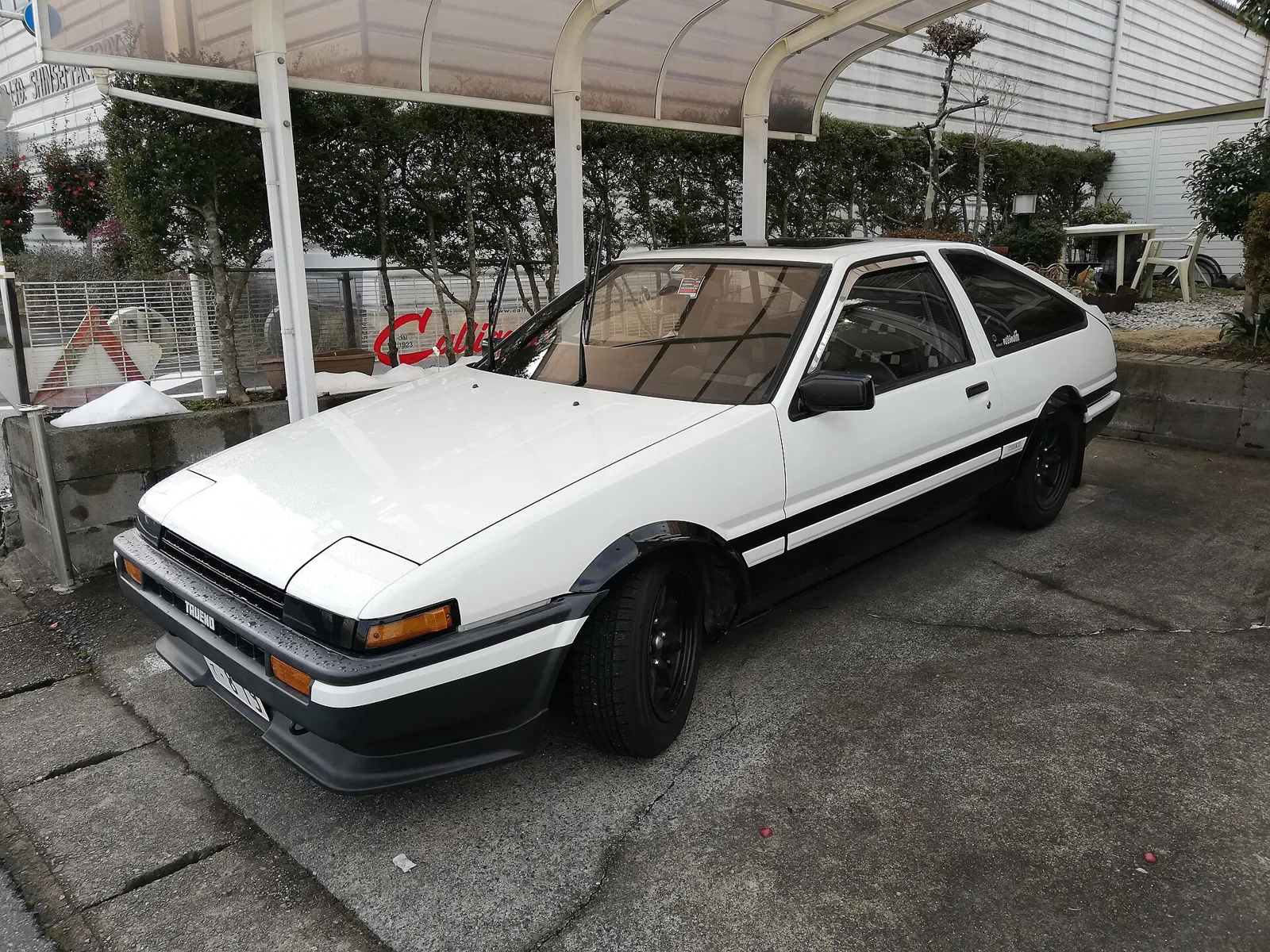
The AE85 and AE86 generation, released in May 1983, is the one most people mean when they talk about the Trueno. It came in 2-door coupe and 3-door liftback bodies, and it was the final model in the line to keep the old front-engine, rear-drive layout, inherited from the previous generation with major changes.
Each model received its own identity. The Corolla Levin used fixed rectangular headlights, while the Sprinter Trueno had retractable pop-up headlights. Trim levels ranged from GL, GL-Lime, XL and XL-Lisse at the base, through SE and SR, to the top GT, GT-V and GT-APEX grades.
The old 1.6 L 2T-GEU was replaced by a modern 16-valve DOHC 4A-GE engine. The new unit made 15 PS more, weighed 23 kg less and was 4 dB quieter than the old one, and it was the engine that became the heart of the car's reputation.
Japan also received a 1.5 L SOHC 8-valve 3A-U engine exclusively for the AE85, and automatic transmission became available in the Trueno and Levin range for the first time. The 1985 facelift added halogen lamps and new front indicators, and a set of new colours.
What were the AE86 special editions?
The AE86 Black Limited, released in January 1986, was based on the facelifted Sprinter Trueno GT-APEX 3-door liftback. Toyota advertised it as a limited production model of only 400 units, with an exclusive all-black paint job, gold wheels and gold badges.
The model was echoed much later. In June 2023 Toyota introduced the GR86 Trueno Edition, a limited version celebrating the 40th anniversary of the AE86 Sprinter Trueno, which was made only for North America and limited to 860 units.
How did the fifth generation change the layout?
The fifth generation arrived in May 1987 and dropped the rear-drive layout in favour of a conventional front-engine, front-wheel drive arrangement shared with the Corolla range. The 3-door liftback was removed, and the car became a 2-door coupe only.
The Sprinter Trueno had a sloping front with retractable pop-up headlights, while the Corolla Levin had a more level bonnet line and fixed rectangular headlights. Every engine in the generation was a DOHC unit, a clear break from the previous SOHC models.
New at the top was the supercharged GT-Z. It used the 4A-GZE, a supercharged version of the 4A-GE fitted with an SC12 Roots-type supercharger, a top-mounted intercooler and a bonnet scoop. The same engine had first appeared in the supercharged AW11 MR2 a year earlier.
How much power did the fifth-generation engines make?
The early cars, known as Zenki, were rated at 120 PS for the naturally aspirated 4A-GE and 145 PS for the supercharged 4A-GZE. The carburetted 5A-F produced 85 PS, and the fuel-injected 5A-FE added 9 PS over that figure.
The Kouki cars arrived in May 1989 with a single-runner intake and smaller ports, a change nicknamed smallport. Output rose to 140 PS in naturally aspirated form and 165 PS (121 kW; 163 hp) in supercharged form. Compression rose from 9.4:1 to 10.3:1 in the naturally aspirated cars and from 8:1 to 8.9:1 in the supercharged ones.
Carburettor engines disappeared in the Kouki cars. The XS and ZS replaced the earlier Xi and Zi trims, with the 5A-FHE EFI-S engine producing 105 PS (77 kW; 104 hp).
What were the late fifth-generation limited editions?
The Black Levin 204, added to the line in early 1989, was based on the Levin GT-APEX and built in a run of 520 units. It was painted in the export 204 code black metallic, and 240 of the cars had yellow halogen headlight bulbs and a standard electric moonroof.
The GT-APEX Limited followed in January 1990 with a production run of 2000 units. Toyota later offered it on both the Levin and Trueno in January 1991, with a limit of 1000 units and a black body paint code of 205 for the GT-APEX trim.
The tuning house TOM'S produced 40 complete Levin GT cars, all with 5-speed manuals, with performance shock absorbers, Recaro seats, a three-spoke wheel and Rays wheels.
What about the North American cars?
In North America the GT-S and SR-5 coupes followed the earlier AE86 pattern, using the Trueno's retractable headlights and longer bumpers to meet US federal rules. The US coupes never offered the supercharged engine, which was available on the AW11 MR2 in that market instead.
The US GT-S used a naturally aspirated 4A-GE rated at 117 PS (86 kW; 115 hp), and the SR-5 used a carburetted 4A-F at 95 PS (70 kW; 94 hp). The 1990 model year brought the smallport 4A-GE to the GT-S at 132 PS (97 kW; 130 hp) and replaced the carburetted engine in the SR-5 with a fuel-injected 4A-FE.
Some cars were also exported as the Corolla Coupe to markets such as Chile, Hong Kong and Malta. These were based on the Trueno with its retractable headlights, but they used a carburetted 1.6 L 4A-F in the XL trim, with either a 5-speed or 3-speed automatic.
How did the sixth generation respond to the bubble economy?
The sixth generation was launched in June 1991, developed during the peak of the Japanese asset price bubble. Its body grew close to the 1,700 mm width limit for compact cars in Japan and became 70-80 kg heavier, which made it less attractive as a sports compact than the earlier cars.
Unlike earlier cars, the E100 coupes were not officially exported. They were sold exclusively in Japan, and the chassis used a higher and more rigid body with re-tuned MacPherson struts at both ends.
The headline engine was the 4A-GE in GT and GT-APEX models. It used five valves per cylinder, with three inlet and two exhaust, plus variable valve timing on the intake side. It made 160 PS (118 kW; 158 hp) and earned the nickname Silver Top from its chrome-lettered silver cam covers. Individual throttle bodies were fitted, which was rare for a car of its class.
The supercharged 4A-GZE in the GT-Z kept the 16-valve head and made 170 PS (125 kW; 168 hp), with an intercooler bearing Toyota's new logo. The most visible change was the loss of the retractable headlights, which were replaced by fixed headlamps, although the Trueno kept a front-end look distinct from the Levin.
Who promoted the Levin in the 1990s?
Japanese Formula One driver Ukyo Katayama was chosen as the image representative for the sixth-generation car. He was popular in Japan at the time, and a commercial showed him driving a Levin on the Mine Circuit under the catchphrase Ukyo, Levin.
Trim grades were simplified from six to five in this generation. The low-priced S took over from the G, with the 1.5 L 5A-FE engine producing 105 PS (77 kW; 104 hp), and the SJ replaced the ZS and XS with the updated 4A-FE at 115 PS (85 kW; 113 hp).
How did the final generation end the line?
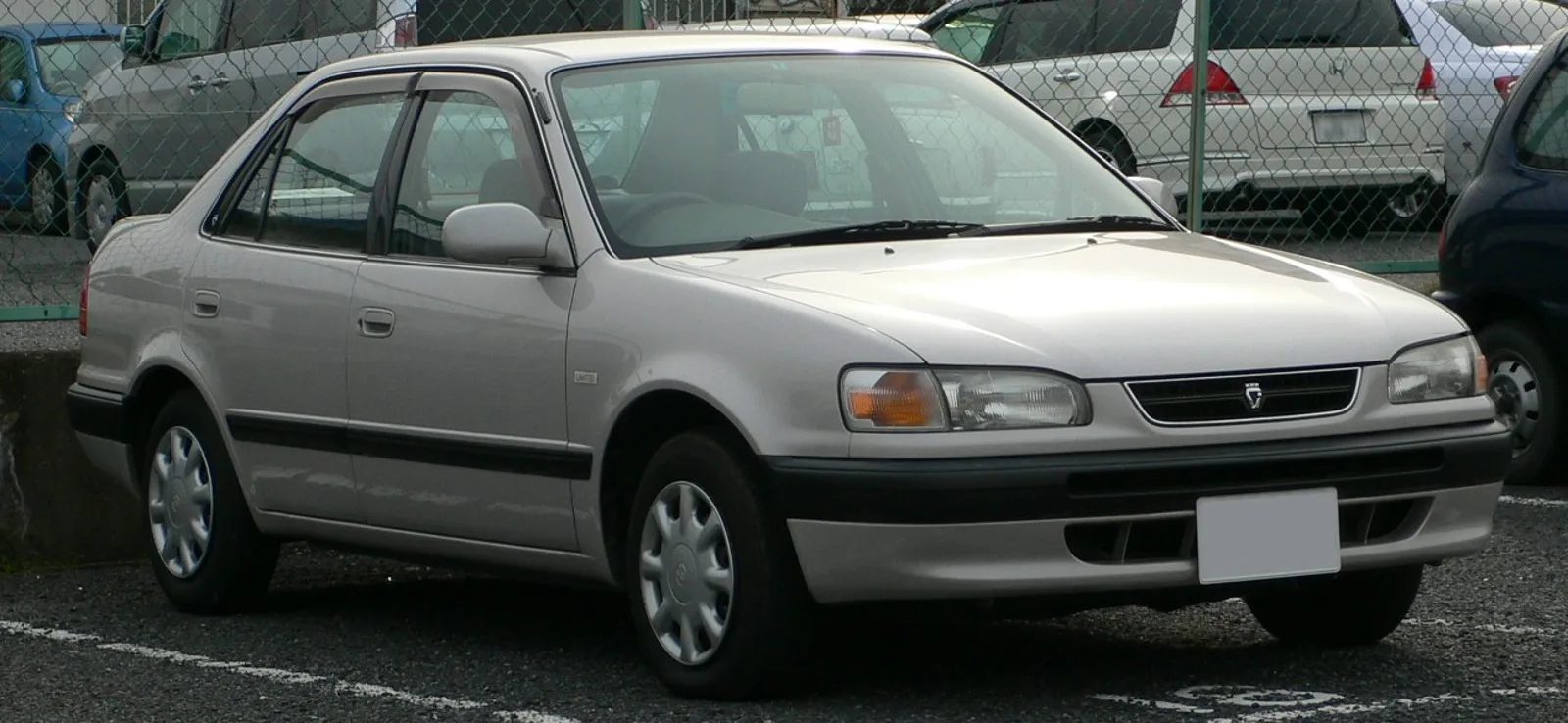
The seventh and final generation was introduced in May 1995 and was the last to use the Sprinter Trueno name. It was also the last to be offered as a sport compact coupe. Cost-cutting during Japan's recession shared many parts and the platform with its predecessor, and the car's weight fell thanks to a revised structure and TSOP thermoplastic resin for the bumpers and interior.
The initial models, known as Zenki, ran from 1995 to 1997, and the facelifted Kouki cars from 1997 to 2000. The FZ and FZ Limited used a detuned 1.5 L 5A-FE producing 100 PS (74 kW; 99 hp), while the XZ used a 1.6 L 4A-FE, and the BZ-V, BZ-G and BZ-R used the 20-valve 4A-GE in its Black Top form at 165 PS (121 kW; 163 hp).
In 1997 the BZ-R gained a 6-speed manual, a limited-slip differential, bigger front rotors and Super Strut Suspension. Recaro SR3 confetti-pattern seats were available as an option. Driver airbag and ABS became standard across the range in May 1996, and the car used Toyota's Global Outstanding Assessment body technology from the 1997 update.
The Sprinter Trueno and Corolla Levin were discontinued in August 2000 as the E120 Corolla arrived. The T230 Celica, launched in 1999, had taken over the sporty front-wheel drive coupe role, and the Sprinter sedans were replaced by a hatchback called the Allex.
What happened to the Trueno and Levin names?
The Levin name lived on in Australia and New Zealand, where Corolla hatchbacks carried the Levin label from 1999 to 2018, and in China, where GAC Toyota sold Levin saloons. In 2025 the Chinese Levin range was simplified to a single model called the Levin L.
The Trueno name returned most clearly in 2023 with the GR86 Trueno Edition, a North American special that commemorated the AE86 model. Its limited run of 860 units shows how strongly the original car still resonates with enthusiasts today.
What are the Trueno specifications?
| Generation | Engine and output |
|---|---|
| TE27 (1972 to 1974) | 1.6 L 2T-G, 115 PS (85 kW; 113 hp) gross, 190 km/h (118 mph) claimed |
| J model (from 1973) | 2T-B/BR, 100-105 PS (74-77 kW; 99-104 hp) gross |
| TE71 (1979 to 1983) | 2T-GEU fuel injected, 115 PS (85 kW; 113 hp) |
| AE85/AE86 (1983 to 1987) | 1.6 L 4A-GE 16-valve DOHC, 15 PS more than the 2T-GEU |
| AE91/AE92 Zenki (1987 to 1989) | 4A-GE 120 PS; 4A-GZE supercharged 145 PS |
| AE91/AE92 Kouki (1989 onward) | 4A-GE smallport 140 PS; 4A-GZE supercharged 165 PS (121 kW; 163 hp) |
| AE100 (1991 to 1995) | 5-valve 4A-GE 160 PS (118 kW; 158 hp); GT-Z 170 PS (125 kW; 168 hp) |
| AE110/AE111 (1995 to 2000) | 4A-GE Black Top 165 PS (121 kW; 163 hp); FZ 100 PS (74 kW; 99 hp) |
| Trueno Edition (2023) | GR86 based, 860 units, North America |