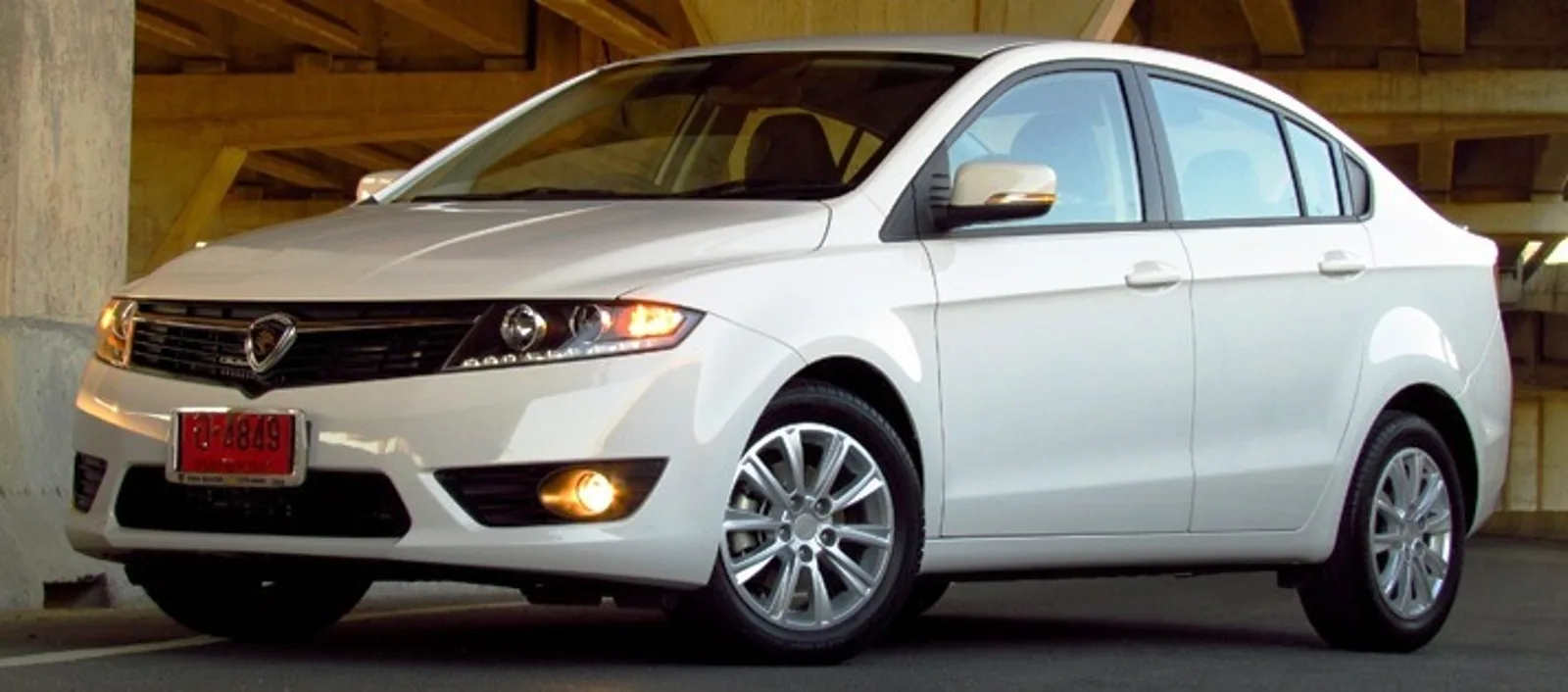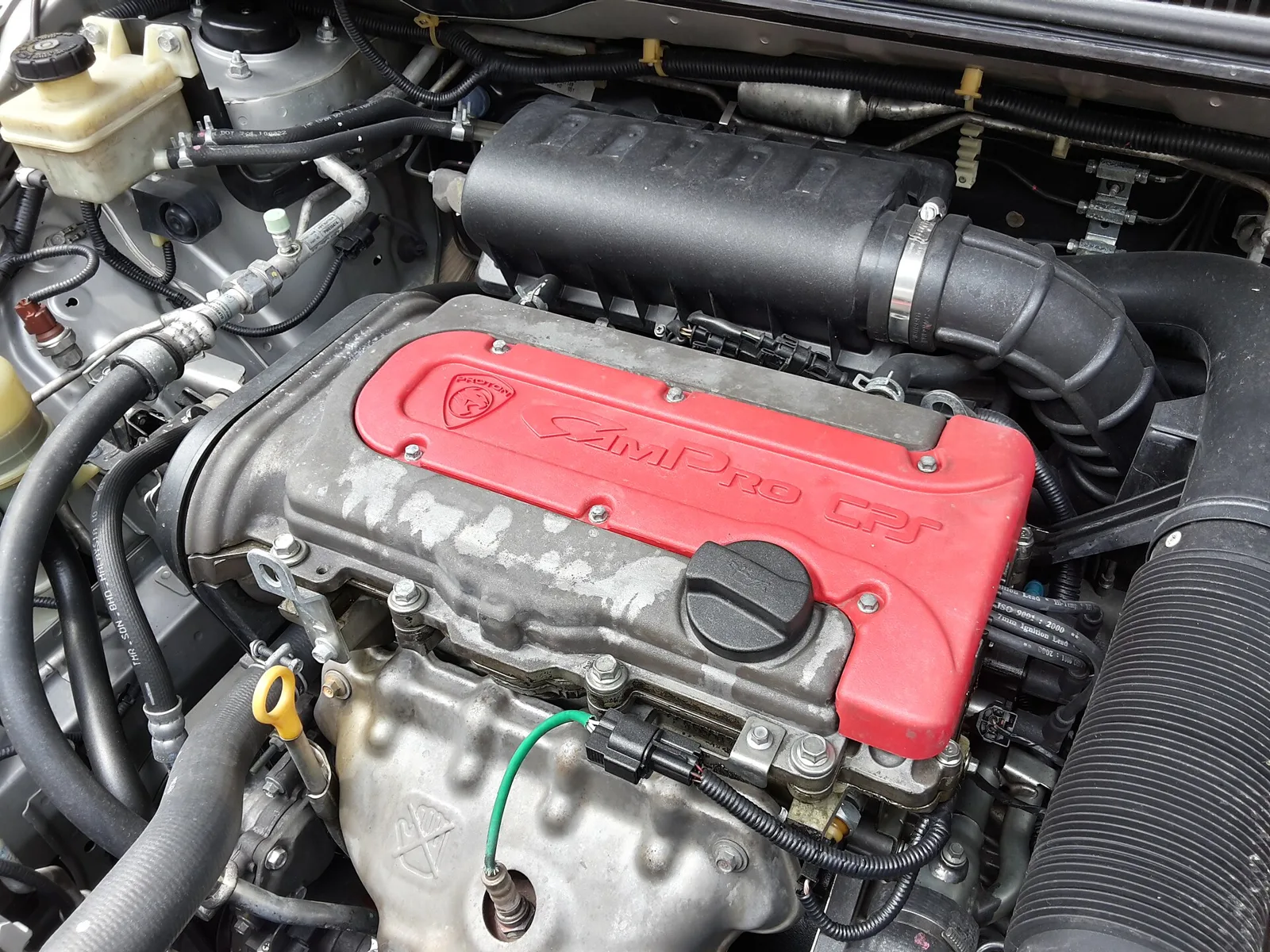
Proton's first home-developed engine family began as a 1.6-litre unit with 110 bhp and grew through variable valve lift, a turbo and a hybrid concept.
The Proton CamPro is a family of petrol engines developed in-house by Malaysian manufacturer Proton. It debuted in the 2004 Gen-2 as a 1.6-litre with 110 bhp, and later versions added variable valve lift, a variable-length intake, a turbocharger and a hybrid concept.
The Proton CamPro was the first engine that Malaysian manufacturer Proton developed entirely in-house. Launched in the 2004 Gen-2, it was a 1.6-litre engine that later grew through variable valve lift, a variable-length intake manifold and a turbocharged version. The CamPro name stuck to the family until the company moved to a new VVT design in 2014.
What is the Proton CamPro engine?
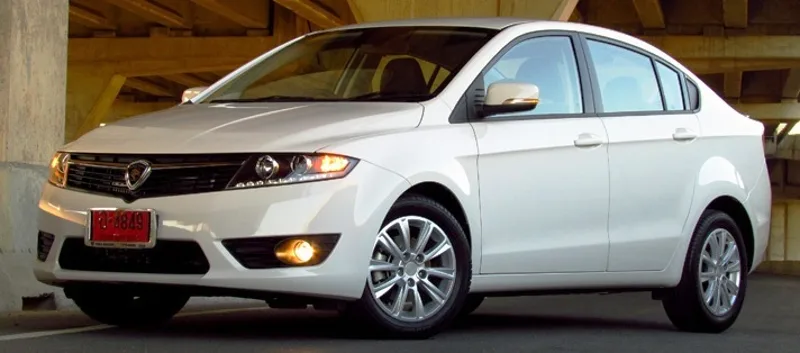
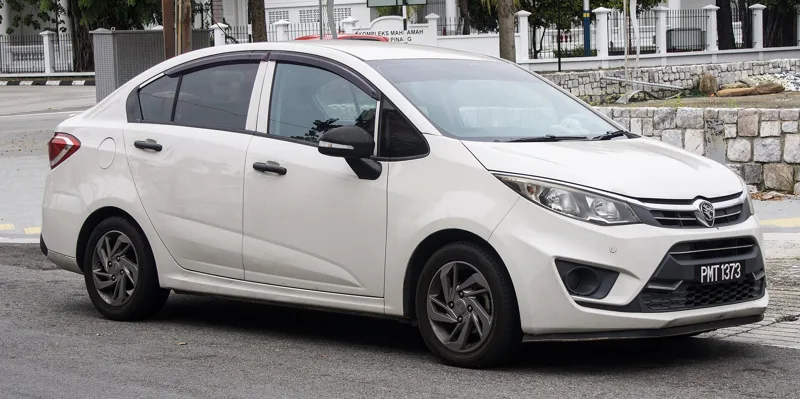
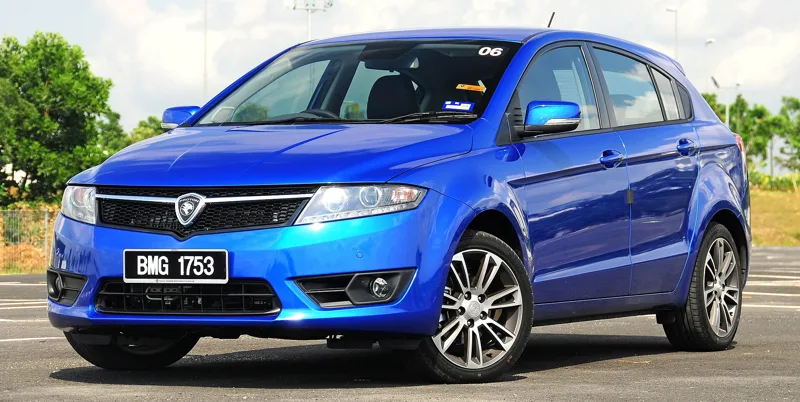
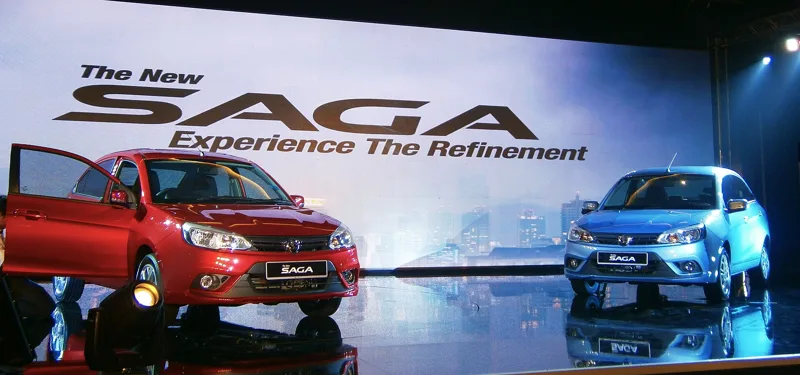
The CamPro is an internal combustion engine made by Proton Holdings, and it was the first engine model the company designed itself. The name is short for cam profiling. It powered a long run of Proton models, including the Gen-2, Satria Neo, Waja, Persona, Saga, Exora, Preve, Suprima S and Iriz, and the engine was built to show that Proton could meet newer emission standards with competitive power.
Every CamPro engine uses drive-by-wire electronic throttle control. That removes the mechanical linkages and cables that would otherwise create friction, and it gives sharper throttle response. The family covers both 1.3-litre and 1.6-litre engines across its various sub-variants.
A 1.6-litre engine that was Proton's first home-grown design and became a testbed for variable valves, turbocharging and hybrid ideas.
Where did the CamPro engine come from?
The prototype was unveiled on 6 October 2000 at the Lotus factory in the United Kingdom, and it was a clear signal of Proton's intent to build its own engine. The first production CamPro then arrived in 2004 in the Gen-2, and it was codenamed S4PH. The project had a clear purpose: to show that Proton could produce engines with good output and comply with tightening emission rules.
Because the CamPro was developed in-house, it became the platform on which later Proton variants were built, from the CPS and IAFM versions through to the CFE turbo.
How did the original S4PH and S4PE perform?
The S4PH was a DOHC 16-valve engine with a capacity of 1,598 cc. Its peak figures were 82 kW (110 bhp) at 6,000 rpm, with torque reaching 148 N-m (109 ft-lbf) at 4,000 rpm. Its bore and stroke were 76 mm by 88 mm.
Despite a Cam Profile Switching name, the S4PH was not fitted with that system, and it also lacked the variable inlet manifold that later engines used. Performance in everyday driving was reportedly sluggish, because the torque fell away between 2,500 and 3,500 rpm before recovering at 4,000 rpm. That dip showed clearly on the published performance curves, and it was a problem the company had to solve.
Proton also produced a 1.3-litre version called the S4PE. It had a bore of 76 mm and a stroke of 73.4 mm, giving 1,332 cc, and its ratings were 70 kW (94 bhp; 95 PS) at 6,000 rpm, with torque of 120 N-m (89 lb-ft) at 4,000 rpm. Like the larger engine, it showed the same mid-range dip in torque.
What was Cam Profile Switching?
The CamPro CPS engine used a variable valve lift system known as Cam Profile Switching, which worked alongside a variable-length intake manifold. The CPS system relied on a tri-lobe camshaft that could switch between two cam profiles. The low-lift profile was used at low and mid speeds to keep the engine smooth at idle and to limit emissions, while the high-lift profile took over at higher speeds for more peak power and torque.
Unlike VTEC, VVT-i or MIVEC, which change valve timing with rocker arm locking pins, the CPS system used direct-acting tappets with locking pins to change both timing and lift. The variable inlet manifold worked in parallel. It used a long runner at low speed, which encouraged mixing of air and fuel, and a short runner at high speed, which let more air into the cylinders.
How much did the CPS engine improve on the original?
The CPS version switched manifold runners at 4,800 rpm, while the cam profile changed at 3,800 rpm, or 4,400 rpm in the Satria Neo CPS. The result was 93 kW (125 bhp; 127 PS) at 6,500 rpm, with 110 lb-ft (150 N-m) reached at 4,500 rpm, compared with the non-CPS engine's 110 bhp (82 kW; 112 PS) at 6,000 rpm. Proton said the new engine gave better response and torque between 2,000 and 2,500 rpm.
The CPS engine first appeared in the facelifted Gen-2 launched in Thailand in 2008. Its Malaysian debut came in the Waja CamPro 1.6 Premium (CPS), and it went on to power the Waja, Satria Neo, Exora and later Gen-2 variants until 2016.
What was the IAFM and why did it fail?
The CamPro IAFM was an Intake Air-Fuel Module, which was a variable-length intake manifold that could be fitted to an original CamPro engine. It was developed under a fast-track programme that began in April 2005, run jointly by EPMB, Bosch and Proton. Unlike the VIM on the CPS engine, the IAFM was a stand-alone module operated by engine vacuum rather than by an ECU-controlled solenoid.
The IAFM debuted in the second-generation Proton Saga, which was launched on 18 January 2008. It had first been shown publicly in October 2006, while still in advanced tooling. With the IAFM the 1.3-litre engine delivered 98 bhp (73 kW) at 6,500 rpm, and the maximum torque of 113.2 N-m (83.5 lb-ft) was slightly lower. The torque dip that had marked the original design was removed, although Proton kept quoting the familiar 94 bhp brochure figure.
The IAFM's weakness was durability. When the solenoid broke, the flap could no longer direct air properly through the manifold. The result was a distinctive tak-tak-tak noise, similar to tappets, along with a major vacuum leak. The 1.6-litre IAFM used in the 2008 Gen-2 M-Line produced 110 bhp (82 kW) at 6,500 rpm, and its torque dip around 2,500 to 3,500 rpm was also eliminated, but the parts did not last as well as the design promised.
What did the IAFM+ change?
The second-generation IAFM, known as the IAFM+, debuted in the 2011 Proton Saga FLX. It was tuned to pair with a new CVT gearbox from Punch Powertrain, which required the maximum operating speed to fall from 6,500 rpm to 6,000 rpm. The 1.3-litre IAFM+ gave 94 bhp (70 kW) at 5,750 rpm plus 120 N-m (89 lb-ft) of torque, while the 1.6-litre version reached 81 kW (108 bhp) at 5,750 rpm, with 150 N-m (110 lb-ft) on top.
The combination of the IAFM+ and the CVT was credited with a 4% reduction in fuel use in urban driving and a 10% reduction on the highway. The IAFM+ was fitted to the Saga, Gen-2 M-Line, Persona and Preve over several years, and it became the main way the CamPro reached the mainstream Proton range.
What was the EVE hybrid concept?
In March 2007 Proton and Lotus announced a concept Gen-2 powered by a hybrid version of the CamPro. It was revealed at the 2007 Geneva Motor Show, which ran from 8 to 18 March. The hybrid system was called EVE, short for Efficient, Viable, Environmental, and it used the same S4PH petrol engine as the production car together with a 30 kW, 144V electric motor.
The EVE layout was designed to be retrofitted to existing models rather than to need a new platform, which the company contrasted with the Honda Civic Hybrid. It used a lithium-ion battery pack in the engine bay, where the Honda's bulkier nickel-metal hydride pack sat in the car's IMA system. Three technologies made up the system: a micro-hybrid start-stop with an integrated starter-alternator, a full parallel hybrid and a continuously variable transmission.
Together they gave 141 bhp (105 kW; 143 PS) at 5,500 rpm, and torque peaked at 233 N-m (172 lb-ft) at 1,500rpm, which was limited to 180 N-m (133 lb-ft) for continuous use. The planners claimed up to 22% lower CO2 emissions and fuel economy of up to 4.6 L/100 km. Proton said it would commercialise hybrid vehicles using EVE in the future.
What was the CFE turbo engine?
The CFE, which stood for Charged Fuel Efficiency, was a light-pressure intercooled turbocharged version of the 1.6-litre CamPro. Its maximum boost pressure was 0.75 bar (75 kPa; 10.9 psi). Proton's managing director, Datuk Syed Zainal Abidin, first revealed the idea on 13 December 2008, in response to a market trend towards smaller, boosted engines that matched the output of larger units.
The CFE was finalised in time for the KLIMS 2010 show. It gave 138 bhp (103 kW; 140 PS) at 5,000 rpm, with 205 N-m (151 lb-ft) of torque across 2,000 to 4,000 rpm. The bore stayed at 76 mm, but the stroke was shortened to 86 mm from 88 mm, giving a displacement of 1,561 cc. A variable valve timing mechanism was added to the intake valves, changing cam phasing continuously rather than switching lift at a set speed.
The CFE also carries a reliability lesson. In 2016 a public recall covered more than 90,000 CFE vehicles over an oil cooler hose. Service intervals for replacing the hose were cut to every 40,000 km, and they were later extended to every 80,000 km after a higher-quality part, combining rubber and metal, was introduced in 2018.
What was the VVT engine?
The VVT, or Variable Valve Timing, engine was unveiled in September 2014 with its first use in the Proton Iriz. It used a new block, new pistons and new valves, and although some technology was shared with the CamPro, the company decided not to use the CamPro name for it. Older models such as the Exora, Preve and Suprima S kept the name until they were retired in favour of the planned GDi engines.
The VVT family includes a 1.3-litre engine with a 76 mm bore and 73.4 mm stroke, delivering 94 bhp (70 kW; 95 PS) at 5,750 rpm, and 120 N-m (89 lb-ft) of torque is reached at 4,000 rpm. The 1.6-litre version has an 88 mm stroke and produces 107 bhp (80 kW; 108 PS) at 5,750 rpm, where 150 N-m (111 lb-ft) of torque arrives at 4,000 rpm. Its applications included the Iriz from 2014, the Persona 1.6 from 2016 and the Saga 1.3 from 2016.
In 2016 Proton introduced its ECO Drive Assist system on the Persona, and the Iriz and Saga followed in 2017. The system watches the driver's throttle input and lights a green indicator on the instrument cluster when the car is being driven economically, which encourages economical driving.
What comes after the CamPro?
Proton planned a new engine family called GDi, with a TGDi turbocharged variant. The range was to include 1.0/1.2L three-cylinder options, along with 1.3 and 1.5-litre naturally aspirated and turbocharged engines, and later 2.0 and 2.3-litre units. The company said the 1.3 and 1.5 turbo engines would produce 140 hp with 210 Nm, and 180 hp with 250 Nm, respectively.
The CamPro, limited to 1.3 and 1.6-litre engines, was expected to reach the end of its life soon after. The sequence of variants shows the move from simple naturally aspirated designs towards turbo, hybrid and efficiency-focused powertrains.
Specifications at a glance
| Variant | Displacement | Output | Torque | Typical car |
|---|---|---|---|---|
| S4PH | 1,598 cc | 110 bhp (82 kW) at 6,000 rpm | 148 N-m (109 ft-lbf) at 4,000 rpm | Gen-2 2004 |
| S4PE | 1,332 cc | 94 bhp (70 kW; 95 PS) at 6,000 rpm | 120 N-m (89 lb-ft) at 4,000 rpm | Early 1.3 models |
| CPS | 1,598 cc | 125 bhp (93 kW; 127 PS) at 6,500 rpm | 150 N-m (110 lb-ft) at 4,500 rpm | Waja CamPro 1.6 Premium |
| IAFM | 1,332 cc | 98 bhp (73 kW) at 6,500 rpm | 113.2 N-m (83.5 lb-ft) | Saga 2008 |
| IAFM+ 1.6 | 1,598 cc | 108 bhp (81 kW) at 5,750 rpm | 150 N-m (110 lb-ft) | Saga FLX 2011 |
| CFE | 1,561 cc | 138 bhp (103 kW; 140 PS) at 5,000 rpm | 205 N-m (151 lb-ft) at 2,000 to 4,000 rpm | Exora 2011 |
| VVT 1.6 | 1,598 cc | 107 bhp (80 kW; 108 PS) at 5,750 rpm | 150 N-m (111 lb-ft) at 4,000 rpm | Persona 2016 |