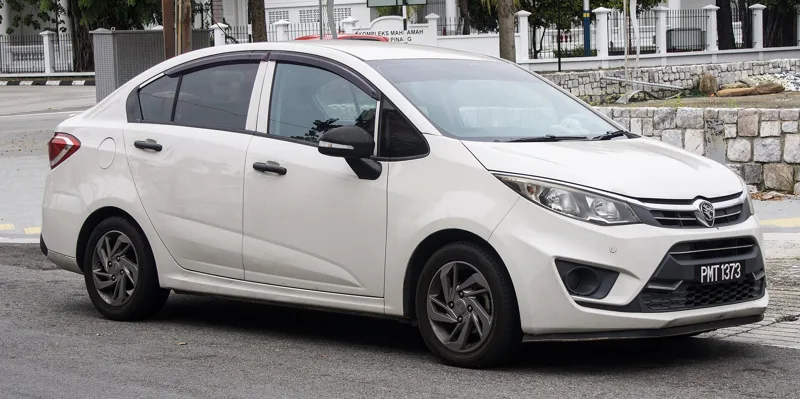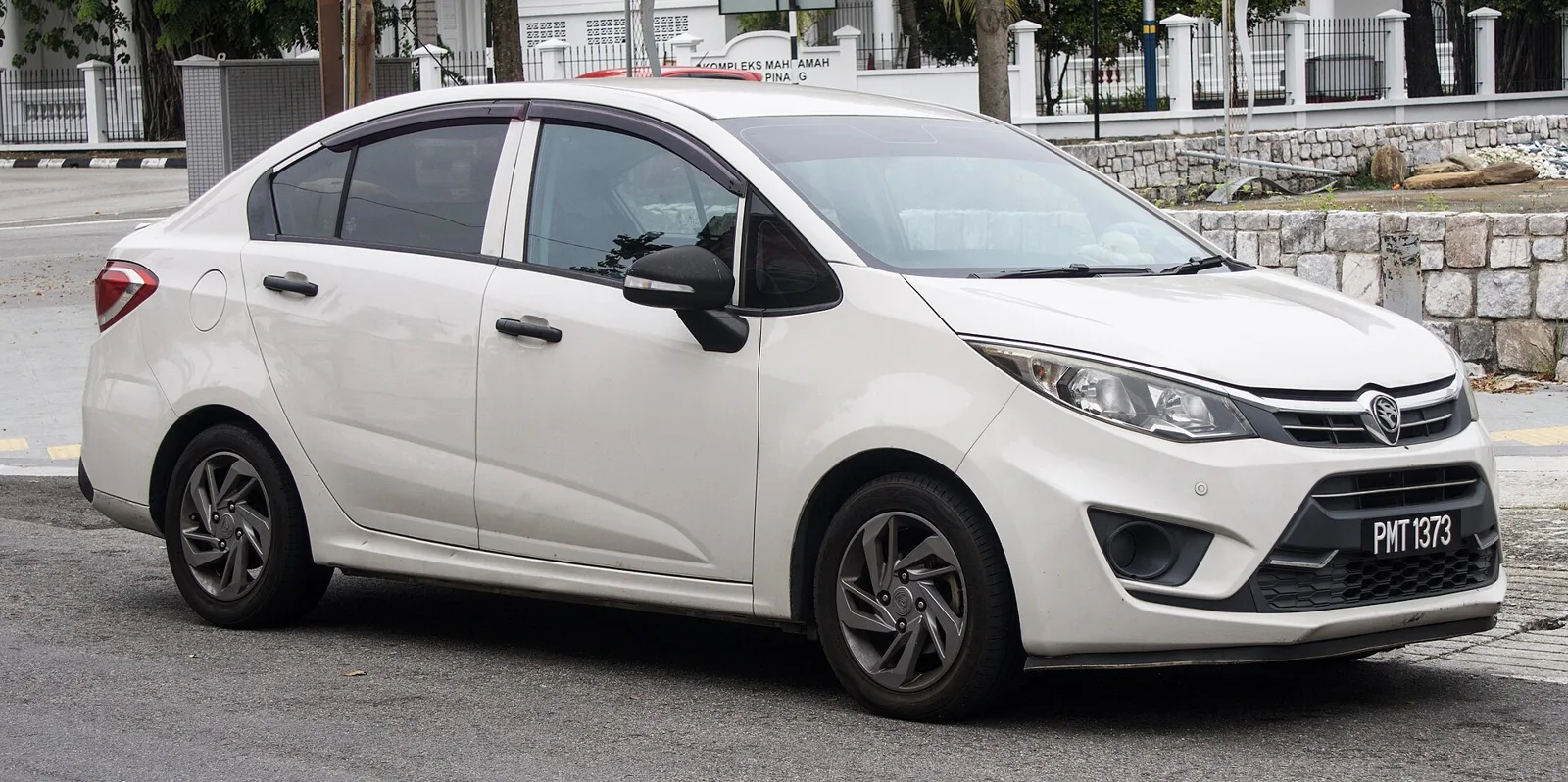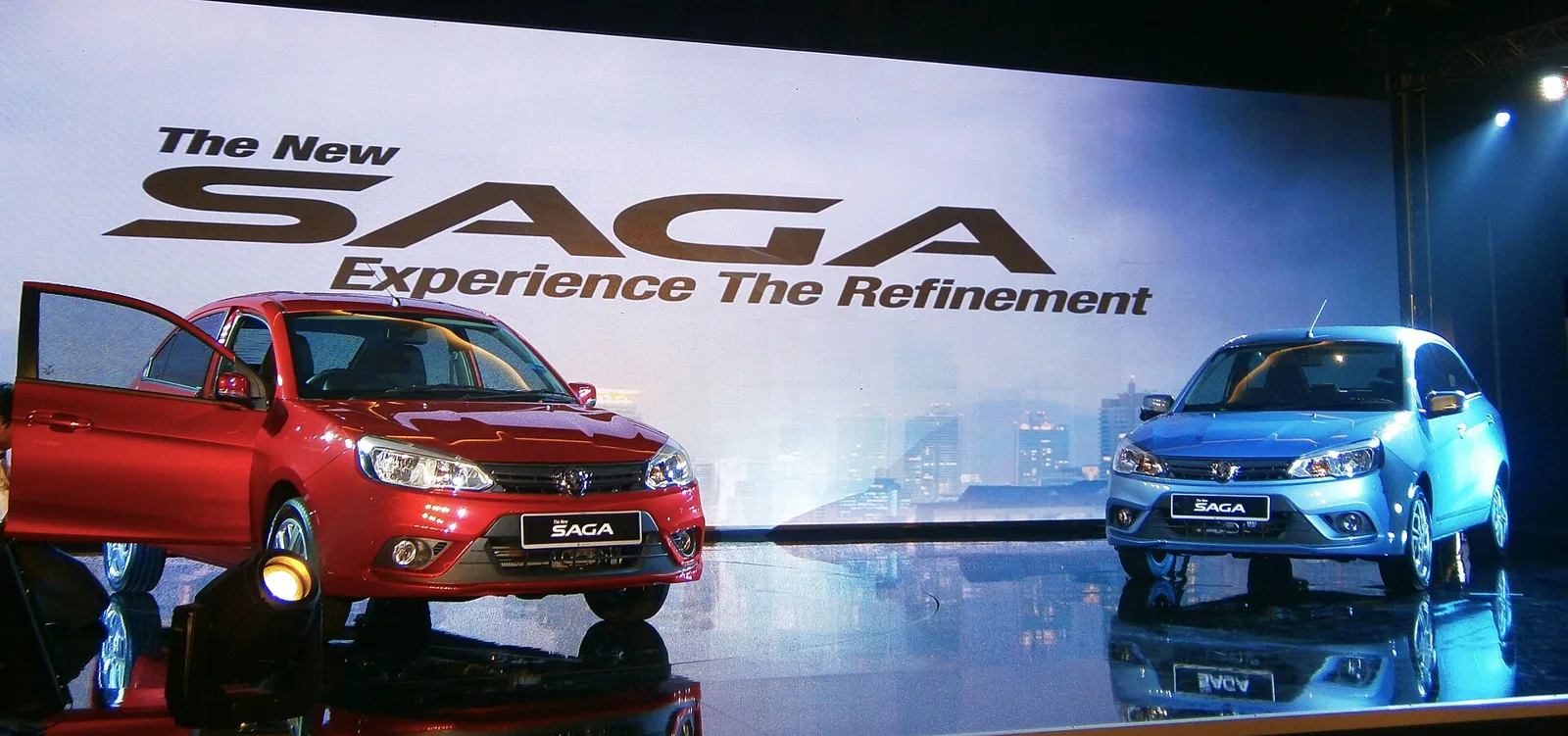
The P2-13A Saga of 2016: a re-engineered body on an older platform, a 1.3-litre VVT engine, a long run of facelifts and a 4-star ASEAN NCAP result.
Proton's P2-13A entry sedan arrived in September 2016 with a 1.3-litre VVT engine rated at 94 hp. It earned a 4-star ASEAN NCAP result, and the range was facelifted in 2019, 2022 and 2025.
P2-13A is the codename for Proton's third generation Saga, an A-segment saloon from Malaysia. It went on sale in September 2016 as the successor to the second generation car, and it kept the Saga name while its body was largely new.
When was the third generation Saga launched?
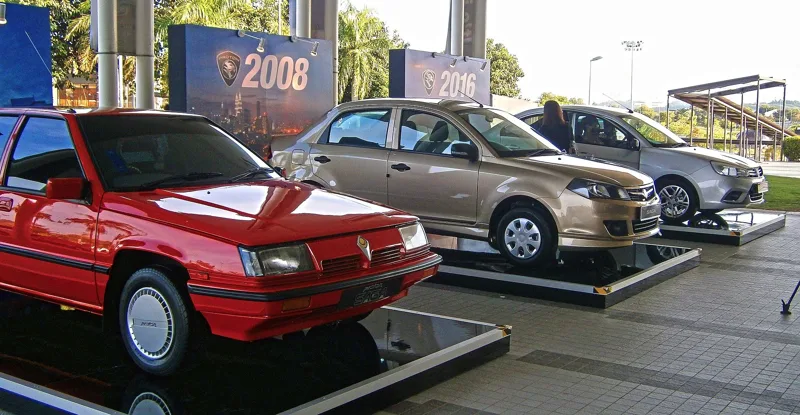
Proton unveiled the new car on 28 September 2016 at Setia City Convention Centre, Shah Alam. It came roughly a month after the larger Persona and took the place of a second generation car built from early 2008 to late 2016.
The launch event was carried by a live broadcast from paultan.org. Proton has used the Saga badge on several generations, and this was the latest model to reuse an existing nameplate for a new car.
A 2016 entry sedan that kept an older platform but gained a new body, a VVT engine and a 4-star ASEAN NCAP result.
What platform does the Saga use?
The new Saga is built on the Saga FLX platform, which was the car's predecessor, but its exterior and interior were completely re-engineered. The engine and transmission were carried over in refined form, so the change lies mostly in the body and cabin.
The platform itself traces back to an extended Proton Savvy platform from 2005. That base underpinned the second generation Saga, the BLM, FL and FLX models, all sold between 2008 and 2016. For the 2016 revision Proton lengthened both overhangs and re-engineered the structure to justify calling the result a generational leap.
Proton kept development spending down by recycling as much as 60% of parts from the outgoing car and by borrowing some equipment from other Proton models. Development cost RM150 million, and the company expected to break even within three years against a sales target of 5,000 units a month.
How big is the third generation Saga?
Overall length is 4,331 mm, width 1,689 mm and height 1,491 mm. The wheelbase stays at 2,465 mm, as it has been since the Saga BLM, while the overhangs grew by 44mm and 30mm. The rated boot volume is 420 litres, which is 7 litres larger than the outgoing model.
Despite being larger than the second generation cars, the third generation is marketed as an A-segment or A+-segment sedan. The earlier Saga sat in the B-segment throughout its life. Proton's revised marketing strategy aims to stop the Saga overlapping with the Persona, which has taken over the B-segment bracket.
The Saga keeps its status as Proton's most affordable sedan, a position it has held for many years. Its entry-level role is central to how the car is positioned against the rest of the range.
What changed in the design?
The body in white is all-new after extensive re-engineering, and only the wing mirror housings carry over from the old panels. The drag coefficient fell to 0.33 Cd, and the body has a sleeker profile than the cars it replaced.
The headlamps remain halogen reflector units, but the rear lamps reverted to bulb-based lighting rather than LEDs, a cost-cutting choice. Every variant gets a rear fog light and Proton lettering on both front and rear lamps, plus Proton's sculptured three-dimensional badge.
The Perdana, Persona and Saga were all designed at the same time, which gives the three sedans a shared family resemblance.
Which wheels and trim details came with each grade?
Standard cars wore 13-inch steel wheels with hubcaps inherited from the second generation. The Executive and Premium models received new alloys, with 14-inch snowflake Y-spoke rims on the Executive and 15-inch turbine split-spoke rims on the Premium.
Trim details also varied by grade. Door handles were matte black on the Standard and body coloured on the Executive and Premium, and the rear garnish was matte black, body coloured or chrome plated depending on the trim. A boot lid lip spoiler and front fog lights were reserved for the Executive and Premium.
The 2016 range offered six paints, among them Fire Red, Topaz Blue and Midnight Black, with Cotton White, Sterling Silver and Metal Grey completing the list.
What changed in the 2019 facelift?
The first facelift launched on 6 August 2019 at the Malaysia International Trade and Exhibition Centre in Kuala Lumpur. Proton regarded it as a minor internal change but presented it to the public as a proper facelift, with a revised front fascia using the new Infinite Weave design language.
Standard MT variants received 14-inch steel rims, the Standard AT moved to single-tone 14-inch alloys, and the Premium AT gained 15-inch dual-tone alloys. Front and rear fog lamps were discontinued, and power-adjustable wing mirrors became standard across the range.
The facelift also dropped the Executive variant, leaving the range as Standard MT, Standard AT and Premium AT.
What changed in the 2022 facelift?
The second facelift, the MC2, was launched on 12 May 2022 inside the Proton Centre of Excellence in Shah Alam. It introduced the Premium S AT, and a Standard Lite AT followed on 26 August 2022 to join the existing Standard MT, Standard AT and Premium AT.
The Premium S differed from the Premium with side skirtings, side-cornered front bumper skirtings, a red-painted Ethereal Bow strip, a smart key button and an exterior boot-opening button. The 2022 car kept the same powertrain, with minor upgrades and modifications to its features.
From June 2023 the Hyundai-sourced automatic gave way to an Aisin four-speed unit for the MC2 range.
How much power does the Saga's engine make?
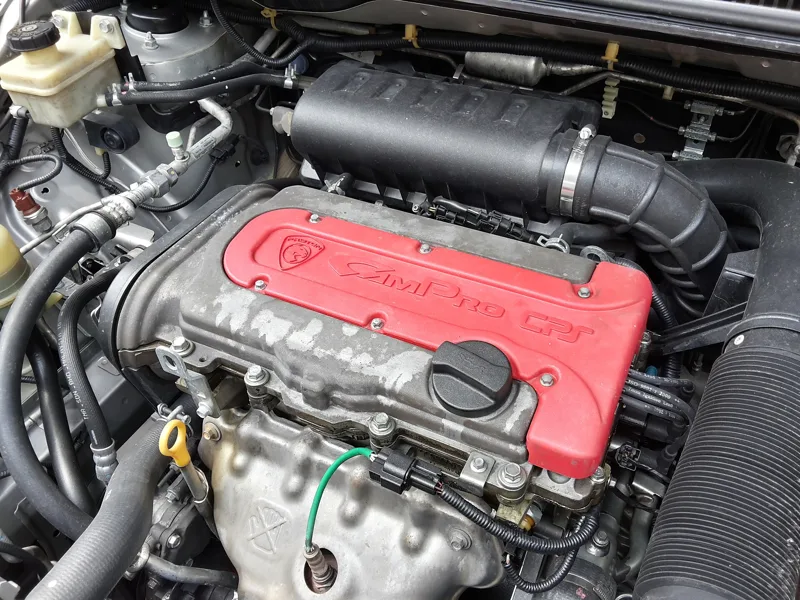
Under the bonnet sits Proton's 1.3-litre VVT S4PE, a naturally aspirated petrol four with 16 valves and DOHC. Output is 94 hp at 5,750 rpm and torque 120 Nm at 4,000 rpm, and the unit draws its design from the Proton Iriz.
The new unit replaces the CamPro IAFM+ that powered the Saga FLX family. It produces the same power as that older engine, but it has a new block, new pistons and new valves, and the service interval rises to 10,000 km.
It is the first car in the Saga line to offer variable valve timing in the cylinder head. The engine moved from a four-mount to a three-mount arrangement, which reduced vibration into the cabin, and the ECU was calibrated for a more linear throttle response.
Which transmissions were offered at launch?
At launch the Saga came with a Getrag 5-speed manual or a Punch Powertrain VT2+ CVT. Acceleration to 100 km/h from a standstill took 12.2 seconds for the manual and 13.1 seconds for the CVT.
Those times were 0.8 and 1.4 seconds quicker than the old Saga FLX respectively. Proton said the revised CVT was smoother and more responsive than the units in the Iriz and the FLX.
The 2019 MC1 replaced the CVT with a Hyundai-sourced 4-speed automatic, removed the CVT's low mode and added an S or sport mode to the automatic. In June 2023 the Aisin unit took over from the Hyundai one.
How economical is the Saga?
Proton claims fuel use of 5.4L/100 km with the manual and 5.6L/100 km with the CVT, both at a steady 90 km/h. Those figures represent improvements of 10% and 11% over the outgoing model.
The car uses ECO Drive Assist, which reads the driver's throttle input and lights a green indicator on the instrument cluster when the car is being driven economically. It is shown on the head-up display in the cabin.
Why is there no 1.6-litre Saga?
The new Saga was not offered with a larger 1.6-litre engine, and it is sold only with the 1.3-litre unit. Proton's revised marketing strategy is behind that decision, because it aims to stop products overlapping and cannibalising sales.
Future Saga models were planned to receive economy 1.0-litre and 1.2-litre engines instead. The 2019 MC1 kept the 1.3-litre, and the 2022 car kept its capacity too, so the range stayed on that engine for the MC2.
How safe is the third generation Saga?
The third generation Saga earned a 4-star ASEAN NCAP rating for all variants, a clear step up from the 3-star rating of the outgoing Saga SV, which was tested in January 2013. It is also the first car in its lineage to offer electronic stability control in its home market.
The body structure was strengthened, and torsional rigidity rose to 12,000 Nm/deg from 10,000 Nm/deg. Ultra high strength steel reinforces critical sections, and the front and rear crumple zones grew with the longer overhangs.
What did ASEAN NCAP score the new Saga?
The new car scored 13.33 points out of 16 for adult occupant protection (AOP) and 71% compliance in child occupant protection (COP). The old Saga SV scored 10.23 AOP points and 48% COP compliance.
The new Saga fell short of the full 5 stars by just 0.67 AOP points. ASEAN NCAP nonetheless credited Proton for re-engineering an ageing platform to meet tougher standards.
What active safety systems did the Saga get?
The Saga uses Proton's Vehicle Dynamic Control (VDC) program, which combines ABS with EBD and brake assist, hill-hold assist, traction control and electronic stability control. Up to ten computer systems monitor all four wheels alongside the driver's steering, throttle and braking inputs.
VDC is not fitted across the range. The Standard has no VDC components, the Executive adds ABS, EBD and BA, and the Premium is the only variant to receive ESC, TCS and HHA at launch.
The 2022 MC2 update made the VDC package, including ESC, TCS and HHA, standard on all automatic variants. A Standard Lite AT without the VDC package slotted between the Standard MT and the Standard AT.
How did the chassis and steering change?
The suspension keeps MacPherson struts at the front and a torsion beam axle at the rear, but Proton fitted new springs, new dampers and a new strut bar in the engine bay. The steering ratio dropped to 16:1 from 20:1, and the turning radius tightened to 5.1 m from 5.3 m.
Steering effort fell to 2.75 kgf from 3.0 kgf, and the car kept hydraulic power steering because it offers more feedback at the cost of lighter effort. The brakes are ventilated discs at the front and drums at the rear.
Tyres vary by trim, with 175/70R13 on the Standard, 185/60R14 on the Executive and 185/55R15 on the Premium. Kerb weight ranges from 1,035 kg to 1,075 kg depending on the variant.
How does the interior compare with the old Saga?
The cabin keeps the mounting points of the old platform, but the door cards, dashboard panels, centre console, air-con vents, glove box, seats and instrument binnacle were all redesigned. Several parts were borrowed from other Proton models to cut costs, including the steering wheel and the CVT gear lever.
The notable carryovers are the air-con controls, the handbrake lever and the manual gear knob. Every variant gets twin USB charging ports behind the handbrake, with a storage space for the charging device.
Head units depend on trim. The Standard and Executive use a single-DIN unit, while the Premium has a double-DIN unit with steering wheel audio switches and a reverse camera feed shown on a screen built into the rear view mirror.
What is the rear seat and storage space like?
Rear legroom improved slightly thanks to a scalloped front seat back. The rear bench is less reclined than before and folds fully in all variants, although it does not split. The cabin has ten storage compartments, two cup holders and four bottle holders.
Door operation was also reworked, so the doors need less effort and give a more solid feel than older Proton models.
Where is the Saga sold?
Proton planned exports to right-hand drive ASEAN markets and to Chile, with production for those markets starting in early 2017. Shipments to South Africa began on 31 May 2022, and Proton started sending the first batch of components to Egypt in September 2024 for local assembly.
In Kenya, the Saga is assembled from imported CKD packs at the Associated Vehicle Assemblers plant in Mombasa, a move meant to keep prices competitive and build local skills. The Kenyan launch took place on 10 December 2020, and the Nepal launch followed on 14 January 2021.
Who buys the Saga?
Proton's market insight says 64% of Saga buyers are first-time car buyers. Another 18% are buying an additional car, and 17% are replacing one. A late 2024 survey found roughly 59% of buyers were male and 41% female.
What is the 2025 MC3 I-GT?
Proton unveiled a third facelift, the Saga MC3 I-GT, on 27 November 2025, in Standard, Executive and Premium trims. All versions use the new BHE15PFI 1.5-litre petrol engine, with a 4-speed Aisin automatic on the Standard and Executive and a Punch Powertrain CVT on the Premium.
In December 2025 it was reported that the Saga would be sold across the Philippines as a Geely-based vehicle, which points to a further export market.
What awards did the Saga win?
The Saga won the ASEAN NCAP Rising Star Award in 2016 and the Value-For-Money Car title at the Malaysia Car of the Year awards the same year. It also won the Compact Sedan of the Year at the 2017 DSF.my Allianz Vehicle of the Year awards.
In 2018 it was named one of the Best 3 City Cars of Malaysia at the Aurizn Awards and took bronze as a Budget Car at the Carlist.my People's Choice Awards.