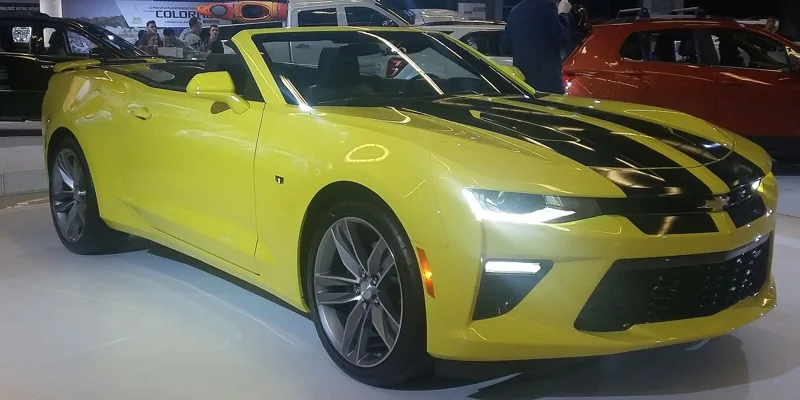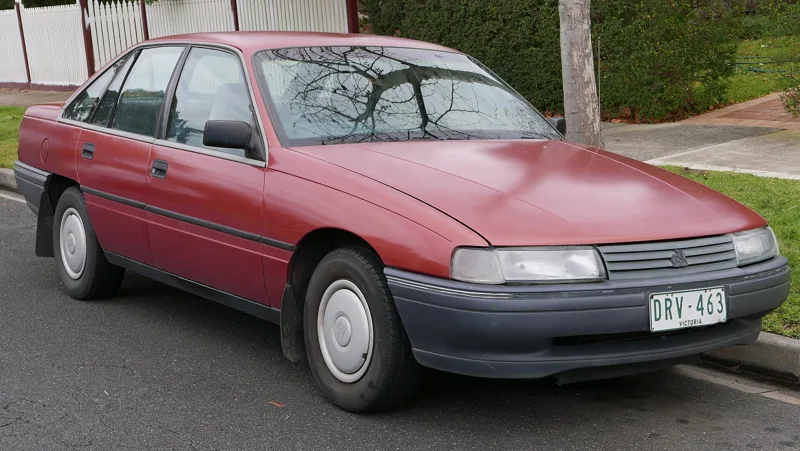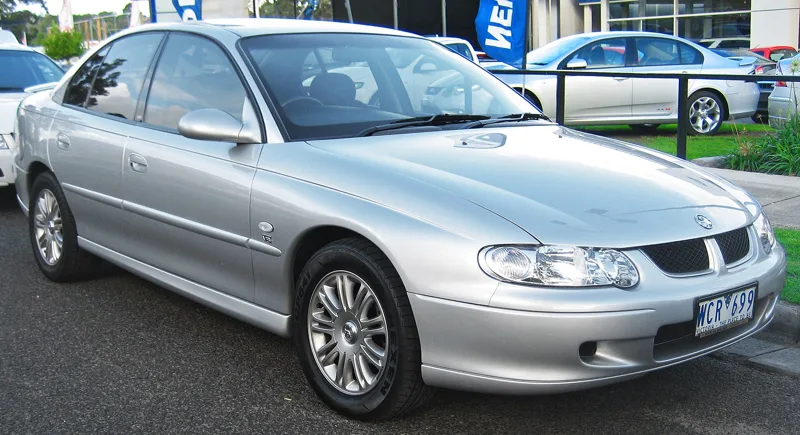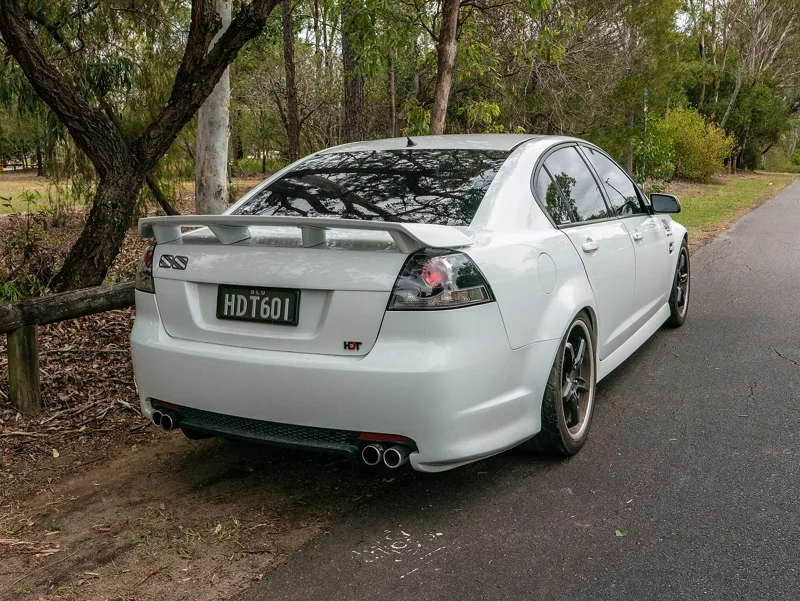
Holden's 253 and 308 V8s arrived in the 1969 HT, became the 5.0-litre Iron Lion of the Commodore years and ended with the VS Series III ute in 2000.
The Holden V8, known as the Iron Lion, was built from 1969 to 2000 in 253 and 308 cu in sizes. Its 5000i fuel-injected version arrived in 1988, and the last V8 Commodore utility was sold in 2000, ending a run that began in the HT.
Enthusiasts call it the Iron Lion. This overhead valve V8 was made by the Australian arm of General Motors, Holden (GMH), from 1969 to 2000. It first appeared in the HT range, grew through the Torana and Commodore families, and ended in Holden's last V8 Commodore utility. Its performance versions also powered the HDT and HSV specials that became part of Australian motorsport history.
When did Holden first build a V8?
Ford and Chrysler released V8 versions of their US Falcon and Valiant models in 1964. In response, Holden's engineering division reviewed its forward engine program in January 1965 and concluded that a V8 option was a necessity by 1969. Forecasts suggested that 35 per cent of Holdens sold in 1970 would be V8s, rising to 50 per cent by 1975.
The first V8s went into the HT in 1969 as a manual and automatic pairing. The 253 was the manual-car engine, while the 308 was fitted only to automatics at first. In the HT, the Holden V8 sold alongside the 350 cubic-inch Chevrolet small block until 1974, when the HJ arrived and the imported engine was phased out.
A two-capacity V8 that began as a 253 economy engine and ended as a fuel-injected 5.0-litre utility engine.
Why did Holden settle on two capacities?
Holden originally planned six capacities, from 237 to 308 cu in, over a 12-year life cycle. Early in the design phase that list was cut to two, an economy 253 and an enlarged performance 308. The two engines became known as the 4.2 L and 5.0 L, and they were mechanically identical apart from a larger bore and bigger pistons in the 308.
The 308 carried heavier counterweights on the crankshaft to balance its extra reciprocating mass. Its cast-iron manifold replaced an original alloy design that had proved difficult to cast. The timing case cover stayed in alloy, and the exhaust manifolds were cast iron throughout.
How did the first Holden V8 perform against its targets?
Designers wanted a weight of 525 lb (238 kg) for the 308, which would be lighter than comparable American engines, and a net output of 161 hp (120 kW). The first pre-production 253 exceeded those goals. Its complete assembly from fan to flywheel weighed 460 lb, about 12% under target, and its net output was 185 hp (138 kW) with 262 lb ft of torque.
The engine was also compact at 22 inches wide, and it weighed only 80 lb more than the 186 cu in straight-six it was designed to replace. It produced over 40% more power than that six in standard form. The first running engine was delivered in October 1966, but it failed after four days of testing because of a seized oil pump. The fault was traced to swarf residue rather than a design flaw.
What were the HT, HQ and HJ power figures?
Holden's power figures changed with the HJ, when the company moved from advertised horsepower to SAE gross ratings. The HT and HQ advertised 185 hp for the 253 and 240 hp for the 308. Under SAE gross those figures were 175 hp and 227 hp, which made every engine look weaker on paper even though the cars had not changed.
| Engine | Introduced | Capacity | Notable detail | Output |
|---|---|---|---|---|
| 253 (HT) | 1969 | 253 cu in (4.2 L) | Manual cars, two-barrel carburettor | 185 hp advertised; 175 hp SAE gross |
| 308 (HT and HQ) | 1969 | 308 cu in (5.0 L) | Automatic only at first, four-barrel | 240 hp advertised; 227 hp SAE gross |
| 308 (HJ) | 1974 | 5.0 L | Compression raised from 9:1 to 9.7:1 | 250 hp SAE gross |
| HDT 5.6 L | 1986 | 344.4 cu in (5.6 L) | Bore 102.4 mm, stroke 85.7 mm | 310 hp (231 kW) |
What was the L34 and why does it matter?
The L34 was a high-performance 308 developed from a Repco-built Formula 5000 engine of 1973. That racing unit used a slightly smaller bore and a stronger four-bolt block, and Holden used some of its ideas for the production L34. It was homologated in a limited run of 263 SLR5000 cars in the LH Torana, which were fitted with the engine for the manufacturer's championship endurance rounds.
The car that carried the code was nicknamed the L34 after its engine. Race teams could modify its exhaust and carburettor under the rules of the day, but production tuning kept the standard headers restrictive. Only CAMS-licensed teams could buy one, and the A9X racing version had to use an L34 engine to compete.
Why did the 5000i matter?
In 1988 fuel injection appeared for the first time on a Holden V8, in the VL Commodore SS Group A built by Holden Special Vehicles with Tom Walkinshaw Racing. The same year the VN introduced the 5000i, which had new cylinder heads and multi-point fuel injection and was the most extensive redesign of the standard production V8 since 1969. It was used in every subsequent Commodore until 1999.
The 5000i fixed an important weakness. The early heads placed exhaust valves side by side in the centre, which created a hot spot that caused warping and cracking. The redesigned heads used a repeated intake-exhaust layout across every combustion chamber, which spread the heat more evenly and improved reliability.
How did the Iron Lion come to an end?
The fuel-injected 5.0 L remained in Commodores until the VS Series III ute in 2000. In June 1999 the VT Series II Commodore and the WH Statesman and Caprice switched to the 5.7-litre Gen III LS1 V8 imported from the United States. The older engine remained in the Commodore VS Series III utility for a while longer, because no similar vehicle was available in that range.
The new utility, the VU, arrived in late 2000 and ended the Iron Lion's run. Holden's V8 had been its mainstream performance engine for decades, and its life spanned the Torana, the Commodore and the Statesman, along with the HDT and HSV specials that exploited its potential.
How did the engine spread through the 1970s?
The V8 spread across Holden's range during the decade. It appeared in the Statesman range from 1971, when Holden made the Statesman a separate marque in place of the Brougham. Both capacities were offered in the HQ Statesman at first, and the 308 was the standard engine in the HQ Deville. The HJ Statesman Deville later became the base Statesman model, and the V8 stayed in the range through the HX, HZ and WB.
The Torana was the next target. The LH series brought both engines into the small car in 1974, after an earlier attempt to fit the V8 to the LJ in 1972 had been stopped by the supercar scare. In 1976 the LX introduced emission-controlled versions of the older Red engines to comply with ADR27A, and the V8 was dropped from the Torana with the UC of 1978.
What did the Commodore years bring to the engine?
The Commodore arrived in 1978 as the VB, and it offered both capacities from the start. In 1980 the VC introduced the revised Blue series in both sizes, and that engine continued through the VH in 1982. The VC also brought the first high-performance versions, although these still used mostly L34 parts.
The VK of 1984 brought the Black engine and, with it, the end of the 253 in Commodores. Only the 308 remained, while the WB commercials kept the smaller engine until the end of 1984. The VL of 1986 switched to unleaded fuel, and the engine carried on in that form.
How did the 304 and the HDT engines fit the Group A rules?
Group A touring car rules set a limit of 5000 cc, which the standard 308 slightly exceeded. In 1985 Holden and HDT introduced the 304 cu in (4,980 cc) version in the VK Commodore, which slipped under that limit and allowed competitors to run at a lower weight. The VK SS Group A's racing weight dropped from 1,400 kg to 1,325 kg (3,086 to 2,921 lb), a saving of 75 kg, and the car was one of the fastest in Group A racing in 1986.
HDT also offered a larger 5.6-litre engine, 344.4 cu in (5,643 cc), in some VL models between 1986 and 1988. It made as much as 231 kW (310 hp), but it was costly. Holden severed ties with HDT in February 1987, which pushed up the prices of HDT models, so very few of the 5.6-litre engines were built.
What did Holden Special Vehicles add to the V8?
Holden Special Vehicles took the V8 further. Its SV Enhanced package offered more powerful versions of the 5.0-litre engine on regular V8 Holdens. From the VR series in 1994, a 5.7-litre stroker of 349.8 cu in (5,733 cc) was standard on the HSV GTS and optional on the HSV Senator, and it later appeared in the Statesman and Caprice based Grange from its 1996 introduction.
The VL SS Group A that opened the fuel-injection chapter was a special racing car rather than a standard production unit. That distinction matters when comparing its output with the 5000i, which was a production engine used across the Commodore range.
What were the design details of the engine?
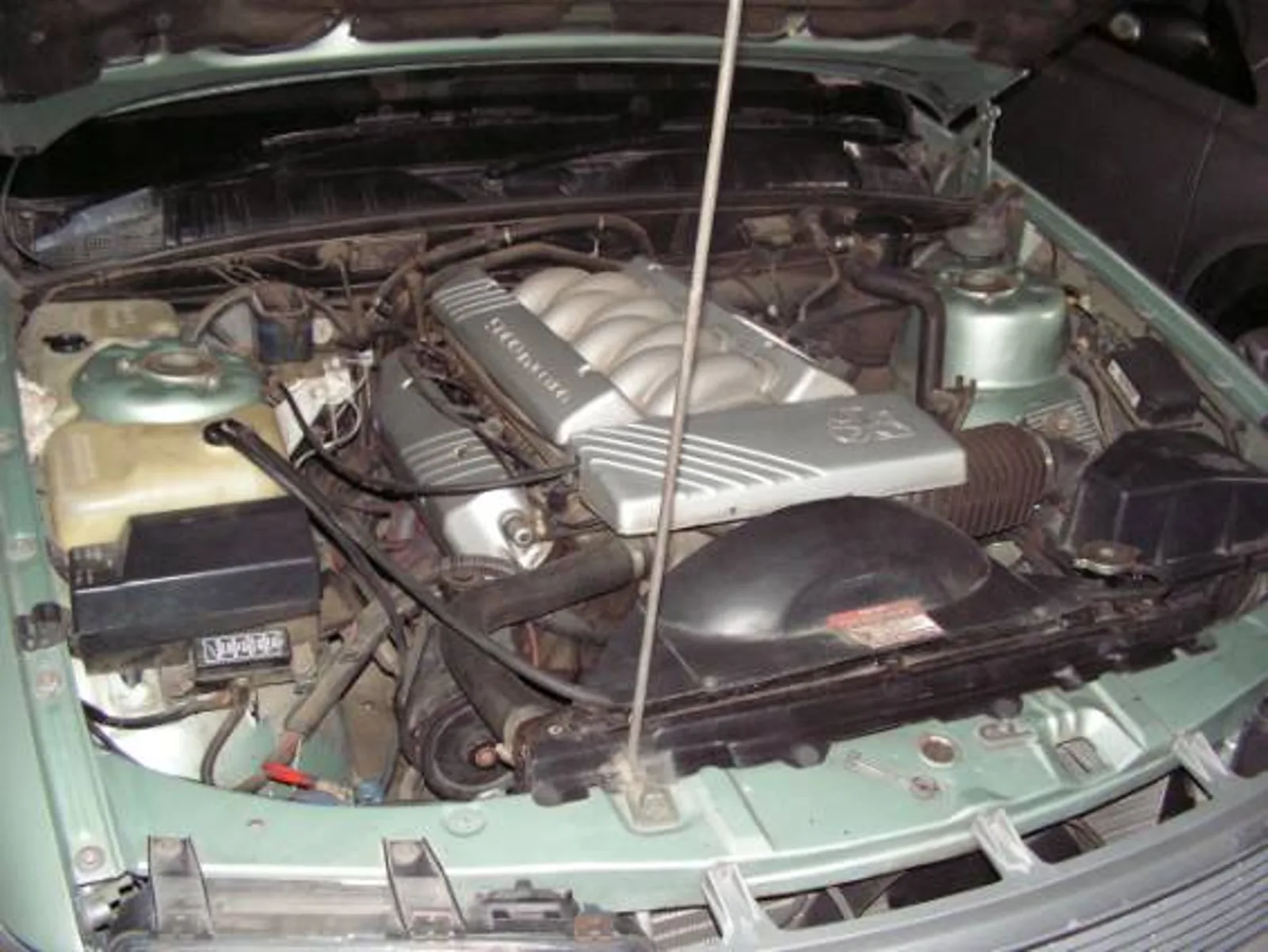
The Holden V8 was a water-cooled, naturally aspirated four-stroke with eight cylinders in a 90-degree vee. It used an overhead valve layout with two valves per cylinder, operated by hydraulic lifters and pushrods to rocker arms. The camshaft sat centrally in the block, driven by a timing chain, and it also drove the distributor and the oil pump. The lifter bores were set at 45 degrees from the block centreline.
The cast-iron block carried five main bearing journals, with two-bolt caps on standard engines and four-bolt caps on the later performance versions. A pressed-steel sump sat beneath it, and a belt drove the radiator fan, the water pump and the alternator from the front of the engine. The cylinder heads were cross-flow designs with wedge-shaped chambers and a single spark plug per cylinder.