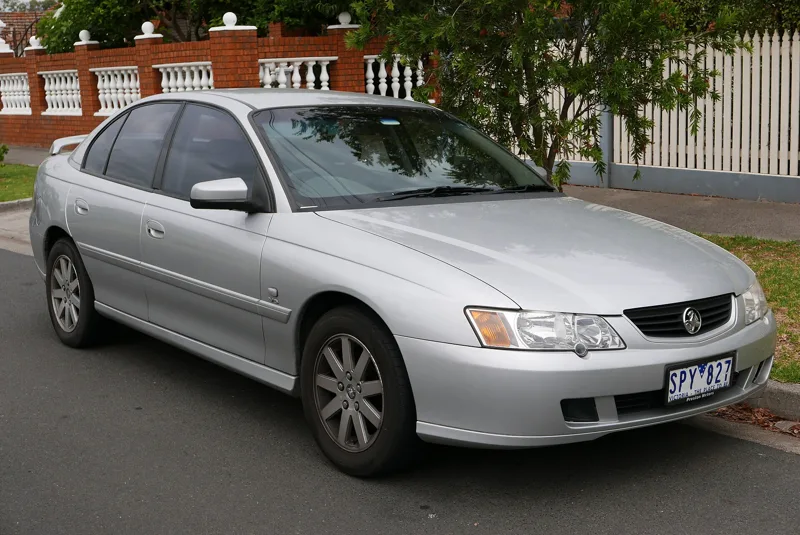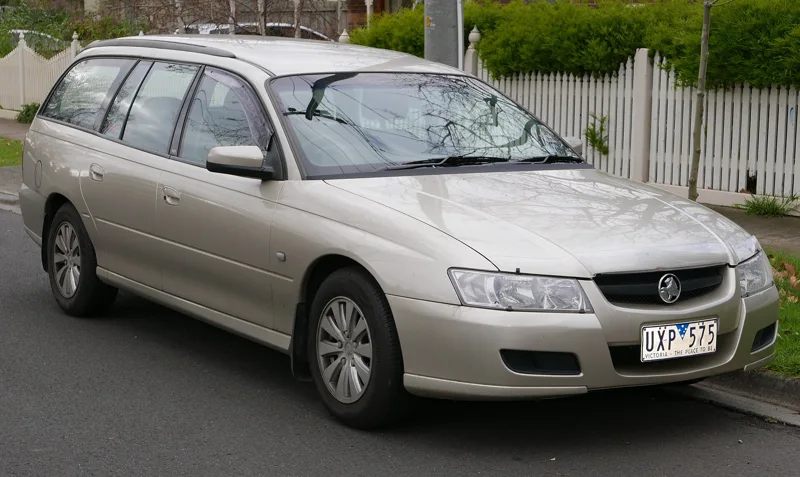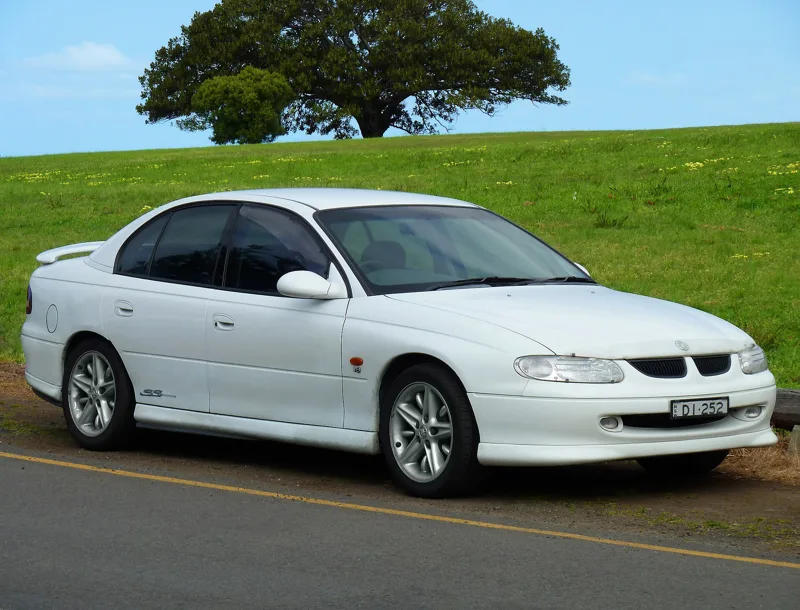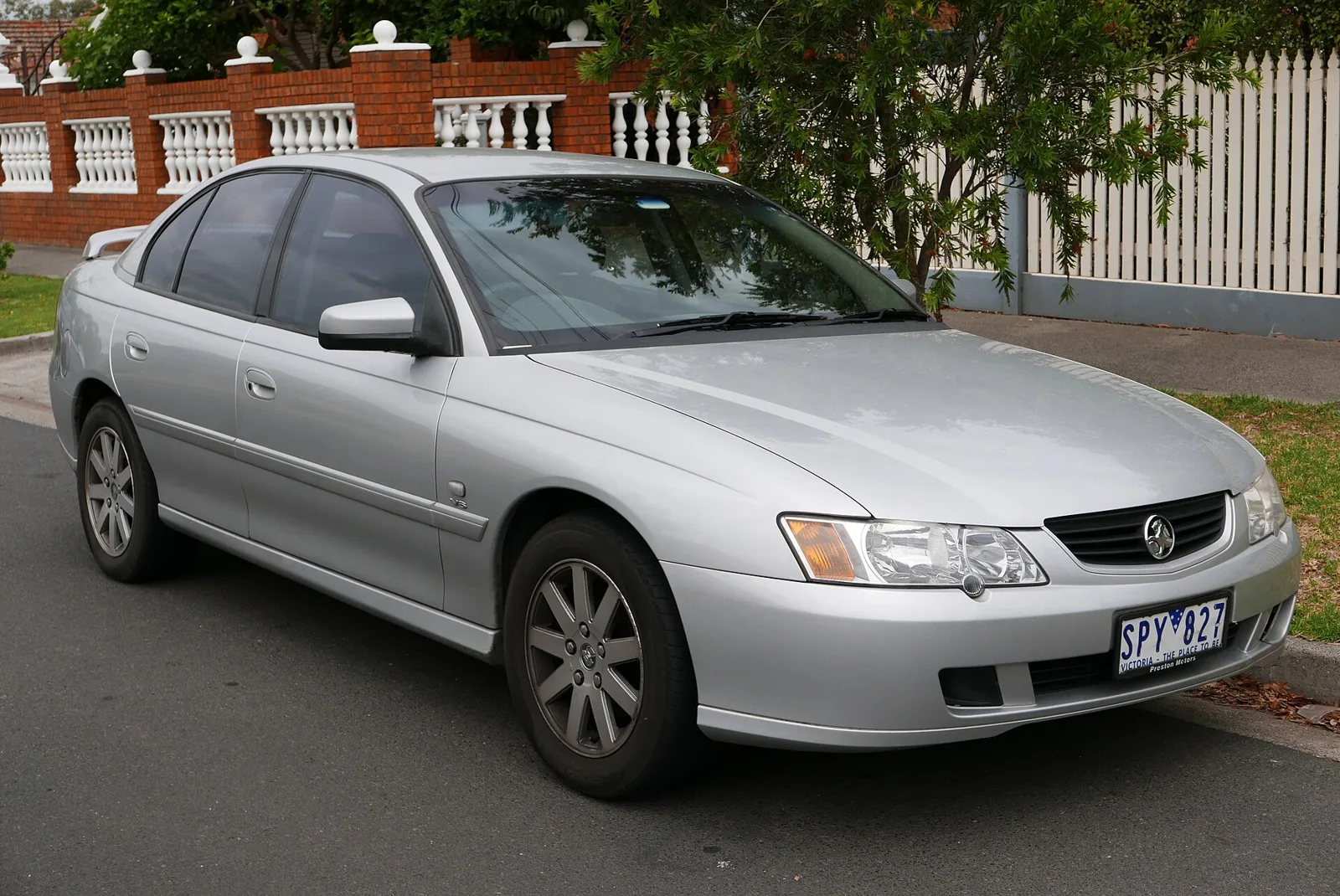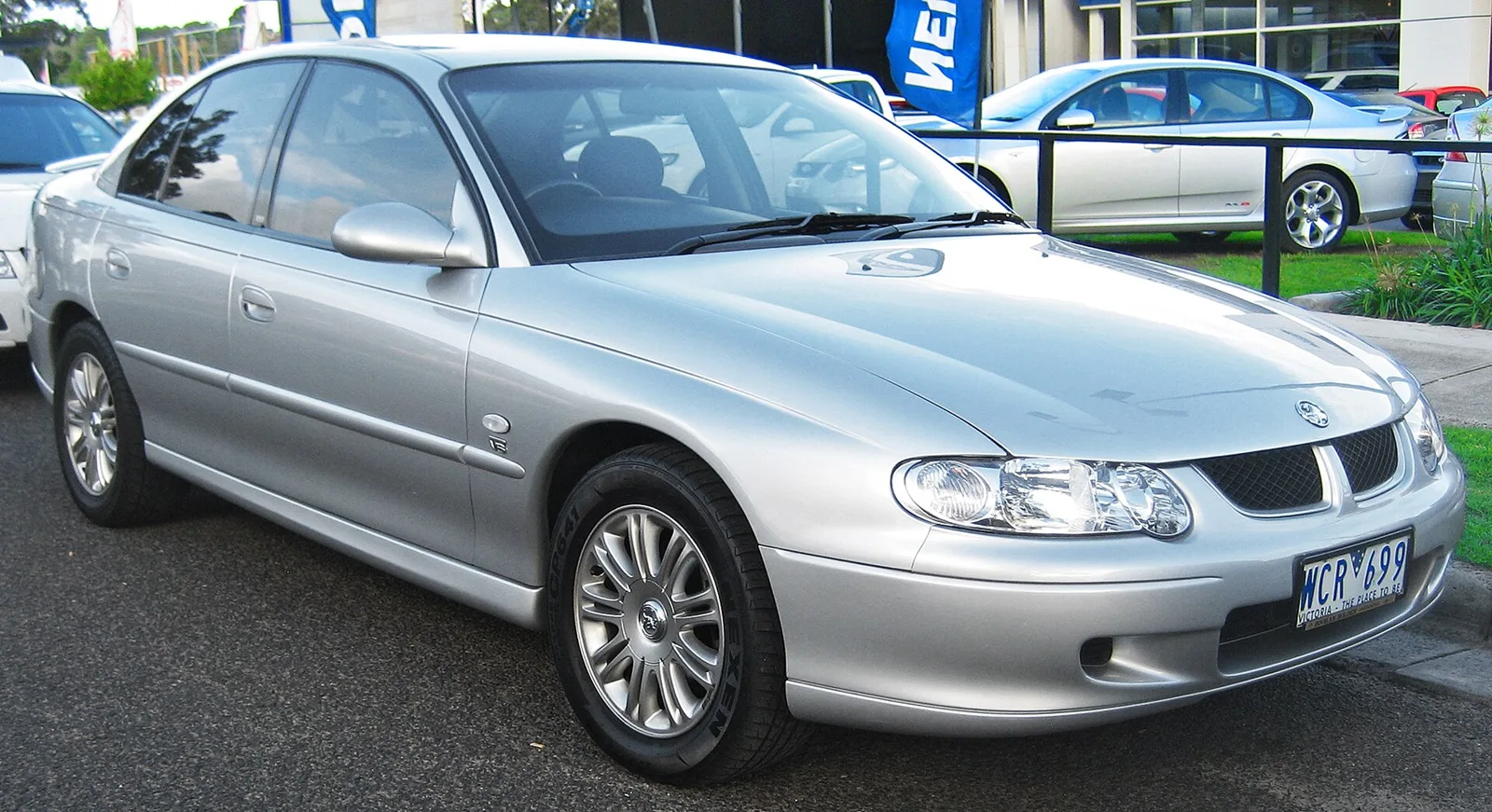
A 2000 to 2002 Australian full-size sedan with a restyled nose, a 5.7-litre V8 option and HSV performance variants.
Built by Holden from 2000 to 2002, the VX Commodore was a restyled VT with standard anti-lock brakes, a supercharged V6 and 5.7-litre V8 options, and HSV Clubsport and Maloo variants that carried 255 kW. Its Series II update arrived in August 2001.
The Holden Commodore VX was a full-size Australian sedan built from October 2000 to September 2002. It was a minor restyle of the VT series, yet it made anti-lock brakes standard on every variant, which was a first for an Australian-built car.
The range ran from fleet-friendly Executives to HSV performance models with 255 kW (342 hp) V8s, and it spawned the Ute, the Monaro and a family of special editions along the way.
What was the VX Commodore?
The VX was the second iteration of the third-generation Commodore, built by Holden for 2000 to 2002. Its range included the luxury Berlina and Calais, and it formed the basis for the new Holden Ute (VU) coupe utility and the Holden Monaro (V2) coupe.
The VX was a minor restyling update of the VT series from 1997. It introduced greater model differentiation and gains in crash safety, which gave buyers more reasons to pick one trim over another.
An intermediate Series II arrived in August 2001 with a revised suspension system among other changes. The Statesman and Caprice, which used the WH body, were built alongside the VX from 2000 to 2003.
The first Australian-built car with standard anti-lock brakes, and a sedan that ran up to 255 kW in HSV form.
What did the VX change visually?
The VX had a revised headlamp design over the VT, and the tail lamp panel was replaced by two separate light assemblies. The Berlina and Calais kept a full-width boot-lid panel that carried the tail lamps and the number plate.
The Berlina and Calais shared a notably restyled exterior, with a full-width rectangular grille that merged into the angled headlamps. The rear of the sedan carried a full-width taillight bar with transparent lenses.
The Calais was told apart by its 16-inch alloy wheels and chrome-outlined foglamps. The Berlina wore nine-spoke, 15-inch alloys with a machine-finished look, and the Calais console could be wood grain, or a satin-finished facade on Series II cars.
Series II cars also gained a new rear cross member and revised rear control arms with new bushings. Toe-control links on the semi-trailing arm rear suspension kept the toe settings steadier as the suspension moved.
Which safety features did the VX add?
Bosch version 5.3 anti-lock brakes became standard on all variants, a first for an Australian-manufactured car. Traction control was offered on vehicles fitted with the manual transmission, and the B-pillars were modified to reduce side-impact effects.
Safety played a substantial role in the VX's development. Engineers reworked the B-pillars after extensive research into side collisions, and the side-impact risk of a VX without side airbags was reduced by 50 percent compared with a similar VT.
The Acclaim added to the package with four airbags and traction control as part of its standard equipment.
What engines did the VX use?
The base engine was a naturally aspirated 3.8-litre Ecotec V6 rated at 152 kW (204 hp). The optional Supercharged Ecotec V6 produced 171 kW (229 hp), and a 5.7-litre Chevrolet-sourced Gen III V8 was also offered.
The 3.8-litre received engine management changes to lift its power to 152 kW, and fuel economy improved by three to four percent over the previous model. Front suspension also received lower control arm pivot points.
The supercharged V6 was extended to the Executive and Acclaim variants, and its 171 kW output remained unchanged from the VT. The Gen III V8 gained power, rising from 220 kW to 225 kW (295 to 302 hp).
V6 engines were paired with a five-speed manual, while V8s came with a six-speed manual. A four-speed automatic was available as an optional extra regardless of the engine chosen.
What did the Executive, Acclaim and S offer?
The entry-level Executive was a popular fleet choice, with anti-lock brakes, a driver's airbag, a trip computer and central locking as standard. Across the range, a CD player, a power antenna that retracted electrically and steering wheel audio controls were now standard.
The second-tier Acclaim was marketed as a family-oriented variant with a strong emphasis on safety. It added four airbags, cruise control, traction control, a limited-slip differential, air conditioning and power windows, and it came only with the four-speed automatic, although the supercharged V6 was available.
The Commodore S was a sporty alternative to the Acclaim, built on the Executive. It brought a sporty body kit and powered windows, with 16-inch alloys, firmer suspension and air conditioning, and cruise control and a leather-rimmed wheel completed the package.
Leather upholstery, traction control, four airbags, 17-inch alloy wheels and the supercharged V6 were offered as options on the S.
What was the SS and what did it add?
The SS continued the S's sporting theme, with bumper-integrated foglamps and more aggressively styled alloy wheels. A Gen III V8 and a six-speed manual came as standard in place of the six-cylinder used on the S pack.
A more advanced suspension setup, traction control and a passenger airbag were also standard. Side-impact airbags and leather upholstery remained optional.
What did the Berlina and Calais add?
The Berlina added climate control air conditioning and adjustable seatbelt anchors to the Acclaim's equipment. The flagship Calais went further, with an eight-speaker audio system, a ten-stack CD player, dual-zone automatic climate control, electric front seats and a leather steering wheel.
Optional extras on the Berlina included 17-inch alloys, sports suspension, the limited-slip differential and the V8. The Calais was the only model that could be had with all three engines, and manual transmissions were not offered on it.
The Berlina's centre console was finished in black or beige plastic, depending on the interior colour. The Calais used a wood grain console, or on Series II cars a satin-finished facade.
What was the Holden Ute VU?
The VU replaced the VS Utility and arrived 36 months after the VT Commodore sedan, in time for the VX's launch. It used the wheelbase of the VT Commodore station wagon, a wheelbase increase of 116 mm (4.6 in).
Base VU utes were built up from the Executive specification, with a 3.8-litre V6 mated to a four-speed automatic or five-speed manual, or a 5.7-litre V8 with a six-speed manual or four-speed automatic. The S followed the Commodore S, and the SS lost its side-impact airbags.
The VU was superseded by the VY ute in May 2003, after a minor refresh with the VU Series II that came alongside the VX Series II.
Which special editions were made?
The SS Fifty was released in October 2001 to mark the 50th anniversary of the first Holden Ute, the 50-2106 coupe utility. Only 500 were built, and all of them had a black exterior with hyper yellow accents.
Its features included a chrome sports bar at the back, a black-and-yellow engine cover, a leather-wrapped steering wheel, a leather handbrake cover and gear knob, and a colour-coded instrument cluster to match the leather bolsters on the sports seats.
What did HSV add to the VX?
The VX Clubsport arrived in October 2000 with the same V8 as the VT Series II Clubsport, but with 5 kW (7 PS; 7 hp) more, for 255 kW (347 PS; 342 hp). HSV gave it a more flamboyant bodykit and exclusive interior features.
The changes were a response to customer complaints that Clubsports were hard to tell apart from standard Holden Commodores. The new styling made the car stand out clearly from its base model.
The VX GTS came in two forms. Series 1 had 112 built, and Series 2 was the SV300, a rebadged GTS.
The Maloo replaced the VS utility from March 2001 as an all-new VU range that mirrored the VX HSV sedans. It used the same LS1 5.7-litre V8 as the Clubsport, at 255 kW (342 hp). The first series built 301 examples, while the Series II Maloo introduced HSV DNA, a microdot identification system, and 483 were built.
The Maloo R8 came with standard Performance brakes and a hard tonneau cover with a raised rear wing.
What was the Senator and how did it differ?
The VX Senator was a 2000 facelift with angular styling and an eggcrate grille. It was partly based on the Calais, and it used the 255 kW (342 hp) LS1 V8 with electronic traction control as a standard option.
Dimensions were 4,964 mm (195.4 in) long, 1,842 mm (72.5 in) wide and 1,450 mm (57.1 in) high, with a 2,788 mm (109.8 in) wheelbase. The car weighed 1,710 kg (3,770 lb) and used 18.1 L/100 km in the city, from a 75 litre tank.
Rear parking sensors appeared for the first time in the Senator range, with an optional satellite navigation system and sunroof. Self-levelling rear suspension, leather trim and dark wood grain on the dashboard completed the upmarket package.
How fast was the Senator 300?
The Senator 300 used a Callaway-tuned V8 producing 300 kW (402 hp), available only with a six-speed manual. It accelerated from 0-100 km/h (0-62 mph) in 6.1 seconds and covered 400 metres in under 14.7 seconds.
Only 33 were built, and seven of them went to New Zealand. It was presented to the public at the Melbourne international motor show and carried a 10-stacker CD, eight-way power front seats, woodgrain instruments and front and side airbags.
Its 10-spoke 18-inch chrome shadow wheels sat over cross-drilled premium brakes, and the engine was offered only with a six-speed manual. The model was released in 2001 alongside the VX and continued into the Y series.
What was the XU6?
The XU6 was a 3.8-litre supercharged V6 rated at 180 kW (241 hp) at 5000 rpm, with 380 N m (280 lb ft) of torque at 3200 rpm. The VT XU6 had matching figures, and the only transmission was the 4L60-E four-speed automatic.
Standard equipment included 17-inch alloys, a six-speaker sound system with CD, climate control air conditioning, cruise control and a four-way powered driver seat. It also had front fog lights, a leather-wrapped steering wheel, four airbags and an immobiliser.
The XU6 was introduced in September 2000 and was the last HSV vehicle to carry that nameplate.
How were VX models sold overseas?
The VX was exported to the Middle East as the Chevrolet Lumina from 2000, in LS sedan and wagon, LTZ sedan and SS sedan forms. The Lumina LS was based on the Commodore Executive, the LTZ on the Berlina and the SS on the Commodore SS.
In Brazil, General Motors do Brasil sold the car as a Chevrolet Omega from 2001, a single-specification model based on the Calais. It kept the boot lid of the more basic VX, without tail lamps extending into it, and sales ended in 2003 when a VY-based model replaced it.
Holden Commodore VX specifications
| Specification | Detail |
|---|---|
| Production | October 2000 to September 2002 |
| Series II | August 2001 |
| Base engine | 3.8-litre Ecotec V6, 152 kW (204 hp) |
| Supercharged V6 | 171 kW (229 hp) |
| V8 | 5.7-litre Gen III, 225 kW (302 hp) |
| HSV Clubsport | 255 kW (347 PS; 342 hp) from the LS1 V8 |
| Senator 300 | 300 kW (402 hp), 0-100 km/h (0-62 mph) in 6.1 seconds |
| XU6 | 180 kW (241 hp), 380 N m (280 lb ft) |
| Senator weight | 1,710 kg (3,770 lb) |
| Senator wheelbase | 2,788 mm (109.8 in) |
| SS Fifty | 500 built, October 2001 |
| Maloo, first series | 301 built |
| Maloo, Series II | 483 built |