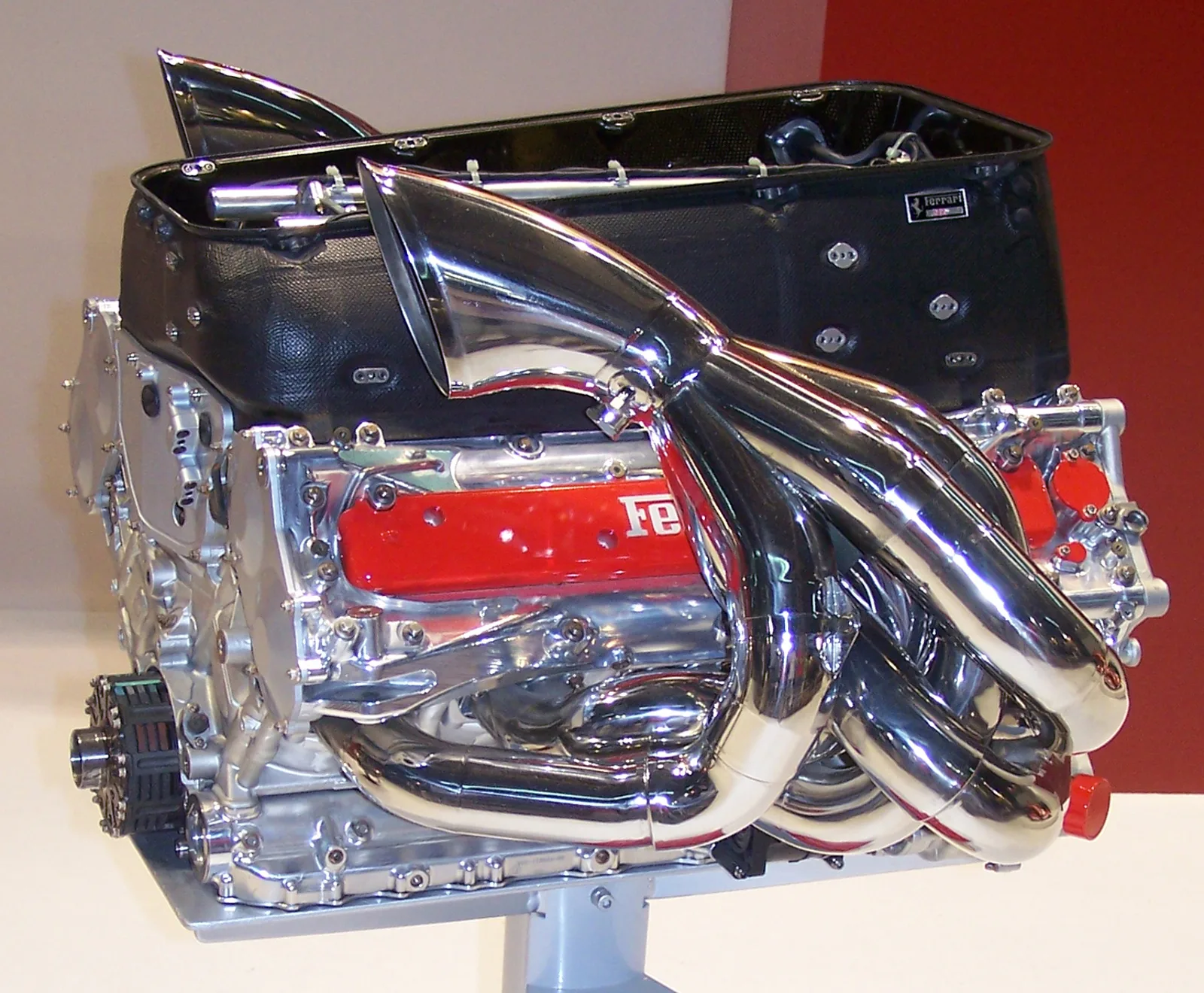
Ferrari's 3.0-litre V10s rose from 715 hp in 1996 to about 935 hp by 2005, and they carried the team through six constructors' titles before the V8 era began.
The Ferrari V10 was a 3.0-litre naturally aspirated Formula One engine used only in Ferrari cars from 1996 to 2005. Output rose from 715 hp to over 900 hp, the engines won six World Constructors' Championships and five World Drivers' Championships, and Ferrari moved to a V8 in 2006.
The Ferrari V10 was a series of 3.0-litre naturally aspirated Formula One racing engines that Ferrari built exclusively for its own cars between 1996 and 2005. Over the decade its output rose from about 715 hp to more than 900 hp in qualifying trim. It was Ferrari's last ten-cylinder racing engine before the switch to the 2.4-litre V8.
What was the Ferrari V10 engine?
The Ferrari V10 was a naturally aspirated 3.0-litre racing engine used only in Ferrari's Formula One cars, with each generation given a Tipo designation. The first generation was the Tipo 04x family from 1996 to 2000, and the second was the Tipo 05x family from 2001 to 2005. Over the decade the engines moved from 75-degree and 80-degree cylinder banks to a 90-degree layout.
The engineers tuned each generation for high revs and strong power. Reputed qualifying figures in the final years went beyond 900 hp at 19,000 rpm, while the race engine was detuned for durability.
A ten-cylinder racing engine that started at 715 hp, passed 900 hp in qualifying and carried Ferrari through a decade of titles.
Why did Ferrari choose a V10?
Ferrari picked a V10 because it offered the best compromise between power and fuel efficiency. A V12 was more powerful but thirstier, while a V8 was less powerful and more economical. The ten-cylinder layout gave the team a balance that suited the racing rules of the time.
The decision was not permanent. Ferrari switched to a 2.4-litre naturally aspirated V8 for the 2006 season, when the technical regulations changed to require a smaller capacity. The V10 era therefore closed as the rules themselves moved on.
How did the Tipo 046 begin the V10 story?
The Tipo 046 was the first of the family and the first Ferrari F1 engine in the more conventional V10 format. It was also known as the 310, and it was engineered by former Honda technician Osamu Goto. It had a 75-degree bank angle and produced 715 hp at 15,550 rpm.
The engine weighed 120 kg (265 lb) and had a bore of 90 mm and a stroke of 47.1mm, giving a displacement of 2998.1 cc. Four valves per cylinder were used, and the maximum revolutions reached 16,000 to 17,000 rpm. The specific output was 238 hp per litre.
What changed with the Tipo 047 and Tipo 048?
The Tipo 047 was built around a narrower track that the FIA had mandated for 1998, so the engine was reshaped to fit. Its bank angle was 80 degrees, and the output was 805 hp (600 kW) at 17,300 rpm. Its 92 mm bore and 45.08mm stroke gave a displacement of 2996.7 cc, and each version weighed about 120 kg.
The Tipo 048 followed in 1999, with an 80-degree layout and a bore of 94 mm. Giles Simon led the engine design work, and the car produced 790 BHP (552 kW) at 16,300 rpm. That engine helped Ferrari claim its first World Constructors' Championship in 20 years, and its weights were 114 kg, 107 kg and 105 kg depending on the version.
Why did the Tipo 049 widen the V-angle?
The Tipo 049 of 2000 was newly designed with a wider 90-degree V-angle, compared with the 75 degrees of the Tipo 048. The change lowered the centre of gravity of the car it powered. The engine produced between 805 and 815 hp at 17,300 rpm, and it weighed 106 kg.
Its bore was 96mm and its stroke 41.4mm, giving 2996.6 cc. The specific output of 272 hp per litre showed how far the team had moved on since the first generation. The engine was installed mid-mounted and longitudinally, and it used two exhaust outlets.
How did the Tipo 050 and Tipo 051 develop the 90-degree V10?
The Tipo 050 was designed by Gilles Simon and produced 825 hp at 17,300 rpm in race mode. It could be tuned for up to 900 hp in qualifying, and it weighed 94 kg (207 lb). It powered the F2001 and set up the second generation of the Tipo 05x family.
The Tipo 051 arrived for the 2002 season under engine chief Paolo Martinelli. Its block used micro-casting technology, and the cylinder heads were downsized, which allowed the crankshaft to sit lower and give the car an exceptionally low centre of gravity. The transmission was about 15% lighter and used clutchless direct shifting, and Magneti Marelli looked after the engine management.
Ferrari officially quoted 835 hp at 17,800 rpm for the Tipo 051, with up to 900 hp available in qualifying. For reliability the race output was reduced to 865 hp at 18,600 rpm, and the engine weighed 95 kg. BMW's P81 in the Williams made up to 940 hp but was less reliable, so the Tipo 051 was one of the most powerful engines in the field and far more dependable than the BMW unit.
What did the Tipo 052 offer in 2003?
The Tipo 052 was a completely new development for the 2003 season, and it was designed to improve performance and driveability without sacrificing reliability. Ferrari raced the first four rounds with the F2002 before the F2003-GA arrived for the fifth race, because its chassis had been designed around the engine. The engine was rated at 845 hp at 18,300 rpm, and experts suspected output nearer 900 hp at 19,000 rpm.
The engine weighed 85 kg and produced 282 hp per litre. Its specification at the start of the season delivered around 200 rpm more than the predecessor, and the rear integration of the car saved between 4% and 5% in weight. Engine management again came from Magneti Marelli.
Why did the Tipo 053 need to last a whole weekend?
The Tipo 053 was used in 2004 under new rules that required each engine to last an entire race weekend. An illegal engine change would have brought a 10-place grid penalty, so Ferrari focused the design on durability and reliability. Nearly every moving part was redesigned, and the weight rose only slightly thanks to new alloys.
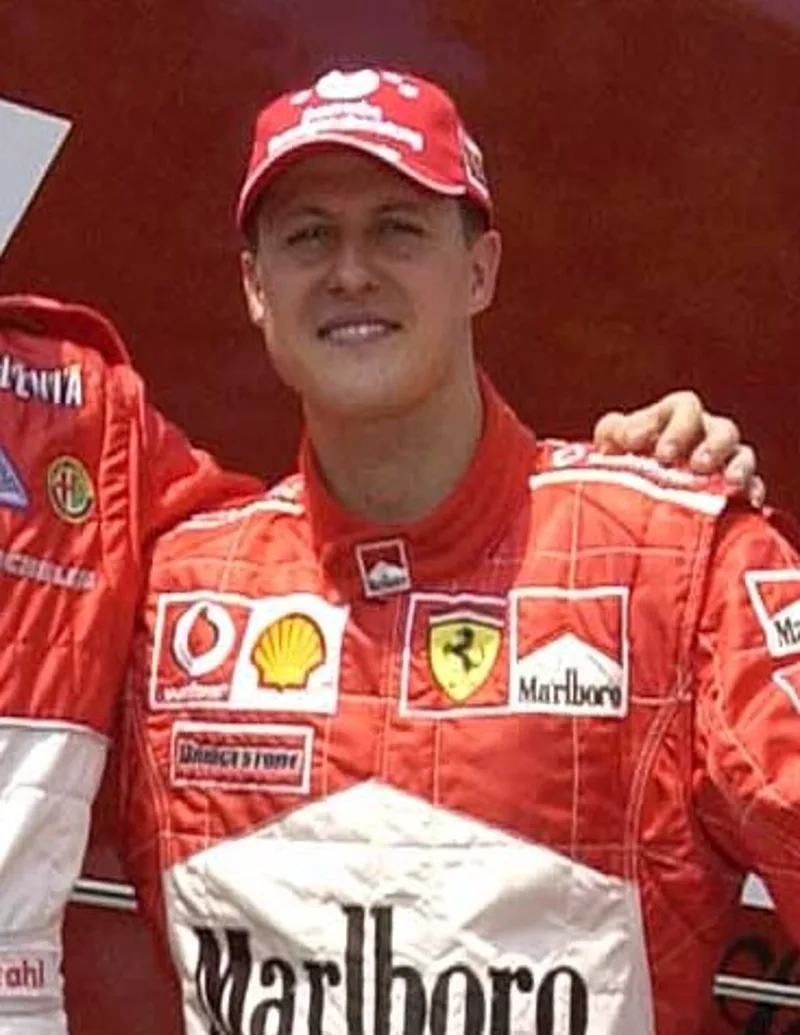
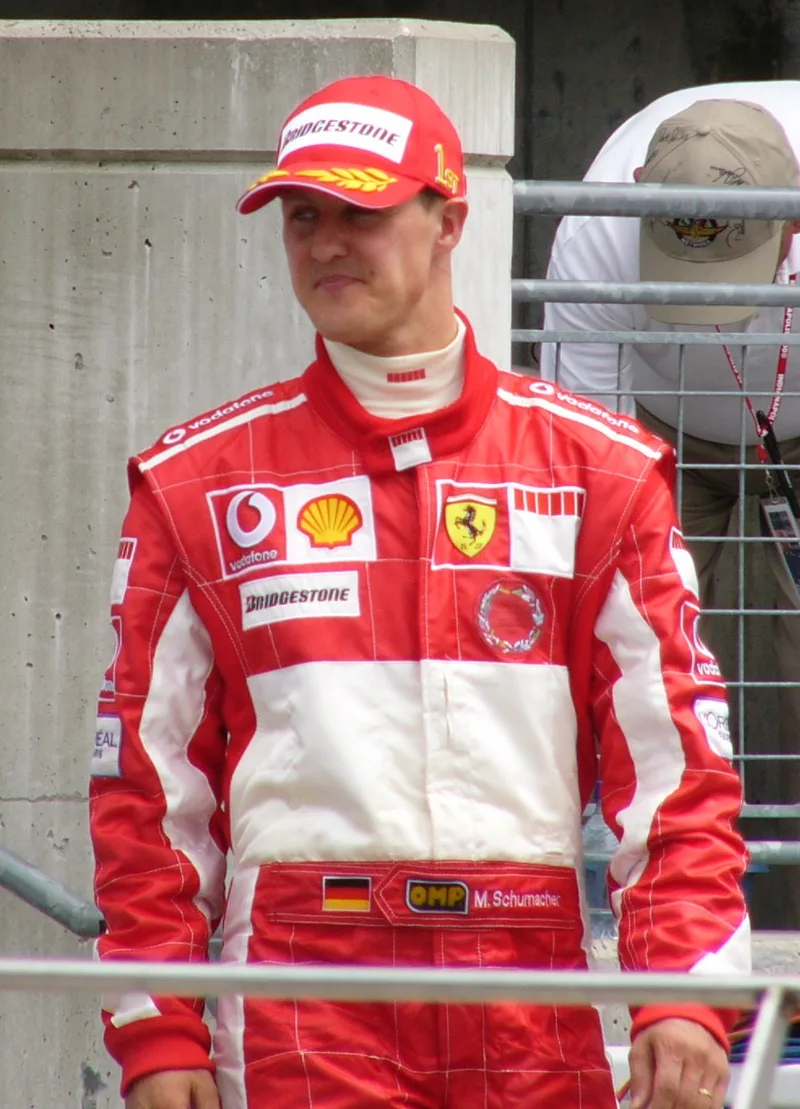
The Tipo 053 powered the F2004 driven by Michael Schumacher and Rubens Barrichello. It produced 865 hp at 18,300 rpm in race trim and around 920 hp at 19,000 rpm in qualifying. Schumacher won his fifth Ferrari title at the Belgian Grand Prix with this engine, and it was his seventh Formula One World Championship overall. The engine weighed 92 kg (203 lbs).
What was the Tipo 055 and how did the V10 era end?
The Tipo 055 was a development of the Tipo 053 for 2005. The rules were tightened again so that an engine had to last two race weekends, and the team once more prioritised durability. Race trim gave 865 hp at 18,300 rpm, and qualifying pushed past 940 hp at 19,000 rpm, while the engine weighed around 90 kg (198 lb).
The Tipo 055 was also Ferrari's last V10 engine. Schumacher and Barrichello drove the F2005 with it, and the engine was used by Sauber as well under the PETRONAS name. From the 2006 season Formula One relied on 2.4-litre V8 engines, which ended the V10 generation.
What were the results of the Ferrari V10?
The V10 family was part of a championship record that includes Ferrari's constructors' and drivers' titles. Across the period the engines took 77 race wins and 62 pole positions, and they recorded 185 podium finishes including the results of the Sauber team that ran the engine under its own name.
The output path tells its own story. The Tipo 046 began at 715 hp, the Tipo 049 reached 805 to 815 hp, and the Tipo 055 was over 940 hp in qualifying. Each new generation added power while trying to keep the engine reliable enough to survive a race weekend, which became a central concern once the rules changed.
How did the engines change during a season?
Ferrari did not wait for the start of a year to improve the V10. Each season brought a sequence of expansion stages, with new parts tried through the summer and autumn races. In 2002 the Tipo 051 was joined by two further stages, designated 051B and 051C, which lifted output as the year went on.
The Tipo 053 followed the same pattern. The first stage of development arrived for the San Marino Grand Prix and delivered 920 hp, a figure that the team could not have used in race trim without risking the engine's life for a full race weekend. For 2005 the usual stages of expansion were again run through the season, although the Tipo 055 was stable from the start and changed only marginally in weight.
Who designed the Ferrari V10?
Osamu Goto, a former Honda technician, engineered the first Tipo 046, which was also known as the 310. Giles Simon led the design and operations of the Tipo 048, the Tipo 049 and later engines, and his name is attached to the wider-angle 90-degree layout that followed the 80-degree units of the late 1990s.
Paolo Martinelli took over as engine chief for the Tipo 051, and he led the engine work for the 2002 to 2005 seasons. In each of those years Martinelli was assisted by Giles Simon, which meant that the same small group carried the V10 through its second generation. Martinelli's role ended with the Tipo 055, which was the final V10 Ferrari built.
Specifications at a glance
| Engine | Year | Bank angle | Displacement | Race output | Weight |
|---|---|---|---|---|---|
| Tipo 046 | 1996 | 75 degrees | 2998.1 cc | 715 hp at 15,550 rpm | 120 kg |
| Tipo 047 | 1998 | 80 degrees | 2996.7 cc | 805 hp at 17,300 rpm | 120 kg |
| Tipo 048 | 1999 | 80 degrees | 2997.3 cc | 790 BHP (552 kW) at 16,300 rpm | 105 to 114 kg |
| Tipo 049 | 2000 | 90 degrees | 2996.6 cc | 805 to 815 hp at 17,300 rpm | 106 kg |
| Tipo 050 | 2001 | 90 degrees | 2996.6 cc | 825 hp at 17,300 rpm | 94 kg |
| Tipo 051 | 2002 | 90 degrees | 2996.6 cc | 865 hp at 18,600 rpm | 95 kg |
| Tipo 052 | 2003 | 90 degrees | 2996.6 cc | 845 hp at 18,300 rpm | 85 kg |
| Tipo 053 | 2004 | 90 degrees | 2998.3 cc | 865 hp at 18,300 rpm | 92 kg |
| Tipo 055 | 2005 | 90 degrees | 2998.3 cc | 865 hp at 18,300 rpm | 90 kg |