From the 1951 FirePower to the 426 race engine and the 707 hp supercharged Hellcat, the Hemi has been defined by its combustion chamber shape.
Built in three generations, the Chrysler Hemi is a family of American V8s whose hemispherical heads defined its design. It began as the 1951 FirePower, grew through the 426 race engine and became the modern HEMI, launched in 2003 and still in production.
The Chrysler Hemi is a series of high-performance American overhead valve V8 engines with hemispherical combustion chambers, sold under the Hemi or HEMI name. Three generations have been built, and each one takes the hemispherical chamber in a different direction.
What is a hemispherical combustion chamber?
A hemispherical chamber has an excellent surface-to-volume ratio, which means little heat is lost to the cylinder head, and it leaves room for two large valves. Those qualities are why the design is prized for power, and why Chrysler stuck with it through several generations.
The trade-offs are real. A hemi head allows no more than two valves per cylinder, the valves are heavier than those in a multi-valve engine, and the intake and exhaust valves lie on opposite sides of the chamber. That layout needs a cross-flow head and complex valve trains that add cost and weight.
Because the chamber is only part of a sphere, a flat-topped piston would give a low compression ratio. Engineers instead domed the piston crown so it protrudes into the head at top dead centre. The chamber is the gap between that dome and the shape of the head that receives it.
The hemi also has a sensitivity to fuel. With little squish to mix fuel and air, a hemi needs a higher octane rating than some conventional designs, such as the wedge and bathtub shapes, to avoid detonation at the same compression ratio.
A hemispherical chamber that carried Chrysler from the 1951 FirePower to a 707 hp supercharged engine in one unbroken line.
Where did the first Hemi come from?
Chrysler's first experimental hemi was built for the Republic P-47 Thunderbolt fighter. The XIV-2220 was an inverted overhead valve V16 rated at 2,500 hp (1,860 kW), and it flew successfully in trials in 1945 as a possible upgrade. The war was winding down, so it never went into production, but it taught Chrysler's engineers a great deal about hemi chambers.
Chrysler also worked with Continental Motors on the air-cooled AV-1790-5B V12 Hemi, which was used in the M47 Patton tank. That military experience fed directly into Chrysler's first automobile engine with a hemispherical head.
The car engine, launched as the FirePower rather than the Hemi, arrived in 1950 for the 1951 model year. Its opening version measured 331 cu in (5.4 L) and made 180 bhp (134 kW), which began a long line.
How did the FirePower family spread across Chrysler's brands?
Three of Chrysler's four divisions eventually had their own FirePower variants, and the versions shared almost no parts. The bore spacing differed between them, which made commonality difficult. Chrysler and Imperial called theirs the FirePower, DeSoto called its version the FireDome, and Dodge built a smaller engine known as the Red Ram.
Plymouth never had a FirePower. It kept Dodge's poly-head engines until the 426 arrived in 1964.
The first-generation Hemis are now called the FirePower series, covering 1951 to 1958. They can be identified by their rear-mounted distributor and by a row of spark plugs down the centre of wide valve covers.
What were the main first-generation displacements?
The Chrysler FirePower grew steadily through the 1950s. The 331 was used from 1951 to 1955, and a 354 arrived in 1956 with a bore of 3.9375 in (100 mm) and a stroke of 3.625 in (92.1 mm). The 392 followed in 1957 with a 4.00 in (101.6 mm) bore and a 3.906 in (99.21 mm) stroke.
| Engine | Years | Displacement | Headline output |
|---|---|---|---|
| FirePower 331 | 1951 to 1955 | 331 cu in (5.4 L) | 180 bhp (134 kW) |
| FirePower 354 | 1956 | 5,787 cc (353.1 cu in) | 340 bhp (254 kW) in the 300B |
| FirePower 392 | 1957 to 1958 | 392.67 cu in (6,435 cc) | 325 bhp (242 kW) to 345 bhp (257 kW) |
| Street Hemi 426 | 1966 to 1971 | 426 cu in (7.0 L) | 425 bhp (317 kW) gross |
| HEMI 6.4 L (392) | 2011 model year onwards | 6.4 L | 470 hp (350 kW) |
| Hellcat 6.2 L | 2015 | 6,166 cc (376.3 cu in) | 707 hp (717 PS; 527 kW) |
The table traces the main headline figures across the three generations, and the ratings are the figures Chrysler published at the time. The 1950s ratings were quoted on the gross basis of their day, while modern engines are rated net, so the numbers do not compare directly.
How did the 331, 354 and 392 engines compare?
The 331 was oversquare, with its bore at 3.8125 in (96.8 mm) and its stroke at 3.625 in (92.1 mm). Most versions used a two-barrel carburettor and made 180 bhp (134 kW). The exception was the 1955 Chrysler C-300, which had dual four-barrel carburettors and was rated at 300 hp (224 kW).
The 354 raised output for the 1956 model year. In the 300B it was rated at 340 bhp (254 kW), and an optional 355 hp (265 kW; 360 PS) version made it the first American V8 rated at one horsepower per cubic inch. The engine was also built for heavy-duty truck service with one or two four-barrel carburettors.
The 392 arrived in 1957 on a raised deck that stood 10.87 in (276.1 mm) high. Its heads had wider intake ports so older manifolds could still be used. The 1958 engine was offered in two states of tune, at 325 bhp (242 kW) with 9.25:1 compression or 345 bhp (257 kW) at 10:1.
An extremely rare option on the 1958 300D was Bendix Electrojector fuel injection, rated at 390 bhp (291 kW). Reliability problems with its primitive onboard computer led to 15 of the 16 cars built with the option being recalled and fitted with carburettors.
How did DeSoto and Dodge build their Hemis?
DeSoto introduced its FireDome version in 1952 with a displacement of 276.1 cu in (4.5 L) and 160 bhp (119 kW). Roughly 50,000 vehicles were built with it before its replacement in 1954. Its bore grew to 3.72 in (94.49 mm) for 1955, giving 291 cu in (4.8 L) and 185 bhp (138 kW) in Firedome form.
DeSoto's high-performance version was the Adventurer. Its 341 cu in (5.6 L) engine had a compression ratio of 9.5:1 and produced 320 bhp (239 kW) with dual Carter four-barrel carburettors. In 1957 the 345 Adventurer was rated at 345 bhp (257 kW), producing one horsepower per cubic inch as standard equipment.
Dodge's Hemi arrived in 1953 as the Red Ram, based on the 1951 Chrysler design but downsized for the smaller Dodge line. It had the smallest bore centre spacing of any Hemi at 4.1875 in (106.4 mm). Dodge's 241 produced 140 bhp (104 kW) in 1953, and a 270 cu in version followed in 1955.
The 1956 Dodge D-500 used a 315 cu in engine with a taller raised-deck block. The 325 cu in Super Red Ram arrived for 1957, with a hemi-headed KD-500 variant. Dodge Trucks marketed its own Hemi under the name PowerDome.
What was the second-generation 426 Hemi?
The 426 was developed from December 1962, when Chrysler asked its engineers for an engine capable of winning stock car events on closed circuits and drag races. The design began in January 1963, and the first engine ran under its own power on 6 December 1963. It was the first engine Chrysler officially called Hemi in that era.
The engineers nicknamed the 426 the elephant engine, a reference to its high power, heavy weight and large dimensions. Those dimensions made it the largest racing engine of its period.
Chrysler's track version was raced by drivers including Richard Petty in a Plymouth Belvedere in 1964. Complaints from Ford about its power led NASCAR to ban the race Hemi from the 1965 season, because no production car used it, and Chrysler then had to sell a version to the public.
Chrysler introduced the Street Hemi in 1966 for its intermediate cars and sold enough engines to homologate it for NASCAR. The street version lowered compression from 12.5 to 10.25 and used cast iron bearing caps, a heated intake manifold and a milder cam. It was rated at 425 bhp (317 kW) gross at 5000 rpm, with 490 lb ft at 4000 rpm.
In dynamometer testing, a stock Street Hemi produced 433.5 hp (323 kW) and 472 lb ft of torque. Chrysler's sales literature for 1971 published both the gross 425 hp (317 kW) rating and a net 350 hp (261 kW) figure, which showed how much the rating method could change the headline.
Which cars carried the Street Hemi?
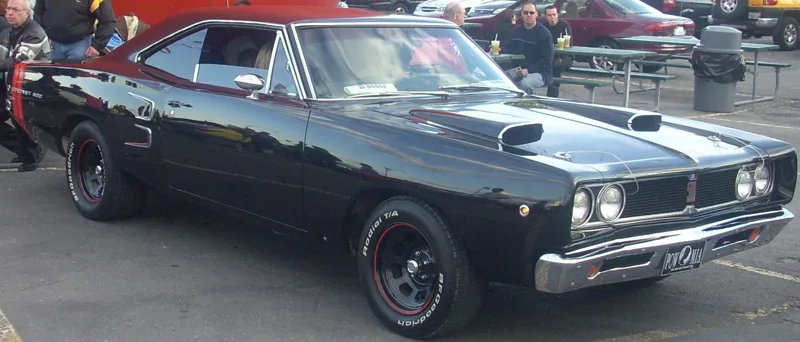
The Street Hemi was offered in a long list of models, including the Dodge Coronet, the Plymouth Satellite and GTX, the Dodge Charger and Super Bee, the Plymouth Road Runner, and the Dodge Charger R/T and Daytona. The Plymouth Superbird and the Plymouth Hemi 'Cuda and the Dodge Challenger also used it at the end of the decade.
Racing Hemis differed from the street version in compression ratio, camshaft, intake and exhaust manifolds. Some 1960s NASCAR and NHRA engines used magnesium cross-ram intakes and magnesium oil pans, plus chain-driven internal dry sump oil systems, to cut weight.
How did the third-generation HEMI differ?
The current HEMI was launched in 2003. Its cylinder heads are flatter and more complex than the 1950s to 1970s chambers, and the combustion chambers are no longer truly hemispherical. It uses a coil-on-plug ignition system with two spark plugs per cylinder, which shortens flame travel and makes combustion more consistent.
Some versions also use the Multi-Displacement System, which deactivates cylinders under light load to save fuel. The newer engines are rated net, while the old Hemis were rated gross, and the 5.7 L was rated at roughly one horsepower per cubic inch in the same spirit as its predecessors.
The 5.7 L was released for the 2003 model year in the Dodge Ram pickup to replace the Magnum 5.9. It was the only gasoline engine in the Ram Heavy Duty from 2004 to 2013, and it was later offered across the Chrysler 300C, Dodge Charger, Challenger and Jeep Grand Cherokee ranges. The engine earned a place on Ward's 10 Best Engines list in several years, including 2009.
What changed in the 2009 revisions?
For 2009 Chrysler introduced Variable Camshaft Timing, which uses an oil control valve and a phasing device to advance or retard the camshaft. The heads were revised for more flow, and the intake was changed on every application, with some models using an active intake manifold with a short runner valve.
Power rose to 357 to 395 horsepower and 389 to 410 lb ft depending on the application, and fuel economy improved by 4 per cent. The 2009 engines also moved from the old spark plug seat design, so the spark plugs changed to NGK LZFR5C-11 and the plug gap grew to 1.1 mm.
How big was the 6.1 and 6.4 Hemi?
The 6.1 L Hemi was developed in 2004 for the 2005 Chrysler 300C SRT8. It produced 425 bhp (317 kW) at 6,200 rpm and 420 lb ft of torque at 4,800 rpm, with a forged crankshaft, lighter pistons and strengthened connecting rods for durability.
The 6.4 L 392 HEMI was first shown in 2005, rated at 525 hp (391 kW; 532 PS) and 510 lb ft of torque. The production version was developed in 2010 for the 2011 Dodge Challenger SRT8, using a forged steel crankshaft, hypereutectic aluminium pistons and a 10.9:1 compression ratio.
The production 6.4 was rated at 470 hp (350 kW), with horsepower later raised to 485 hp (362 kW) for the 2015 SRT 392 models. Its 392 name paid tribute to the original first-generation engine of the same displacement.
What made the Hellcat and Demon so powerful?
For 2015 Chrysler introduced the Hellcat, a supercharged 6.2 L Hemi named after the Grumman F6F Hellcat. It used the 6.4 L bore and the 5.7 L stroke, with a twin-screw IHI supercharger that produced 11.6 psi of boost. Its output was 707 hp (717 PS; 527 kW), reached at 6,000 rpm, with 650 lb ft at 4,000 rpm.
The Redeye version of the Hellcat debuted in the Dodge Challenger in 2019 with 797 hp (808 PS; 594 kW), and it was followed by the Dodge Charger. In 2017 Mopar announced the Hellcrate crate engine, which let customers buy the Hellcat unit on its own.
The SRT Demon used a larger 2.7 L twin-screw supercharger, reinforced reciprocating parts, a new camshaft and other valvetrain upgrades. On 91-octane pump fuel the Challenger SRT Demon made 808 hp (603 kW), and on 100-octane racing fuel it reached 840 horsepower.
The 1,000 hp (746 kW) Hellephant was a supercharged crate engine sold from 2018, and its name was a spin on the nickname of the original 426 engine, the Elephant. It produced 950 lb ft of torque.
Frequently asked questions
What does Hemi stand for?
Hemi is a trademark term for the hemispherical combustion chamber, which Chrysler uses as its marketing name. Many other manufacturers have used hemispherical heads, but Chrysler is the company most closely identified with the name.
How many generations of Hemi were built?
Three generations have been built. The FirePower series ran from 1951 to 1958, the 426 from 1964 to 1971, and the modern family from 2003 onwards.
What is the most powerful Hemi?
The 1,000 hp (746 kW) Hellephant crate engine is the most powerful Hemi that Chrysler sold, although the Hellcat and Redeye figures are the strongest production ratings. The Redeye reached 797 hp (808 PS; 594 kW).
Why was the 426 called the elephant engine?
Its nickname came from its high power, heavy weight and large physical dimensions. Its deck height and bore spacing made it the biggest engine in racing at the time.
Where is the 5.7 L Hemi made?
Production takes place at the Saltillo Engine plant in Ramos Arizpe, Mexico, and the engine dates from the 2003 model year.