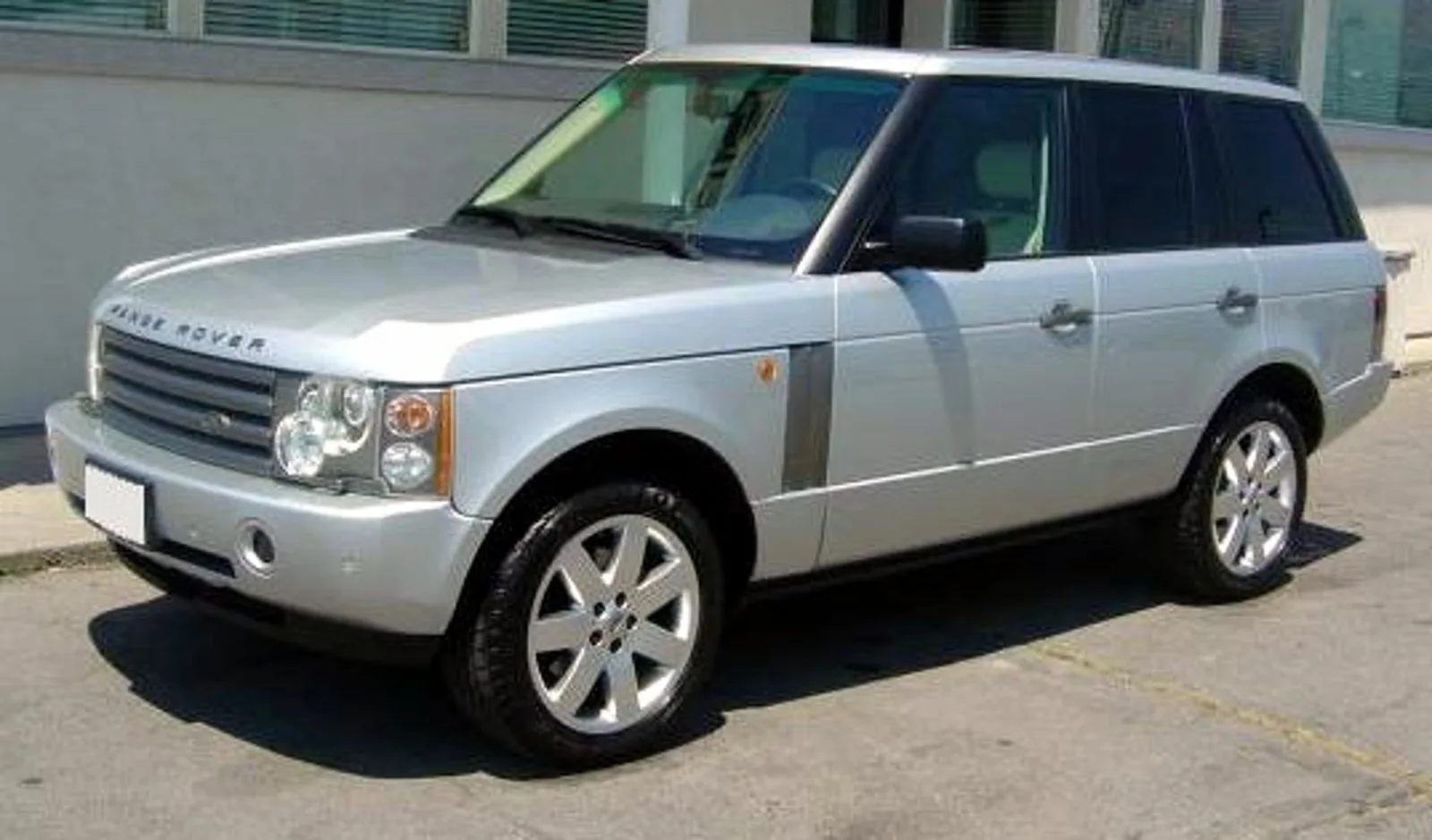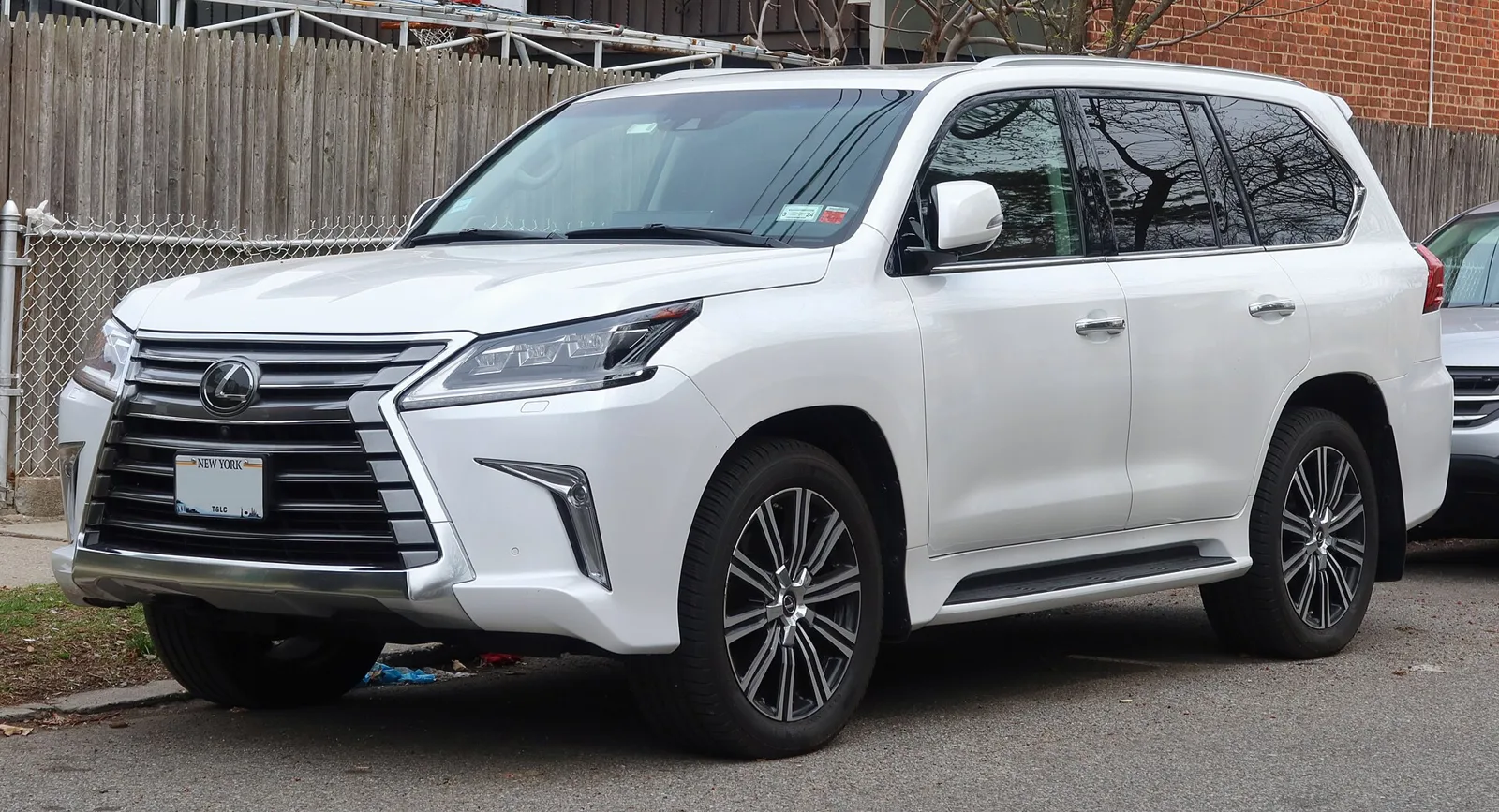
Lexus's LX was a rebadged Land Cruiser with a truck frame, while the British Range Rover L322 came from a monocoque body with four-wheel independent suspension.
The Lexus LX started in 1995 as a rebadged Toyota Land Cruiser with a truck frame and a straight-six, later moving to V8 power. The Range Rover L322 was a 2001 monocoque with four-wheel independent air suspension that switched to Jaguar V8s in 2006 and added a TDV8 diesel in 2007.
The Lexus LX and the Range Rover L322 were both full-size luxury off-roaders, but they came from very different starting points. The LX began as a Toyota Land Cruiser with a Lexus interior and a body-on-frame chassis. The L322 was a monocoque Range Rover with four-wheel independent air suspension, developed under BMW and finished under Ford. Both sold to buyers who wanted a flagship that could cross rough ground and still look at home outside a hotel.
Why did Lexus build an SUV at all?
The first LX was rushed out of necessity. It was developed in the mid-1990s in response to threatened US trade sanctions on Japanese luxury cars, and the LX 450 started production in November 1995, reaching US showrooms as a 1996 model in January 1996. Canada received it from 1997. Lexus's first SUV was built almost entirely on the sixth-generation Toyota Land Cruiser J80, with a restyled and more luxurious interior and softer suspension settings.
The tariff question was a real driver. The US government threatened 100 percent tariffs on Japanese luxury imports but not on SUVs. Because the LX 450 was a rebadged Land Cruiser rather than a divergent Lexus design, it was exempt. A gentlemen's agreement was reached, and the tariffs were never imposed.
A Land Cruiser with a Lexus badge and a Range Rover built on a monocoque body, sold to buyers who wanted luxury that could still leave the road.
What did the first LX 450 offer?
The LX 450 used a 4.5 L twin-cam, four-valve inline-six producing 160 kW (215 hp) and 373 N m (275 lb-ft) of torque. Both axles were solid, and the car looked like a J80 Land Cruiser apart from the grille, side cladding and wheels. The vehicle was pre-wired for the Lexus remote telephone system and came with a remote entry key. Running boards gave step-up access, and the cabin seated seven in three rows, with the third row reached by tilting the second-row bench forward.
It was priced at US$47,995 at its US debut, about US$7,000 more than the Land Cruiser's base price of US$40,678, though a similarly equipped Land Cruiser would have cost US$46,968. Options were a six-disc CD changer, electronic locking differentials and a power moonroof. Lexus sold out its first allocation, leaving a two-month waiting list, and it sold over 5,000 units in 1996 and over 9,000 in 1997.
How did the LX 450 measure against the Range Rover?
The LX was aimed at luxury SUV rivals such as the Range Rover. Critics regarded the inline-six as underpowered for a vehicle of about 5,000 lb (2,300 kg), and that led to the LX 450's relatively short model cycle and its replacement by a V8. The LX 450 was nonetheless the top-ranked full-size SUV in J.D. Power's Initial Quality Survey, with the fewest problems in the first three months of ownership. Lexus customer research found that one in six owners were buying large SUVs to add to their garages.
In Canada the LX replaced the Land Cruiser from 1996, which reduced internal competition, since large expensive SUVs had traditionally struggled in that market. Rebadged models were not always successful in Canada outside the GM, Ford and Chrysler brands.
What changed with the LX 470 in 1998?
The second-generation LX (J100) was styled and tested through the mid-1990s, with the final design approved in 1995 and later updated in 2001 and 2004. The LX 470 debuted at the Los Angeles Auto Show in December 1997 and went on sale in the second quarter of 1998. It shared its floor pan and most body panels with the Land Cruiser, but it had a quad-headlamp front, a larger grille and a more luxurious interior.
The engine was a LEV-certified 4.7 L V8 that began at 172 kW (230 hp), was raised to 175 kW (235 hp), and reached 200 kW (268 hp) later on, with torque peaking at 445 N m (328 lb-ft). With the tow package the car could pull 2,900 kg (6,500 lb). The front gained independent suspension, and the optional electronic locking differentials were dropped, except for the rear differential in Canada in 1998 and 1999.
How did the LX 470's suspension and electronics work?
The LX 470 used Adjustable Height Control, a hydraulic system that could raise the car for off-road work or lower it to reduce the centre of gravity and wind resistance, and a lowest setting that made entry and loading easier. Adaptive Variable Suspension, AVS, changed shock firmness in under 2.5 milliseconds at each wheel, choosing from 64 settings, with normal, comfort and sport modes for the driver to pick.
Stability control and brake assist became standard for 2000, along with Toyota's A-TRAC traction control. A DVD-based navigation system was offered from 2001 with a Mark Levinson sound system, and from 2003 the LX 470 had Variable Gear Ratio Steering, which varied the ratio from 12.4:1 to 18.0:1, down from a fixed 19.8:1. In 2002 Lexus had also added front-row side torso airbags, side curtain airbags, electronic brakeforce distribution and rain-sensing wipers as standard, and a Night View infrared camera was offered as an option that year.
Which awards did the LX 470 win?
J.D. Power named the LX 470 the best luxury SUV in initial quality in 2000, 2002 and 2004, and in 2005 it judged the car the most dependable luxury SUV across three years in its Vehicle Dependability Study. Kelley Blue Book gave the LX 470 its Best to Hold Value award for 1998, 1999 and 2000, and in a 2000 Edmunds comparison with four other premium SUVs it took first place.
What did the LX 570 bring?
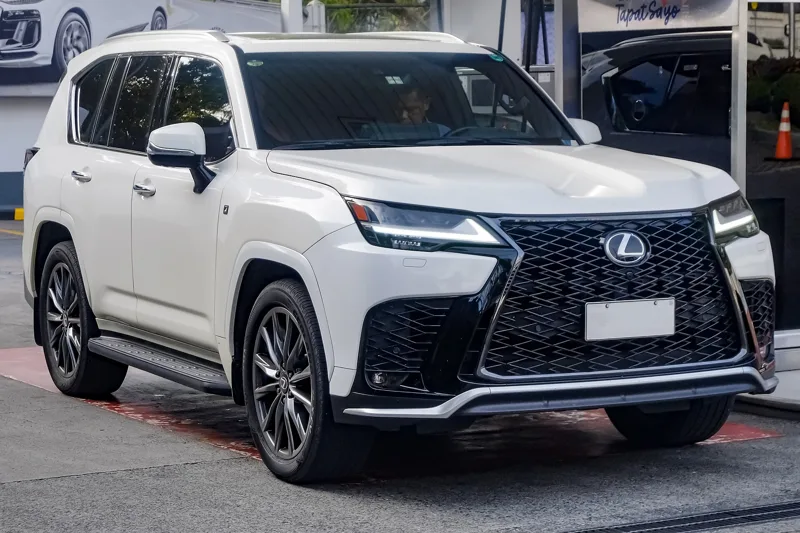
Lexus unveiled the 2008 model year LX 570 at the New York International Auto Show on April 4, 2007. It was a complete redesign, and the first LX to be shown before its Land Cruiser counterpart. Its 5.7 L 3UR-FE V8 produced 286 kW (383 hp) and 546 N m (403 lb-ft), with towing capacity up to 3,900 kg (8,500 lb). A six-speed automatic and an all-new four-wheel drive system with a Torsen centre differential were tied to the engine.
The LX 570 was 102 mm (4 in) longer and 25 mm (1 in) wider than its predecessor, on the same wheelbase, and it used double wishbones at the front instead of a torsion beam, with 230 mm (9 in) of front suspension travel. The rear kept a multi-link suspension with a solid rear axle. Standard 20-inch wheels came with four-wheel electro-hydraulic suspension, and Crawl Control handled off-road obstacles at low speed in either direction. A third of the frame's body mass was high-tensile steel, and Lexus said the platform had logged 240,000 test kilometres through subtropical forests, the Australian Outback and American deserts.
How did the Range Rover L322 come about?
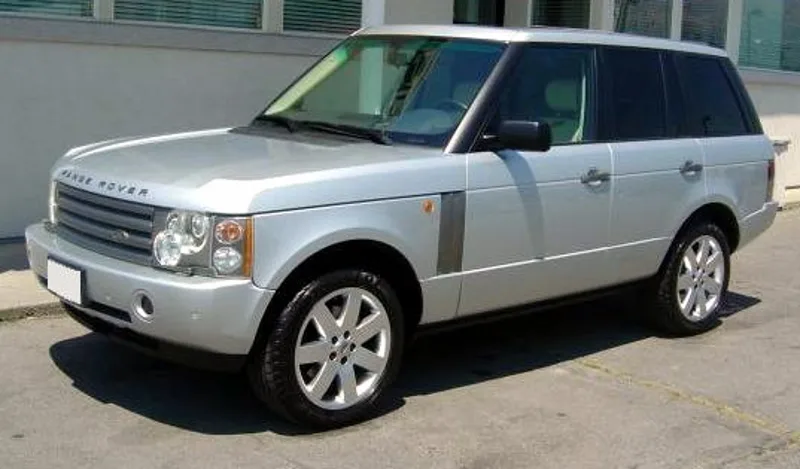
The L322 was the third-generation Range Rover, produced by Land Rover from 2001 to 2012. It was the first Range Rover with a unitary monocoque body, and it switched to independent suspension at all four corners in place of the earlier live axles. It grew in size, and its styling became more butch, as one later account put it.
The car began life as the L30 under BMW's ownership of Land Rover, and it was intended to share electronics and core power units with the BMW 7 Series E38. BMW sold Land Rover to Ford two years before the L322 reached production, and a contract clause kept BMW involved until volume production began. The codename then changed to L322.
What did the L322 change in its engines?
The early L322 used a BMW V8, but the 2006 model year brought a switch to Jaguar's AJ-V8, in 4.4 L form with 300 hp (220 kW) or a supercharged 4.2 L with 400 hp (300 kW). The aluminium engines had torque-based engine management and drive-by-wire throttles, and the supercharged version reached 60 mph in as little as 6.5 seconds. The audio system was a Harman Kardon Logic 7 unit, the first OEM system to use the discrete Logic 7 surround algorithm.
A 3.6 L twin-turbo TDV8 diesel arrived for 2007, replacing the BMW diesel, with 272 hp (203 kW) and 472 lb-ft (640 N m) of torque at 2,000 rpm. It reached 60 mph in 8.6 seconds, which was good for a car weighing about 2.75 tons. Land Rover's Terrain Response system and a redesigned four-wheel-drive control panel also arrived in 2007.
How was the 2010 refresh handled?
The 2010 refresh brought an updated grille, a multicamera vision system, LED-accented bi-xenon headlights and optional blind spot assist. Two new petrol engines were added, a 5.0 naturally aspirated V8 and a 5.0 supercharged V8. The interior received repositioned switchgear and push-button engine start, and a 12-inch TFT display replaced the conventional instrument cluster, showing navigation or suspension schematics depending on the driving mode.
Specifications side by side
| Feature | Lexus LX (LX 450 to LX 570) | Range Rover (L322) |
|---|---|---|
| Launch | LX 450 production November 1995; US sales January 1996 | Production 2001; US 2003 model year, introduced early 2002 |
| Basis | Toyota Land Cruiser, body-on-frame | Unitary monocoque with four-wheel independent air suspension |
| Early engine | 4.5 L inline-six, 215 hp (160 kW) | BMW V8 at launch (replaced by Jaguar AJ-V8 in 2006) |
| Later engine | LX 570 5.7 L V8, 383 hp (286 kW) | 4.2 L supercharged V8, 400 hp (300 kW); 3.6 L TDV8 diesel, 272 hp (203 kW) |
| Torque | LX 570 546 N m (403 lb-ft) | TDV8 472 lb-ft (640 N m) |
| Towing | LX 470 2,900 kg (6,500 lb); LX 570 3,900 kg (8,500 lb) | Not listed |
| Seats | Seven in three rows (first generation); eight in later generations | Not listed |
| Suspension | Solid axles on the LX 450; double wishbones at the front on the LX 570 | Independent at all four corners, air springs |
| Awards | J.D. Power best luxury SUV in initial quality (2000, 2002, 2004) | Not listed |
| Sales | Over 9,000 LX 450s in 1997 | Not listed |
| Price | LX 450 from US$47,995 (1996) | Not listed |
Which luxury off-roader suits which buyer?
The Lexus suits a buyer who wants the reliability and resale strength of a Toyota-derived SUV, with a large V8 and a long line of awards for quality and value. Its frame and solid axles made it a durable working luxury car, and its towing ratings were a strong point.
The Range Rover suits a buyer who prefers the more refined independent suspension and the British design. Its air suspension allowed variable ride height, and its diesel and supercharged engines gave a choice that the LX did not offer in the same way.
Both sold on prestige as much as on capability, and both were built to work on and off the road. On the evidence here, neither car takes a clear overall lead. The LX offers the heavier-duty platform and the better-documented quality record, while the L322 offers the more advanced suspension and the diesel option. Buyers should decide whether they want a Toyota-derived truck with a luxury interior or a British luxury car with a monocoque body.