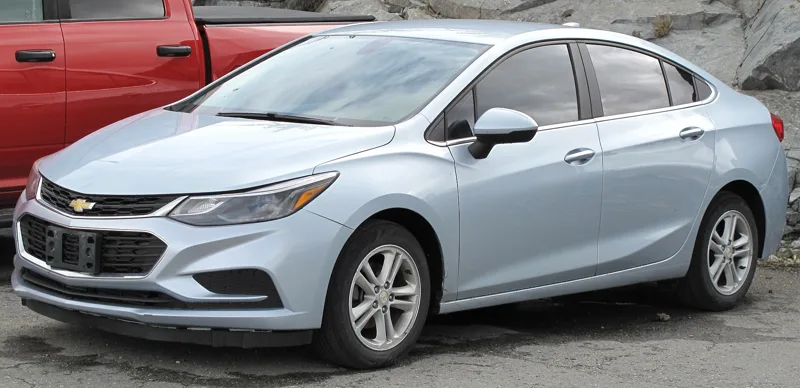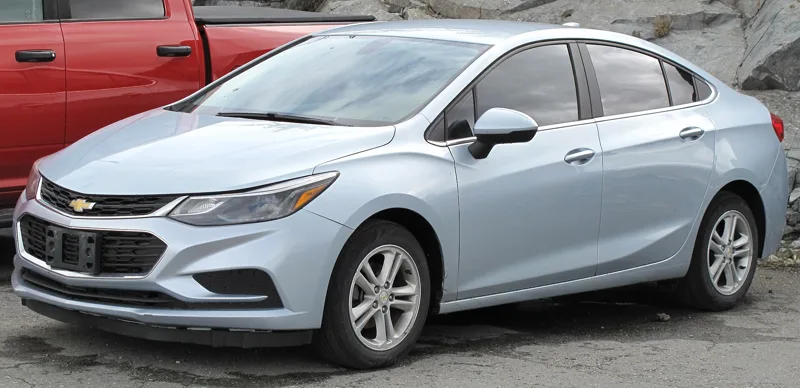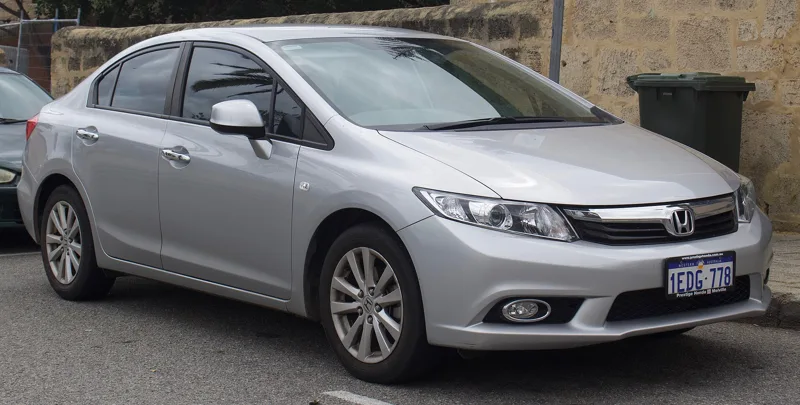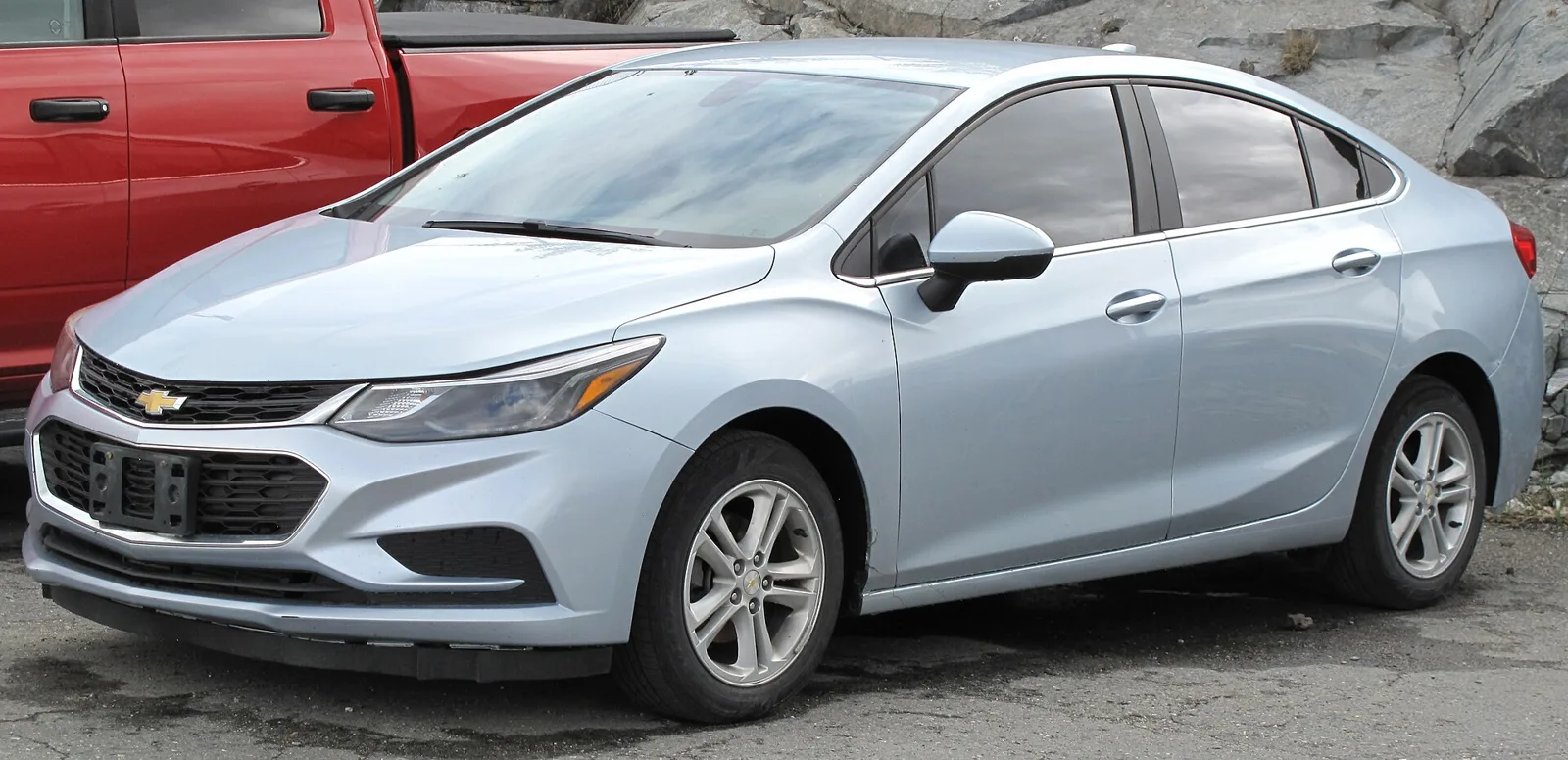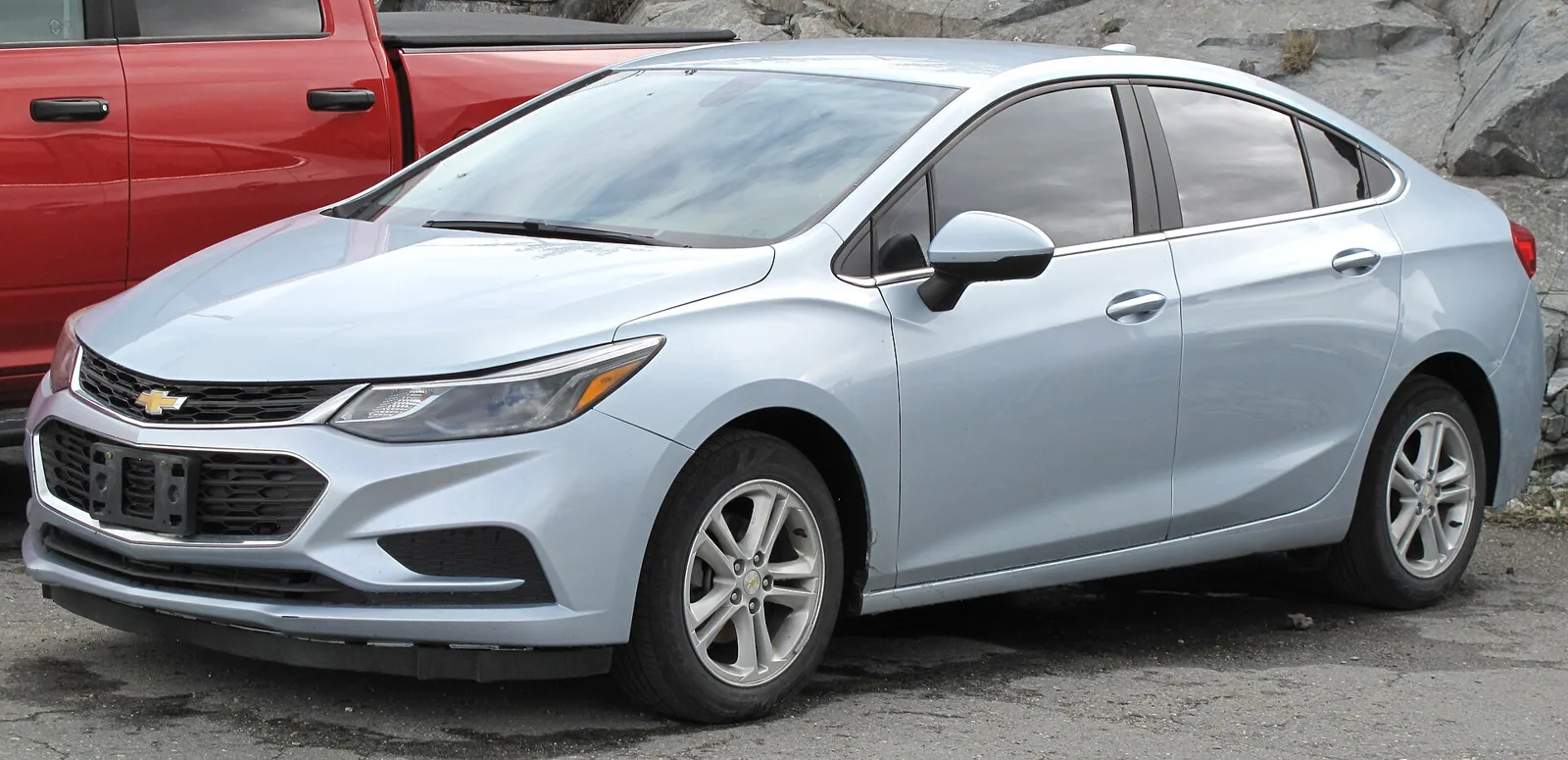
A General Motors compact with strong crash scores and a heavy recall record, set against a Honda that won fuel-economy credit and then faced a rough first review cycle.
The Chevrolet Cruze, produced by General Motors from 2008 through 2023, was rated five stars by ANCAP in 2009. The Civic HF model earned the strongest fuel-economy rating in Honda's range, while the 2012 Civic drew harsh criticism from Consumer Reports.
The Chevrolet Cruze and the ninth-generation Honda Civic were both compact cars that competed for North American buyers from 2011. The Cruze earned five stars from ANCAP and Euro NCAP and was sold until 2023, but it later faced some of the largest recalls in its class. The Civic won fuel-economy credit with its HF and hybrid models, then struggled with a first generation of reviews that were far from kind.
Why were the Cruze and Civic compared?
Both cars were compact sedans built to a global plan, and both went on sale in the United States in the early 2010s. The Cruze reached the US in 2010, while the Civic arrived in April 2011 for the 2012 model year.
The Cruze replaced several earlier compacts, including the Chevrolet Cobalt, the Daewoo Lacetti and the Holden Astra. The Civic, by contrast, was a Honda that set out to make a smaller and more fuel-efficient car, as the company's global plans shifted after the 2008 crisis.
The Cruze name had a history before 2008. General Motors used it between 2001 and 2008 in Japan, Australia (as the Holden Cruze) and New Zealand, on a car derived from the subcompact Suzuki Ignis. Holden's engineers devised the nameplate, and the first version carried a 1.3- or 1.5-litre engine with a five-speed manual or four-speed automatic.
The Civic also had a nameplate history of its own. The HF name had been used last on the 1991 CRX HF, and the Civic's Type R sat on top of the range as the performance model, with the hatchback forming its basis.
A GM compact with strong crash scores and a bruising recall record, set against a Honda that led on economy and then took a hard first year.
How were the Cruze and Civic developed?
The Cruze was launched as the J300 in 2008, mainly developed by GM Korea and built on the front-wheel drive GM Delta II platform. It was a global programme that spent 27 months and US$4 billion, with 221 prototypes tested in seven countries.
GM's global product development chief, Mark Reuss, said the North American Cruze differed from the global car because it needed reinforcement in the engine compartment to fit a bigger engine, and it used a torsion beam rear suspension. Engineers also used an isolated four-point engine mount and extensive sound damping to reduce noise and vibration.
The Civic's development was shaped by the 2008 financial crisis. Honda's CEO Takanobu Ito later explained that the company had believed buyers would accept less upscale content if the car was efficient and affordable, a bet that backfired when rivals raised their own compact quality.
Honda's ninth-generation Civic used a one-motion design with a longer hood and a slightly smaller, lighter body than the car it replaced. The sedan's passenger volume still grew to 94.7 ft3 (2682 L), with three more inches of front elbowroom.
How did the body styles compare?
The Cruze came as a four-door sedan, with a five-door hatchback from 2011 and a station wagon from 2012. Holden in Australia handled the design and development of the hatchback, which was first shown as a concept at the Paris Motor Show in October 2010.
The Civic came as a sedan, coupe, hatchback and station wagon, marketed as the Tourer. The hatchback formed the basis of the Civic Type R, which was released in 2015 and limited to 750 units.
The Cruze wagon offered load space from about 500 litres (20 cu ft) up to nearly 1,500 litres (50 cu ft) with the rear seats folded. Honda also reworked the Civic's interior, with a two-tier dashboard and a 5-inch colour display replacing the trip computer.
What engines did each car offer?
The Cruze used a 1.6-litre Family 1 four-cylinder and a 1.8-litre version of the same engine, plus a 2.0-litre VM Motori VCDi turbodiesel. A five-speed manual or an optional six-speed automatic with Active Select was available across the range.
In the US the Cruze also received a 1.4-litre Family 0 turbocharged petrol engine when it launched in 2010. The 1.8-litre in North America later gained a standard six-speed manual, and a 2.0-litre Family Z diesel replaced the earlier VCDi unit in 2011.
The HF also carried 15-inch alloy wheels with low rolling-resistance tyres that cut rolling resistance by 20%, underbody covers, a rear decklid spoiler and keyless entry with a security alarm. It gained a 4% aerodynamic improvement from those changes.
The Civic's North American range was built around the R18 1.8-litre, the hybrid's 1.5-litre i-VTEC and the Si's 2.4-litre K24Z7. The HF used a 1.8-litre with a five-speed automatic, and the Si took a six-speed manual with a helical limited-slip differential.
The Si's K24Z7 produced 201 hp (150 kW) and 170 lb-ft (230 N-m). Honda retuned the exhaust in early 2014 to raise output to 205 hp (153 kW) and 174 lb-ft (236 N-m), and the Si's redline was 7,000 rpm.
Specifications side by side
| Specification | Chevrolet Cruze | Honda Civic (ninth generation) |
|---|---|---|
| Launch | 2008 globally; US from 2010 | North America April 2011; Europe February 2012 |
| Body styles | Sedan; hatchback from 2011; wagon from 2012 | Sedan, coupe, hatchback and Tourer wagon |
| Engines | 1.6 and 1.8-litre Family 1; 1.4-litre turbo (US); 2.0-litre VCDi diesel | 1.8-litre R18; 2.4-litre K24Z7 Si; 1.5-litre i-VTEC hybrid |
| Transmissions | Five-speed manual or six-speed automatic with Active Select | Five-speed automatic on the HF; six-speed manual on the Si |
| Fuel economy | Not given | HF: 41 mpg-US highway, 33 mpg-US combined; hybrid 44 mpg-US combined |
| Crash rating | ANCAP five stars, 35.04 of 37 points; Euro NCAP five stars | Not given |
| IIHS | 2011 Top Safety Pick | Not given |
| Recalls | 413,418 cars in 2012; 292,879 in 2013 | 50,000 cars in 2012 |
| Reviews | Lowest reliability score among compacts in its first year, per Consumer Reports | Removed from Consumer Reports' Recommended list for 2012 |
| Production ended | South Korea 2018; US and Mexico 2019; China 2020; Argentina 2023 | Generation ran 2011 to 2016 |
Which car used less fuel?
The Civic had the stronger economy story. The HF was the most efficient petrol-only Civic, rated at 41 mpg-US on the highway, and it reached 33 mpg-US combined with a 3.4% drag improvement and a lighter body.
Honda's hybrid was rated at 44 mpg-US combined, an improvement of 3 mpg-US over the previous hybrid. Its 1.5-litre i-VTEC produced 90 hp, and the new electric motor added 23 hp.
No Cruze fuel economy figure is offered. The Civic's Eco Assist system, which Honda said improved hybrid economy by about 10% in Japan, came on most petrol Civics except the Si.
How did the cars perform on crash tests?
The Cruze earned five stars from ANCAP in May 2009, with 35.04 of 37 points, and China's C-NCAP gave it five stars in July 2009. Euro NCAP also gave five stars, with 96% for adult protection and 84% for children.
The Cruze's pedestrian score was only 34%, and its Latin American version earned 4 stars for adults and 3 for infants in 2011. In the US, IIHS named the Cruze a 2011 Top Safety Pick, while it received a marginal rating in the small overlap test.
NHTSA gave the Cruze five stars overall and four for rollover.
Where were the two cars sold outside North America?
The Cruze launched in the Egyptian market in mid-2009, South African sales started in September 2009, and the Chinese market received the car on 18 April 2009 as a sedan built at GM India's Halol factory. Chinese hatchbacks followed in 2013.
The Civic reached China on 29 October 2011 with 1.8-litre and 2.0-litre engines, including a five-speed tiptronic on the 2.0 Type-S. Turkey began LPG-only production in September 2015, and Pakistan's Honda Atlas launched the car in mid-September 2012.
In the Philippines the Civic first arrived in early 2012 with a single 1.8 EXi automatic. The range was filled out after production moved to Thailand, and by 2014 it had been trimmed back to the 1.8 S as the sole trim with no special bodykit.
What recall problems did each car have?
The Cruze's recall history was heavy. In April 2011 GM recalled 2,100 cars for a steering wheel that could break away from the column, and in June 2012 it recalled 413,418 Lordstown-built cars over a risk of engine compartment fires.
The fire recall included 9,547 Australian-built Cruzes, although no engine fires were reported in Australia. In August 2013 GM recalled 292,879 cars over a faulty microswitch that could cut power brake assist, and it cited 27 low-speed crashes that might have involved the fault.
In March 2014 GM halted sales of 1.4-litre Cruzes, about 60% of the model, first without a reason and later citing a faulty right-side axle shaft.
The Civic's recall was smaller. Honda called back 50,000 2012 Civics because an assembly step for the driver's side driveshaft retaining clip was not completed.
How did the critics judge the two cars?
Consumer Reports found the Cruze had the lowest reliability score among compact sedans in its first year.
Reviews of the 2012 Civic were largely lacklustre. Critics pointed to cheap interior materials, worse driving dynamics and modest styling changes, and Consumer Reports dropped the car from its Recommended list after many years on it.
Edmunds added excessive wind noise, cheap interior plastics and a small trunk to the complaints. Honda answered with a heavily revamped 2013 Civic, with a U-shaped honeycomb grille, a reworked rear and better sound insulation.
How did each car change through its life?
The Cruze received a mild facelift for 2013, unveiled at the 2012 Geneva Motor Show, with new fog lamp vents, minor grille and headlamp updates, new alloy wheels and the MyLink entertainment system. Chevrolet announced a refreshed 2015 model at the New York show on 12 April 2014.
The Civic's 2013 model year brought the revamped grille and a reworked rear end, and the base DX trim was discontinued.
Production of the Cruze ended in South Korea in 2018, in the United States and Mexico in 2019, in China in 2020 and in Argentina in 2023. The Civic generation itself ran from 2011 until 2016, when Honda moved on to the tenth generation.
Which car suits which buyer?
On the figures, the Civic suits a buyer who values fuel economy, a hybrid option and a Si for enthusiasts. The Cruze suits a buyer who values a strong crash-test record, a diesel option and the body variants of its hatchback and wagon variants.
The Cruze's early years carry the heavier recall record, so a used Cruze buyer should check whether the steering, fire and brake campaigns were completed on the car in question. The Civic's single recall was smaller, but its first-year reviews were harder to shake. Australian buyers knew the Cruze as the Holden Cruze until 2016, when the sedan was restyled and renamed the Holden Astra Sedan.
Neither car wins outright. The Cruze has the stronger published crash scores, while the Civic has the stronger fuel-economy story. The decision rests on whether a buyer prizes crash results or running costs.