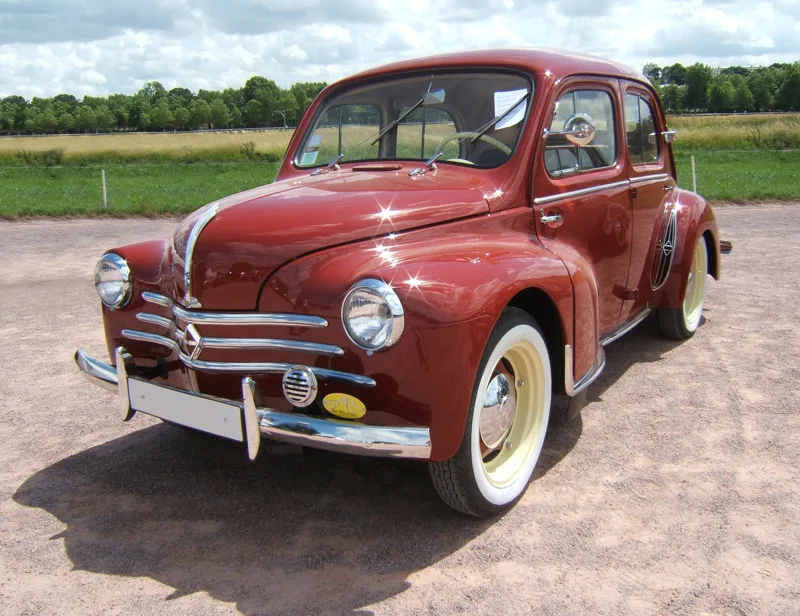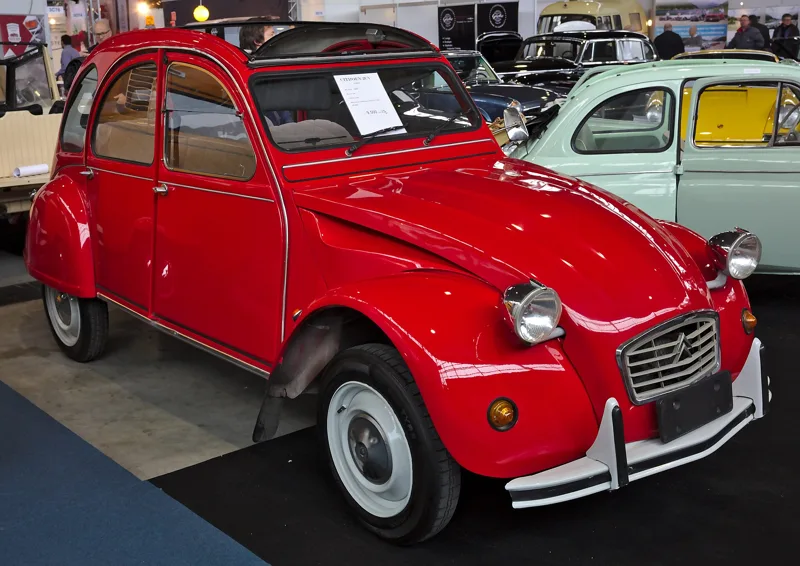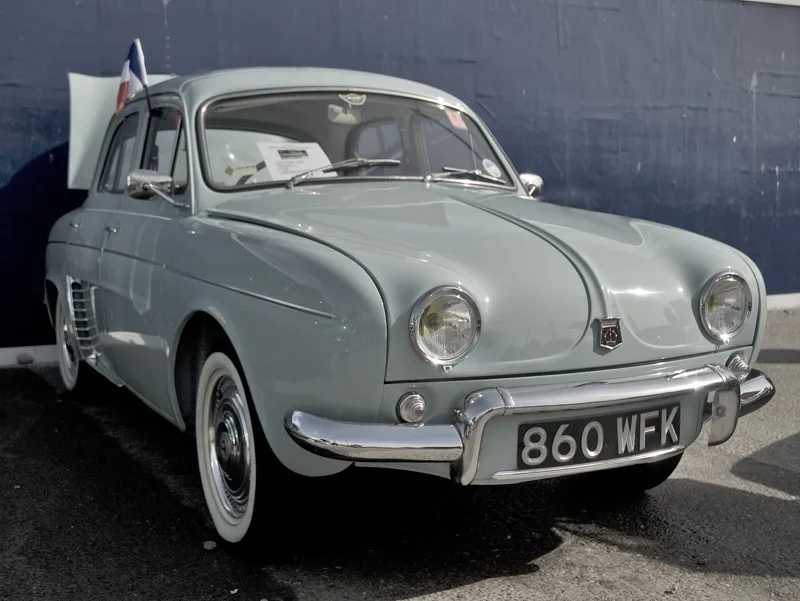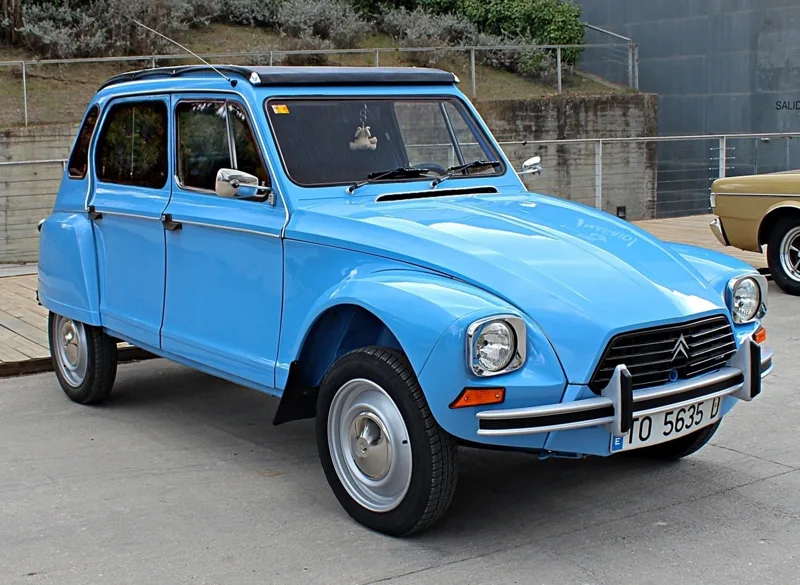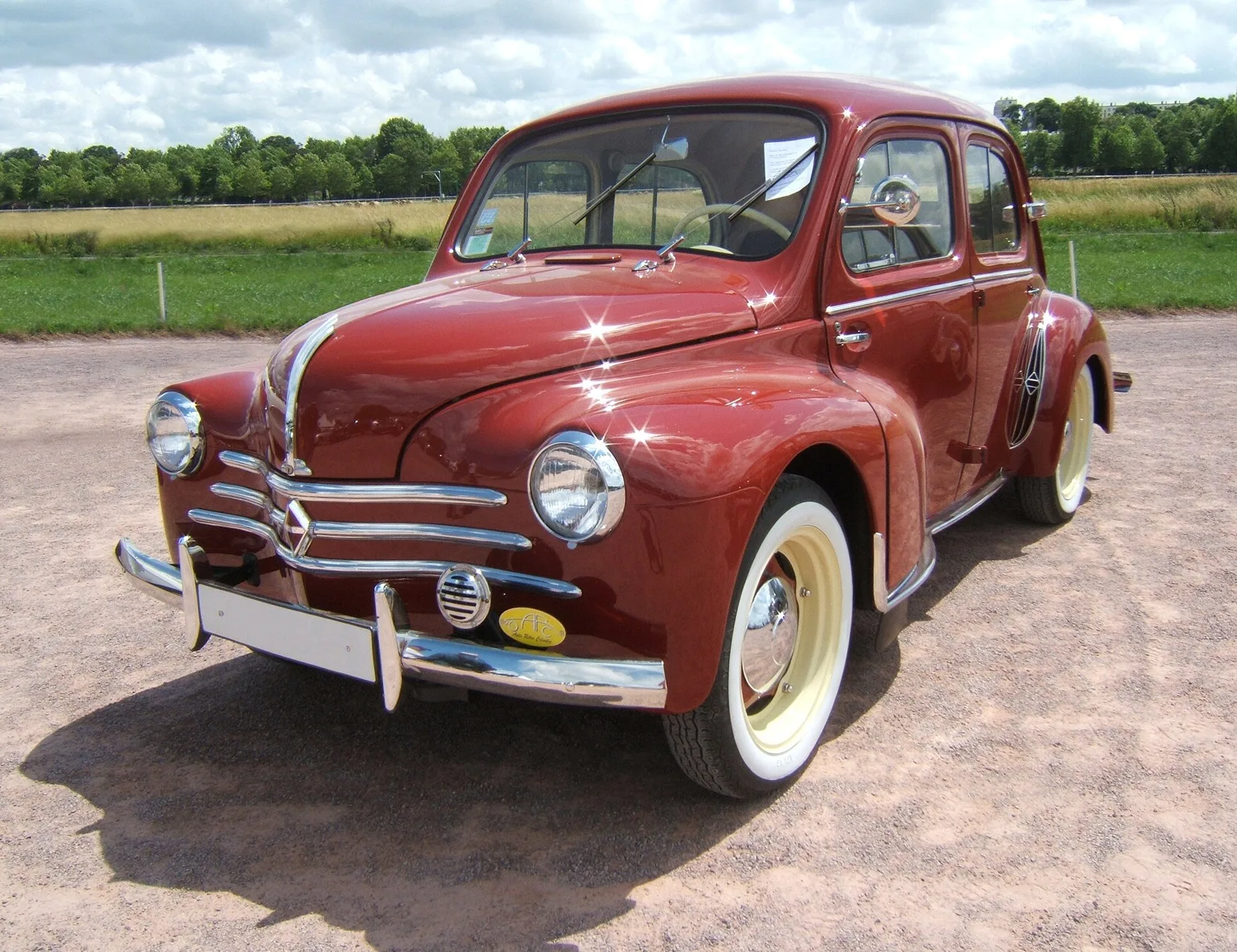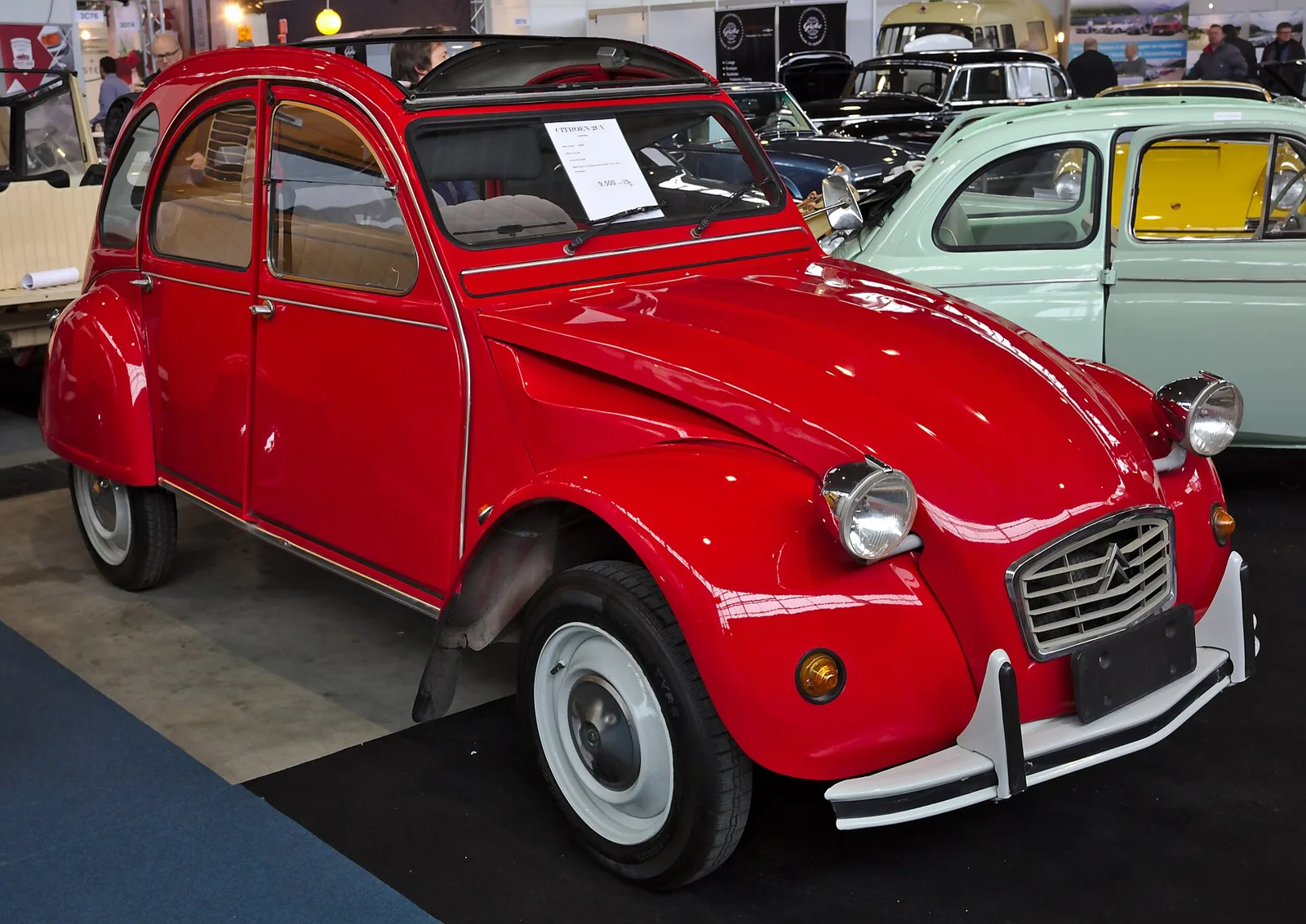
Two French economy cars from the 1940s and 1950s, one a front-drive rural icon and the other Renault's rear-engined postwar answer, compared on design, engines and sales.
The Citroen 2CV and Renault 4CV were French economy cars that competed for postwar buyers. The 4CV was faster and became France's first million-selling car of its kind, while the 2CV had a longer life and a more loyal rural following.
The Citroen 2CV and the Renault 4CV were both French economy cars built for a country that had little money and poor roads. The 4CV went on sale first, in 1947, and the 2CV followed in 1949. They sat in the same market, but their layouts were opposite: the 2CV drove its front wheels with an air-cooled engine at the front, while the 4CV put a water-cooled four in the back.
Were the 2CV and 4CV rivals?
They were, and the 2CV's growth had a direct effect on the 4CV's range. Renault tried a stripped-down 4CV Service in the early 1950s, aimed at buyers at the bottom of the market. It vanished from showrooms after less than a year, and the 2CV's growing popularity may have been part of the reason.
In 1952 the 2CV started at 341,870 francs, and it was bigger than the 4CV. Its rural following was the core of its appeal.
Front drive and an egg test on one side, a rear-engined postwar seller that became the first French car to pass a million on the other.
How did the 2CV come about?
Pierre Boulanger, Citroen's vice-president, conceived the 2CV to help motorise the many French farmers who still used horses and carts. Its brief called for a rugged car that could carry 50 kg of farm goods to market, and an egg had to survive a run across a freshly ploughed field.
The team built 47 experimental prototypes by 1939, and a pilot run of 250 cars followed in mid-1939. Its wartime history was dramatic, and the car finally reached the public at the Paris show in October 1948. The Michelin radial tyre was first commercialised on it.
How did the 4CV come about?
Renault's 4CV was designed in secret during the German occupation, when the company was under orders to build only commercial and military vehicles. A design team led by technical director Fernand Picard, with Charles-Edmond Serre, envisaged a small and economical car for the austerity expected after the war.
Louis Renault himself was at first more interested in the mid-range Juvaquatre and Primaquatre, but he gave the project his approval in May 1941, under the code 106E. The work was officially a low-priority spin-off from an engine project, which kept it out of sight of the German supervisors.
The 4CV was first presented to the public at the 1946 Paris show, and it reached showrooms in 1947. Its name refers to the tax horsepower of the car rather than its engine output, since CV stands for chevaux-vapeur, the French word for horsepower.
Specifications side by side
| Specification | Citroen 2CV | Renault 4CV |
|---|---|---|
| Years on sale | 1948 to 1990 | August 1947 to July 1961 |
| Layout | Front engine, front-wheel drive | Rear-mounted engine, rear-wheel drive |
| Engine | Air-cooled two-cylinder, 375 cc at first | Water-cooled four-cylinder, 760 cc at first, then 747 cc |
| Power | 6.6 kW (9 hp) at first | 17 PS (12.5 kW) in 1950; later 21 hp (16 kW) |
| Top speed | 65 km/h (40 mph) in 1949 | Barely under 100 km/h (62 mph) |
| Body | Fixed-profile convertible with a canvas roll-back roof | Four-door saloon, monocoque, 3.6 m (11 ft 10 in) long |
| Transmission | Four-speed manual | Three-speed manual with no synchromesh on first |
| Total built | Over 3.8 million | 1,105,543 |
Which car was quicker?
The 4CV was faster. Its later 21 hp engine let the car run to just under 100 km/h (62 mph), while the 2CV was limited to 65 km/h (40 mph) in 1949.
The 4CV's 0 to 90 km/h time was quoted at 38 seconds. Its engine was flexible, with second and top gear usable from 5 to 100 km/h, but the absence of synchromesh on first gear kept drivers out of it except when pulling away.
How did the engines differ?
The 2CV's engine was small and air-cooled, with two cylinders and 375 cc at first. It was reliable and economical, but it was not built for speed. Its air-cooled design echoed the Volkswagen Beetle's approach.
The 4CV began with a 760 cc rear-mounted four and a three-speed gearbox. In 1950 that engine gave way to a narrower-bore 747 cc version, which stayed below the 750 cc tax threshold in many markets. Renault later raised the output to 21 hp (16 kW) as higher-octane fuel allowed higher compression ratios.
The 4CV's rear engine also made its steering highly geared, which was a strong point for keen drivers. Its steering needed about two and a quarter turns from lock to lock in the early cars, and that quick action drew warnings about oversteer on wet roads. Later cars needed about four and a half turns.
How did the 4CV and 2CV handle on the road?
The 2CV's long-travel suspension and soft springs gave it a famously gentle ride on rough roads. It handled poor surfaces well, but it was mechanically complex and needed regular lubrication to keep working.
The 4CV's rear-engined layout gave it a different character, with direct steering that demanded attention. Road tests of the time warned drivers to be careful on wet roads, where the rear engine could push the car into oversteer.
How did the postwar market treat the two cars?
The 4CV was France's most popular car in its early years. By mid-1949 some 37,000 had been sold, and in 1950 1,760 of them went to West Germany, which made up 23% of that country's imported cars.
The 2CV's sales took off with a rush. Within months of its launch it had a three-year waiting list, which later grew to five years, and production rose from 876 units in 1949 to 6,196 in 1950 and 16,288 by the end of 1951.
The 4CV was built far beyond France. It was assembled in seven other countries, including Australia, Belgium, England, Ireland, Japan, Spain and South Africa. In Japan Hino built it from 1953 to 1961, and in Spain FASA produced it from 1951 to 1961.
How did the 4CV's successor and rival change?
The Dauphine, which arrived in 1956, took over from the 4CV. The 4CV stayed in production until 1961 and was then replaced by the Renault 4, which used the same engine as the 4CV and sold at a similar price.
The 2CV kept going until 1990, and its family grew to include the Ami, the Dyane, the Acadiane, the Mehari and the Fourgonnette panel van. The 2CV outlasted the 4CV by almost thirty years.
What was the 4CV's motorsport life?
Racers found the 4CV easy to modify, and it saw plenty of track use. It also laid the foundation for the first Alpine and Renault collaboration, the Alpine A106, which took its basis from the 4CV.
That partnership later led to the Alpine A110, which won the 1973 World Rally Championship. The 2CV's fame rested on everyday usefulness rather than competition.
Both cars were launched into a France of poor roads. Horse-drawn vehicles had reappeared in large numbers, and the few engined vehicles often ran on town gas or charcoal gas. The French called those years the grey years, and both designs were shaped by the need for cheap, dependable transport.
How did the wartime and postwar years shape the two cars?
The 2CV's history was shaped by the war. Boulanger refused to collaborate with German authorities and was listed by the Gestapo as an enemy of the Reich. Several prototypes were buried, and the project was hidden from the Nazis.
The 4CV's history was shaped by Porsche. The government invited Ferdinand Porsche to advise Renault in 1945, and Pierre Lefaucheux, who ran Renault after the war, insisted the advice would not influence the design. The car's dummy grille was meant to play down any resemblance to the Volkswagen.
How was the 4CV built?
Production engineering was a strength of the 4CV. Pierre Bezier, who spent 42 years at Renault, designed the transfer lines that machined most of the car's mechanical parts in 1949. The transfer stations moved a part from one workstation to the next, and they were the forerunners of later factory robots.
Renault advertised the hundreds of machine tools and processes installed for the car, presenting it as a reality rather than a prototype. Volume production was said to have started at the Billancourt plant a few weeks before the October 1947 show, though the cars were scarce for the following year.
The 4CV picked up nicknames. Its shape earned it the name La motte de beurre, the lump of butter, and early deliveries used surplus sand-yellow paint from the German army's Afrika Korps vehicles. It later became known affectionately as the quatre pattes, or four paws.
How did the 2CV and 4CV families grow?
The 2CV had its own family from early on. The Fourgonnette panel van was introduced in 1951, and the Ami, Dyane, Acadiane and Mehari followed from the same platform. Those derivatives helped take total output past nine million.
The 4CV family was smaller. Ghia built 50 Beach Wagons in 1961 from consecutively numbered 4CVs, and roughly a dozen are thought to survive. In 1996 Renault marked the car's 50th anniversary with the Fiftie, a two-door, mid-engined concept with styling similar to the 4CV.
How did critics and the press judge the 2CV?
The 2CV was heavily criticised at first, and it became a target for French comedians for a short while. Grudging respect came later, and the German magazine Auto, Motor und Sport called it highly interesting in spite of its ugliness and primitiveness.
In 1951 the car gained an ignition lock and a lockable driver's door, and production reached 100 cars a week. Its critics had been wrong about its appeal to ordinary buyers, and the waiting lists showed how much the public wanted the car.
How did Renault try to reach cheaper buyers?
Early in 1953 Renault launched a stripped-down 4CV with nothing that could be called a luxury. The tyres were narrower, the dummy grille and the chrome headlamp surrounds were removed, and the seats were simplified. The steering wheel went from three spokes to two, and the only colour offered was grey.
The aim was to sell the car for less than 400,000 francs. Renault was preparing the Dauphine at the same time, and a lower 4CV could have opened a clearer gap between the two models. The 4CV Service disappeared from showrooms after less than a year, which disappointed the company.
Which car suits which buyer?
A buyer who wants a practical, characterful car with a front-drive layout and a huge following in rural France will look at the 2CV. A buyer who wants a faster postwar economy car with a rear engine and a strong sales record will look at the 4CV.
Performance favours the Renault. Its top speed of just under 100 km/h (62 mph) sits well above the 2CV's figures from its early years, and its engine was flexible across a broader range.
Neither car is better on every count. The 2CV is the more famous of the pair, and it lasted far longer. The 4CV is the faster car and the first French car to sell over a million units.