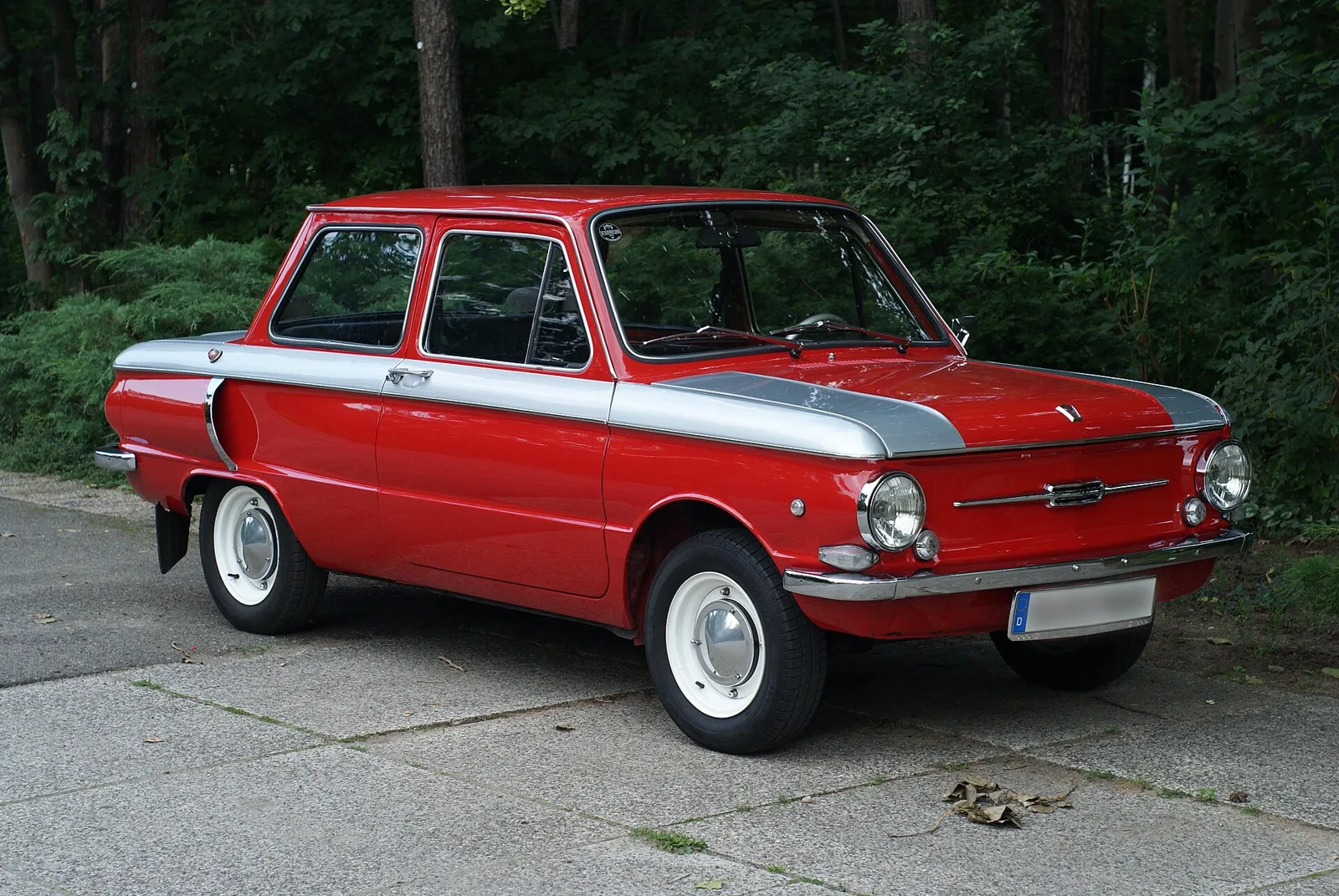
An air-cooled, rear-engined Soviet small car, its overheating V4 engine and the East German test reports that judged it.
The SAS-968 Saporoshez was a two-door, air-cooled, rear-engined small car from the Soviet maker SAS, built from 1971 to 1994. Its V4 engine of 1,196 cc (73 cu in) overheated easily, but it was the only GDR car with almost no waiting time.
The SAS-968 Saporoshez, a small car from the Soviet maker Saporisky Awtomobilebudiwny Sawod, was built from 1971 to 1994 with a two-door body. Its air-cooled engine sat at the rear and tended to overheat, and the car had a poor reputation in East Germany. Even so, it was the only car in the GDR that was available with almost no waiting time.
How was the SAS-968 engineered?
The self-supporting two-door body was styled after the NSU Prinz 4, with an air-cooled V4 mounted lengthways at the rear. Standard cars had 1,196 cc (73 cu in) of displacement and a four-speed gearbox, and drum brakes were fitted all round.
Coil springs were used all round, and the front wheels also had torsion bars running across the car. No anti-roll bars were used at either axle. The front suspension used longitudinal crank arms in a double-crank layout, the rear axle had semi-trailing arms, and the steering used a worm-and-roller gear.
A floor panel fixed at the bottom of the sills gave a flat underfloor, although the high sills made getting in and out harder and narrowed the interior. Large slots on the inside of the sills made anti-rust treatment easy.
In wet conditions the car tended to lose its rear end in corners taken on the throttle, and it was prone to aquaplaning. On loose ground and in snow it did well; a contemporary guide even recommended doing without winter tyres. Snow chains could not be fitted, as the tyres had too little clearance from the suspension arms.
The engine had overhead valves in two outputs: the 40 PS (29 kW; 39 hp) version with 7.2:1 compression, and the 45 PS (33 kW; 44 hp) version with 8.4:1 compression, which is said to have been built only on a trial basis. Overheating was a persistent problem. Even a flawless car saw its oil temperature climb to 110 degrees C (230 degrees F) at full throttle, which pointed to difficult temperatures in the air-cooled cylinders.
Conversion parts, including larger oil sumps, were offered in the GDR, adding 1 litre of oil capacity. Glow-ignition running-on, where the engine keeps firing after the ignition is switched off, happened often on the SAS-968. On the other hand the engine warmed up slowly, which pushed consumption up to 13 l/100 km (22 mpg-imp; 18 mpg-US) on short trips.
Heating was another weak point. An air-cooled rear engine is a poor basis for a heater, so a separate petrol heater was fitted. It could run with the engine switched off, but it could not be adjusted, was fault-prone, and a malfunction risked a car fire. The heater had to be switched off 6 to 8 minutes before reaching a filling station, and many owners fitted a separate tank so the heater could run on cheaper catalyst petrol.
Easy to buy in the GDR, but the air-cooled rear engine tended to overheat.
Engine and performance at a glance
| Item | Figure |
|---|---|
| Standard engine | 1,196 cc (73 cu in), 40 PS (29 kW; 39 hp) at 4,200 to 4,400 rpm |
| Trial 45 PS version | 45 PS (33 kW; 44 hp) at 4,400 to 4,600 rpm |
| Top speed | 118 to 123 km/h (73 to 76 mph) |
| 0 to 100 km/h | 32 s |
| Official fuel use | 7.4 l/100 km (38 mpg-imp; 32 mpg-US) |
| Actual average fuel use | About 11 l/100 km (26 mpg-imp; 21 mpg-US) |
How did the models develop?
The SAS-968 was presented in October 1970, and series production began in 1971 according to the manufacturer's records. The changes from the predecessor SAS-966 were few, mostly extra lights including reversing lights. The SAS-968A followed in 1973 or 1974, and the SAS-968M arrived in 1979 as the last major revision.
The 968A brought a deformable steering column, seat-belt anchorages, a dual-circuit brake system and ECE-compliant door locks, plus an anti-theft device. Its tank grew to 40 litres, and the additional boot behind the rear bench was dropped.
The SAS-968M was built mainly for the Soviet market. It had a smoother body without the large side intakes, rectangular tail lights, new bumpers and a larger boot. Its kerb weight fell by 40 kg (88 lb) to 800 kg (1,764 lb), and it measured 1,490 mm (58.7 in) wide and 3,765 mm (148.2 in) long.
Were adapted versions built too?
Alongside normal production, adapted models were built for physically disabled people and war veterans, fitted with hand and foot controls and sometimes an electromagnetic clutch. At times these versions reportedly made up nearly a third of output. They used the smaller engine of the predecessor, rated at 27 PS (20 kW; 27 hp) and 887 cc (54 cu in), together with the older three-speed gearbox.
How did the car fare in the GDR tests?
The KFT test of 1972 praised the car's road holding, springing and damping, and its suitability for poor and unsurfaced roads. It criticised the low seating position, the indirect steering and the weak safety fittings. The test recorded a top speed of 114 km/h (71 mph), against the factory's 118 km/h (73 mph), and fuel use of 9.8 l/100 km (29 mpg-imp; 24 mpg-US).
The seating position was unusually low and very close to the windscreen, so driving with half-extended arms to the wheel was impossible. Steering, brakes, throttle and clutch all worked indirectly, which took some getting used to.
The test car needed new piston rings at 5,000 km because of thermal overload, and its small boot drew complaints. The safety provisions were judged deficient: brakes that were hard to meter, front seats that could not be locked to the floor, and an ignition lock close to the driver's kneecap. KFT also urged that customer service carry out a zero-kilometre check on new cars before they were sold.
How did it compare with the Trabant?
A 1975 test of the 968A compared it with the Trabant 601. The Saporoshez had a far shorter wait, but it cost about 1.5 times as much as a Trabant. Despite twice the displacement and 14 PS more, it did not accelerate to 90 km/h any faster, and its top speed of 116.5 km/h (72 mph) was largely theoretical.
In engine power the car was superior to the Trabant 601. It was also loud, but its lower frequencies made the noise more pleasant than the Trabant's, and it excelled on bad roads.
The cooling held up only to about 100 km/h, and at full throttle the oil temperature rose above 110 degrees C (230 degrees F) even on a flawless car. Consumption of 10.2 l/100 km (28 mpg-imp; 23 mpg-US) was high for a small car, and a 1977 test over 7,000 km recorded 9.2 l/100 km (31 mpg-imp; 26 mpg-US). Its 11,947 Deutsche Mark (DM) price in 1974 was much higher than the Trabant's.
The heater and the brakes drew the sharpest criticism. The car towed a trailer well thanks to its large-volume rear engine and off-road ability, although its drum brakes were hard to meter. Its tendency to oversteer was less pronounced than on the Skoda 100.
How was it sold in Austria?
In Austria it was sold as the Zaporoshez ZAZ 968 'Eliette' at around 40,000 schillings, which made it by far the cheapest new car. It was the only car of its time delivered as standard with a hand crank, which could be fitted near the rear number plate to help the engine start.
An Austrian motoring magazine test criticised poor starting and strong braking forces that pulled unpredictably and had to be countered with the steering. Its report noted a stubborn run-on that continued after half a tank of premium had been added, and said a carburettor and ignition-timing correction would surely have cured it.
Nicknames and cultural footnotes
Its engine sound was distinctive enough that popular speech dubbed the SAS-968 'T-34 Sport'. In the GDR its rear side air intakes were nicknamed 'ears'. Pixar's animated film Cars 2 based a character, Vladimir Trunkov, on the SAS-968.