A cheap, front-wheel-drive family car from Zwickau that ran on a two-stroke engine, became East Germany's most common vehicle and still draws owners today.
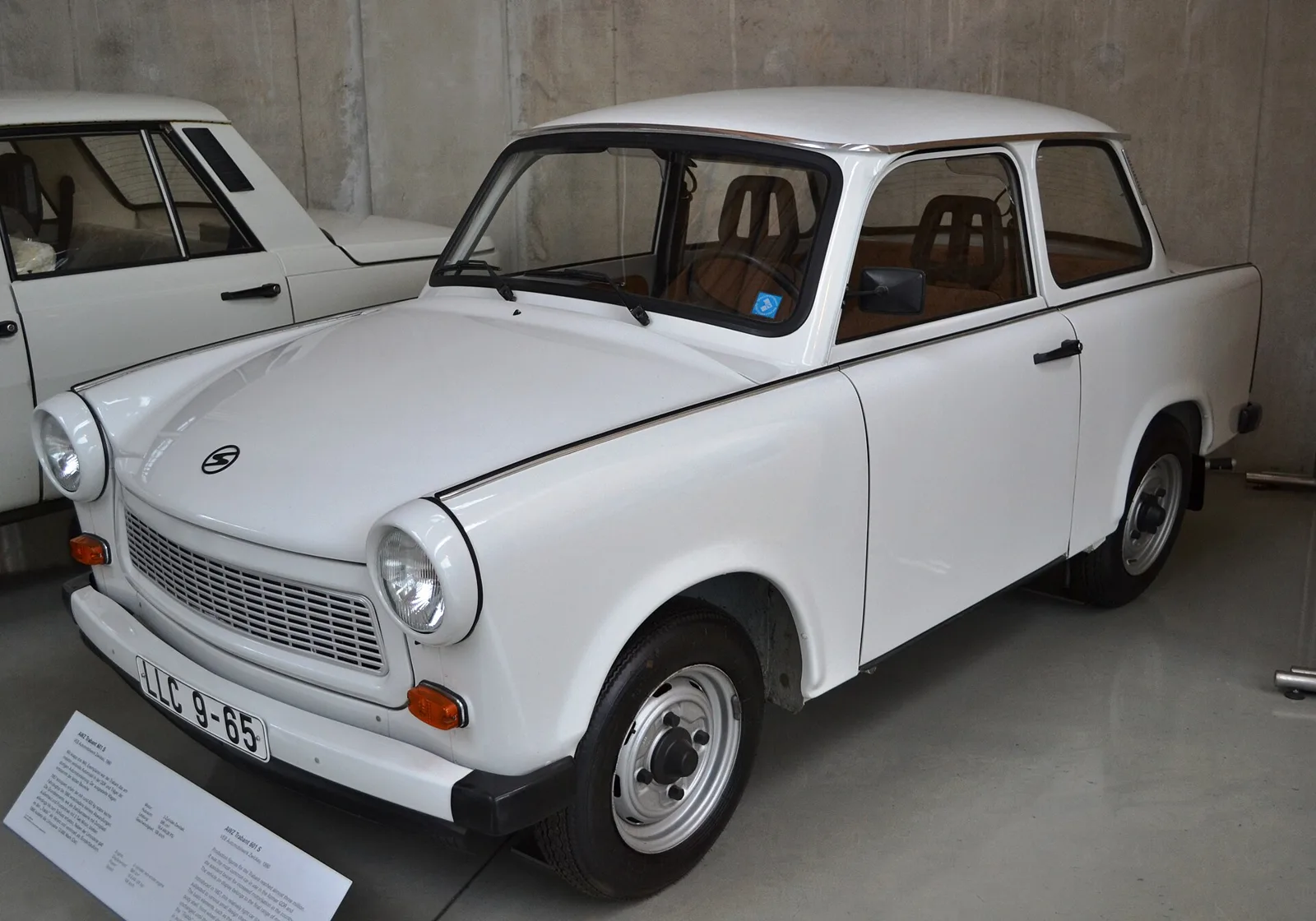
Built in Zwickau between 1964 and 1990, the Trabant 601 was the third Trabant generation. The front-wheel-drive, two-stroke car sold in large numbers and remains the best-known model in the line.
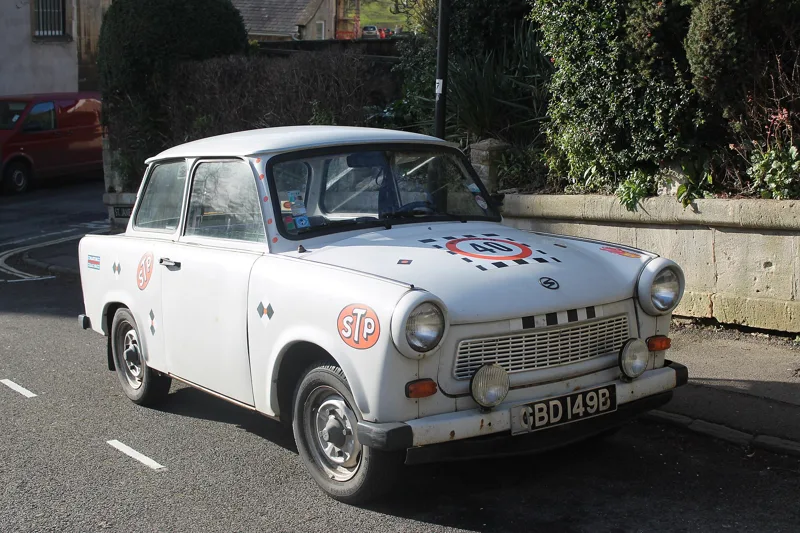
The Trabant 601 was the third generation of the Trabant, built by VEB Sachsenring in Zwickau from 1964 to 1990. It was the longest-running Trabant, with 2,818,547 units produced, and it became the most common vehicle in East Germany. It is often called simply the Trabi.
Where did the 601 fit in East Germany?
The 601 was East Germany's answer to the Volkswagen Beetle, a cheap car that was reliable and easy to maintain. Its engineers gave it front-wheel drive with a transversely mounted engine, unitary construction, rack and pinion steering and independent suspension, all of which were modern features for its day.
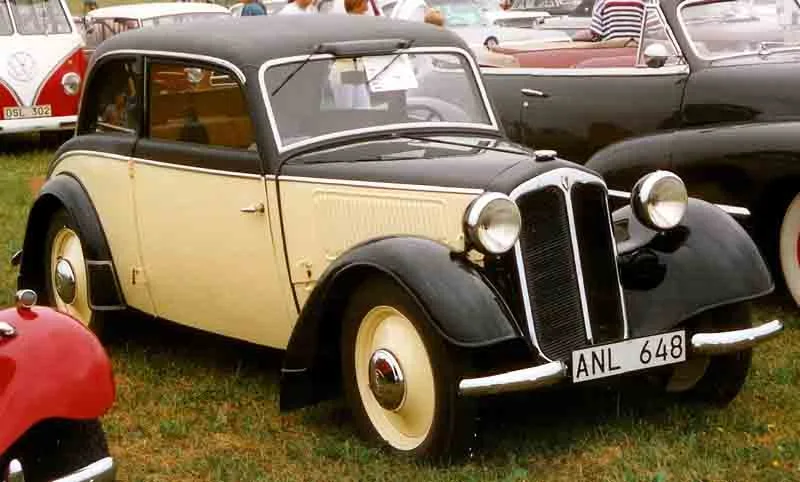
The body was made of Duroplast, a composite material, and the power unit was a two-stroke derived from a pre-war DKW design. That engine was the car's main weakness, although it was competitive when the 601 was launched.
A cheap, reliable car that was easy to repair, built around an engine the rest of the world had left behind.
Why was the two-stroke engine a problem?
Two-stroke engines of this kind deliberately burn some of their lubricating oil and give off smoky exhaust, so they lost ground in the West as cleaner four-stroke engines took over small cars. The Trabant's power unit was competitive at launch but aged badly through the 1960s.
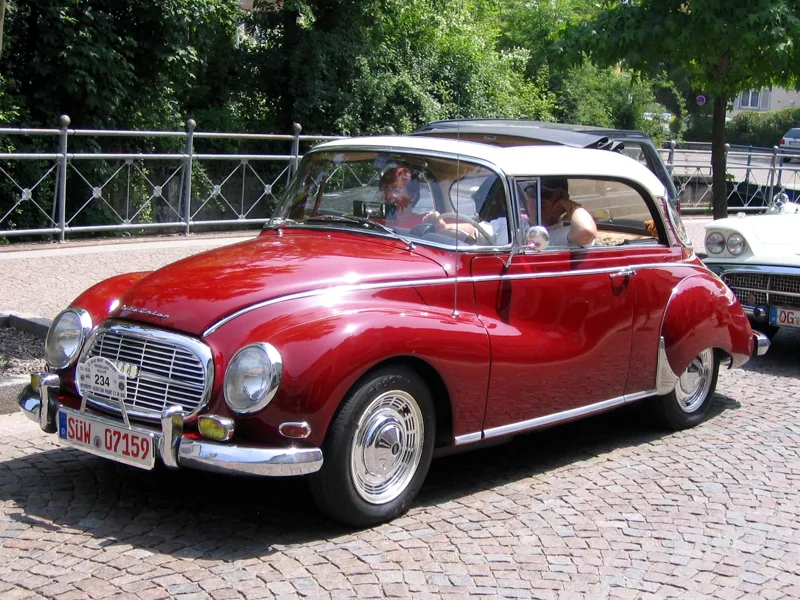
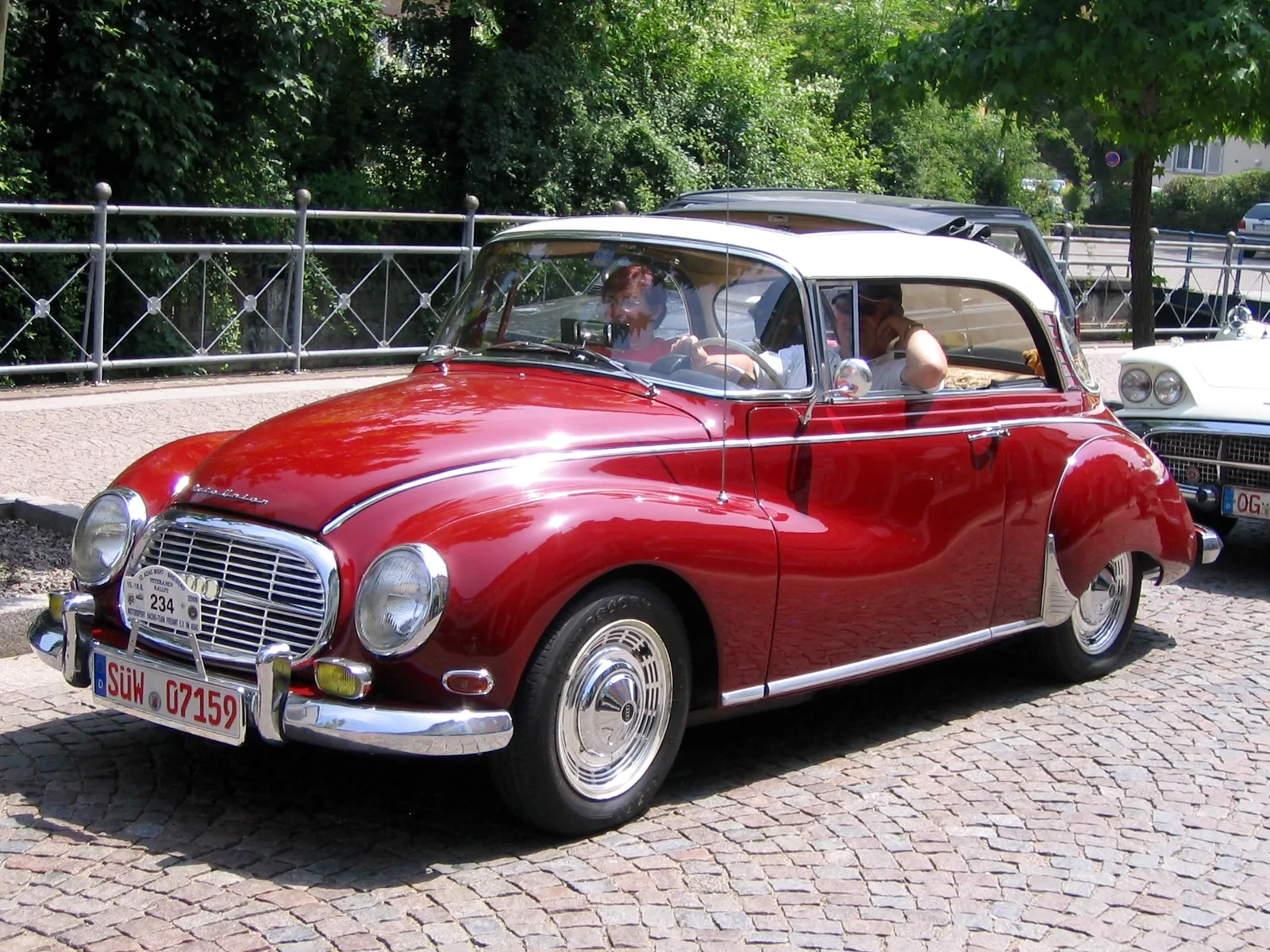
Other two-strokes lasted longer. The West German Auto Union 1000 was built until 1965, and the Swedish Saab 96 only moved to four-stroke power in 1967. East Germany planned a Wankel engine as the replacement, but it never developed a practical version.
How did the 601 change over its life?
The 601 arrived in 1963 as a modern-looking car, with 150 pre-production examples built before full production began. The body was reshaped with more emphasis on the front and roof, and the rear gained new taillights and a higher trunk loading height.
The original P 60 engine produced 23 PS (16.9 kW), and the P62 version offered from 1969 raised that to 26 PS (19.1 kW). A needle roller bearing added to the connecting rod in 1974 allowed a 50/1 lubricant mix, and a two-stage carburettor in 1984 trimmed fuel use by 1/100 L/km. The top speed was measured at 107 km/h, although fuel use could still climb rapidly under hard acceleration or when towing a trailer.
The first production schedule ran only from 1967 to 1971, yet in the end the car stayed in production until 1990. Plans for the P602, P603 and P610 were blocked by the East German government, which regarded the improvements as unnecessary and feared the extra cost.
What did a Trabant cost and how long was the wait?
In 1985 a 601 Standard cost 8,500 Mark, and the priciest variant, the 601 Universal S de Luxe, cost 9,700 Mark. Waiting times of 10 years or more for a new car were not uncommon, so demand stayed high even as the design grew old.
Extras were few, and a shelf beneath the dash and intermittent wipers were among them. When the car moved to 12-volt electrics in 1984, hazard flashers and a rear window heater became available.
Did the Trabant race?
Yes. Eastern Bloc states organised motorsport on a large scale, with equipment largely sourced from behind the Iron Curtain. The 601 was raced on circuits and in rallies, and East Germany had a Trabant-only track category whose cars were affectionately called Rennpappe, meaning cardboard racers.
The 601 gained FIA Group 1 certification in 1967 and was rallied abroad to promote its reliability for export sales. At the 1970 Monte Carlo Rally it took a double class victory in Group 2, under 850 cc, with Eberhard Asmus and Helmut Piehler first and Franz Galle and Jochen Muller second. Both class crews finished 71st and 72nd overall out of 77 finishers from 233 entries.
Monte Carlo cost hard currency, and the government gradually withdrew enthusiastic support for motorsport. The 12-person competition department stayed mostly inside the Eastern Bloc after 1973, although it occasionally entered the 1000 Lakes Rally. Helmut Piehler later led Sachsenring's competition department from 1975 to 1981.
The 601 returned to international rallying in 1985 as the 800 RS, a 771 cc version homologated in June 1985 for Group A (A0). It first competed internationally at the 1986 Finnish Rally, but rivals like the Daihatsu Charade and the Fiat Panda 45 left it behind. The strongest World Rally Championship finish was 50th overall in Finland, taken by Ulrich Weichsel and Jens Richter in 1987.
Which variants of the 601 were built?
The Standard, S and DeLuxe models were sold as a limousine or a universal estate, and several specialist versions followed. The Kubel, a doorless open Jeep-style car with a folding roof, arrived in 1966. The civilian Tramp Kubel followed in 1978, mainly for export to Greece.
- Standard: limousine and universal bodies
- 601 S (Sonderwunsch): fog lamps, a white rear light and an odometer
- 601 DeLuxe: twin-tone colouring and a chrome bumper
- Kubel, from 1966: open Jeep-style body with a folding roof and auxiliary heater
- Tramp, from 1978: civilian Kubel, mainly exported to Greece
- Hycomat (P601 H): automatic clutch, built from 1965 to 1990 in limited numbers
- 800 RS: 771 cc rally version from 1986 to 1988, with an optional five-speed manual
What was the Hycomat?
Hycomat was an automatic clutch actuation system offered as a factory option. It was developed in 1964, entered series production in 1965, and remained available until the two-stroke 601 ended in 1990. Cars with it were designated 601 H.
The first Hycomats used hydraulic actuation, and later versions were electro-hydraulic. A parking lock took the place of the clutch pedal, and the car could be ordered by people with or without disabilities. Around 10 percent of the population had disabilities at the time, many of them from the war, and VEB Sachsenring was one of the few manufacturers of the 1960s to build such vehicles directly from the factory.
From 1982 a disabled-driver version of the Universal was offered too. It came with modified seats and better equipment, plus controls that worked entirely by hand.
How did production end?
Production ran until 1990. Following the 1989 upheaval, Volkswagen agreed to supply a 1.1-litre four-stroke engine for the car, in an attempt to modernise it. The flood of cheaper, more modern Western cars proved too great a challenge, and the factory shut in early 1991.
The Trabant 1.1 that succeeded the 601 looked much like its predecessor. Visually it differed through a new radiator grille, revised bumpers, new taillights, a squarer bonnet and a fuel cap moved to the rear right of the car, while the interior received more changes.
How is the Trabant remembered today?
Many former East Germans have mixed feelings about the car. It is loud and uncomfortable, and it stands for the system that produced it, yet it was also robust, functional and easy to repair, which is why many owners formed a strong bond with it.
The Trabant never stood for the Communist officials, who usually drove Ladas, Polski Fiats or Volgas. It also represents the breaking through of the wall in 1989. Collectors' interest has grown in recent years, green examples are said to bring good luck, and owners' clubs exist across Europe, with many 601s still used in rally racing.
The car has a strong presence in popular culture. The film Go Trabi Go presented it as a kind of East German character, while David Hasselhoff drove one, though he had trouble getting in, and later admitted to being a fan. Stephen Kinzer of The New York Times read the Trabant as a symbol of the people who built it, and the car also appeared in the US film Everything Is Illuminated.
Jalopy, a 2016 road-trip game, is set in June 1990 and has players keeping a fictional Laika 601 running. It also appears as wreckage across City 17 in Half-Life 2, based on the Universal model.