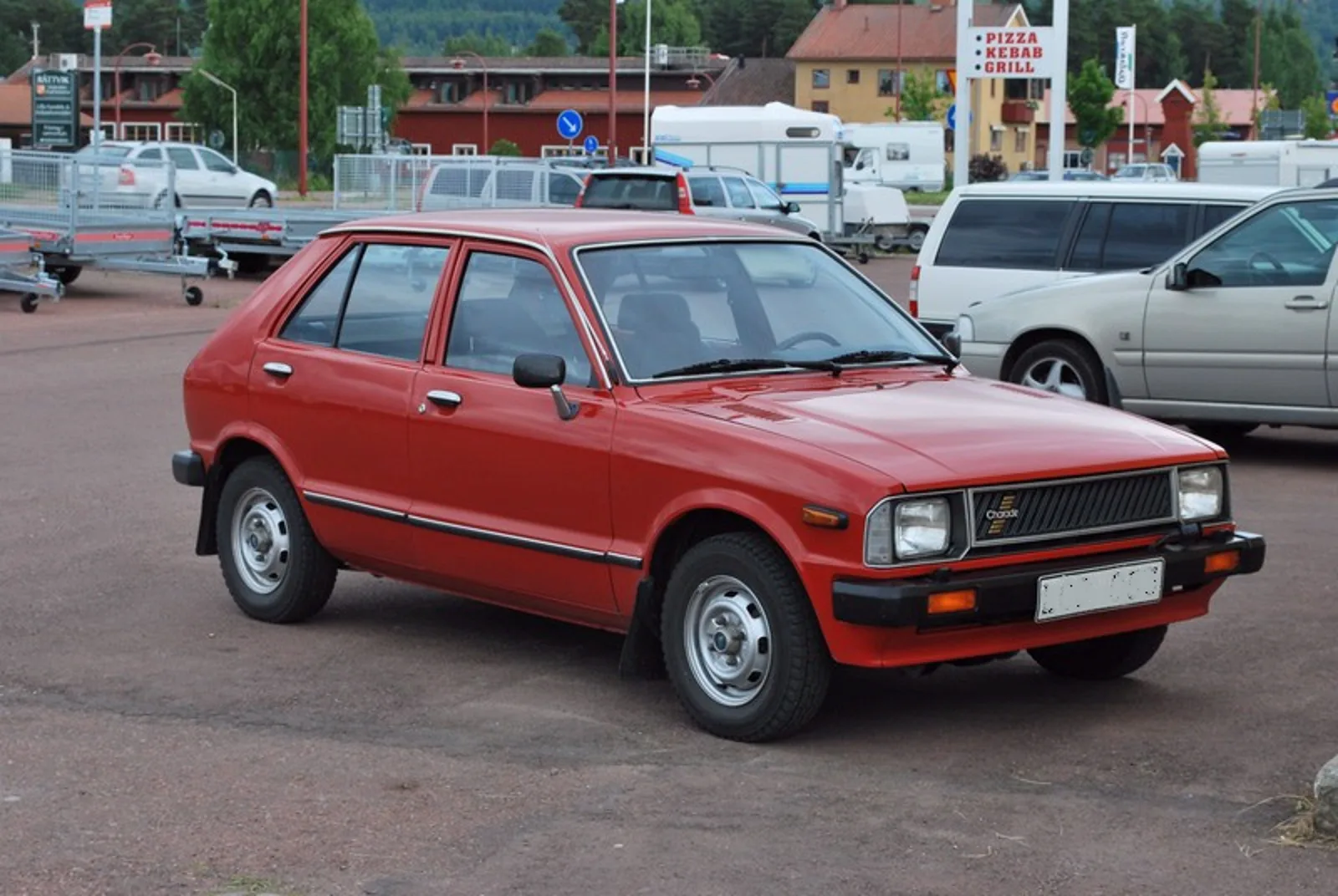
A small Japanese hatchback that sold strongly at home, won rallies, ran a turbo and GTi sporting line and became the Xiali in China.
The Daihatsu Charade was a supermini built from 1977 to 2000 across four generations. It was a strong seller in Japan, won rallies, offered turbo and GTi versions and was copied in China as the Xiali.
The Daihatsu Charade was a supermini that the Japanese maker built from 1977 to 2000 across four generations. Daihatsu described it as a large compact, set apart from the smaller kei cars in its range. It sold strongly at home, went on to win rallies, and became the Xiali in China, where more than 1.5 million cars sold.
Where did the Charade come from?
It succeeded the Consorte, while the Charmant covered the larger-engined Consorte models. The Charade did not share its platform with any Toyota model, which mattered because Toyota later gained a controlling interest in Daihatsu. The first generation, the G10, appeared in October 1977.
The G10 was a front-engined, front-wheel drive car, originally sold only as a five-door hatchback. Its 993 cc three-cylinder engine, the all-aluminium CB20, produced 50 PS (37 kW), and Japanese cars were rated at 55 PS (40 kW) JIS at 5,500 rpm.
A supermini that was a surprise best-seller in Japan, took rally classes and reached China as the Xiali.
Why was the first Charade a success in Japan?
The Charade became a surprise best-seller in Japan at a time when tighter emissions rules had led many observers to see the one-litre car as finished. It became an overnight success and was named Japanese Car of the Year for 1979. The three-door Runabout arrived in the autumn of 1978 with two small circular opera windows in the C-pillars.
Between November 1977 and December 1982, Daihatsu built 89,792 G10 and G20 Charades. The Series 1 car had round headlights, and the Series 2 switched to square headlights from October 1980. The Runabout kept the larger CB20 engine and gained a five-speed manual and a tachometer.
How did the Charade sell in Chile and South America?
Chile and several other Latin American markets took to the Charade in a big way during the 1970s and 1980s. Chilean cars, called G20s, came with an 843 cc version of the three-cylinder engine producing 41 PS (30 kW) at 5,500 rpm. The engine was also used in export versions of the Daihatsu Hijet.
The G20 was a response to Chile's decision in May 1979 to lower import tariffs on cars with engines below 850 cc. It appeared in 1980. It could run on low-octane fuel or even ethanol. The first G20 had round headlights, while the second generation, sold from 1981 to 1984, received the same facelift as the G10.
Which other countries built the first Charade?
In Greece, the Automeccanica company, founded in 1979, built an off-road style torpedo design based on the Charade, with a metal body. Called the Daihatsu Zebra, it used Daihatsu mechanicals, grille and headlights. Production ran from 1981 to 1985, when changing Greek tax laws ended its market as a commercial vehicle.
In New Zealand, the facelifted G10 was assembled locally by General Motors New Zealand from 1981. Before that the original model had been imported fully built up from Japan.
How did the first Charade do in rallying?
Two G10s entered the 2,400 km Tour of Malaysia Rally in 1979 and took first and second places. The G10 went on to win its class at the 1981 Monte Carlo Rally, where it finished 28th overall out of 263 entrants.
At the 1982 Safari Rally the G10 won its class and finished 17th out of 72 starting cars. A Uruguayan driver, Guillermo Viera, campaigned a G10 for years in the 19 Capitals Historic Rally, finishing second overall in 2016.
What did the second generation bring?
The second generation, the G11, was released in March 1983 as a three- or five-door hatchback. It came with several new variations of the three-cylinder 1.0-litre engine, including a turbocharged version and naturally aspirated diesel and turbodiesel engines. The new 1.0-litre diesel engine was tested on 1 September 1983, and one Charade fitted with it ran 10 non-stop laps around the Japanese archipelago over 117 days.
The turbo diesel arrived in the autumn of 1984. Base cars took naturally aspirated CB-series engines, 993 cc in size, delivering between 52 and 60 PS (38 to 44 kW; 51 to 59 bhp). Zero to 62 mph (0-100 km/h) took about 15 to 17 seconds, and the drag coefficient was Cd=0.36. Japanese market models had twin carburettors as standard, while most export cars had a single unit with slightly less power.
How did the Turbo and De Tomaso models differ?
The Charade Turbo and Charade De Tomaso used an upgraded 1.0-litre CB-series engine. The CB50 carried a very small IHI turbocharger and made 80 PS (59 kW; 79 bhp) JIS in Japanese cars. The CB60 gave 68 PS (50 kW; 67 bhp) DIN in European export models, and the tiny turbo needed no intercooler.
Handling was tweaked with heavier anti-roll bars and firmer springs, and alloy wheels replaced the steel ones. The Charade De Tomaso had been shown at the 1981 Tokyo Motor Show as a 1-litre turbo concept developed with the Italian sports car maker De Tomaso Automobili, and the idea reached production in the second generation.
What was the 926 Turbo?
At the 1985 Tokyo Motor Show Daihatsu introduced the 926R, a prototype mid-engined Charade developed with De Tomaso for the World Rally Championship's under-1,300 cc class. The 926 cc twin-cam, turbocharged three-cylinder produced 120 PS (88 kW; 118 bhp), and the car weighed 800 kg (1,764 lb).
Serious accidents in the 1985 championship led to Group B being banned, and the 926R project was abandoned. A small homologation run of 200 Charade 926 Turbos, with a 76 PS (56 kW; 75 bhp) SOHC six-valve engine, had gone on sale in October 1984.
Which Charades were sold in South Africa and Australia?
In South Africa, Alfa Romeo's local subsidiary assembled Charades from March 1983. The only model was a naturally aspirated 1.0 with five doors and the high roof, rated at 60 PS (44 kW; 59 bhp). These cars were also exported to Italy, which had laws that hindered Japanese imports. South African assembly ended in late 1985 when Alfa Romeo closed the subsidiary, and the Charade had accounted for nearly half of Alfa Romeo's South African output that year.
In Australia the second generation began with the high-roofed CC two-seater three-door, while the rest of the range, the CS, CX, CX-A and turbo CX-T, used five-door bodywork. The high-roofed van sold there as the Charade Duet, a route that avoided quotas and some ADR rules.
How did the third generation perform?
The third generation, the G100, debuted in January 1987 with styling by Daihatsu's chief stylist, Hiroshi Aoki, and colleague Hideyuki Ueda. Its more rounded body reached a drag coefficient of Cd=0.32. The engines were carbureted or fuel-injected naturally aspirated and turbocharged 1.0-litre three-cylinder units, plus diesel and turbodiesel versions.
In February 1988 the turbocharged 1.0 was dropped and replaced by a 1.3-litre four-cylinder with a single carburettor or fuel injection. The four was built with lightness in mind, using a hollow crankshaft and camshaft. A permanent four-wheel drive version with the fuel-injected 1.3 was sold as the TXF, CXF or Will, on the G112 chassis.
The sporting range was led by the GTti, a 1.0-litre twin-cam intercooled turbo rated at 105 PS (104 hp; 77 kW) and sold only as a three-door. The GT-XX was rarer, mostly sold in Japan, and added a full bodykit, 14-inch Speedline alloys, air conditioning, power steering, one-touch windows and an electric sunroof.
The third generation also won in rallying. It took its class in the 1988 Monte Carlo Rally and finished second in class at the 1988 Safari Rally, 12th overall behind a Nissan March Turbo. Two 1.3i models finished first and second in class at the 1990 Safari Rally, and GT-XX cars finished fifth, sixth and seventh overall in 1993.
Why did the Charade sell poorly in America?
In the US the third generation ran for five years, 1988 to 1992, and it sold poorly. Its build quality was praised, and the styling suited its segment, but the high price, few dealerships, a rough-running three-cylinder and modest performance all counted against it. Its 0-60 mph (97 km/h) time was about 15 seconds.
Toyota, which had recently gained a controlling interest in Daihatsu, retired the brand from the US market after an abbreviated 1992 model year, but it kept supporting existing owners until at least 2002. Only three-door hatchbacks and four-door sedans were sold there. Just 43,590 Charades found US buyers between 1988 and 1991.
What happened in Indonesia and Taiwan?
G100 assembly started in Taiwan in 1989, while the G11-based Skywing liftback stayed on sale into 1990. Local assembler Yu Tian went bankrupt in 1996 in the middle of a financial scandal.
Daihatsu's Indonesian subsidiary, Astra Daihatsu Motor, started building the G100 in 1987 as a five-door hatchback with the carbureted 60 PS (59 hp; 44 kW) 1.0-litre three-cylinder. In 1990 a 76 PS (75 hp; 56 kW) 1.3-litre four-cylinder Winner hatchback and Classy sedan arrived, with power windows, power steering and alloy wheels. The Classy sedan was updated as the Classy Pro in 1994 and the Classy Royal in 1996, and it was built until 1998.
What did the fourth generation change?
The fourth generation, the G200, was introduced in January 1993 with hatchback bodywork and a sedan later on. It was somewhat larger than its predecessor, with a marginally longer wheelbase, but it stayed very compact. The 1.0-litre engines were dropped in most markets, although the G202 kept a 1.0 for Australia and Brazil, where lower tax applied to engines below 1.0 litres.
The sedan arrived in 1994 with a 1.5-litre engine and optional four-wheel drive. The turbocharged GTti gave way to a more conventional GTi with a 1.6-litre SOHC 16-valve engine. In Japan that car was named after the Argentine ex-racing driver Alejandro de Tomaso, and it made 124 PS (91 kW) JIS. The export GTi was detuned to 105 PS (77 kW) DIN, and De Tomaso added its own bodykit, Recaro seats and Pirelli tyres.
A total of 120,000 Charade GTis were built after that joint effort. The Charade was restyled in 1996 with a smiley face grille and new headlights, looking more like its Toyota sibling, the Starlet. Production ended in 2000, when the car was replaced by the Sirion and Storia.
Where did the Charade name go after 2000?
In Australia the name had earlier been used for the L500 series of the Daihatsu Mira, sold there as the Charade Centro between March 1995 and 1998. The badge reappeared in 2003 in Europe, Australia and South Africa, on a rebadged Mira L250 with a 1.0-litre inline-four in three- or five-door form.
The Australian version was dropped in 2006 when Toyota retired the Daihatsu nameplate there. South Africa sold the Mira L275 as the Charade from 2007 until about 2011. From 2011 to 2013 Daihatsu Europe offered the French-built Toyota Yaris XP90 under the Charade name, its last use in Europe.
Which Chinese copies came from the Charade?
In China the Charade became the Xiali. Tianjin FAW assembled the TJ730 from G11-based knock-down kits between 1986 and 1988. It was replaced by the TJ7100 and TJ7100U, based on the G100 and G102. The hatchback began production in 1988 and the sedan arrived in October 1990 for the 1991 model year.
The Xiali was also a Beijing taxi through the 1980s and 1990s, in red livery with white Chinese characters, until it was retired in February 2006. Several other Chinese makers built Xiali derivatives, including Zhonghua, Liangjing and an MPV from Anda'er. Chinese production of the basic design was spread across many brands, and many of them were later discontinued.
What are the Daihatsu Charade specifications?
| Specification | Detail |
|---|---|
| Built | 1977 to 2000 by Daihatsu |
| First generation engine | 993 cc three-cylinder CB20, 50 PS (37 kW) |
| Japanese first generation | 55 PS (40 kW) JIS at 5,500 rpm |
| Chilean G20 engine | 843 cc three-cylinder, 41 PS (30 kW) at 5,500 rpm |
| Second generation naturally aspirated | 52-60 PS (38-44 kW; 51-59 bhp) |
| CB50 turbo | 80 PS (59 kW; 79 bhp) JIS |
| CB60 turbo | 68 PS (50 kW; 67 bhp) DIN |
| Second generation 0-100 km/h | About 15 to 17 seconds (0-62 mph) |
| Drag coefficient | Cd=0.36 second generation; Cd=0.32 third generation |
| Third generation GTti | 1.0-litre twin-cam turbo, 105 PS (104 hp; 77 kW) |
| Third generation 1.3-litre | Four-cylinder HC-E from February 1988 |
| Fourth generation GTi | 1.6-litre SOHC 16-valve, 124 PS (91 kW) JIS; 105 PS (77 kW) DIN export |
| Turbodiesel economy | 2.74 L/100 km (85.9 mpg-US) claimed at 60 km/h |
| Total GTi production | About 120,000 cars |