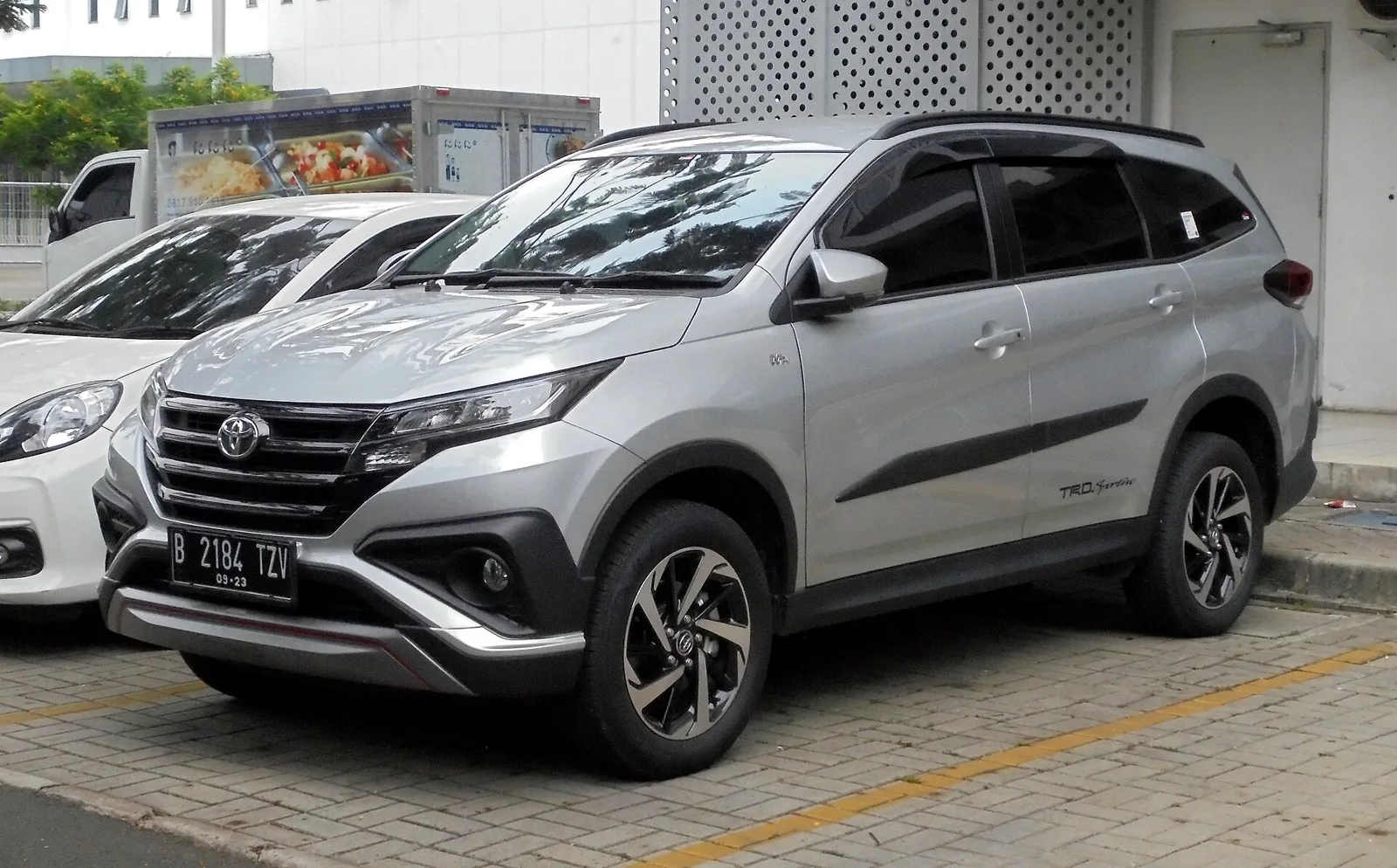
A rear-wheel-drive mini SUV from 1997 that grew through three generations, wore several badges abroad and now sells only in Indonesia.
Terios is a mini SUV from Daihatsu, built since 1997 across three generations with rear-wheel drive as standard. Since 2016 it has been sold only in Indonesia, where the third generation remains on sale in facelifted form after a 2023 update, and four-wheel drive was offered only on the first two generations.
Daihatsu began building the Terios in 1997 as the successor to the F300 series Rocky, and it has been sold in some form ever since. The mini SUV went through three generations, and Toyota and Perodua also sold versions of it under their own nameplates. Since August 2016 it has been offered only in Indonesia.
Rear-wheel drive has been standard on every generation, while four-wheel drive was offered only on the first two. The car's character shifted as it moved from a five-door wagon toward a streamlined, crossover-style body, and its name is said to mean roughly making dreams come true.
Where did the Terios come from?
The first Terios was initially previewed as the MS-X97 and reached the market as a five-door wagon with model codes J100, J102 and J122. A smaller kei car called the Terios Kid arrived in October 1998, and it was released only in Japan. Daihatsu had built the original car since 1997.
In 2000 Daihatsu gave the car a facelift. A new chrome grille replaced the black plastic one, and the high-grade model gained electric windows, central locking and alloy wheels. Under the bonnet, the 1.3-litre SOHC engine was replaced by a 1.3-litre DOHC unit, and power rose by 3 kW (4 hp; 4 PS).
Australia received a limited sports series in 2001, with only 200 units built. It came with body-colour bumpers, and a rear spoiler and sunroof were standard, which set it apart from the regular car.
Venezuela also played a part in the story. Production there began in November 2001 and made it the first Daihatsu assembled in that country. Sales reached 33,000 Terios and 97,000 Terios Kid units by the close of 2002, which shows that the kei version outsold the main car by a wide margin.
The Terios began as a five-door wagon and became a crossover-styled family car sold almost entirely in Indonesia.
How did the second generation change the Terios?
The second generation, coded J200 for short-wheelbase cars and F700 for long-wheelbase ones, went into production in January 2006 on a built-in ladder frame monocoque body. Daihatsu also supplied the same vehicle to Toyota as the Rush. In Indonesia both models came only as long-wheelbase, rear-wheel-drive cars.
The concept behind it, the D-Compact 4x4, appeared at the 61st Frankfurt Motor Show in September 2005. Daihatsu claimed the ladder frame struck a balance between lighter weight, higher rigidity and comfort, and that balance shaped the production car.
In Japan the second generation became the Daihatsu Be-go, a name built from the words being and going, and the Toyota Rush. Both were announced on 17 January 2006 and used either a 1.3-litre or a 1.5-litre engine. Only the 1.5-litre car was offered in two-wheel and four-wheel drive, and its permanent four-wheel-drive system used a lockable central differential but had no low-ratio gears.
Indonesia received the second generation on 14 December 2006. Three-row seating was standard on the Terios and optional on the Rush, and the Terios launched in TS and TX grades, with the Rush offering G and S trims.
Changes followed steadily. The Terios and Rush received their first facelifts on 5 and 6 October 2010 respectively, and in August 2013 the Terios gained ABS and dual airbags for the first time. Those were meaningful additions for a car that had previously gone without them.
What changed with the third generation?
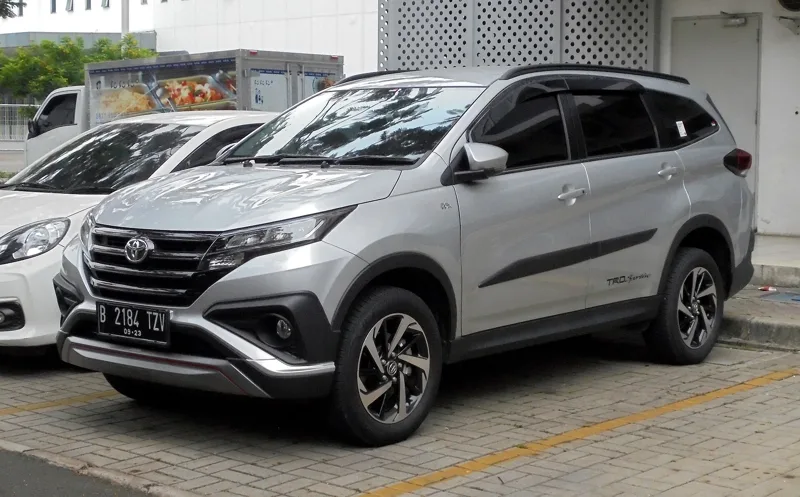
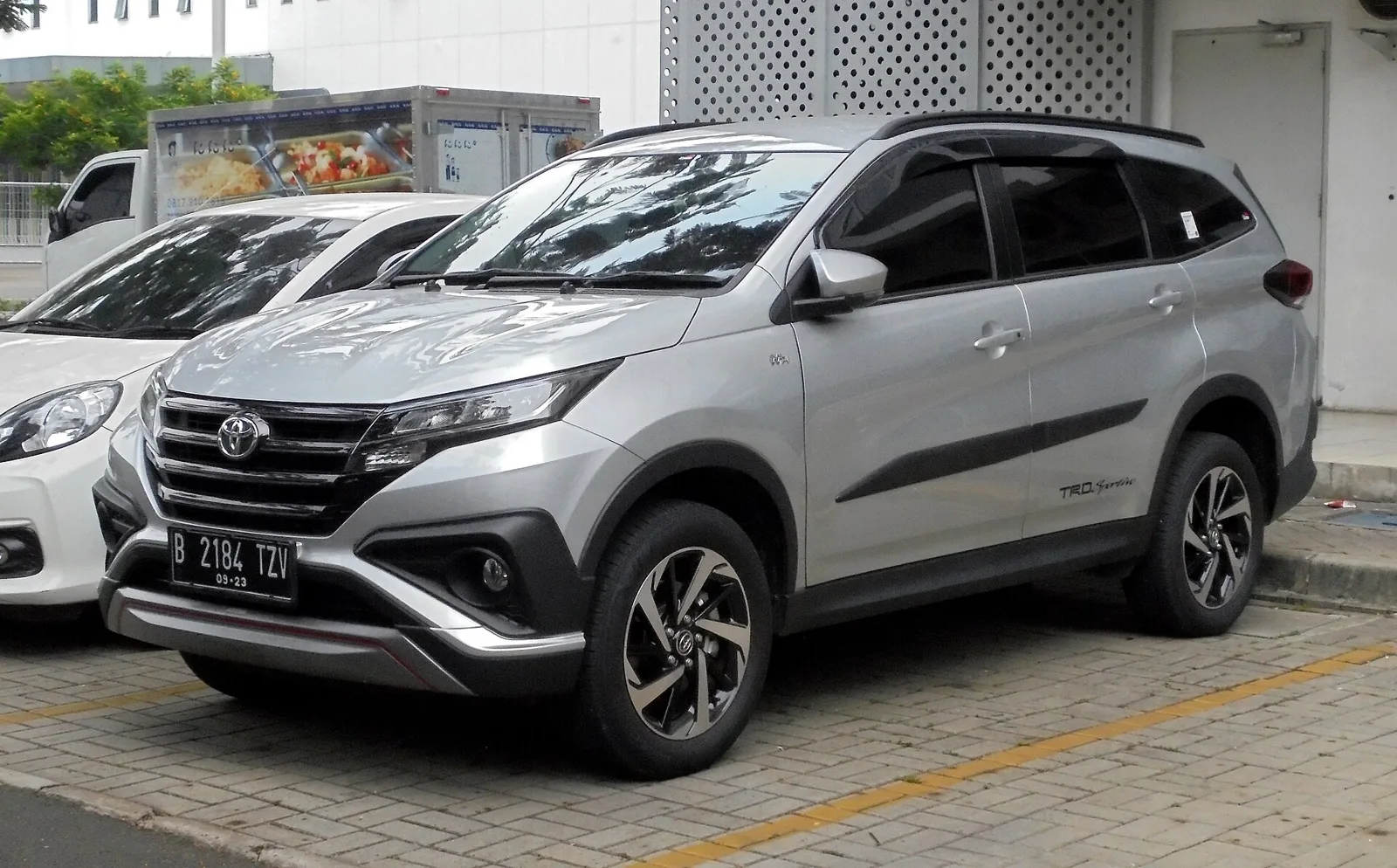
The third generation was unveiled in Indonesia on 23 November 2017 and went on sale on 3 January 2018. It was offered only as a long-wheelbase, three-row car with no four-wheel drive option, and it relied on the 1.5 L 2NR-VE engine also found in the Avanza and Xenia.
Development was led in 2015 by chief engineer Eiji Fujibayashi, and the look drew on the FT Concept. The body grew more streamlined and crossover-like. A rear liftgate replaced the side-opening door, and the spare tyre no longer hung from the back door.
Karawang joined the Sunter plant as a production site from August 2019 because demand was high. Storage measured 217 L (7.7 cu ft) with the third-row backrest folded down, rising to 514 L (18.2 cu ft) when the row was tumbled up.
A facelift on 8 June 2023 brought X, R and R Custom grades, and the X Deluxe and R Deluxe trims were dropped. The 2026 GIIAS show then saw a Special Edition of 20 units, which marked the latest step in the car's Indonesian run.
Which markets sold the Terios and its twin models?
Outside Indonesia and Japan, the Terios and its relatives were sold across Asia, Africa and the Middle East under several names. The most useful way to read the family is by market, since the same vehicle often wore a different badge in each country.
Indonesia was the home market for most of the story. The Taruna, the second generation and the third generation all sold there, and Karawang became a second production site as demand grew. Since August 2016 the Terios has been sold nowhere else, which makes Indonesia the one market that matters for the car today.
China had its own story. Zotye built the 2008 and 5008 versions, while FAW badged its version as the Dario Terios. Daihatsu withdrew from China in 2009, selling the tooling to FAW, which had been its joint venture partner there.
Malaysia produced several versions. The full-time four-wheel-drive Terios was assembled locally as the Perodua Kembara, which was unveiled in August 1998. The Perodua Nautica was a rebadged short-wheelbase car, and only 489 units were sold before it was discontinued in 2009. Toyota Rush sales began in January 2008 and ended in January 2024 because of low sales.
In Japan the Toyota Cami was a rebadged first-generation car sold from May 1999. The Be-go and Rush were discontinued in March 2016, and their successor, the A200 series Rocky and Raize, arrived in November 2019.
South Africa received the second generation in 2006 as a short-wheelbase 4x4 and 4x2 model, and a three-row version followed in 2008. The Rush later reached the United Arab Emirates in May 2018, where only a seven-seat version was offered.
Which engines powered the Terios?
First-generation Terios cars ran 1295 cc and 1297 cc petrol engines, with a turbocharged option rated at 140 PS (103 kW; 138 hp). The Indonesian Taruna used 1589 cc and 1498 cc units, and the third generation used a 1.5 L 2NR-VE. Each step kept the same basic layout while the engines changed around it.
The J100G, built from 1997 to 1999, used an 1295 cc SOHC engine rated at 89 PS (65 kW; 88 hp) and was the four-wheel-drive variant. The J102G, from 2000 to 2004, moved to a 1297 cc DOHC unit making 92 PS (68 kW; 91 hp). The K3-VET turbo, also a 1297 cc DOHC design, lifted output to 140 PS (103 kW; 138 hp).
The Indonesian Taruna began with a 1.6-litre HD-C carburettor engine rated at 85.7 PS (63 kW; 85 hp). A fuel-injected HD-E followed in April 2000, producing 90.4 PS (66 kW; 89 hp). From August 2001 the C-series used a fuel-injected 1498 cc HE-E rated at 86.1 PS (63 kW; 85 hp).
The Perodua Nautica used a 1.5-litre DVVT engine with full-time four-wheel drive. The third generation relied on the 1.5 L 2NR-VE, while Japanese second-generation models offered 1.3-litre or 1.5-litre choices.
What were the Terios Kid and Taruna?
The Terios Kid was a kei car sold in Japan with a 658 cc turbocharged engine, while the Taruna was Daihatsu's Indonesian version with a 5+2 or seven-seat layout. Both ended production before the third generation of the Terios arrived in Indonesia in 2017.
The Kid's four-wheel-drive version arrived in October 1998, and a rear-wheel-drive version followed in January 2000. Power ran from 60 PS (44 kW; 59 hp) to 64 PS (47 kW; 63 hp) across the Kid range. A facelift came in 2003, and production ended in June 2012.
The Terios Lucia was a limited version sold from January 2002 to August 2003. It was based on the Kid, and the rear spare tyre was removed.
The Taruna went on sale on 1 July 1999 as a short-wheelbase C-series with 5+2 seating. The long-wheelbase F-series, with seven seats, followed in August 2001. A facelift in March 2005 introduced the Taruna Oxxy name, and production ended in late 2006 when the F700 series took its place.
Did the Terios face recalls or awards?
The Terios won a Red Dot Design Award in 2006, and it was named Good Design Indonesia of the Year in July 2018. Its sibling, the Rush, was recalled in 2019 over side curtain airbags, but the Terios was not affected because it never had those airbags fitted.
The recall was announced on 15 July 2019 and covered about 60,000 Indonesian Rush vehicles built between December 2017 and February 2019. The airbag control module had been programmed improperly, so a pothole or dent could be read as a collision. That could make the side curtain airbags deploy during normal running.
The episode shows how one fault can reach several badges at once, since the Rush was closely related to the Terios. The Terios escaped the problem only because it lacked the side curtain airbags in the first place.
What are the Daihatsu Terios specifications?
Across three generations the Terios kept rear-wheel drive as standard, and four-wheel drive was limited to the first two. First-generation engines ran from 1295 cc to 1297 cc, while the latest model runs a 1.5 L 2NR-VE. The table below sets out the main figures for each generation, along with the Perodua Nautica and Special Edition details.
| Specification | Detail |
|---|---|
| Generations | Three; codes J100/F500, J200/F700, F800/F850 |
| Drive | Rear-wheel drive standard; four-wheel drive on first and second generations |
| First-generation engine | 1295 cc SOHC, 89 PS (65 kW; 88 hp), 4WD on J100G |
| Facelift engine | 1297 cc DOHC, 92 PS (68 kW; 91 hp) |
| Turbo engine | 1297 cc DOHC turbo, 140 PS (103 kW; 138 hp) |
| Third-generation engine | 1.5 L 2NR-VE |
| Third-generation storage | 217 L (7.7 cu ft) with third row folded; 514 L (18.2 cu ft) tumbled up |
| Perodua Nautica | 1.5-litre DVVT, full-time 4WD, 489 units sold |
| Special Edition | 20 units, unveiled at 2026 GIIAS |
,_South_Tangerang.jpg)