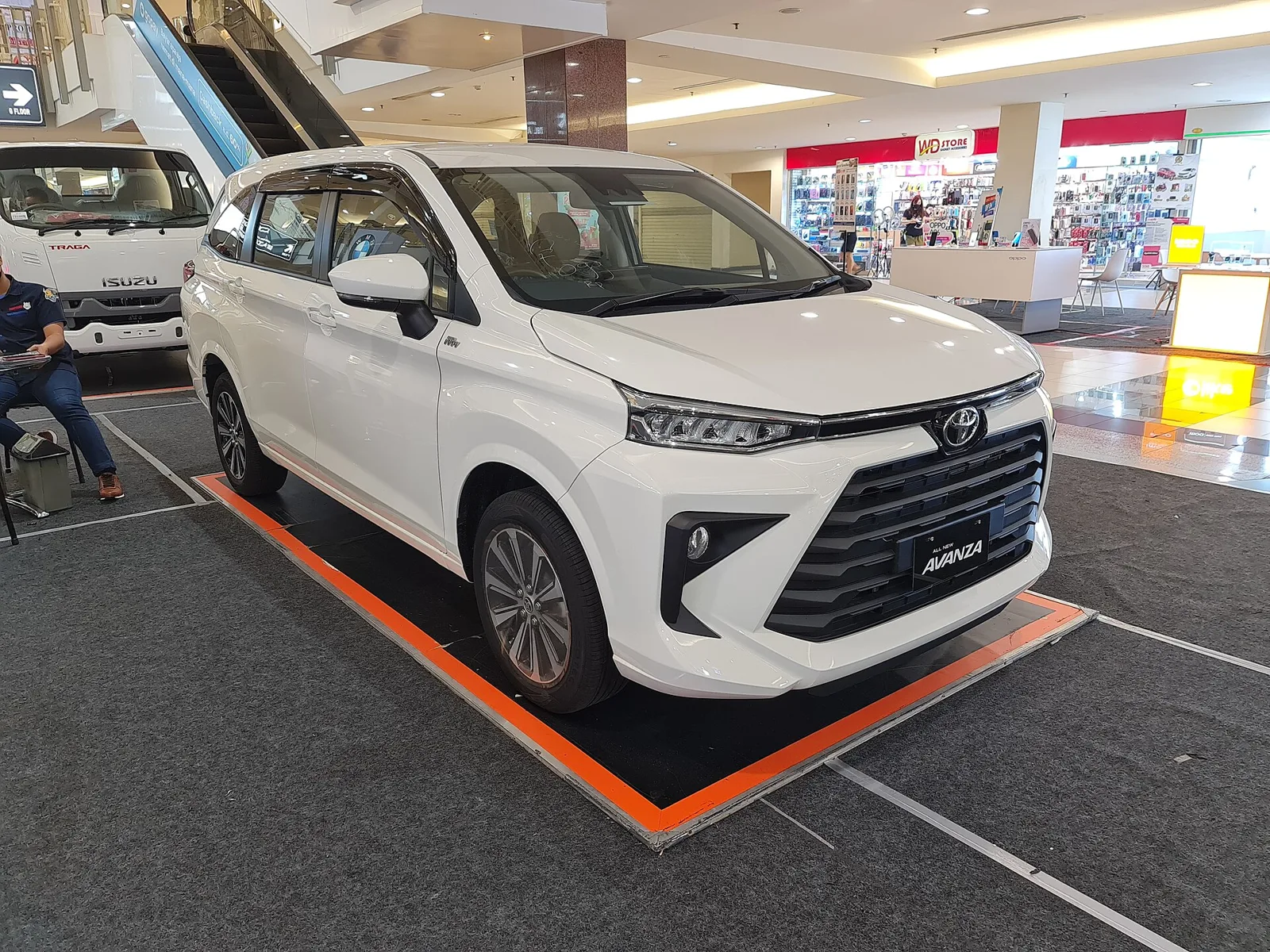
An entry-level multi-purpose vehicle from Daihatsu and Toyota, built first for Indonesia and reborn as a front-wheel-drive unibody in 2021.
The Toyota Avanza is a Daihatsu-developed multi-purpose vehicle sold by Toyota and Daihatsu, launched in Indonesia in 2004 and now in its third generation. Its Xenia twin and Veloz spin-off extended the range across Asia and beyond.
The Toyota Avanza is a multi-purpose vehicle developed by Daihatsu and sold by both Toyota and Daihatsu, mainly with three-row seating and largely sold in Indonesia and other emerging markets. It was released on 15 January 2004 and has since passed through three generations, the latest launched on 10 November 2021. Its Daihatsu twin, the Xenia, was offered as the cheaper of the pair.
Each name in the family has a root in another language. Avanza comes from the Spanish word for get moving, Xenia from the Greek concept of hospitality, and Veloz from the Spanish word for fast. The car has since travelled well beyond its home market, which makes its naming a useful thread through the whole story.
Where did the Avanza come from?
The Avanza emerged after the 1997 Asian financial crisis as an entry-level people carrier for Indonesia and other emerging markets. Feasibility studies began in 1999, and Toyota and Daihatsu put US$90,000,000 into the project. Its spiritual predecessor was the Kijang.
Toyota also called the project U-IMV, short for Under-IMV, because the new car sat below the Innova in the range. That placement explains the car's purpose: it was an entry point to the family, positioned beneath the Innova.
The brief was an entry-level MPV for Indonesia and other emerging markets, with mainly three-row seating. Toyota and Daihatsu both marketed the result, so the same car appeared under two badges.
An entry-level people carrier that became a regional sales leader, then reinvented itself as a front-wheel-drive unibody.
What did the first-generation Avanza offer?
The first generation, codename F600, reached buyers in two steps: unveiling on 11 December 2003 and release on 15 January 2004. At launch its engine was a 1.3-litre K3-DE, a four-cylinder unit paired with a 5-speed manual gearbox, and a 1.3 S with a 4-speed automatic followed in July 2004.
Demand arrived quickly, with 25,000 bookings received in January 2004 alone. The car sold 43,936 units during 2004, placing it third among Indonesia's best sellers that year.
The car was built at Astra Daihatsu's Sunter plant, with 61 percent of its parts sourced locally. Local sourcing was a defining part of how the car was built.
Malaysia was another strong market. The Avanza accounted for 40 percent of Toyota sales in Malaysia in 2006, and around 140,000 Malaysian units had been sold by 2012. In the Philippines, the J grade became a familiar sight as a metered taxicab.
The range gained a larger-engined flagship in October 2006, when the 1.5 S arrived with a 3SZ-VE 1.5-litre engine. That gave buyers a step up in the range without changing the basic format of the car.
What changed in the second generation?
The second-generation Avanza, codename F650, was launched in Indonesia on 9 November 2011. Its body was about 20 kg (44 lb) lighter, its track was 25 mm (1.0 in) wider, and its rear used a four-link suspension with a lateral control rod.
Toyota's engineers paired the lighter structure with low rolling resistance tyres and electric power steering. Development was led by Kaoru Hosokawa, Toyota's chief engineer.
Dual SRS airbags were added from 15 May 2013, and Malaysia received the second generation on 11 January 2012. Those changes were part of a steady programme of updates rather than a single reinvention.
The second facelift was led by chief engineer Kazutoshi Sakamoto. By then the Xenia had also moved to its own second generation, launched alongside the Avanza on 9 November 2011, with grades running from the 1.0 D to the 1.3 R.
Why did the early Avanza chassis draw criticism?
The first two generations used a semi-unibody chassis, with a body-on-frame front half and a monocoque rear half. Journalists cited an unstable ride at high speed and noise, vibration and harshness (NVH) they described as unrefined.
The two construction methods sat side by side in one car, and that hybrid arrangement is what journalists of the period pointed to. The later move away from it was therefore a substantial change to how the whole car was put together.
The third generation dropped that arrangement in favour of a full unibody and front-wheel drive. The change removed the hybrid construction that had defined the first two generations and gave the engineers a different starting point.
Did the third generation change the formula?
Yes. The third-generation W100/W150, launched on 10 November 2021, moved to a full unibody with front-wheel drive on Daihatsu's New Global Architecture. Length rose by 205 mm (8.1 in) and wheelbase by 95 mm (3.7 in).
Development was led by Eiji Fujibayashi. Despite the larger footprint, the turning radius is 4.9 m (16.1 ft), and the claimed weight fell by around 45 kg (99 lb).
Automatic models use the Dual-Mode CVT (D-CVT), a transmission developed by Daihatsu. The third generation's engine is the 1.5-litre 2NR-VE. The same 2NR-VE code was already used in the later second generation, so the two generations share an engine family.
Markets moved quickly after the launch. The Philippines received the car on 7 March 2022, and Vietnam followed on 22 March 2022, where it was marketed as the Avanza Premio to set it apart from the previous generation.
What is the Toyota Veloz?
The Toyota Veloz is a separate nameplate spun off from the Avanza in 2021, with a body 20 mm (0.79 in) wider than the Avanza's. It is sold in several Asian and Gulf markets, including Indonesia, Malaysia, the Philippines and the UAE.
Thailand launched the Veloz on 24 February 2022, ahead of the Philippines and Malaysia. Its grades differ from market to market. Malaysia introduced the Veloz on 18 October 2022 with a single grade, while the Philippines offered 1.5 G and 1.5 V grades from 29 April 2022.
In the UAE, the Veloz launched in the GCC on 5 February 2023 with a single GX grade. Indonesia then brought a hybrid version on 21 November 2025, and non-hybrid Veloz production for the Indonesian market ended after February 2026.
What is the Daihatsu Xenia?
The Daihatsu Xenia is the Avanza's twin, sold as the cheaper option with less safety equipment. Its grades were set up to sit below the Avanza's, so it reached buyers who wanted the same basic vehicle at a lower price. Because the grades differ, the two models are easiest to compare through their equipment lists.
The early Xenia grades were the 1.0 Mi and 1.0 Li, plus the 1.3 Xi. The second generation offered 1.0 D and 1.0 M plus 1.3 X and 1.3 R, and a flagship R Attivo ran from 2011 to 2014.
The Xenia gained a 1.5-litre 2NR-VE option from January 2019, offered only on the R Deluxe. The third-generation Xenia then offered 1.3 M and 1.3 X, plus 1.3 R and 1.5 R, keeping the twin relationship with the Avanza in place.
Where is the Avanza sold?
The Avanza is sold across Southeast Asia and in markets including Mexico, Pakistan, Nepal, Bangladesh and Egypt. Indonesia has been its main production base, and Astra Daihatsu's Sunter plant built the first generation.
The third generation also reached the Americas. Mexico received it on 14 March 2022, and Costa Rica followed on 26 July 2022.
The Xenia reached China as the FAW Senya M80 on 21 June 2007. FAW sold 223,461 units until production ended in 2016, and a crossover-led Senya S80 was revealed at the 2010 Beijing Auto Show.
The Perodua Alza, which is based on the Avanza, was introduced on 20 July 2022 and sits 45 mm (1.8 in) lower than the Avanza. That sibling shows how far the platform has been adapted for other buyers.
How many Avanzas have been sold?
By November 2018, around 2,750,576 Avanza and Xenia units had been sold globally. Of those, 1,714,196 were Indonesian market Avanzas, which shows how central the home market has been.
Indonesia remained the core of the story. Around 1.8 million Avanzas had been sold in Indonesia by December 2019, and the car accounted for 17 percent of Indonesian car sales in 2013, or 22 percent with the Xenia included. That share is a large slice of the market for a single model.
The Avanza held the crown as Indonesia's best-selling passenger car from 2006 until Honda Brio overtook it in 2020 and 2022. Across the wider MPV segment, the Avanza and Xenia together were the second best-selling MPV globally in 2012, behind the Chrysler minivans.
How did the Avanza's engines change?
The first generation launched with the 1.3-litre K3-DE, and the 1.5-litre 3SZ-VE arrived in October 2006 with the 1.5 S. The second generation then moved to the 1.3-litre 1NR-VE, which replaced the K3-VE.
The 1.5-litre 3SZ-VE was replaced by the 2NR-VE in the second generation's later years. The third generation keeps the 1.5-litre 2NR-VE as its engine.
Were there any Avanza recalls?
Yes. Toyota issued recalls in early 2024 covering Avanza and Veloz units, and the largest of them, in February 2024, covered 163,654 Indonesian units and 36,930 Philippine units.
The first campaign, in January 2024, covered 6,630 Philippine units. A further recall followed, covering 4,378 Indonesian units and 2,756 Philippine units, which meant the Philippines and Indonesia were both affected in the same period. The Philippines appears in all three campaigns, which makes it the common thread across the recall record.
On safety testing, Global NCAP scored it 4 stars for adults and 2 stars for infants.
Which special editions were built?
The Avanza Limited Edition was shown at the 2017 Gaikindo Indonesia International Auto Show, with 150 units built. The Veloz GR Limited launched on 9 August 2021, and 3,805 units were sold.
The Veloz GR Limited carried a Gazoo Racing bodykit and replaced the regular Veloz model in the range. Both special runs were short, and the Veloz GR Limited was by far the larger of the two. The Avanza Limited Edition was the smaller of the two special runs, with 150 units produced.
Toyota introduced the Transmover in November 2016 as a fleet variant, giving the range a model aimed at commercial use rather than private buyers.
What are the key specifications?
The first generation relied on a 1.3-litre K3-DE, a four-cylinder paired with a 5-speed manual, while the third generation uses a 1.5-litre 2NR-VE. The third generation is also the largest Avanza, with a turning radius of 4.9 m (16.1 ft) and a claimed weight reduction of around 45 kg (99 lb).
| Item | Detail |
|---|---|
| First generation | Unveiled 11 December 2003, released 15 January 2004 |
| First-generation engine | 1.3-litre K3-DE four-cylinder, 5-speed manual |
| Second generation | Launched 9 November 2011, codename F650 |
| Third generation | Launched 10 November 2021, W100/W150 |
| Third-generation engine | 1.5-litre 2NR-VE |
| Length increase | 205 mm (8.1 in) over the second generation |
| Wheelbase increase | 95 mm (3.7 in) |
| Turning radius | 4.9 m (16.1 ft) |
| Weight change | Claimed down around 45 kg (99 lb) |
| Sales by November 2018 | 2,750,576 Avanza and Xenia units |
Taken together, the 2021 changes amount to a new car built on the same name. The unibody, the front-wheel drive and the wider wheelbase set the third generation apart from the rear-drive cars that came before it.
_1.5_G,_Pakuwon_Trade_Center,_West_Surabaya.jpg)