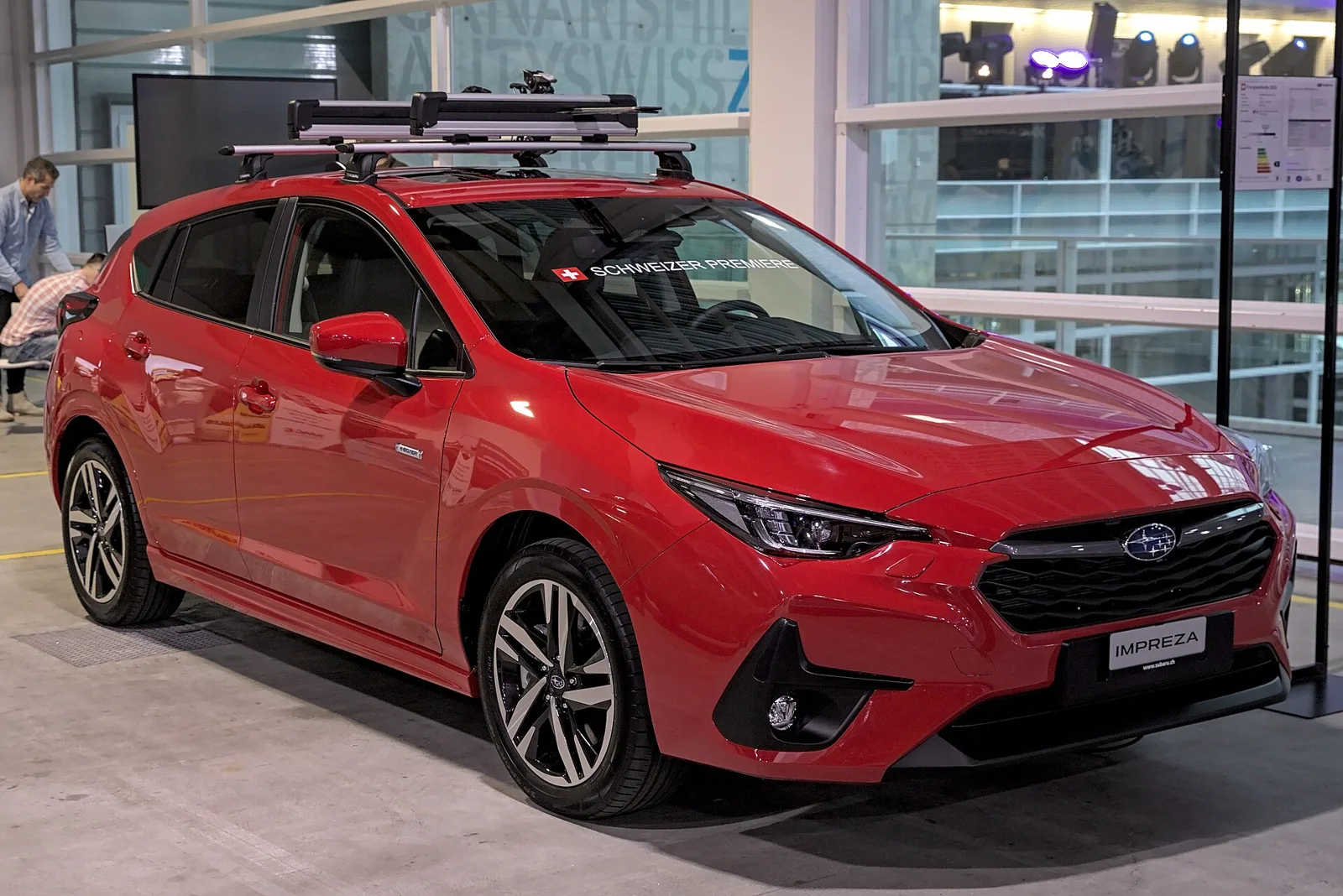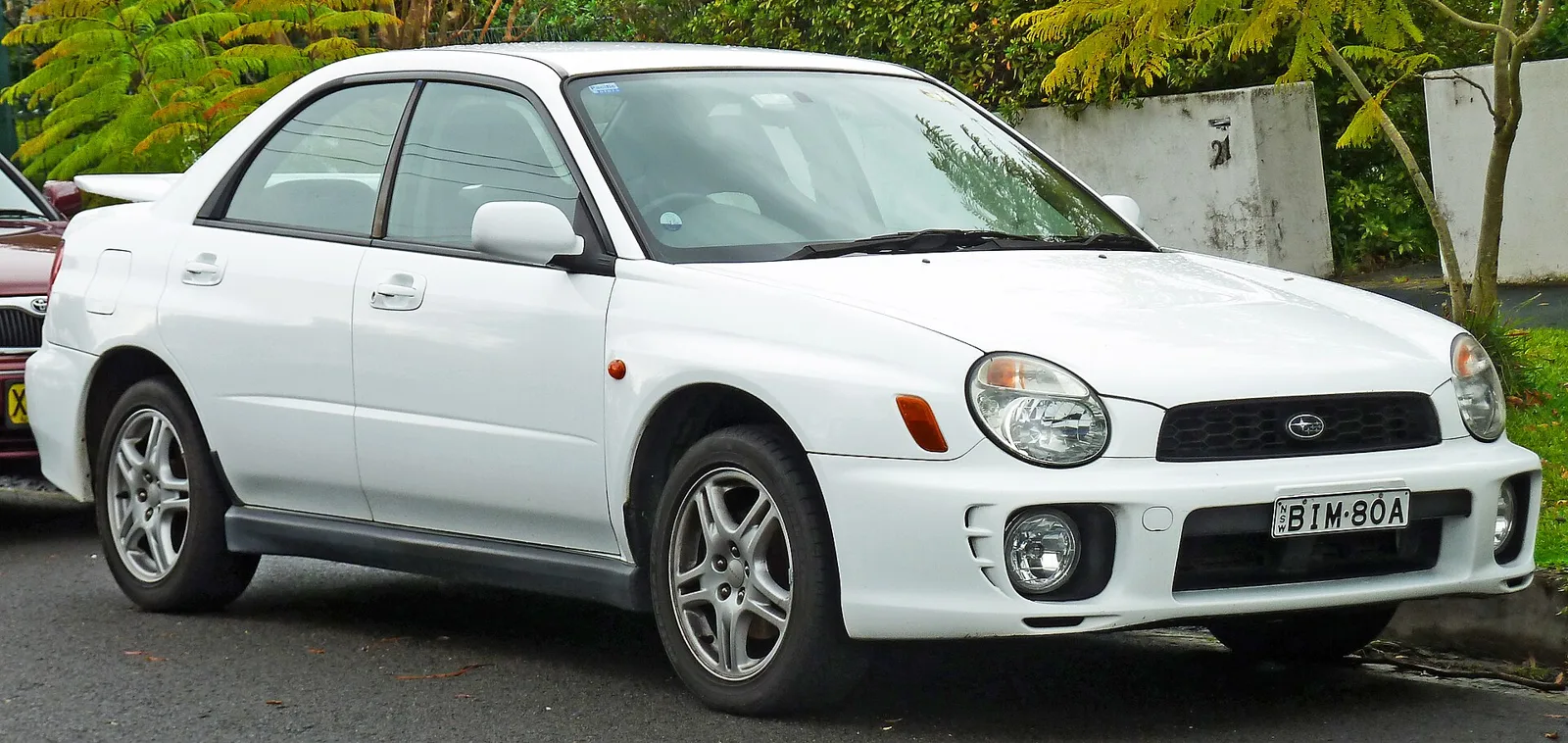
Bug Eye, Blob Eye and Hawk Eye: the second-generation Impreza grew stiffer and wider, and its WRX and STI versions built a rally-bred legend.
Built in Japan from 2000 to 2007 as a compact sedan and hatchback, the second-generation Impreza used flat-four engines, with all-wheel drive on most export models. Its WRX and STI versions, along with the Japanese S-series cars, gave it lasting performance appeal.
The second-generation Subaru Impreza was a compact car built by Subaru from 2000 to 2007, in both sedan and five-door hatchback bodies. Its flat-four engines, all-wheel drive and three styling phases gave it a long life, and the WRX and STI versions turned it into one of the most recognised performance cars of its era.
When was the second-generation Impreza built?
The second generation was introduced in 2000 and manufactured until 2007 at Subaru's plant in Ota, Gunma, Japan. The sedan used the GD series code and the five-door hatchback used the GG series code, and the car went through two intermediate facelifts during its life.
Export models typically came with all-wheel drive, while the Japanese market also offered front-wheel drive. The range covered naturally aspirated 1.5, 1.6, 2.0 and 2.5 litre flat-four engines, with the performance versions using turbocharged versions of the two larger engines.
Stiffer, wider and built in three looks, the second-generation Impreza gave the WRX a rally-bred legend.
How did the second generation differ from the first?
The new car was built on a significantly modified version of the first-generation platform and followed much the same formula, including a similarly contoured silhouette. Its sedan body grew by 45 mm (1.8 in) in length, 40 mm (1.6 in) in width and 25 mm (1.0 in) in height, while the wheelbase increased by 5 mm (0.2 in).
The chassis was much stiffer. Revisions to the front subframe lifted torsional rigidity by 120 percent, and a steel ring around the cabin at the B-pillar added further stiffness. The GD chassis gained nearly 200 kg (441 lb) over the earlier GC.
Why were the headlights so controversial?
The front end was the car's most debated feature, because the first version's ovoid headlamps attracted significant criticism. Subaru enthusiasts gave that version the nickname Bug Eye.
Subaru enlisted Peter Stevens of Prodrive to update the fascia, and the 2002 car was given more rectangular headlamps. Enthusiasts called that version Blob Eye. A second facelift from June 2005 in Japan, with the 2006 model year, brought new headlights, taillights and bumpers, and enthusiasts called that car Hawk Eye.
The second facelift front end was penned by Andreas Zapatinas, a Greek designer formerly of Alfa Romeo. It introduced Subaru's new corporate face, including a jet intake and wings grille that first appeared on the Subaru R2 kei car. The company said the design honoured its aircraft manufacturing roots at the Nakajima Aircraft Company.
What engines did the Impreza offer?
Japanese buyers started with the 1.5i, powered by the 1.5-litre EJ15 single-cam engine with a manual gearbox or optional automatic. A twin-cam version of the same engine went into the automatic-only 1.5R, which had an active valve control system. From 2006 the EJ15 was replaced by the new EL15.
In North America the Impreza WRX arrived in 2001 for the 2002 model year, with a 2.0-litre turbocharged engine rated at 169 kW (230 PS; 227 bhp). The US STI used a turbocharged 2.5-litre EJ257 instead of the twin-scroll 2.0 litre sold elsewhere, and all 2006 American Imprezas used some form of the 2.5-litre EJ25.
How did the WRX and STI develop?
The WRX moved to a second generation in December 2000, keeping the five-speed manual of the GC8, and a stronger six-speed gearbox later arrived for the GDB STI. The chassis received two styling changes, with the early design proving unpopular and a more conventional look following for the later cars.
The STI gained 17 inch alloy wheels in place of 16 inch units, and its five-speed manual, often seen as a weak point, was replaced by an STI-engineered six-speed. The engine kept its semi-closed deck block, labelled EJ207, but it gained AVCS for better low-end torque. Brembo four-piston front brakes became standard on the STI.
In 2000 most of Asia, Oceania and Europe received the new STI in a detuned form to meet emissions standards. Output ranged from 265 PS (261 hp; 195 kW) to 280 PS (276 bhp; 206 kW), depending on the market, and 2005 STIs received the driver-controlled centre differential that other markets already had.
What were the Japanese S-series cars?
The S202 was based on the featherweight Type RA Spec C and is still seen as the most radical factory STI. Its production run was 400 units for the Japanese market and it sold out in about two weeks, with individually numbered badges under the ashtray.
The S202 weighed 1,330 kg (2,932 lb), 140 kg (309 lb) less than a stock STI, and it claimed 316 bhp (320 hp). It used a lightweight aluminium hood, thinner door skins, gas-slotted brake rotors, molybdenum-coated pistons and a manually operated roof vent in the rally style.
The S203 was a limited edition based on the WRX STI with 18 inch BBS alloys and Pirelli tyres. The S204 arrived at the end of 2005 with a 2.0 litre EJ20 making 324 PS (239 kW; 320 bhp) and a six-speed manual. Recaro seats in carbon fibre gave it strong side support, and advertising put the run at 600 cars.
The Spec C Type RA-R opened for orders on 30 October 2007 with 18-inch Enkei wheels and a blueprinted engine rated at 320 PS (235 kW; 316 hp). Its front brakes were 6-piston Brembo units, and the engineers said the second R in its name stood for radical.
How did the Impreza sell in Australia and Europe?
In Australia the WRX first used the 2.0 litre EJ205 rated at 218 PS (160 kW; 215 hp), with 17 inch wheels and four-piston front brakes. The 2002 revision changed the gear and differential ratios to match the Japanese WRX after owners complained of slower acceleration than the earlier GC.
Australia also received the Outback Sport from 2001 to 2007, which was renamed the Impreza RV. The WRP10 of 2005 was limited to 200 units, and its name combined World Rally, Pirelli and the tenth anniversary of the Pirelli partnership. The WRP10 added STI parts to lower the car by 15 mm (0.6 in) and raised peak power to 175 kW (235 hp).
In Europe the WRX received the same Stevens facelift, and the engine was improved to 225 PS (165 kW; 222 hp). The 2006 European WRX switched to the EJ25 engine, making 230 PS (169 kW; 227 hp) at 5,600 rpm. The Prodrive Performance Pack was offered as an official accessory for UK cars, raising power to 270 PS (199 kW; 266 hp) for the 2007 version.
What did the North American market receive?
North America got its first WRX in 2001, with an EJ205 rated at 227 hp (169 kW) and a Mitsubishi turbocharger. The four-speed automatic WRX used a Variable Torque Distribution system, which split power 45:55 between the front and rear axles in normal driving.
The 2004 WRX STI brought the first EJ257, a 2.5-litre version of the EJ207 with hypereutectic cast pistons. Subaru Tecnica International's president wanted to beat the Mitsubishi Lancer Evolution in the US, and each US STI was essentially the same as its Japanese Spec C counterpart.
The 2006 WRX had a complete front-end redesign, a new 2.5-litre turbocharged EJ255 engine and three trim levels: TR, WRX and Limited. Its 230 hp (172 kW) at 5600 rpm and 235 lb-ft (319 Nm) of torque at 3,600 rpm improved on the 2.0 litre, and it was one of the cars featured in the opening scene of the 2017 film Baby Driver.
What UK special editions were built?
The UK had several limited editions across the car's life. The WRX UK300 of 2001 marked the country's rallying success, with 18 inch Prodrive OZ wheels, Pirelli tyres and a blue Alcantara or leather interior. The WR1 of 2004 celebrated the 2003 WRC drivers' championship and used a 1000-unit Japanese run split between Solberg editions and UK cars.
The WRX 300 of 2005 was limited to 300 vehicles and came with the Prodrive Performance Package, lifting power to 265 PS (195 kW; 261 hp). The RB320 of 2006 honoured Richard Burns, the 2001 WRC drivers champion who died in 2005, and it produced 320 PS (235 kW; 316 hp).
The GB270 of 2007 was limited to 400 cars, split between 300 saloons and 100 hatchbacks. Its name came from the 270 PS 2.5 litre turbo engine, and Prodrive lowered its suspension by 30 mm (1 in) at the front while adding an upgraded anti-roll bar.
What was the Saab 9-2X?
The Saab 9-2X was a badge-engineered version of the second-generation Impreza hatchback, sold in North America for the 2005 and 2006 model years. Saab Automobile was then a subsidiary of General Motors, which held a 20 percent stake in Subaru's parent Fuji Heavy Industries, and the car was nicknamed the Saabaru.
Saab redesigned the front and rear styling, added extra acoustic insulation and fitted its own front seats with active head restraints. Its interior was largely the Impreza wagon's, but the 9-2X was not especially popular with Saab loyalists, because most of the changes were cosmetic.
The 9-2X won the highest IIHS safety awards, but the partnership unravelled once General Motors decided in October 2005 to sell 8.4 percent of its stake to Toyota and return the remaining 11.4 percent to Fuji. Saab built 10,346 cars, with 8,514 for 2005 and 1,832 for 2006, and the model ended with the 2006 model year.
How safe was the second-generation Impreza?
The GD chassis scored much higher than its predecessor in crash testing. It earned the IIHS offset crash test's Good rating, the highest mark, and the NHTSA gave it 4 stars for the front driver, 5 stars for the front passenger and 4 stars for side protection.
The stiffer shell also gave the car a useful benefit in motorsport, though rescue crews noted that the B-pillars needed cutting at certain points to free occupants.
What are the key specifications?
| Specification | Detail |
|---|---|
| Production | 2000 to 2007, Ota, Gunma, Japan |
| Bodies | Sedan (GD series) and five-door hatchback (GG series) |
| Naturally aspirated engines | 1.5, 1.6, 2.0 and 2.5 litre flat-four |
| Japanese 2001 WRX NB | 250 PS (184 kW; 247 hp), curb weight 1,340 kg (2,954 lb) |
| European 2006 WRX | 230 PS (169 kW; 227 hp), weight 1,405 kg (3,097 lb) |
| US 2006 WRX | 230 hp (172 kW) at 5600 rpm, 235 lb-ft (319 Nm) at 3,600 rpm |
| WRX wheels, 2006 | 17 in x 7 in (430 mm x 180 mm), seven-spoke alloys |
| Spec C caster | Raised from 3.5 to 5 degrees |
| Torsional rigidity | 120 percent increase over the predecessor |
| S202 weight | 1,330 kg (2,932 lb), 400 units built |
| S204 engine | 2.0 litre EJ20, 324 PS (239 kW; 320 bhp) |
| Saab 9-2X production | 10,346 units, 2005 and 2006 |
| NHTSA rating | 4 stars front driver, 5 stars front passenger, 4 stars side |
How much did the later editions cost?
Prices varied by market and edition. The UK WRX 300 of 2005 was sold with a published on-the-road price, and the GB270 of 2007 carried an on-the-road price of GBP 22,995. The Spec D was listed at GBP 28,450.
Those figures are the launch prices quoted for the UK market.