A watch-company dream, a Mercedes-Benz engine and an egg-shaped Tridion body that made the microcar a city favourite.
The Smart Fortwo W450 was a rear-engined two-seat city car built at Hambach from 1998 to 2007 by a company that began as a Swatch and Mercedes-Benz joint venture. Its 599 cc turbo three-cylinder produced 45 PS or 55 PS, and it later gained a diesel and a Cabrio.
The Smart Fortwo W450 was the first series of a two-seat city car that started as a watch company's dream and reached showrooms in 1998. Its maker began as a joint venture between Swatch and Mercedes-Benz, and the car was built at Hambach in France. Its egg-shaped body sat on a steel Tridion cell, with a rear-mounted three-cylinder engine driving the back wheels.
Where did the Smart idea come from?
The idea belonged to Nicolas Hayek, the eccentric head of the Swatch watch brand, who told the press in summer 1991 that a very small car would arrive after 1995. Volkswagen was approached first without success. Mercedes-Benz came in, and the partnership was made public on 4 March 1994.
Early renderings reached the specialist press in 1992, and the Eco Speedster concept of 1993 carried the Mercedes-Benz badge while already resembling the final car in outline. In April 1994 the two partners set up the Micro Compact Car company, abbreviated MCC, with its legal seat in Biel, Switzerland.
A factory was the next problem. Late in 1994 a site was identified at Hambach, a town in France close to the German frontier, and building work began at the close of 1995. The name Smart was coined in that same period.
Some early claims never came true. Rumours spoke of four electric motors, one at each wheel, fed from a central battery pack placed around seat height. Other promises did materialise, including a roll-bar convertible and the lively interior colours of the Eco Speedster concept.
A watch-company idea became a microcar that won fans through its economy and its parking, even though its sales did not cover the cost of building it.
Why did Daimler-Benz take over the project?
Daimler-Benz almost forcibly took over the project between late 1995 and early 1996, rejecting hybrid and electric ideas in favour of a combustion engine designed from scratch. Under its own coding system the project was then given the designation W450, replacing the Swatch-Car label.
Environmental thinking shaped the build. Many body and interior parts were moulded from synthetic materials that could be recycled when a car reached the end of its life, and the shell was powder-coated, which avoided the solvents that pollute. Marketing played a part too, since buyers were being encouraged to see the car as eco-friendly before it reached production.
Engine plans shifted again. Early leaks pointed to a turbocharged three-cylinder petrol unit of roughly 0.7 litres, later confirmed as a 0.6 litre, and pre-series cars soon appeared in photographs. Around then Smart also revealed its unusual retail idea, Smart Centers, glass towers housing cars on several floors.
How did the Smart reach the market?
The car was unveiled at the Frankfurt show in 1997, yet production did not begin until ten months later. Daimler-Benz wanted to hunt down any defects, and in early 1998 the car needed suspension changes before its July 1998 launch. Those revisions also brought better interior finishes.
Trouble came in early 1998. Test drivers found stability problems resembling those seen months earlier in the A-Class, which was receiving its own safety updates at the same time. The Smart also failed the so-called 'moose test', a manoeuvre that embarrassed the leaders of Mercedes-Benz and MCC.
The remedy reworked both axles. The rear track was widened with bigger tyres, the front track was narrowed, and the new arrangement carried the MCC name TRUST. Naming was messy at first: Smart described the model, MCC was the brand, and the trade press often combined the two as MCC Smart.
What did the Smart look like?
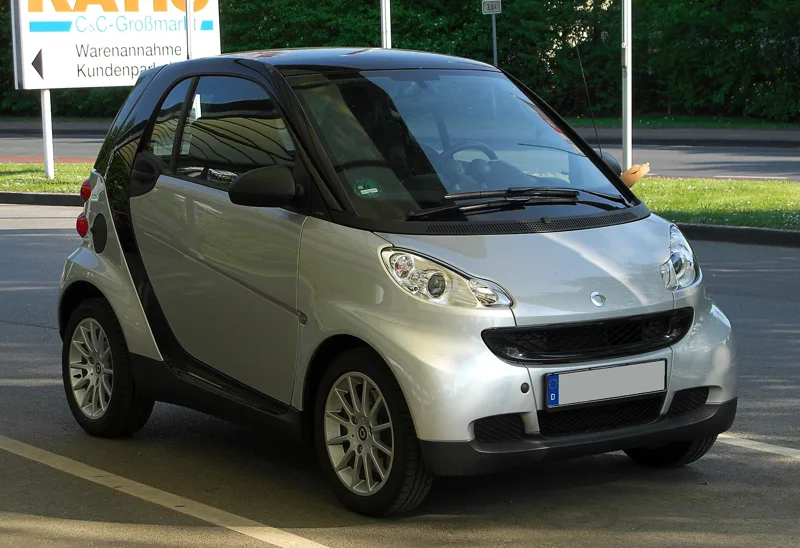
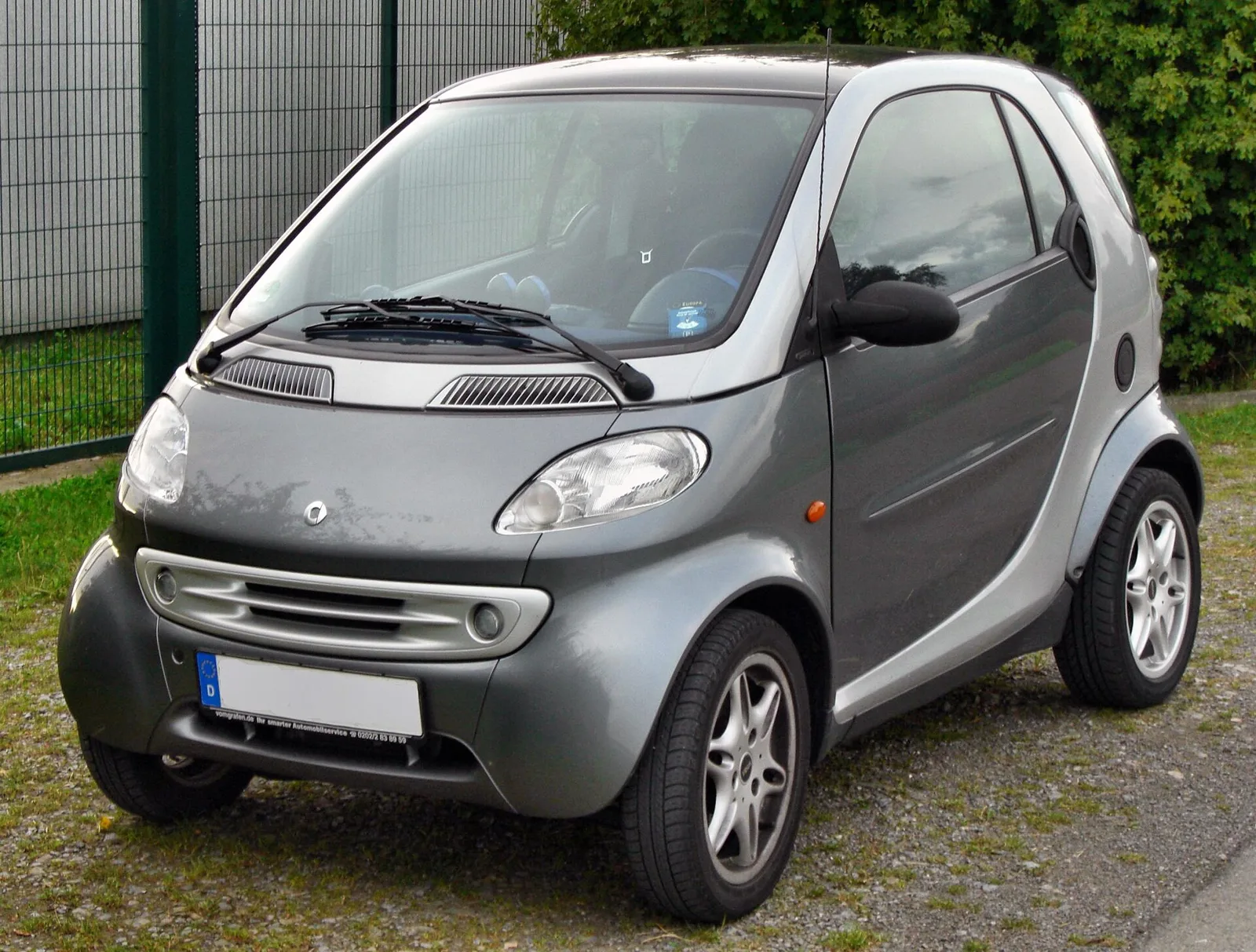
The Smart's egg-shaped outline and exposed Tridion shell made it a modern cousin of the Isetta, which BMW built in the 1950s. Oval light clusters and a small crescent grille dominated the nose, and the whole car measured 2.50 metres (8.2 ft) from nose to tail.
The Isetta had also been made by the Italian firm Iso, and in a sense the microcar story started there.
Next to the Isetta, the Smart was far more modern in every respect. A wide windscreen rested between two sturdy pillars that flowed into the nose, and the doors looked enormous against the short body. The tail was almost upright, with vertical light clusters made of three round elements each.
Viewed from the side, the widened wheel arches at both ends stood out, and the exposed shell dominated the look. It was powder-coated black or grey, with grey optional. Other body panels were plastic in a different colour and could be swapped for others if the owner wished.
What was the cabin like?
The cabin spoke directly to the car's young, urban buyers. Bright upholstery covered the dashboard and seats, and the two seats could slide to enlarge the luggage area, which topped out at 479 litres of total volume. Interior space was good for the car's size, helped by its height.
Equipment was thin for the price. Around 20 million lire was typical in Italy at the time, yet power steering, a rev counter, a clock and a cassette radio were all optional extras. Pulse and Passion added a glass roof that made the interior feel airy.
Three trims were offered. Pure was the base model. Pulse brought alloy wheels with bigger rear tyres, a glass roof and paddles behind the steering wheel for shifting. Passion was the smartest of the three, with 15-inch alloy wheels and a glass roof, plus an automatic option for the gearbox.
How did the engine and chassis work?
The Smart was rear-engined and rear-wheel drive, an unusual layout for a modern segment A car. Its 599 cc three-cylinder all-alloy engine was turbocharged, with an intercooler and overboost, and it produced 45 PS (33 kW; 44 hp) or 55 PS (40 kW; 54 hp) depending on boost pressure.
| Item | Detail |
|---|---|
| Layout | Rear engine, rear-wheel drive |
| Engine | Three-cylinder, all alloy, turbocharged |
| Displacement | 599 cc (36.6 cu in) |
| Outputs | 45 PS (33 kW; 44 hp) or 55 PS (40 kW; 54 hp), peaking at 5,250 rpm |
| Gearbox | Softip six-speed sequential, with softouch automatic mode |
| Brakes | 280 mm front discs, 200 mm rear drums, ABS |
| Steering | Rack and pinion |
| Wheels | 15-inch steel, rear rim 5.5 inches instead of 3.5 |
| Length | 2.50 metres (8.2 ft) |
| Luggage | Up to 479 litres |
The Softip gearbox had six speeds and a compact shape. It combined three gear ratios with one of two final-drive sets, a principle borrowed from the low-range gears found on off-roaders. Pressing a button on the lever moved the car from sequential softip shifting to softouch fully automatic driving, with kickdown for overtakes.
The steel Tridion cell was stiff and robust, offering solid protection if the car rolled, and it did well in crash tests.
The chassis was equally unusual. At the front, MacPherson struts were combined with a transverse leaf spring made of glass-fibre, while the rear used interconnected wheels, an omega-profile semi-trailing axle and coil springs. Gas-filled dampers sat on both ends.
Braking used discs up front and drums at the rear, with ABS fitted throughout. Rack-and-pinion steering completed the set-up, and the 15-inch steel wheels carried a wider rear rim.
Why did Swatch leave the partnership?
Swatch quit the joint venture only months after the launch, and the partnership officially ended in January 1999. Nicolas Hayek was reportedly unhappy with the conventional engine and with a price higher than he had wanted. Hybrid and electric units had been his preference from the first months of the project.
Other accounts argued that development costs had been so heavy that Swatch preferred to step back from the venture.
When did the diesel model arrive?
The Smart CDI diesel came out between late 1999 and early 2000. It used a 799 cc (48.8 cu in) three-cylinder common-rail turbodiesel rated at 40 PS (29 kW; 39 hp), and its frugal running made it a yardstick for the super-city-car class.
Economy helped the Smart win sales and fame. Long after the Forfour and Roadster joined the line-up, when people said Smart they still meant the small German two-seater.
Parking was another draw, since the car could be squeezed in at right angles to the kerb, and such parked Smarts were a familiar sight on city streets. The first-generation car nonetheless had weaknesses: it rode poorly on uneven surfaces, was noisy, and its gearbox was not always quick between ratios.
How did the Smart Cabrio come about?
The Smart Cabrio, coded A450, arrived in early 2000 as the open-top model the range had been missing, while the closed car was coded C450. Mercedes-Benz engineers reworked the shell for torsional rigidity, and the weight grew by only 10 kg (22 lb).
Under the skin the Cabrio mirrored the closed cars, but the 45 PS engine was not offered. Its front lights had the '8' shape that the City Coupe later took up in 2002, and a diagonal rib ran along the flank. The three-layer soft top folded in stages, and only the last stage, lifting out the central pillars, had to be done by hand.
Planned trims were Cabrio and Pulse, and Cabrio and Passion. The convertible followed the coupe's renaming, first as City Cabrio in 2002 and then as Fortwo Cabrio in 2004. Its price ran 4 million lire above the coupe, but it found a good market anyway.
What changed in 2002 and 2003?
The MCC name vanished in 2002, and the company became Smart GmbH. The coupe became the City Coupe, and its fuel tank grew from 22 to 33 litres. Stability complaints resurfaced that same year, and the Crossblade, a limited and costly variant, appeared alongside.
The stability problems were back by the second half of the year, most often on wet or uneven roads, where the car oversteered when the throttle was lifted and spun. The Crossblade had no windscreen, doors or rear window, and it carried a very high price.
In 2003 the engineers reworked the suspension, fitted ESP and brought in the TRUST-PLUS system. The three-cylinder petrol unit grew to 698 cc (42.6 cu in) from 599 cc, giving small power gains across the range. The Pure went up to 50 PS (37 kW; 49 hp) from 45 PS, while the Pure and Passion climbed to 61 PS (45 kW; 60 hp) from 55 PS (40 kW; 54 hp). The Pulse, already on 61 PS, mostly gained torque.
Why did the first Fortwo survive?
The Forfour and Roadster/Coupe flops cast doubt on the Smart brand itself, yet Daimler-Benz decided to keep only the Fortwo in production. Sales had not covered the huge design and production outlay, but the little car became a cult model despite a real risk of commercial failure.
The City Coupe took the Fortwo name in 2004, when the Forfour arrived, and the name stayed on once the small car was again the range's only model. Demand fell sharply in 2005, partly because the design was ageing, even though rivals had nothing directly comparable.
The Fortwo was the most commercially successful model in the Smart line-up. In 2007 the second generation, codenamed W451, replaced the first.