Renault's fourth-generation compact from 2015 to 2024, with a twin-turbo diesel, a plug-in hybrid and a run of hot RS models.
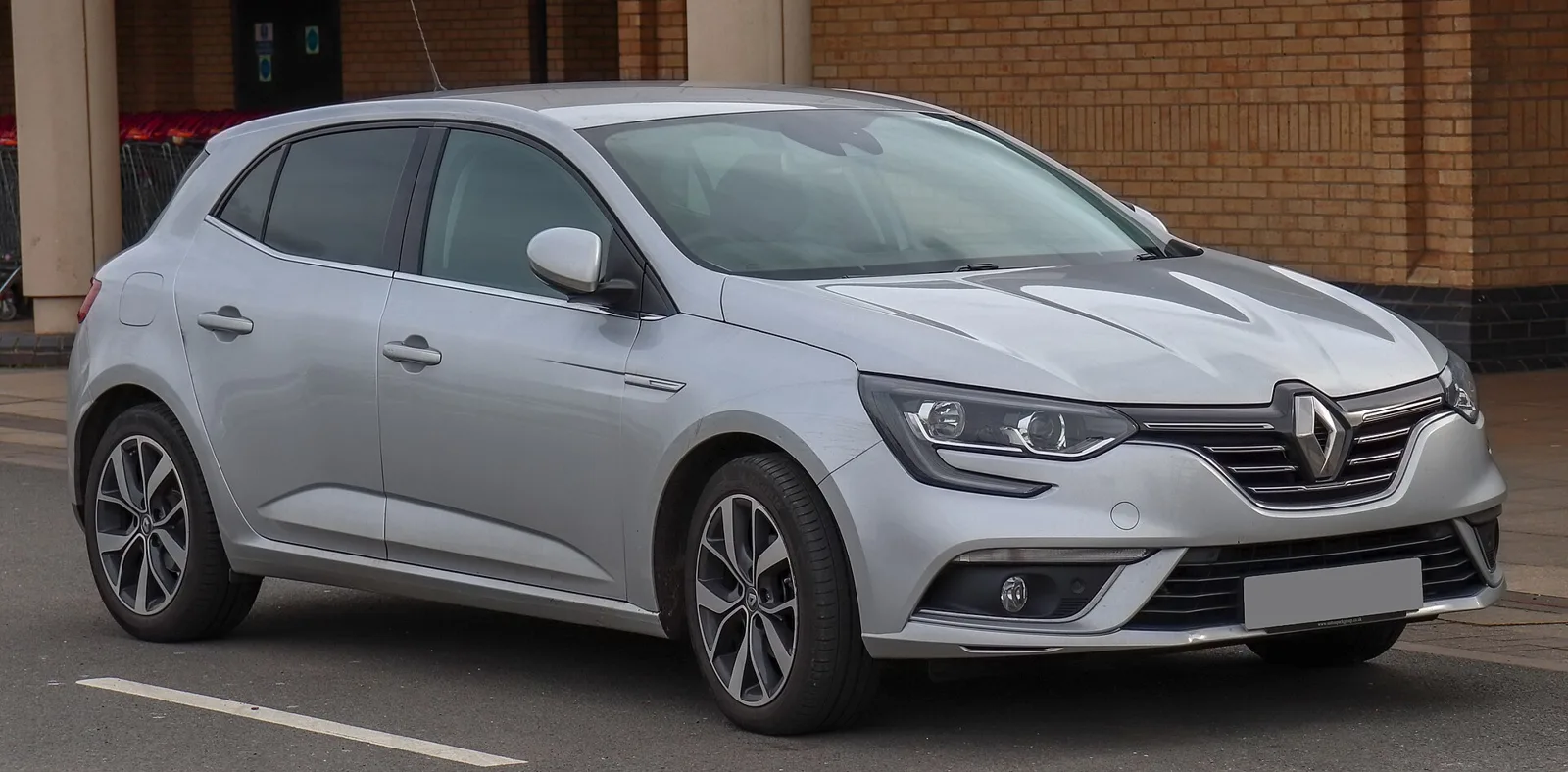
Built from 2015 to 2024, the Megane IV came as a five-door body, an estate and the GrandCoupe saloon. Engines spanned a 1.6 twin-turbo diesel and a 160 PS plug-in hybrid, with the RS, at 280 PS and 300 PS in the Trophy, as the sporting peak, sold alongside the hatch and estate.
The Renault Megane IV was the fourth generation of Renault's compact Megane, built from 2015 to 2024 in three body styles. Its engine range ran from a 1.6 twin-turbo diesel to a plug-in hybrid, and the RS sports line reached 280 PS, later 300 PS in the Trophy. The plug-in hybrid joined the range with the facelift. Production of the hatchback and estate ended in April 2024.
Where did the Megane IV come from?
Images leaked onto the internet on 6 September 2015, and Renault presented the car online the following day. The car made its public debut at the Frankfurt Motor Show on 14 September 2015, and reached dealerships on 14 January 2016. The exterior design concept was created by Franck Le Gall.
The car sat on the CMF-CD platform of the Renault-Nissan group, which it shared with the Kadjar, the Espace V and the Talisman. The same architecture allowed an optional four-wheel steering system, called 4Control, on the GT and RS versions.
Internally, the five-door body was coded BFB and the estate KFB. The chief engineer in charge of development was Fabrice Garcia. The coupe and coupe-cabriolet versions disappeared from the range when this generation arrived.
Three body styles were offered: the five-door body, the Estate, which was unveiled at the Geneva Motor Show in 2016, and the four-door GrandCoupe, called Sedan in some markets. The GrandCoupe was never sold in France, but it has been built in Turkey since 2016. The estate was built until 2024 as well.
A compact with a 1.6 twin-turbo diesel at its heart, and an RS line meant to put it level with its rivals.
What did the design look like?
At the front, a C-shaped LED light signature used light-guide technology with a 3D effect, and the higher versions had full LED headlamps with automatic road and town beam switching. At the rear, LED lamps were lit permanently and formed a horizontal through-signature that stayed visible by day and by night.
Edge Light technology gave the rear lamps a thin brush of light that drew a deep red glow in depth.
The facelift was due to be shown at the Geneva show in 2020, but the show was cancelled because of the COVID-19 epidemic. The updated car went on sale from September 2020, with changes to the headlamps, bumpers and grille. The EasyLink system was updated, new upholstery and ambient colours were offered, and a customisable 10.2-inch screen replaced the old instruments.
Prices rose by 650 euros in May 2022, which lifted the French entry price to 28,800 euros.
Which engines did the Megane IV offer?
Among the petrol engines, the 1.0 TCe of 115 PS arrived at the end of 2020. The 1.6 Energy dCi 165 diesel produced 165 PS (121 kW; 163 hp) from 1,598 cc (97.5 cu in), and the RS used a 280 PS engine. The plug-in hybrid arrived with the facelift.
The 1.6 TCe 165 became available in the second half of 2017, and the 1.3 TCe and 1.7 dCi engines followed in 2018. The first 1.3 TCe models of 2018 met Euro 6b rules but had no particulate filter. Diesel engines received SCR-AdBlue exhaust treatment from the second half of 2018, and at the end of 2020 the 1.0 TCe of 115 PS replaced the 1.3 TCe engines of 100 PS and 115 PS.
The 1.6 Energy dCi 165 Twin Turbo
Renault described the new unit as its first 1.6 diesel with double supercharging. Two turbochargers are fitted in series. A small one serves the low revs, where 90% of the maximum torque is available from 1,500 rpm, while the second takes over higher up and delivers strong power, around 100 PS per litre of capacity.
Renault claimed 25% lower fuel consumption and CO2 emissions than the 2.0 dCi of 175 PS, and the 1.6 dCi 165 weighed 20 kg less than that engine. The unit also borrowed cooling and friction technology from Formula One. Renault's own pitch said the engine always works in its best efficiency range, so the claimed gains came from keeping it there.
It is built at the Cleon plant in Seine-Maritime and, for the moment, is not shared with Nissan. It can be combined with the EDC dual-clutch gearbox or a manual. The engine also powered the brand's D and E segment models, such as the Laguna, the Latitude and the Espace.
How did the plug-in hybrid work?
The plug-in hybrid combined a 1.6-litre 91 PS Atkinson-cycle petrol engine, a 34 PS starter-generator and a 67 PS electric motor, giving 160 PS in total. Its 9.8 kWh battery allowed 50 km of all-electric range on the WLTP cycle.
The battery weighed 105 kg and sat at the rear. The starter-generator was connected directly to the petrol engine, where it could start it, assist it or produce electricity. The main motor-generator sat at the end of a robotised dog-clutch gearbox.
Renault called that gearbox the Locobox internally, and it offered 15 combinations from its 4+2 gears plus neutrals. The main motor-generator could be disconnected when the small starter-generator was enough, or it could be driven from the petrol engine while stationary to recharge the battery.
Three modes were offered. Pure allowed electric driving when enough charge was available, MySense managed the hybrid and kept some charge in reserve, and Sport combined the power of all three motors. The car could reach 135 km/h (84 mph) in electric mode, and the hybrid left the catalogue in April 2023.
How did the Sedan and GrandCoupe differ?
The three-box version was presented in July 2016 and offered more rear-seat space, with a boot of 508 litres. It was built in Turkey by Oyak-Renault and sold in the Middle East, Africa, Australia, Eastern Europe and parts of Western and Central Europe, including Italy, Poland, Serbia and Romania.
Only the mid-range engine could take the six-speed EDC dual-clutch gearbox. The facelift reached this version in February 2021 with a new 1.0 TCe 115 engine. In 2022 the work for this version passed to Karsan, another Turkish subcontractor, so that the Oyak-Renault works could have room.
Which trim levels did buyers choose?
The trims were Life, Zen, Business, Intens, GT and GT-Line, with E-Tech Engineered added in July 2022. Life had manual air conditioning, an 11 cm Bluetooth radio, cruise control and hill-start assist, while Intens brought Full LED Pure Vision headlamps, a 22 cm screen and MULTI SENSE driving modes.
The GT combined Intens trim with Renault Sport chassis and suspension, four-wheel steering, sport seats and launch control. Its engines were the 205 PS TCe and the 165 PS dCi, with the EDC6 gearbox on diesels and the EDC7 on petrol engines. The estate was also offered in this sporty GT form. GT-Line added body parts and sporty wheels to Zen or Intens, and on Intens its interior came from the GT.
Zen added automatic or dual-zone air conditioning, the R-Link system, electrically folding mirrors and an 18 cm screen. Business brought a safe-distance warning and the option of a more powerful engine, and it was replaced in 2018 by the Limited trim. Intens rode on 17-inch Bayadere or 18-inch Grand Tour wheels.
How did the RS line develop?
The Megane 4 RS went on sale in January 2018 with a 1.8 TCe engine of 280 PS (206 kW; 276 hp). Renault first showed it, still camouflaged, at the Monaco Grand Prix on 26 May 2017. It was officially presented at the Frankfurt show in 2017, in Sirius Yellow or Tonic Orange.
The engine came from the Alpine A110. The RS dropped the F engine of 1,998 cc (121.9 cu in) and used an M engine of 1,798 cc (109.7 cu in), a turbocharged unit with direct injection. Buyers could choose an automatic DCT gearbox or a manual.
The RS engine carried the type code M5Pt, and Renault also studied a Megane RS Estate, with mock-ups built, although that project did not reach series production. The Trophy version arrived in July 2018 with 300 PS (221 kW; 296 hp) and 400 Nm (295 lb ft) of torque, or 420 Nm (310 lb ft) with the EDC automatic. It came with the Cup chassis and a Torsen limited-slip differential, as standard.
As with the two previous Megane RS generations, Renault presented a Trophy-R, in 2019. It kept the Trophy engine, paired it with a six-speed manual, and dropped the 4Control chassis to save weight. An optional carbon-ceramic front brake kit and carbon wheels reduced it further, and the car took the record for the quickest front-drive lap of the Nordschleife. The car that set that record had those options fitted.
Special editions and the RS Ultime
The Limited 2017 combined Business or Zen trim with a sober finish, a matt black interior with carbon-look trim and 17-inch Dark Exception wheels. The Limited 2018 was Zen trim with 17-inch Celsium Diamond Black wheels, black mirrors and tinted glass.
The GT-Line special edition added Black Shadow Grand Tour wheels in 18 inches, GT-Line badges on the tailgate and front wings, and mirror caps and side scoops in Dark Metal finish.
The Megane RS, the last model produced by Renault Sport, disappeared in 2023. In its last months, from November 2022, the car was sold in a run of 1,976 units called RS Ultime, first shown at the Tokyo Motor Show in 2023. Black stickers covered the doors, wings, rear bumper, bonnet and roof, and black window surrounds, logos, mirror caps, diffusers and the F1 blade on the front completed the look.
Key specifications
| Specification | Detail |
|---|---|
| Diesel engine | 1.6 Energy dCi 165 Twin Turbo, 1,598 cc (97.5 cu in), 165 PS (121 kW; 163 hp) |
| Diesel torque | 380 Nm (280 lb ft) from 1,750 rpm |
| Plug-in hybrid | 1.6-litre 91 PS petrol, 34 PS starter-generator, 67 PS electric motor; 160 PS combined |
| Hybrid battery | 9.8 kWh lithium-ion, 105 kg, 50 km WLTP electric range |
| Hybrid electric top speed | 135 km/h (84 mph) |
| RS (2018) | 1.8 TCe, 1,798 cc (109.7 cu in), 280 PS (206 kW; 276 hp) |
| RS Trophy | 300 PS (221 kW; 296 hp), 400 Nm (295 lb ft); 420 Nm (310 lb ft) with EDC |
| Sedan boot | 508 litres |
| Gearboxes | EDC dual-clutch, six-speed manual, DCT on the RS, Locobox robotised unit in the hybrid |
| French entry price | 28,800 euros after the May 2022 rise |
When did production end and what replaced it?
Production of the five-door body and the estate was permanently stopped on 5 April 2024. The Megane E-Tech Electric, launched in 2021, took over the role indirectly, and the Renault Symbioz filled the space the Megane IV had occupied among combustion-engined cars.
The Sedan stopped selling in Eastern Europe in spring 2024, except in Poland, Slovakia and the Czech Republic. The aborted plan for a three-door crossover, codenamed DFB, would have replaced the Megane III Coupe and been comparable to a three-door Range Rover Evoque.