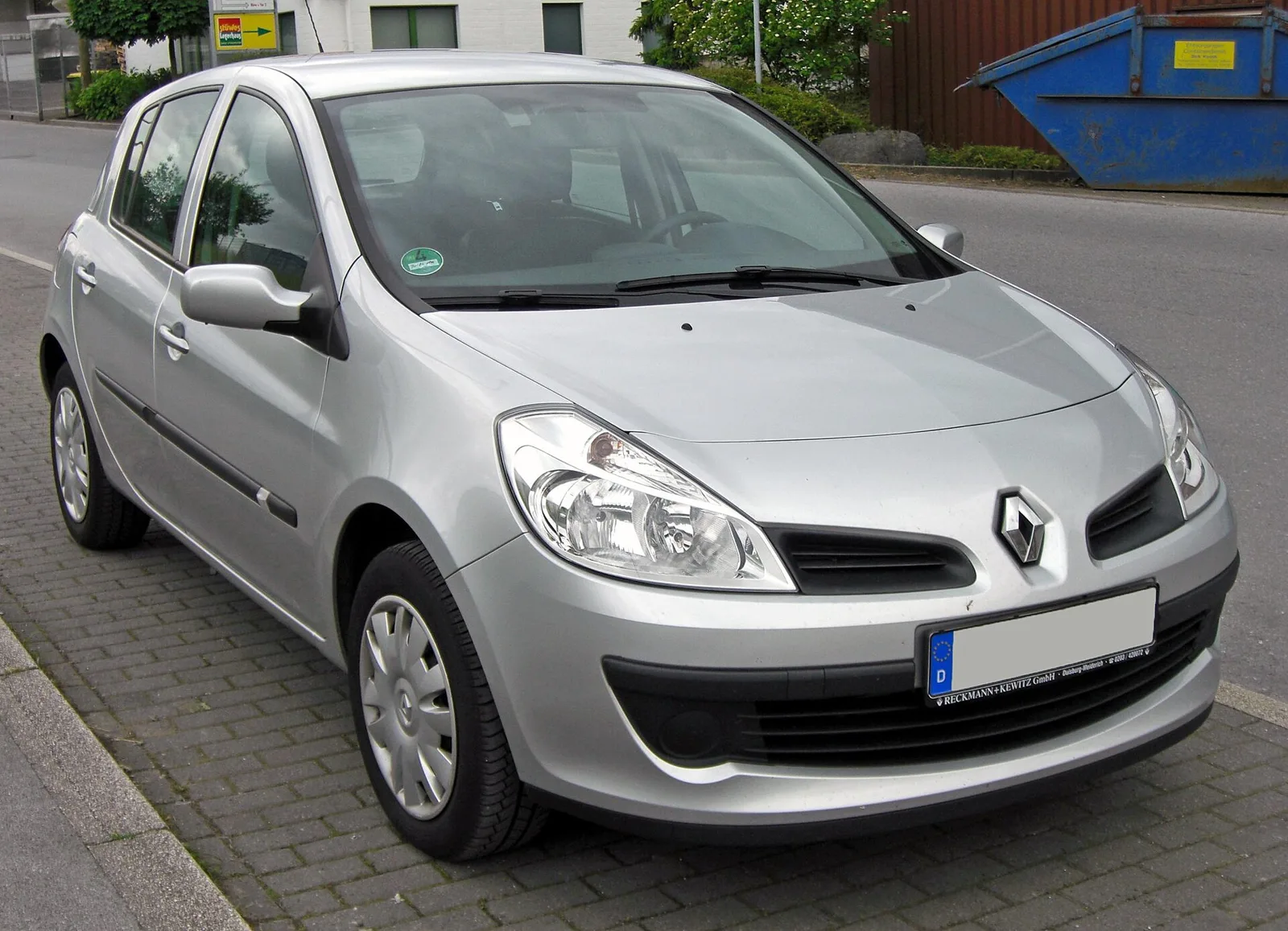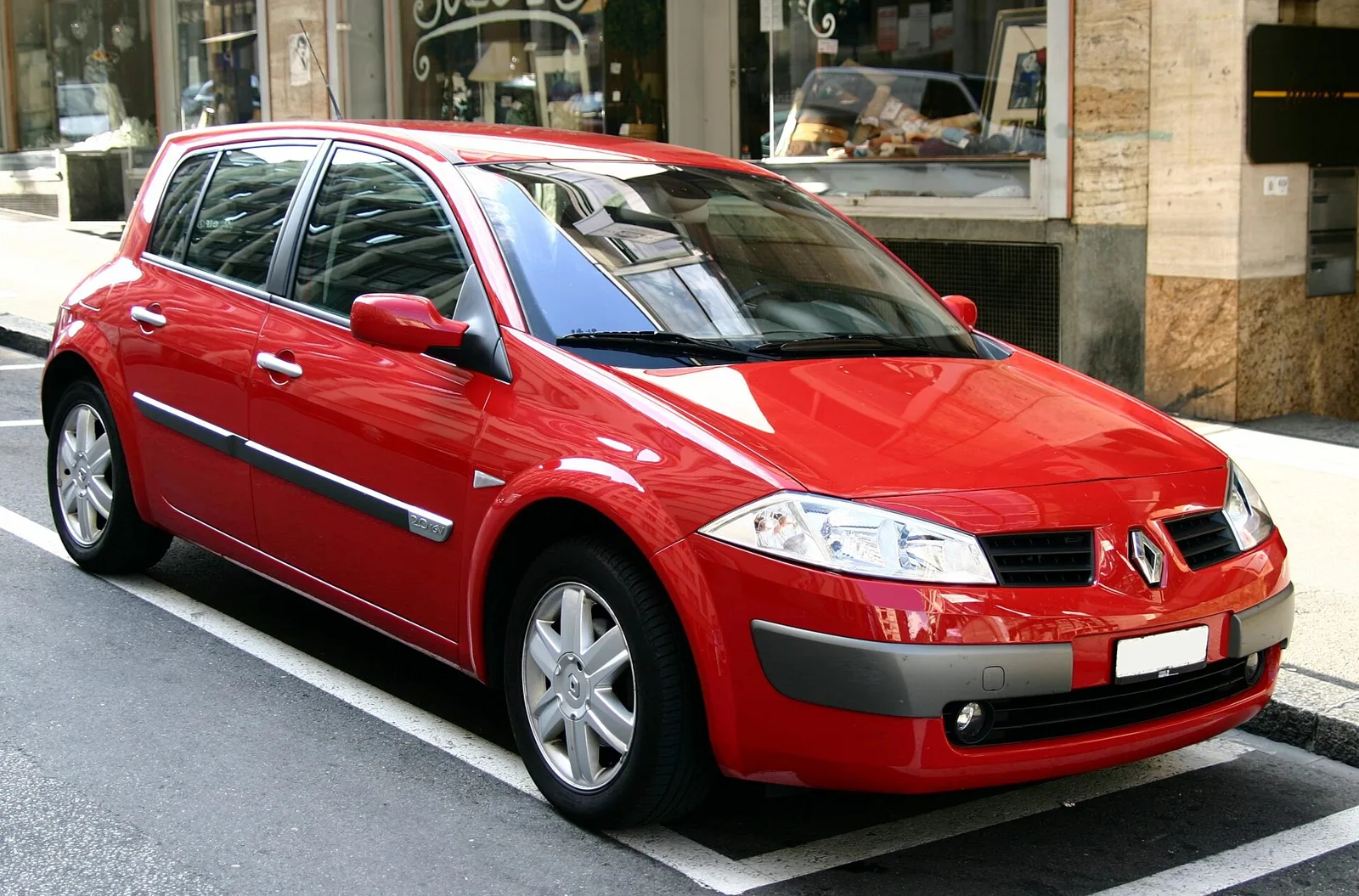
Launched in 2002 on a platform shared with Nissan, the Megane II spawned a four-door saloon, a GrandTour estate and the glass-roofed CC.
The Renault Megane II was the second generation of Renault's lower-middle-range car, built from 2002 to 2008 or 2010 depending on version. It used a platform developed with Nissan, reached five Euro NCAP stars, and spawned the four-door saloon, GrandTour estate and CC coupe-cabriolet.
Renault's second-generation Megane arrived in 2002 on a platform shared with Nissan, and it earned five Euro NCAP stars. Built until 2008 or 2010 depending on the version, it grew into a family of body styles that ran from the saloon to the glass-roofed CC.
Where did the Megane II come from?
Project X84 began in early 2000, a few months after the mid-life restyling of the first Megane. It lasted about two and a half years, and the definitive model reached the public at the Paris Motor Show in 2002, in three-door and five-door saloon bodies.
It was known from the start that the successor would keep the Megane name. The five-door took over from the previous five-door, while the three-door was a new body that only partly replaced the Coach, which had been a true coupe.
In France the three-door was called Coupe, but in the rest of Europe it was simply the three-door. The second series was 4.9 cm longer and 7.7 cm wider than its predecessor, and its wheelbase grew by 4.5 cm to improve interior room.
A car that borrowed its styling from two rare models and spread it across the whole range.
How did the Megane II's styling take shape?
Designers led by Patrick Le Quement borrowed ideas from the Vel Satis and the Avantime, two models sold in much smaller numbers. Key elements included a wide raked windscreen, angular horizontal headlights and a flank with a double angle.
The five-door had a massive vertical rear pillar, while the three-door had a triangular pillar in the same area. The rear window wrapped round and stood upright, the rear light units were very angular, and the curvilinear boot ended in a transverse element that projected well to the rear.
That projecting boot did much to give the Megane II its distinctive line, which sat somewhere between a two-box and a two-and-a-half-box car. In general, though, the car was classed as a plain two-box. The radiator grille carried two moustache-shaped elements between the light units, borrowed from the flagship Vel Satis, with the central badge in the middle.
What was the Megane II cabin like?
The cabin gave adequate room to the front occupants, but rear passengers were penalised, especially the person in the middle seat, where a bulge in the bench made sitting there uncomfortable. The car had 44 litres of storage compartments and a boot of 330 litres, expandable to 1,190 litres.
The driver's position was rational overall, although some controls sat in unintuitive places, and it was not notable for innovation. Trim choices came as four ambience options, Authentique, Expression, Dynamique and Privilege, and three equipment levels, Pack, Confort and Luxe. The electronic key came from the Laguna II, and a glass panoramic roof was offered as an option that other makers would also offer, in more or less advanced form, a few years later.
The three-door saloon had a special airbag under the front seat cushions, which inflated in a frontal impact and pushed the occupants' bottoms down so they could not slide under the belt. It was needed because a seat-sliding mechanism had forced designers to give up the double belt pretensioner. Up to ten airbags were available, depending on trim level, and the car reached five Euro NCAP stars.
Engines and specifications at launch
| Engine | Displacement | Maximum output |
|---|---|---|
| 1.4 16v (K4J) | 1,390 cc (84.8 cu in) | 98 PS (72 kW; 97 hp) |
| 1.6 16v (K4M) | 1,598 cc (97.5 cu in) | 113 PS (83 kW; 111 hp) |
| 2.0 16v (F4R) | 1,998 cc (121.9 cu in) | 134 PS (99 kW; 132 hp) |
| 1.5 dCi (K9K), common rail turbodiesel | 1,461 cc (89.2 cu in) | 82 PS (60 kW; 81 hp) |
| 1.9 dCi (F9Q), common rail turbodiesel | 1,870 cc (114.1 cu in) | 120 PS (88 kW; 118 hp) |
The engines were partly derived from the Clio and partly from the larger Laguna. The standard gearbox was a five-speed manual derived from the third-generation Nissan Primera, while the top versions, the 2.0 16v and the 1.9 dCi, had a six-speed manual.
How did the platform differ from the first Megane?
The Megane II used a new platform developed jointly with Nissan, with which Renault had been linked since 1999. It was the second common platform between the two makers, after the one used for the third-generation Nissan Micra. Named Platform C, it later became the base for many other models, including the Nissan Qashqai.
The wheelbase grew from 2,580 mm (101.6 in) to 2,625 mm (103.3 in), and the tracks widened by 6 cm at the front and 6.4 cm at the rear. These changes were meant to improve road behaviour. The structure used high-strength steels with a strength three times greater than normal steel.
The layout was a transverse front engine with front-wheel drive. The front suspension was a pseudo-MacPherson type and the rear used interconnected wheels, with coaxial coil springs and dampers and an anti-roll bar on each axle. The front brake discs were self-ventilating and 280 mm across, the rear ones 240 mm, with ABS and EBV. The steering was rack and pinion.
What changed between 2003 and 2005?
In 2003 the estate GrandTour, the Megane Sedan and a cabriolet with a folding hard top arrived. The 1.4 16v was offered in an economical version with 82 PS, while the 1.5 dCi received a 100 PS version to fill the gap below the 120 PS 1.9 dCi.
In 2004 two 2-litre turbo engines arrived, one with 165 PS and the other with 225 PS. The latter powered the top sports version, the Megane RS, which became a benchmark for high-performance segment C cars. In some markets the 1.9 dCi was also offered in a detuned 90 PS form that year.
The 2005 update covered the whole range. The 1.4 16v of 82 PS left the price list, and the 1.6 went from 113 to 111 PS while keeping its torque. A bi-fuel petrol and LPG version of the 1.6 produced 102 PS, the 1.5 dCi rose to 86 and 106 PS, and the 1.9 dCi went up to 130 PS.
What did the 2006 restyling change?
The mid-life restyling of 2006 aligned the light units with the moustaches of the radiator grille, which before had formed a slight angle with them. The bumper shield was redesigned, and so was the tail, where the reversing light zone became horizontal instead of vertical.
The engine range gained a new 2-litre dCi of 150 PS, and the 2-litre turbo of 163 PS left the range. The LPG version rose slightly from 102 to 105 PS. The four-door saloon received the same update as the rest of the range.
In 2007 a special version of the RS appeared with output raised to 230 PS. The 2.0 dCi RS took its 2-litre diesel from 150 to 175 PS, the same unit that powered the larger Laguna. Another ecological version, a 1.6 able to run on E85 ethanol, also appeared, with 105 PS.
How did the Megane II end its run?
At the end of 2008 the Megane III arrived, the third generation of Renault's segment C car. The three-door and five-door saloons were the first to leave the scene, and the other body variants followed gradually.
The GrandTour stayed on the price list for a few months longer, until May 2009. The Megane CC stayed longer still, withdrawn from sale only in the first months of 2010, because its modest success had kept it on the list while stock was cleared.
What was the four-door Megane saloon?
The four-door saloon, heir to the earlier Megane Classic, debuted at the Barcelona Motor Show in April 2003 and went on sale the following summer. It used the same platform as the two-box car, but with a wheelbase 61 mm longer and a rear overhang increased by 22.8 cm, which made room for a third box.
Built at the Renault plant in Bursa, Turkey, the four-door was offered with seven engines, four petrol and three diesel. The petrol units included a 1.4 of 82 and 98 PS, a 1.6 of 113 PS and a 2-litre of 135 PS. The diesels were a 1.5 in two outputs, 82 and 100 PS, and a 1.9 of 120 PS.
The 1.9 dCi had its torque curve redrawn for more delivery, rising from the original 270 to 300 Nm (199 to 221 lb ft). The 100 PS 1.5 dCi was new to the saloon, and it was adopted by the two-box car a few months later, in December.
Outwardly the four-door had a true tail, with triangular wrap-around light units and a simple boot door. The boot held 520 litres. Its length reached 450 cm (177.2 in). When the third-generation Megane arrived, the saloon left the price lists along with the three- and five-door versions.
What was the GrandTour?
The GrandTour estate was presented alongside the saloon at Barcelona and sold a few months later. Some markets called it the Megane Estate. It was also built at Bursa, and its floor was 6.1 cm longer than the hatchback's, with an overhang matching that of the saloon, so the car reached 450 cm (177.2 in).
Its load capacity was 520 litres in normal conditions, expandable to 1,600 litres by folding down the rear seats. The bulky tail did not make the overall view heavy, and the sloping rear window gave the car some attitude. Its rear lights were pointed and ran vertically.
The engine range matched the four-door saloon, with three petrol and three diesel engines. Its 120 PS diesel also gained the torque upgrade, rising to 300 Nm (221 lb ft).
What was the Megane CC?
The Megane CC appeared at the Geneva show in 2003, a little ahead of the four-door and GrandTour. It was a coupe-cabriolet with a folding hard top that when closed gave the car a coupe look. The roof was not sheet metal but glass, so the car offered a folding panoramic roof in either configuration.
The CC took over the niche left by the earlier Megane Cabrio based on the first generation. It shared the short-wheelbase platform of the three-door and five-door saloon, with a seat lowered by 24 mm, new panels, trapezoidal light units and a sharply raked windscreen. Its boot held 490 litres with the hood closed, falling to 190 litres with the roof open.
Extra steel elements, including thicker side sills, were added to the body shell. They offset the rigidity lost without a fixed sheet-metal roof and central pillar. The CC was not built at a Renault plant but by the German firm Karmann at Osnabruck, a company that had always specialised in cabriolets.
At launch the CC came with a 1.6 16v of 113 PS (83 kW; 111 hp), a 2.0 16v of 135 PS (99 kW; 133 hp) and a 1.9 dCi of 120 PS (88 kW; 118 hp). A 2-litre turbo of 165 PS (121 kW; 163 hp) joined in 2004. The 1.9 dCi went to 130 PS (96 kW; 128 hp) in 2005, a 150 PS 2-litre turbodiesel arrived in 2006, and a small 1.5 dCi of 103 PS (76 kW; 102 hp) appeared only for 2008.
Karmann itself later faced closure during the economic crisis at the end of the decade. By then the CC was dated and due for replacement, and the stock already built was sold off while it stayed listed.