Concept-car styling, a Clio RS with a dual-clutch gearbox, a station wagon and a range that was sold from 2012 to 2021.
Built from 2012 to 2021, the Clio IV carried a new curved design and a range that included an estate, the RS and the Clio R3T rally car. Its styling was a clear break from the car before it, and the RS was the sporting flagship of the range.
The Renault Clio IV was the fourth generation of the Clio, built from 2012 to 2021. Its styling broke completely from the car it replaced, with a smoother body and curved lines. Around that core came an estate, a sporting RS and a rally car.
How did the Clio IV's styling change?
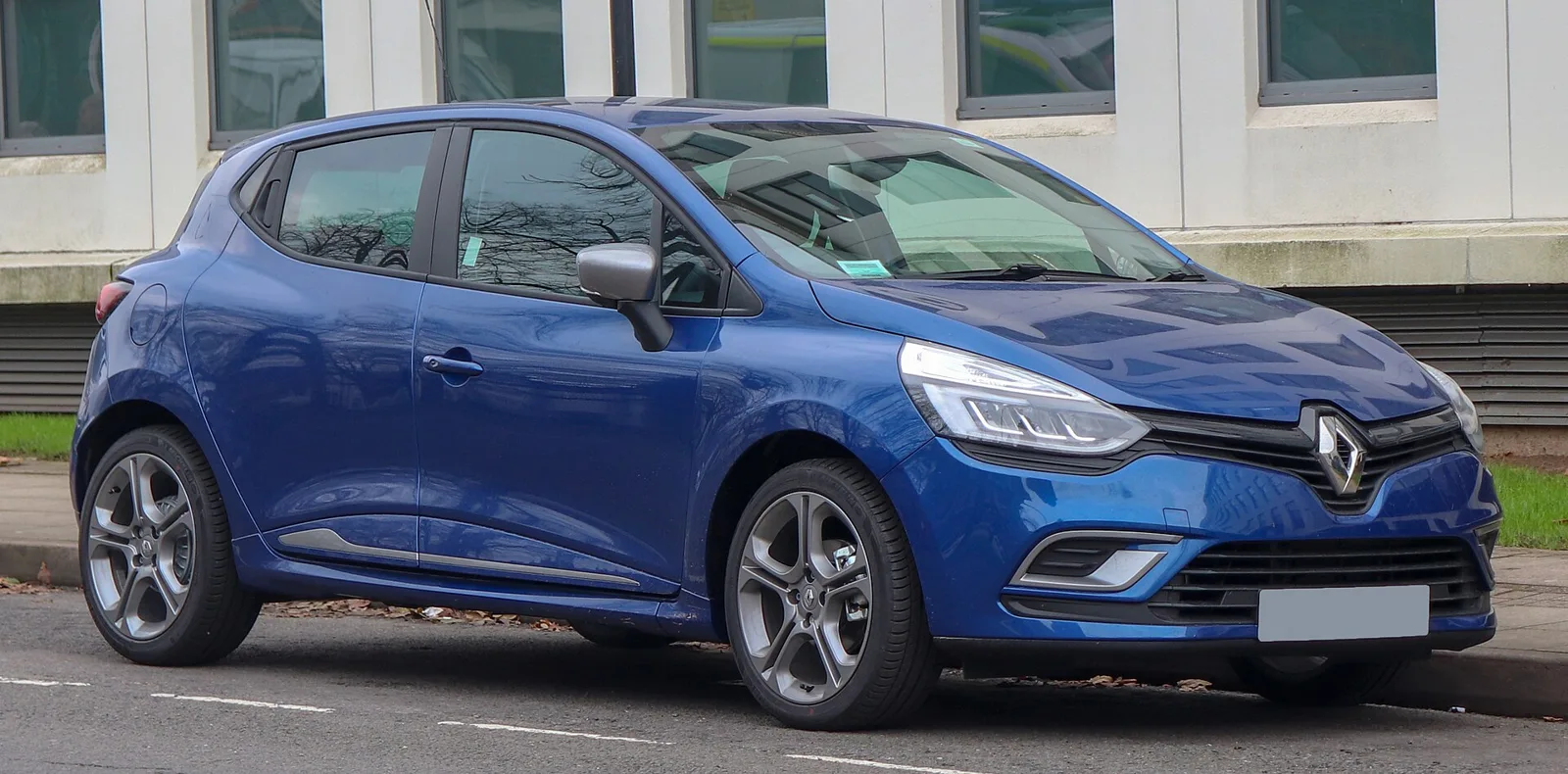
The Clio IV kept the base of the previous generation but lost every visual reference to it. The body grew in external size while its overhangs were smoothed, and the angular styling gave way to a more traditional curved look. Its general lines drew heavily on the R-Space concept car shown at the 2011 Bologna Motor Show.
The front showed the change most clearly. Styling passed from Patrick Le Quement to his successor, a former pupil named Laurens van den Acker. The new language had first appeared on the DeZir concept in 2010 and reached series production in 2011 on the restyled Twingo II.
The grille is a black strip that carries LED daytime running lights and widens in the centre to hold the manufacturer's symbol. Its ends wrap around the lower part of the light clusters, which have a wedge or sickle shape. The bumper shield has a fairly wide mouth.
Only a five-door body was made, so there was never a three-door version. The rear door handles are hidden in the rear pillar, a solution first introduced 15 years earlier on the Alfa 156. On the Clio IV it made its debut on a Renault, and the sill was given a raised-curtain effect that echoes the concept.
A Clio that lost every visual reference to its predecessor, with its rear door handles hidden in the pillar.
What was inside the Clio IV?
The two-tone dashboard carries two round dials, the rev counter and the fuel level gauge, with an oval horizontal digital speedometer laid over them. The side air vents follow a similar design. A multimedia unit in the centre of the dashboard handles navigation and gives access to various instrument functions.
The centre console is square and integrates the air conditioning controls lower down. The central vents are rectangular but follow the same theme as the side vents. The belt line is high and converges further upwards at the rear, which makes the rear windows smaller.
The boot holds 300 litres in the standard five-seat layout. Folding the rear seatback raises the load capacity to 1,146 litres.
Which engines did the Clio IV launch with?
The car launched with three engines, only one of them a diesel: the 0.9 TCe, the 1.2 16v and the 1.5 dCi. The 1.2 TCe GT and 1.6 T RS engines listed below came with those variants later, in 2013. The gearbox was a five-speed manual except on the GT, RS and dCi versions, and the platform was the same one used by the Clio III, the third-generation Nissan Micra and two generations of the Nissan Note.
- 0.9 TCe: three-cylinder turbo H4Bt, 899 cc (54.9 cu in), 90 PS (66 kW; 89 hp)
- 1.2 16v: naturally aspirated D4F, 1,149 cc (70.1 cu in), 75 PS (55 kW; 74 hp)
- 1.5 dCi: common rail diesel, 1,461 cc (89.2 cu in), 75 PS (55 kW; 74 hp) or 90 PS (66 kW; 89 hp)
- 1.2 TCe GT (summer 2013): turbo, 1,197 cc (73.0 cu in), 120 PS (88 kW; 118 hp)
- 1.6 T RS (March 2013): turbo, 1,618 cc (98.7 cu in), 200 PS (147 kW; 197 hp)
The 0.9 TCe was the real novelty, debuting together with the car itself.
What were the early variants of the Clio IV?
The public debut on 29 September 2012 also previewed two other variants, the station wagon called Clio Sporter and a top sporting version named Clio RS once again. Neither was in the launch range, and both were shown in definitive form at the Geneva Motor Show the following year.
At the beginning of 2013 a bi-fuel version joined the price list with the 1.2 16v and LPG. Its power dropped by just one PS. In March 2013 the RS, with its 1.6 Turbo of 200 PS (147 kW; 197 hp) and EDC twin-clutch gearbox, and the estate version joined the range.
In summer 2013 the GT arrived as a middle ground between the Energy and the RS. It was offered only with the 1.2 TCe of 120 PS (88 kW; 118 hp), had redesigned bumpers, an R.S. guide, the EDC twin-clutch gearbox and specific GT upholstery.
How did the station wagon differ from the saloon?
The station wagon is 20 cm longer at the rear than the saloon, and it shares the saloon's mechanical base. Its boot holds 443 litres in standard form and up to 1,380 litres with the seatback folded. The estate takes different names in different markets, including Estate in France, Sporter in Italy and GrandTour in Germany, Austria and Switzerland.
The estate's rear dampers were made stiffer to handle heavier loads. It was offered with the same engines as the saloon, except for the RS. The mid-life restyle that reached the saloon was carried into the estate too, so it received the same visual and technical updates.
What made the Clio RS different?
The RS gained a grey blade on the front bumper and a sill insert painted in body colour. Its chassis was stiffened, and its rear anti-roll bar was 10% stiffer than the one on the previous RS. The engine was a supercharged 1,618 cc unit with direct injection and double variable valve timing, producing 200 PS (147 kW; 197 hp).
The engine was in practice the same unit used in the Nissan Juke 1.6 DIG-T, tuned here for 200 PS. The gearbox changed too, moving from manual to a six-speed dual-clutch unit. The declared figures are 230 km/h (143 mph) at the top and 6 seconds to 100 km/h, or 7 seconds using Launch Control.
Two chassis were available, Sport and Cup. The Cup version sits 3 mm lower and has suspension that is 27% stiffer at the front and 20% stiffer at the rear.
What was the RS220 EDC Trophy?
In spring 2015 the RS220 EDC Trophy joined the standard RS as a limited-run model. Its engine was revised to raise maximum power to 220 PS (162 kW; 217 hp), with a larger turbo and a redesigned exhaust, and the chassis was lowered, with the front axle 20 mm lower and the rear 10 mm lower.
Its suspension was stiffened at both ends, so that its behaviour on the road and on the track would feel sportier. The car also carried a faster gearbox than the standard RS.
How was the Clio IV restyled in 2016?
The July 2016 restyle redrew the front bumper and extended the grille down under the light clusters. The lights gained new C-shaped LEDs that recall those of the Megane IV, which had been launched only a few months earlier. The rear bumper was also updated.
The diesel range gained an upgraded 1.5 dCi of 110 PS (81 kW; 108 hp), an engine already used on several other models of the Renault-Nissan group but never before in the Clio IV. The LPG model moved to the supercharged 0.9 TCe, and the 1.2 TCe of 120 PS could be ordered with a six-speed manual.
Why was the Clio IV range cut back in 2018?
By autumn 2018, in the final phase of the car's commercial life, much of the range had been dropped. Two engines were kept, the 1.5 dCi in 75 and 90 PS forms and a three-cylinder 0.9-litre petrol in 90 and 75 PS forms. The 75 PS petrol replaced an older naturally aspirated 1.2 of the same power.
The bi-fuel version and the 110 PS diesel were deleted, and so were the 1.2 TCe and the RS versions. A Clio Moschino trim was created through an agreement with the Italian fashion house Moschino, which came near the end of the car's life.
How long was the Clio IV on sale?
Renault sold the Clio IV as the Clio Generation in many markets, including France. Production at the French plant ended in August 2020, and Turkish production ended in May 2021. The model continued to be assembled in complete knock-down form in Algeria for the domestic market only.
Teasers for the fifth-generation Clio appeared in January 2019, and the new model was then presented at the Geneva Motor Show. The Clio IV had by then been in production for more than six years.
The Clio in police and Carabinieri service
In 2015 Renault built a fleet of 746 Clios in a livery for the Carabinieri. The standard equipment included a double roof-mounted flashing light, auxiliary controls such as a radio, a double weapons rack with key locking, and a writing support built into the rear boot cover. The base was the Clio Wave, with the 1.2 petrol and the 1.5 dCi turbodiesel, both of 75 PS (55 kW; 74 hp).
Under the Consip 7 supply plan, the Clio dCi went to the Station and Local Command posts for mobile zone patrols, while the Operational Intervention Companies received the petrol Clio to support the territorial units. The following year the State Police added 135 Clios in uniform for the railway police and the police headquarters, with 170 more vehicles in standard colours for the headquarters alone.
The Clio R3T and the RS 16 prototype
The Clio R3T was developed for competition, especially rallying, as a two-wheel-drive racing car based on the Clio RS 200 EDC. Its shock absorbers have many adjustments, which let the set-up be balanced for all types of terrain. Its 1.6-litre turbo was specially treated and produces 242 PS (178 kW; 239 hp) and 480 Nm (354 lb ft) of torque.
A six-speed sequential gearbox, operated by paddles on the steering wheel, sends the power to the wheels. Visually the car used a kit made partly from RS 200 EDC parts and partly from elements specific to the R3T. The Clio RS 16 prototype was shown at Monaco Formula 1 race weekend on 27 May 2016. It borrowed the 2.0-litre engine of 275 PS (202 kW; 271 hp) from the Megane RS Trophy 275-R and marked 40 years of Renault Sport. It had a new Akrapovic exhaust, a fixed rear wing and tracks widened by 60 mm.
Renault Clio IV specifications
| Specification | Detail |
|---|---|
| Body | Five-door only |
| Launch engines | 0.9 TCe 899 cc (54.9 cu in), 90 PS (66 kW; 89 hp); 1.2 16v 1,149 cc (70.1 cu in), 75 PS (55 kW; 74 hp); 1.5 dCi 1,461 cc (89.2 cu in), 75 or 90 PS |
| Later engines | 1.6 T RS 1,618 cc (98.7 cu in), 200 PS (147 kW; 197 hp), March 2013; 1.2 TCe GT 1,197 cc (73.0 cu in), 120 PS (88 kW; 118 hp), summer 2013 |
| Gearbox | Five-speed manual, except GT, RS and dCi |
| RS gearbox and top speed | Six-speed dual-clutch; 230 km/h (143 mph) declared |
| RS 0 to 100 km/h | 6 seconds, 7 with Launch Control |
| Boot | 300 litres; 1,146 litres with seatback folded |
| Station wagon boot | 443 litres; 1,380 litres with seatback folded |
| RS220 EDC Trophy | 220 PS (162 kW; 217 hp), limited run from spring 2015 |
| Clio R3T | 242 PS (178 kW; 239 hp), 480 Nm (354 lb ft), six-speed sequential |
| Production | 2012 to 2021; French plant ended August 2020, Turkey May 2021 |
What replaced the Clio IV?
The fifth-generation Clio succeeded the Clio IV. The Clio IV had been built on the same platform as the Clio III and was followed by a model that was first teased in January 2019. The Clio IV kept being sold in many markets, France included, under the name Clio Generation.