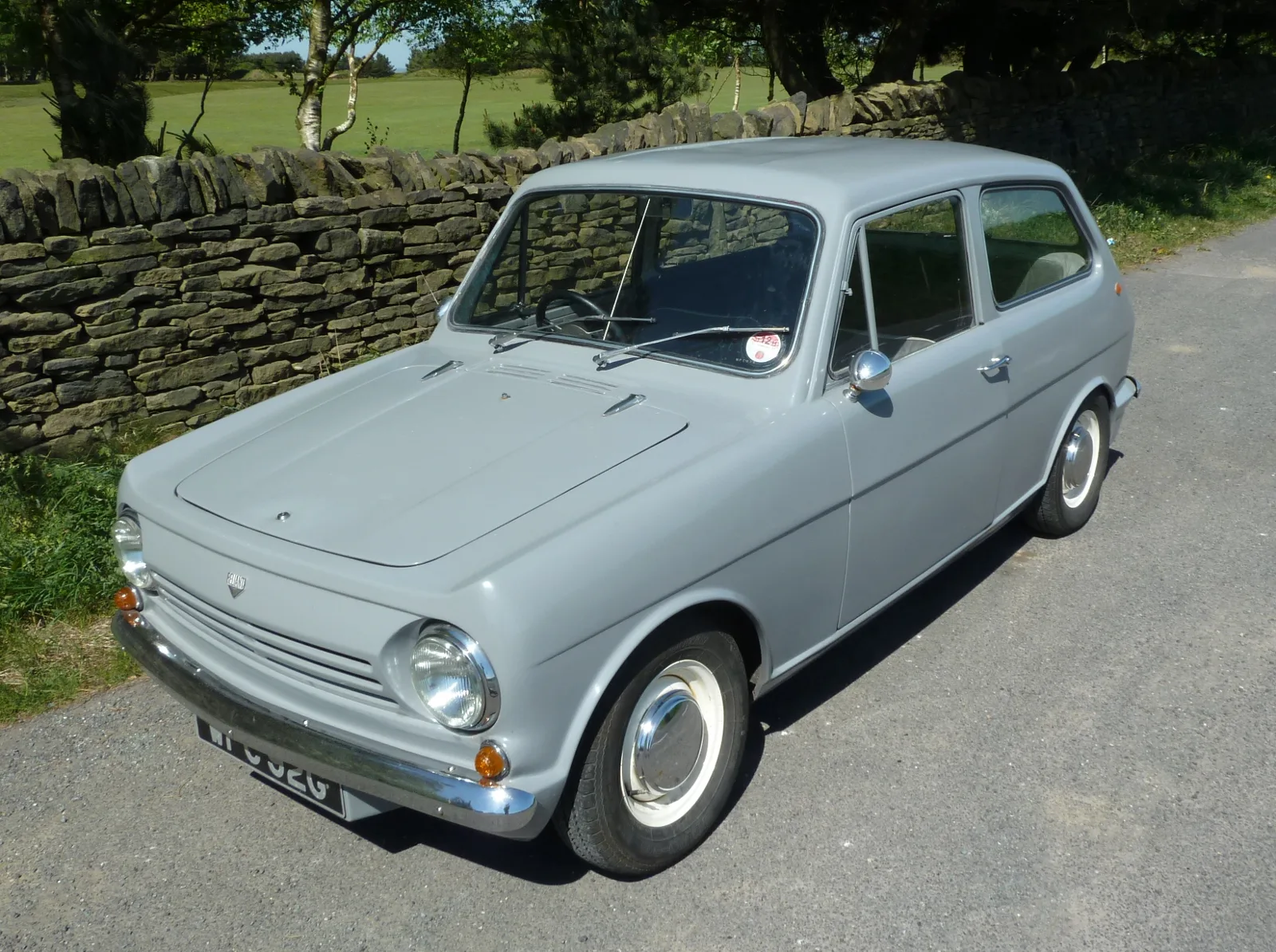
A small four-wheeled economy car from Reliant, built from 1964 to 1974, with a glass-fibre body, a Regal-derived chassis and an estate that outsold the rest.
Reliant sold the Rebel from 1964 to 1974 as a glass-fibre economy car on a Regal-derived chassis. Only 2,600 were built, and the estate body style was the one that sold best.
The Reliant Rebel was a small four-wheeled economy car that Reliant built from 1964 to 1974. It was conceived as a market test that would push the Reliant company beyond its three-wheelers, and it was sold as the smart alternative to the Austin Mini and Hillman Imp, with a glass-fibre body that could not rust.
Why did Reliant build the Rebel?
Managing director Ray Wiggin conceived the Rebel, which took shape after the death of Reliant's founder, T.L. Williams. Wiggin believed the future lay with small four-wheeled cars, and he saw the success of the Austin Mini as proof of that direction.
He also expected the British microcar and three-wheeler market to fade, so the Rebel was a bet on a new segment rather than a straight replacement for the three-wheelers.
A glass-fibre four-wheeler that was meant to test a new market and became the estate that Reliant kept building for decades.
How was the Rebel's chassis built?
Reliant engineers had earlier worked on the four-wheeled Sabra Carmel with Autocars of Haifa in Israel. For the Rebel they took the Regal 3/25 as their starting point, building a rolling chassis from a cut and welded Regal 3/25 frame and driving it around the Two Gates factory to see if it would work.
The 598cc engine from the Regal was judged too small to pull a finished car. Engineers kept the 600 engine but skimmed the cylinder head and fitted larger valves to give better torque for the extra weight.
Which parts came from other manufacturers?
The Rebel borrowed its front suspension from the Triumph Herald and its brakes from the Triumph Courier van, while the steering box came from the Standard 10. The wishbones, trunnions and ball-joints of the front end were drawn from the Triumph GT6, Vitesse and Herald models.
Reliant asked Ogle Design to style the car so that it looked completely different from the Regal, yet the company kept the Regal's doors, windscreen and dashboard to save production costs.
How big was the Rebel?
The finished car measured 138 in (3505 mm) in length and 58 in (1473 mm) in width, with a wheelbase of 89 in (2261 mm). Its kerb weight varied by model between 1185 lb and 1327 lb, which is 539 kg to 603 kg.
Behind the front axle the chassis echoed the three-wheeled Regal, while the front end was reworked for steering and suspension that suited four wheels. The standard 12-inch steel wheels used a 4 x 4 in bolt pattern and carried 5.50 x 12 in tyres.
How did the Rebel launch in 1964?
Earls Court in 1964 was where the car first went public. The show cars were pre-production models assembled in Turkey and driven to London to prove their durability. The launch drew heavy media attention, with many publications praising the new small four-wheeler.
Reliant recorded more than 1000 notices of interest from members of the public at the show. Reliant put its money into a new line and factory for the Scimitar Coupe, which launched alongside the Rebel in 1964, rather than into a Rebel line.
Why were so few Rebels built?
Reliant could not fill its early orders because the Rebel had no production line of its own. Building a batch meant stopping production of the popular Regal 3/25 on the same line, which management was reluctant to do since the Regal was in strong demand and more profitable.
The Rebel did not get its own dedicated production line until 1971, during the Rebel 700 period. It lost that line in 1974, along with the Bond Bug, to increase output of the new Reliant Robin, which had launched in 1973 and sold strongly.
The big marketing push at launch was therefore not matched by cars on the forecourt. Dealers were short of stock for several years, and the Regal 3/25 and 3/30 sold far more cars over the same period.
What were the first Rebels like?
The launch model of October 1964 was a saloon with the Regal 3/25's 598cc engine, a single trim level and a list of accessories. Only around 100 original Rebels were built, in two production batches at Tamworth in November and December 1964.
Those early cars were largely pre-production, built for dealer demonstrations. Their specification changed from car to car as the factory tested different fabrics and materials for the interior. Several used the dashboard and steering wheel of the Regal 3/25, had bonnet hinges hidden in the bodywork and carried the spare wheel under the bonnet.
Rebel prototypes had a larger front grille, but testing showed it made the cars run too cool. On early production cars the grille was left uncut in the moulding, which is why some enthusiasts call it a dummy grille.
What changed in the Rebel 600 and 700?
Only six months after the 1964 launch the car was relaunched as the Rebel Deluxe, a name that was never used again. In 1965 it was updated with a new dashboard, thicker seats for comfort and five leaf springs at the rear instead of seven for a softer ride. Later it was simply named the Rebel 600.
The Rebel 600 also lost the top half of its grille, which was filled smooth, and it gained orange front indicators in place of the original clear units. A unique steering wheel completed the changes.
The Rebel 700 arrived in October 1967 with a full chassis redesign in stronger steel, a new 701cc engine, a move to negative earth and many other specification changes.
Why was the Rebel estate so popular?
The estate was first shown at the Earls Court Motor Show, where it was also announced as on sale. It used longer rear windows and a large side-hinged rear door, and with the new fold-flat rear seat it made the Rebel exceptionally practical.
Within two years the estate had become the best-selling model in the range. Side windows that slid open could be ordered later, and the design was used by Reliant for a long time, being carried on for the Regal, Robin and Rialto models until 1998.
What was the Rebel van for?
A van version of the Rebel was introduced in 1971 after many enquiries from estate buyers. It was basically the estate without its windows, and dealers sold a rear window DIY kit so that owners could turn a van back into an estate and avoid a large amount of tax.
The estate and van both offered 46 cu. ft. of load space, which rose to 60 cu. ft. in the van when the optional front passenger seat was left out. Few Rebel 700 vans were built, because production was already being prepared for the 750, and many more 750 vans followed.
Royal Mail also looked at the Rebel van as a replacement for its fleet of Morris vans. It had already trialled the Reliant Supervan, but it felt the more conventional Rebel van could suit its needs, and as few as 10 vans were trialled.
How did the Rebel 750 change?
The next evolution was the 750, introduced in October 1972. It borrowed several parts from the three-wheeled Reliant Robin, which was due in 1973, including the new 748cc engine, the rear light clusters, a modified four-speed all-synchromesh gearbox and the radiator.
It also had fatter, more comfortable front seats and a softer padded dashboard, while all the interiors now used black vinyl seats and black carpets. Reliant backed the car with full-page colour adverts in magazines and newspapers, and it became the most popular Rebel.
In early 1974 the Robin proved so popular that production of the Rebel, the Bond Bug and the Reliant TW9 ended, freeing capacity for more Robins. In 1975 the Rebel was replaced by the Reliant Kitten.
How fast was the Rebel?
The Rebel's engines were all Reliant's own all-aluminium OHV units, based on a reverse-engineered 803cc Standard SC engine from the discontinued Standard Eight. The car launched with a 598cc unit making 28 horsepower, four more than the 600 in the Regal 3/25, because the Rebel felt sluggish with its extra weight.
After the 70 mph motorway limit was introduced, any car with a top speed below that was considered slow. Reliant therefore enlarged the engine to 701cc and 31 hp, and the 701cc unit gave the Rebel 700 a top speed of 70 mph. By 1972 the 750cc engine, with 35 hp, lifted the car to 80 mph and up to 65 miles per gallon.
Rebel engines always had higher compression and power than the three-wheeled equivalents, and Reliant introduced each new engine size in the Rebel before the Regal or the Bond Bug received it. Every Rebel engine number ends in a capital R.
What was the Rebel 1600 GT prototype?
While the Rebel was in production, Reliant experimented with a sportier variant to complement the Scimitar GT and the forthcoming Scimitar GTE. The prototype, codenamed FW6, was fitted with a 1599cc Ford Crossflow engine from the mk2 Ford Cortina 1600E, which made 80 hp.
Reliant had a relationship with Ford, building Ford's fibreglass truck cabs in return for engines. The 1600 GT was a working road-legal prototype and could have reached showrooms around 1968, but it never went into production because it outperformed the bigger Scimitar models around the factory.
How many Rebels were made?
A total of 2,600 Rebels left the factory across saloon, estate and van bodies. The UK took most of them, and the Caribbean islands took many, and about 900 cars were exported, some in left-hand drive for markets that needed it.
The low volume was largely the result of production constraints. Before 1971 a batch of Rebels meant stopping the Regal 3/25 line, which the company rarely wanted to do.
What are the Reliant Rebel specifications?
| Specification | Detail |
|---|---|
| Built | 1964 to 1974 |
| Launch engine (1964) | 598cc, 28 hp, based on the Reliant all-aluminium OHV design |
| Rebel 700 engine (1967) | 701cc, 31 hp, top speed 70 mph |
| Rebel 750 engine (1972) | 748cc, 35 hp, top speed 80 mph |
| Length and width | 3505 mm long, 1473 mm wide |
| Wheelbase | 2261 mm (89 in) |
| Kerb weight | 539 kg to 603 kg (1185 lb to 1327 lb) |
| Estate and van load | 46 cu. ft.; 60 cu. ft. in the van without passenger seat |
| Production total | 2,600 cars |