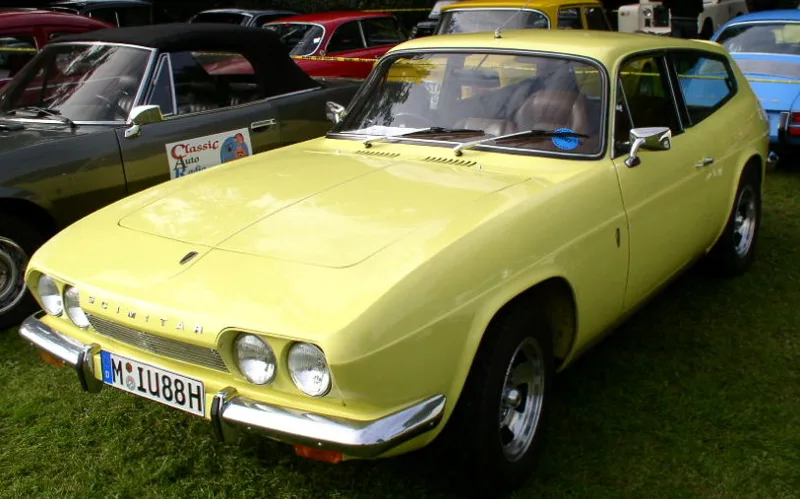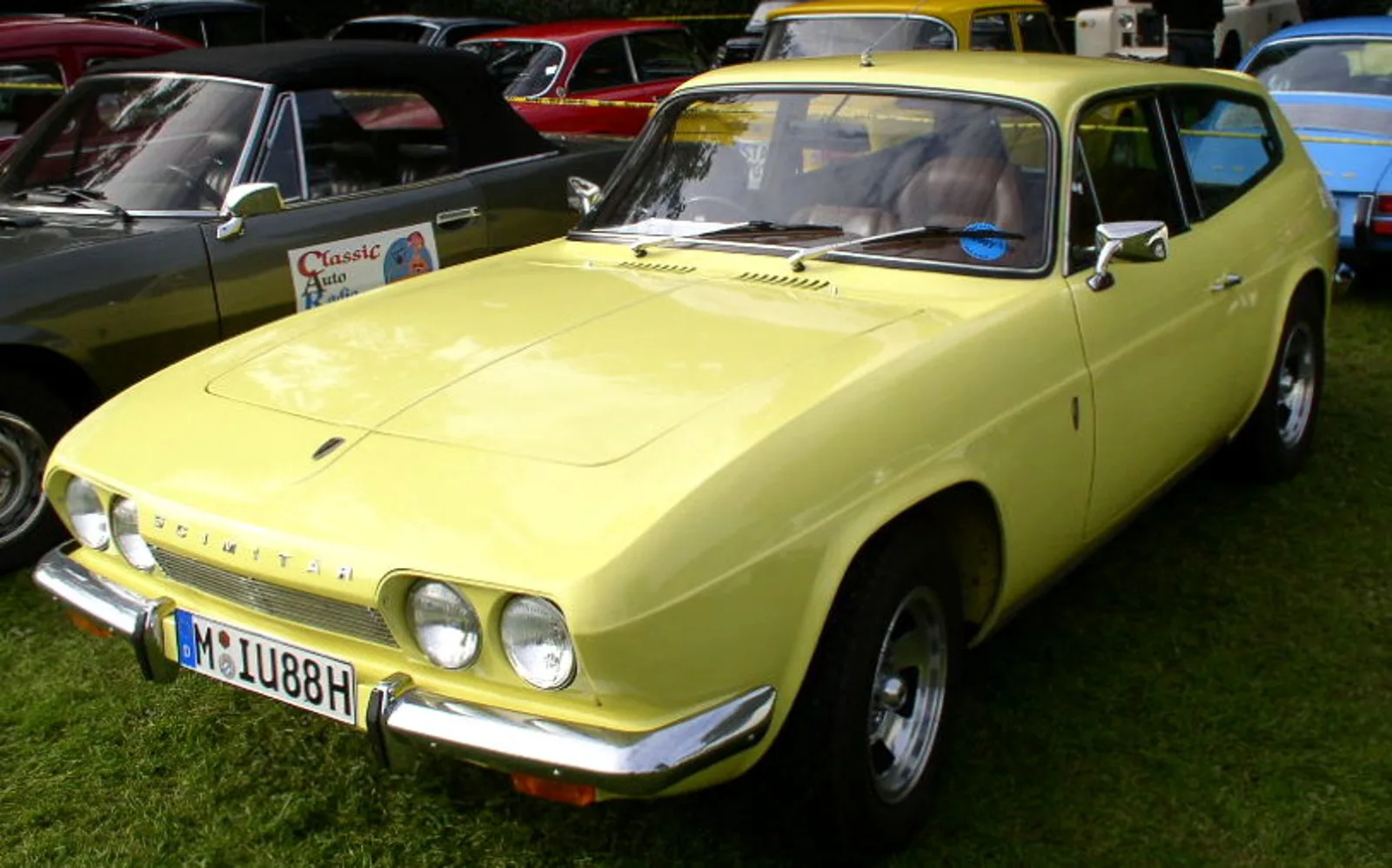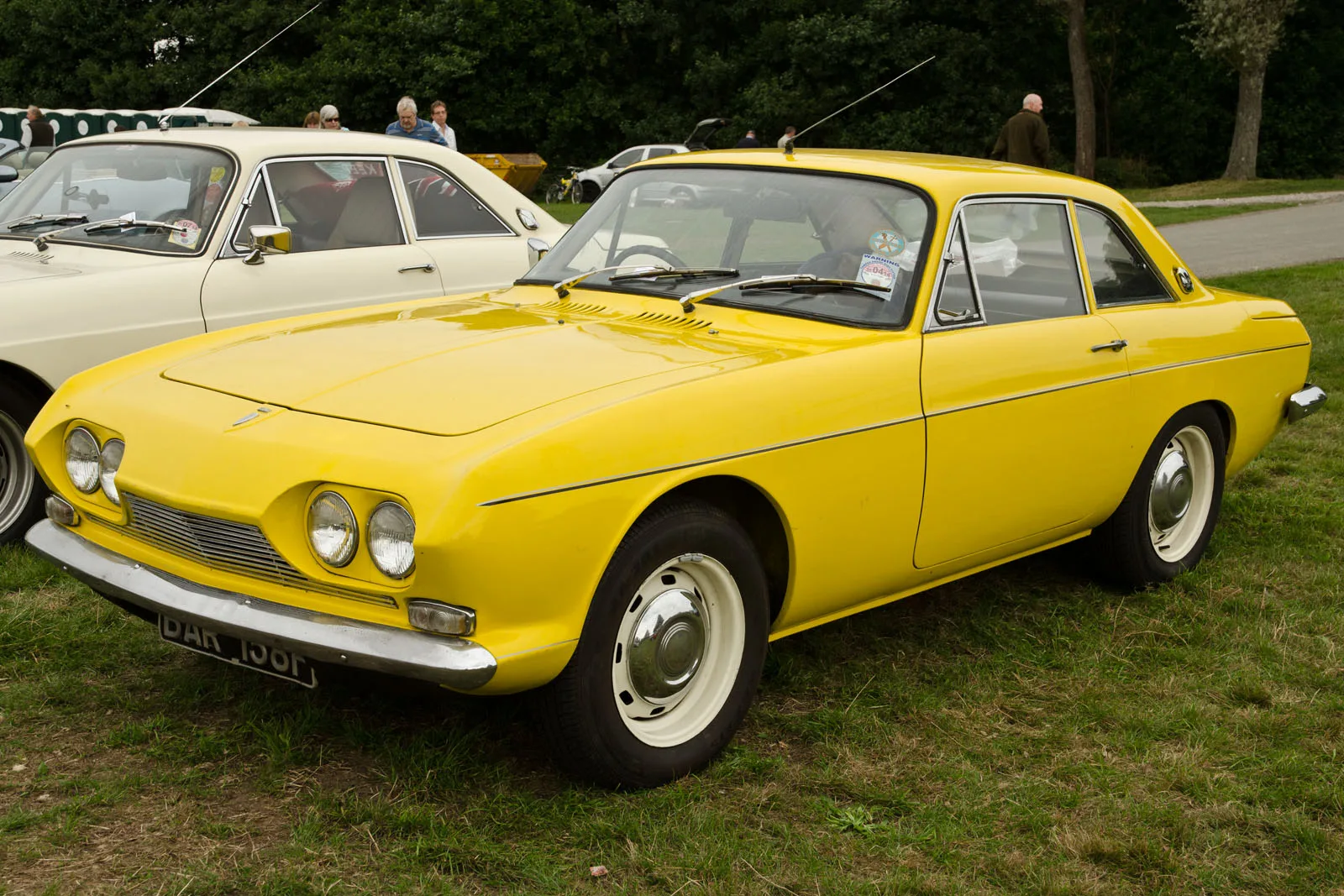
A two-door coupe with a glass-fibre body, adapted by Reliant from an Ogle design and built in small numbers from 1964 to 1970.
The Reliant Scimitar GT, in-house code SE 4, was a two-door glass-fibre coupe built from 1964 to 1970. It came from an Ogle Design concept, used Ford of Britain components and sold in small numbers, with roughly 1,000 cars built across all series.
The Reliant Scimitar GT, known in-house as the SE 4, was a two-door notchback coupe with a glass-fibre reinforced plastic body. The British firm Reliant produced it from 1964 to 1970. Its design began as a concept from Ogle Design, and much of its drivetrain came from Ford of Britain. Only about 1,000 were built, but the car opened the Scimitar family that stayed in the line-up until 1986.
Where did Reliant come from?
Reliant, based in Tamworth in Staffordshire, was best known for three-wheeled cars such as the Regal and the Robin, both before and after the Second World War. Their low weight allowed them to be classed as motorcycles in Britain. Many of the bodies were moulded in plastic for the sake of weight, which made Reliant a pioneer of plastics in automotive use during the 1950s.
Alongside the small cars, Reliant designed a range of larger four-wheelers for manufacturers around the Mediterranean, among them Autocars Company of Haifa. Autocars also built the Sabra Sport, which Reliant had designed using a mix of outside components. In 1962 Reliant took the Sabra on for Britain, where it sold as the Reliant Sabre, in-house code SE2. It opened a new model line above the three-wheeled small cars, but its unusual styling kept it from catching on.
Reliant took an Ogle concept for a Daimler-based coupe and built a plastic car that could be bought for 1,292 pounds.
Why did Reliant buy an Ogle design?
Reliant needed a successor to the Sabre, and it found one in a 1962 concept from Ogle Design. The SX 250, described as a design study, was a two-seat notchback coupe built for a private customer. Technically it was based on the Daimler SP 250 sports car, yet its body was widely seen as very attractive, which the production Daimler's was not.
Daimler had no intention of putting the Ogle coupe into series production. Reliant's director, Ray Wiggin, saw in the concept a basis for a Sabre replacement. The company acquired the rights to the SX 250 design in early 1963.
Development followed through 1964, when the design was adapted to Reliant's chassis dimensions and construction methods. The first prototype, chassis number SC 40002, was finished in late summer 1964. It was registered as the Ogle GT rather than as a Reliant. After five more pre-production cars, series production began under the name Reliant Scimitar GT.
How did the body differ from the Ogle?
The Scimitar GT kept the Ogle's general shape but departed from it in key details. Its panels were attached to a plastic load-bearing structure rather than a metal framework. The passenger cell was shifted rearwards from the centre, which emphasised the length of the engine area, and the car seated 2+2.
The body follows a pontoon style with a trapezoidal roof. That roof reaches further back than the Ogle's, and the doors are just under 13 cm (5 inches) longer.
The front wings end in a slightly protruding point, and twin headlamps sit side by side. Between them is a cooling air intake covered by a metal grille of thin bars, a feature the Ogle did not have. Along the flanks a light band runs to the rear, set higher than on the Ogle, while the rear bumper is mounted lower.
Two round tail lamps sit on each side at the back. The boot lid runs into the flanks and looks as if it has been placed on the car. The fuel filler sits in the left C-pillar rather than centred under the rear window as on the Ogle.
What was under the skin?
The chassis was a box-section steel frame, an evolution of the frame already used on the Sabre and the Israeli Sabra Sport. Its basic design went back to a 1958 layout by Leslie Bellamy for LMB Components. A longitudinal front engine drove the rear wheels.
The rear suspension was newly designed, and a Watt linkage replaced the Sabre's Panhard rods. In 1966 the car moved from inline engines to V engines, which could be mounted further back because they were shorter, and that change required a revised front suspension. An anti-roll bar arrived in 1966 to cope with the higher output of the new engine.
Which engines and gearboxes did it have?
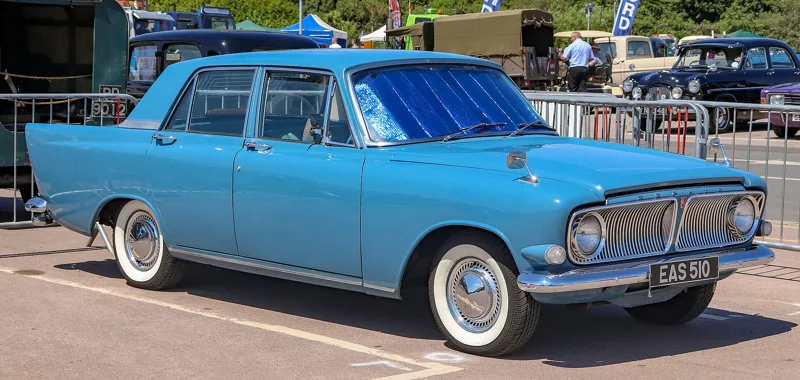
The Scimitar GT used only six-cylinder engines, continuing the path set by the Sabre Six. Early cars used a 2.6-litre (159 cu in) inline six, a regular fit in Ford's contemporary large models, the Zephyr and Zodiac. Reliant fitted it with three SU carburettors as standard, which Ford did not do in its own saloons. From 1966 the company turned to the Essex V6 series, a lighter and more compact unit that took up less room than the Zephyr engine.
The first series was fitted with an inline six from the Zephyr range. Initially Reliant supplied a 3.0-litre Essex V6 as standard, and from 1967 a 2.5-litre (153 cu in) Essex variant came in, with output close to that of the old inline six.
Power went through a manual four-speed Ford gearbox, which buyers could pair with a Laycock overdrive for an extra charge. A four-speed ZF gearbox was also available as an option.
Series overview
| Series | Built | Engine | Cars |
|---|---|---|---|
| SE 4 | September 1964 to autumn 1966 | Inline six, Ford Zephyr range | 296 or 297 |
| SE 4a and SE 4b | autumn 1966 to 1970 | 3.0-litre Essex V6 | 591 |
| SE 4c | autumn 1967 to November 1970 | 2.5-litre Essex six, 122 PS (120 hp) | 118 |
What did the first series cost?
In Great Britain the first series was priced at 1,292 pounds. Its wire-spoke wheels were fitted from the factory, and the engine choices of later years were partly shaped by running costs.
The SE 4c's Essex six came about partly through running-cost considerations, while the Essex V6 that preceded it had been the standard engine since the 1966 switch.
How did the series change?
Changes during the run mostly concerned the drivetrain, and the designations SE 4, SE 4a, SE 4b and SE4c recorded them. The first series had wire-spoke wheels from the factory and the Ford inline six. In autumn 1966 the SE 4a arrived with the Essex V6, whose maximum output sat about 20 per cent above that of the earlier engine. The wire-spoke wheels gave way to conventional metal wheels.
The SE 4 series ran from September 1964 until autumn 1966, and its last car was registered in April 1967.
Early in 1967 the SE 4b followed. Technically it matched the SE 4a, but it had a redesigned instrument carrier and a number of other interior changes.
The last version, the SE 4c, appeared in autumn 1967 and looked unchanged on the outside. Its 2.5-litre Essex six produced 122 PS (120 hp), a little less than the SE 4a and SE 4b engine. The choice was justified by lower fuel consumption and a lower road-tax rate.
How many cars were built?
Reliant built about 1,000 Scimitar GTs across all series. The first series is given as 296 or 297 cars, although one source puts it at 59. The SE 4a and SE 4b together reached 591, and the SE 4c added 118 before production stopped in November 1970.
The first-series cars, known as Straight-Six Scimitars, have become sought-after collectors' items since production ended.
How did the GTE follow the GT?
The GTE was an estate coupe developed on the basis of the GT in 1967, as its direct successor. It stayed in the line-up until 1986 and was a core product of the brand. It was received far better on the market than the notchback GT.
The SE 4c was built alongside the GTE, so the notchback and the estate ran in parallel for a time.