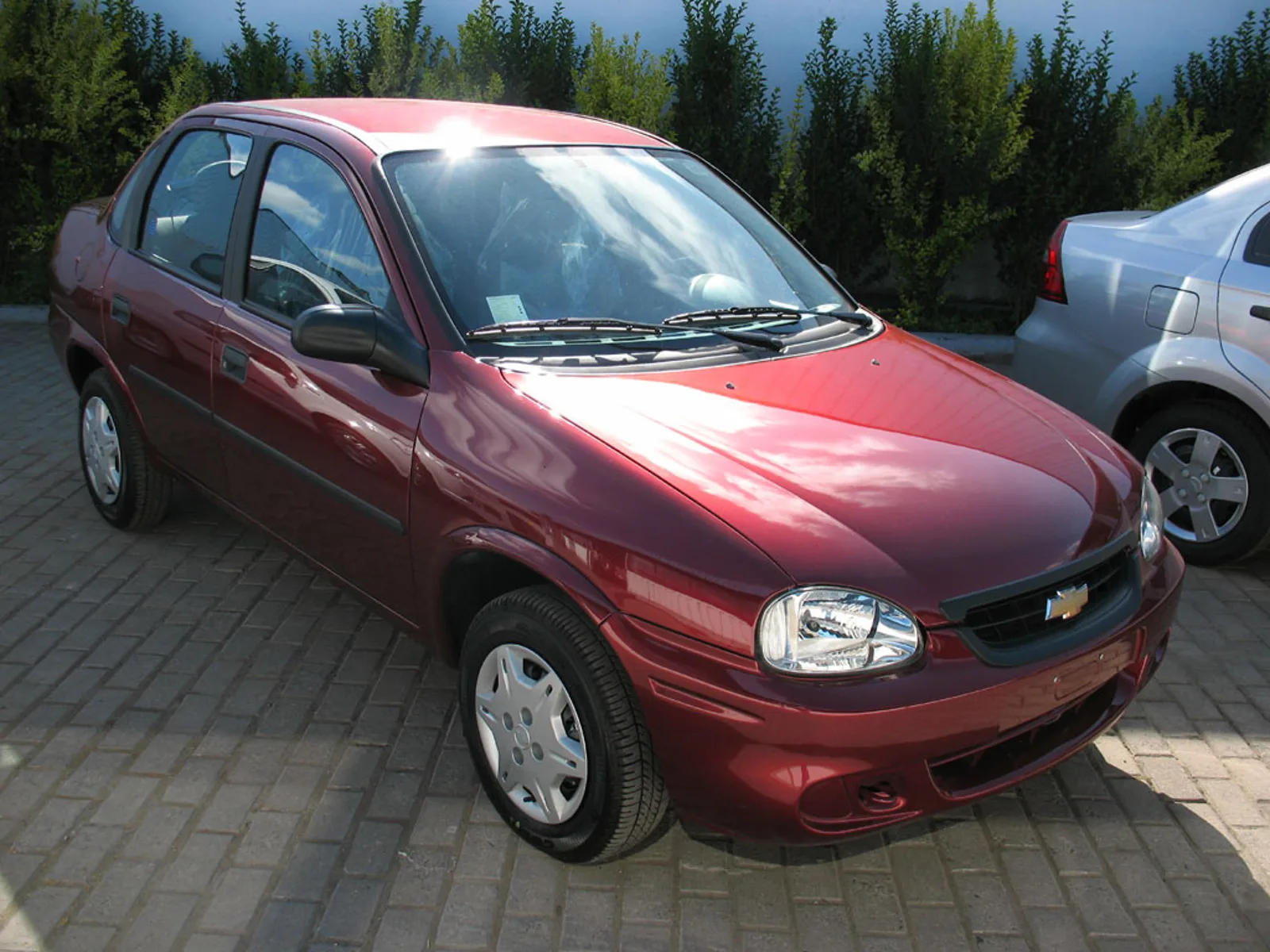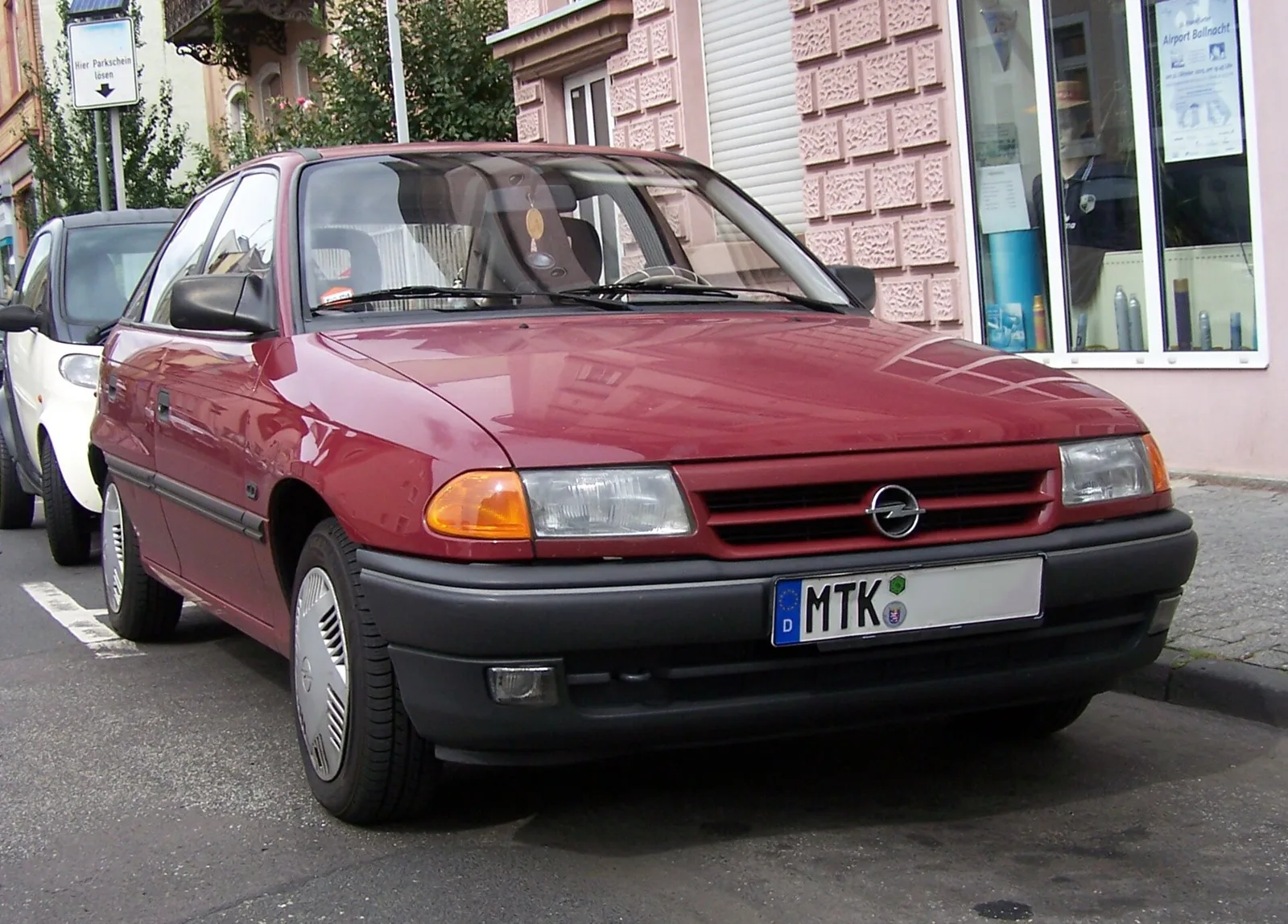
The first Astra, built from 1991 to 1998, carried a range of saloon, estate and cabriolet bodies and a GSi with a 150 PS twin-cam engine.
Opel built the Astra F from 1991 until 1998 as a compact saloon and estate, with a cabriolet until 2000. The car came after the Kadett E, and the GSi sat at the top of the range with a 2-litre twin-cam producing 150 PS.
The Opel Astra F was the first generation of the Astra, a lower-middle-range car that Opel built from 1991 to 1998 as a saloon and estate. It succeeded the Kadett E and brought the Astra name to Opel's compact range. The GSi, with its 150 PS twin-cam engine, was the performance flagship.
Why was the car called Astra?
The name came from a General Motors plan to unify model names, an idea that the group had wanted since the 1970s. Opel's sister brand Vauxhall had built Opel-based models for Britain since 1970, restyled at the front and with different names, so the two brands did not share a single naming system.
The Kadett D reached Europe in 1979 and became the Vauxhall Astra in Britain. The Kadett E kept the Astra name in Britain from 1984. When the Kadett E was due for retirement, General Motors management pushed for one name across Vauxhall and Opel.
The new model that replaced the Kadett E was called Astra. Vauxhall kept its own brand in Britain, however, and applied different rules for its model series.
The Astra F put a 150 PS twin-cam into an everyday compact and gave Opel's compact the Astra name.
How did the Astra F debut in 1991?
The Astra F appeared in September 1991 as a two-volume saloon with three or five doors. Its look recalled the Kadett E, which had sold well, so Opel restyled the car rather than reinventing it. The engines ran from a 1.4 of 60 PS up to the 2-litre twin-cam C20XE of 150 PS in the GSi.
The diesel joined in December 1991 with the 1.7 17YD, which produced 57 PS. Petrol engines used electronic fuel injection, apart from a 1.4 carburettor of 75 PS offered in the first year in some markets, though not Italy.
What engines did the Astra F offer?
Most engines were paired with a five-speed manual gearbox, while a four-speed automatic could be ordered on some versions. The saloon's petrol range included a 1.4 of 82 PS, a 1.6 of 75 PS and a 1.8 of 90 PS, plus a single-cam 2-litre of 115 PS shared with the Calibra.
The 1.6 of 100 PS arrived in 1992, the first 1.6 offered for the Astra F in Italy. In 1993 the 90 PS 1.8 was replaced by a twin-cam 1.8 of 125 PS, which completed the range wherever a 1.8 had been missing.
Summer 1992 brought a turbodiesel 1.7 with 82 PS of Isuzu origin. It replaced the 1.5 TD of the Kadett.
The September 1994 update reshuffled the range again. The single-cam 1.6 gave way to a twin-cam of the same size and power with better torque delivery, and the 1.8 became a detuned X18XE of 115 PS. The single-cam 2-litre of 115 PS was replaced in March 1995 by a twin-cam 2-litre of 136 PS, which sat beside the 150 PS top model.
On the diesel side, the naturally aspirated unit gave way to a low-pressure turbocharged version of 68 PS, which joined the 82 PS engine. Early 1996 brought a twin-cam 1.4 of 90 PS, a single-cam 1.6 of 75 PS and detail changes to the 1.8 16v. The 150 PS 2-litre was removed from price lists in the second half of 1996.
How did the Astra F body variants arrive?
After the saloon, Opel added a station wagon in 1992, followed quickly by a van with only three doors and front seats. A three-volume four-door saloon arrived in May 1992, and a cabriolet followed at the end of 1993 to replace the open Kadett E.
Three-volume saloon
Introduced in 1992, the four-door saloon replaced the three-volume Kadett E and was offered only with four doors. Its rear light clusters were redesigned, while the rest of the body kept the same lines as the other versions. The early engines were a 1.4 of 60 and 82 PS, a 1.6 of 101 PS and the 1.7 diesel of 57 PS. In 1993 the 82 PS turbodiesel also went under the bonnet.
The four-door was never meant as a performance model, and no lively versions were planned with that body. There were therefore no four-door Astra saloons with 1.8 or 2-litre engines in Italy. Later developments that affected the two-volume car reached the three-volume version too, though only for the smaller set of engines planned.
Station wagon
The Astra SW was launched in 1992 to replace the Kadett Caravan, and several markets kept calling it the Caravan. Its capacity and practicality made it a real thorn in the side of the Ford Escort estate, which had been the undisputed best seller in the compact estate segment. A 1.8 16v of 125 PS arrived in 1993, and a twin-cam 2-litre of 136 PS came in 1997. No 2-litre was planned at first, but a sporty-looking 1.8 16v GSi of 125 PS was sold with more aggressive styling. When the saloons ended production, the estate survived a few months before the Astra G estate replaced it in the second half of 1998.
Cabriolet
The cabriolet was launched at the end of 1993 with a line by the Italian stylist Bertone. With the roof up or down, the car kept a balance of proportions rarely found on other cabriolets. Its first engines were a 2-litre single-cam of 115 PS and a 1.6 of 75 PS, but both were replaced in 1994 by a single-cam 1.4 of 82 PS. A twin-cam 1.8 of 116 PS came in 1995, and the 1.4 became a twin-cam of 90 PS in 1997. Italy dropped the cabriolet once the new series arrived, while other markets kept it until 2000.
What made the GSi the top Astra F?
The GSi was produced from mid-1991 in pre-series form and sold until the start of 1996. It took over from the Kadett E GSi and used the same engines, updated to Euro 1 rules with a three-way catalytic converter and lambda sensor. The 2.0 16V C20XE produced 110 kW (150 PS; 148 hp) and was the car's headline figure. It became one of the favourite models of young enthusiasts.
The C20XE displaced 1,998 cc and had a square layout, with an 86 mm bore and an 86 mm stroke. It delivered 110 kW (150 PS; 148 hp) at 6,000 rpm and 196 Nm (145 lb ft) at about 4,800 rpm. Around 90% of its maximum torque was available between 3,100 and 6,000 rpm. The car weighed 1,100 kg (2,425 lb).
The June 1992 Quattroruote test recorded a top speed of 219 km/h (136 mph), 7.3 seconds from 0 to 100 km/h and a stop from 100 km/h in 38.8 metres. Opel declared 150 PS cautiously because output varied between cars, and many examples approached 160 PS. A recall covered the cylinder head castings, which were replaced under warranty.
Visually the GSi had two air intakes on the bonnet, lowered front and rear bumpers, side skirts, alloy wheels with 205/50 ZR15 tyres and a double square exhaust outlet. The 2.0 8v version, with 115 PS, was sold from 1991 to 1993 and looked almost the same, but it had a single square exhaust, no rear anti-roll bar and no traction control, even as an option.
After 1995 the GSi received a restyle with a far less flashy look, with a slightly wider rear spoiler and new wheels. The C20XE-LN was a quieter engine with squarer camshaft pulley teeth, and Bosch Motronic M2.8 electronics replaced the M2.5 unit.
Standard equipment included four-channel ABS, a suspension 1.5 cm lower and an on-board computer. Electronic traction control, which the driver could switch off from the centre console, limited wheelspin on any surface and was gentler than the systems of the time. Only the GSi 16V carried the ETC name, while other versions could take a costly TC option.
Airbags arrived in 1994, with the driver's bag standard and the passenger's optional. Buyers could also add manual air conditioning, headlamp washers, heated front seats, leather, a sunroof and metallic paint. Opel offered a limited-slip differential for the GSi, described only briefly in its workshop manual.
From 1994 the GSi used the twin-cam 1.8 16v of 125 PS, type C18XE, in place of the single-cam 2.0 that no longer met emissions rules. It had no traction control, not even as an option, and it lost the rear anti-roll bar. That version was built only from late 1993 to late 1994. The GSi left the market in 1996.
How did the Astra F perform in motorsport?
The 2.0 16v GSi was a regular in competition. It won the England group A championship in 1993 with David Llewellyn, and in Italy it claimed group N wins in the Two-Litre Rally Championship in 1996, 1997 and 1999.
Further group N wins came in the Tradizione Terra Trophy in 1996, 1997 and 1998. In the Italian Touring Car Speed Championship the car took class wins in 1992 and 1993, while in 1998 a Corsa GSi won its class and Stefania Grassetto took the ladies' class in another Corsa GSi.
How much did the Astra F body styles weigh?
The published data refer to the two-volume three-door saloon, so other body styles can differ. Station wagons weigh 60 to 80 kg more than the two-volume saloons, use about half a litre more per 100 km and reach a top speed about 5 km/h lower. They also take half a second longer from 0 to 100 km/h.
Three-volume saloons weigh 10 to 30 kg more or less than the two-volume cars, depending on the version, with almost identical performance. Cabriolets are about 130 to 140 kg heavier than the two-volume cars. Five-door saloons weigh 15 to 20 kg more than three-door models, again with identical performance.
The 2.0 GSi 16v and the 1.8 GSi 16v were offered only as three-door saloons, in blue, red, white or black in the first series. The second series came in the whole Astra F colour range. The 1.8 GSi 16V with 125 PS was built only with the first-series body until 1994, while the larger GSi kept going for two more years after the restyle.
Where else was the Astra F sold?
Outside Western Europe the Astra F took different forms. As the Astra Classic it was sold in Eastern Europe and Turkey from 1998 to 2002, and that version was built in Poland. The Astra F was also built under licence by Delta in South Africa, where it was a four-door Astra and the two-volume versions kept the Kadett name.
South African Kadett and Astra cars carried 160i, 180i or 200i badges, matching 1.6 16v, 1.8 16v and 2.0 16v engines. A turbocharged 2-litre derived from the Calibra 2.0 16v Turbo 4x4 powered the 200tS, the turbo version of the Kadett.
Holden sold the Astra F in Oceania from 1995. The name Astra had been used there from 1984 to 1989 on rebadged Nissan Pulsars, which were later replaced by a rebadged Toyota Corolla sold as the Holden Nova from 1989 to 1996. In South America the car was sold under the Chevrolet brand.