A single-cylinder buggy from a US maker, drawn by a designer who had worked on the Oldsmobile Curved Dash.
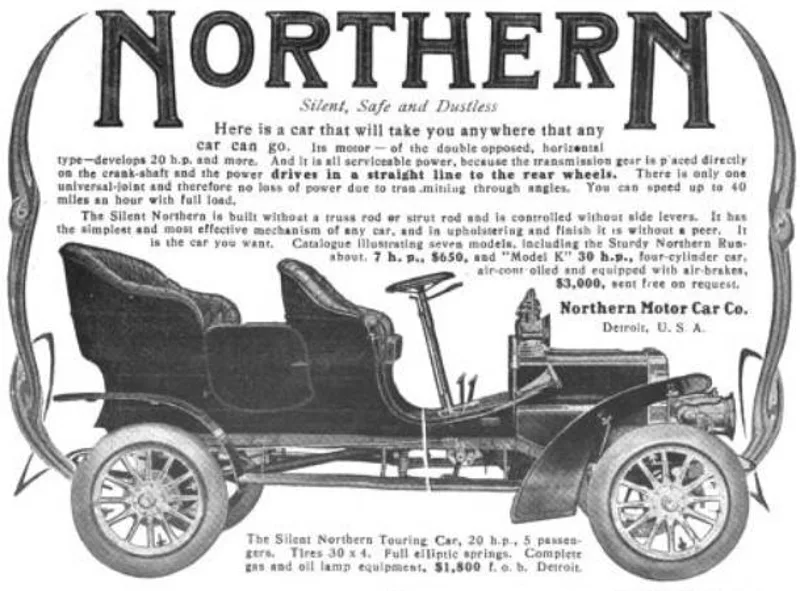
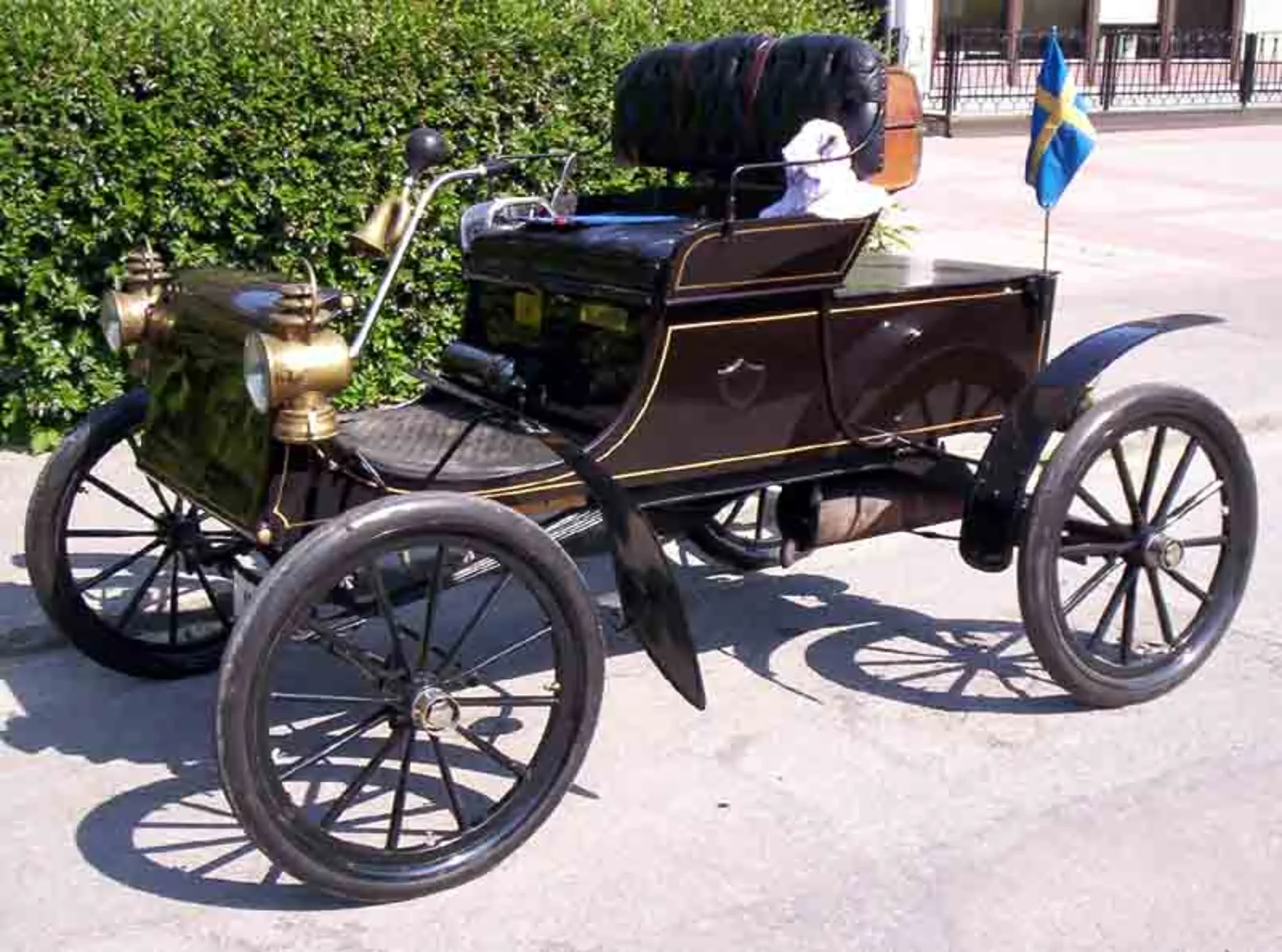
The Northern 7 HP was a single-cylinder Runabout built by Northern Manufacturing Company in the US from 1902 until 1907 or 1908. It had a 1,744 cc engine under the seat, a two-speed planetary gearbox and a lever for steering, and it was the cheapest car in the range.
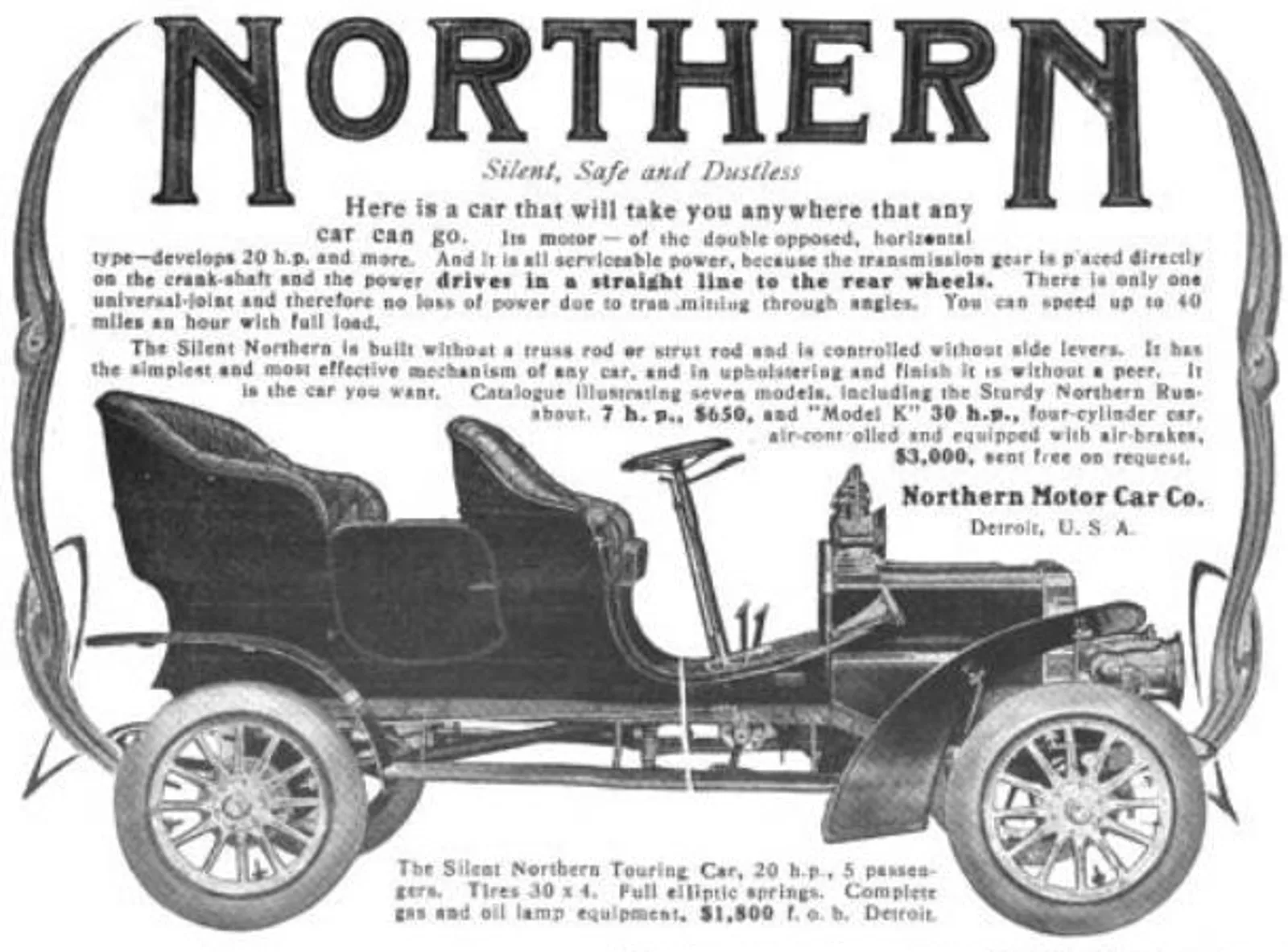
The Northern 7 HP was the single-cylinder Runabout of the American firm Northern Manufacturing Company, which built it throughout the car's life, from 1902 until production ended in 1907 or 1908. Its engine lay under the driver's seat, and it stayed the smallest and cheapest model in the range once the company added larger cars in 1904.
The design came from Jonathan D. Maxwell, who had helped develop the Oldsmobile Curved Dash before he joined Northern. The Runabout shows the same thinking. It was a carefully built automobile, and it laid the basis for the reputation the Northern name went on to enjoy.
Who founded Northern Manufacturing and who designed the first car?
Detroit investors led by industrialist William A. Barbour, with William E. Metzger, founded the firm and recruited two designers from Olds Motor Works in Lansing, Michigan: Jonathan D. Maxwell (1864-1928) and Charles Brady King (1868-1957). Maxwell designed the Silent Northern, which appeared for the 1902 model year.
The Silent Northern, also known as the Northern 5 HP, stayed in the programme until production ended, receiving upgrades and improvements along the way. In its first production year the company built a respectable 300 examples. Even so, a design that had been up to date at launch gradually became technically dated.
Maxwell's time on the Curved Dash undoubtedly shaped the first Northern. He left in 1904 and co-founded Maxwell-Briscoe, which later counted among the precursors of the Chrysler Corporation, while Charles King succeeded him as designer. In 1904 Northern also launched the Northern 15 HP, a two-cylinder middle-class model, and the very innovative Northern Type K followed, which marked its entry into the upper class.
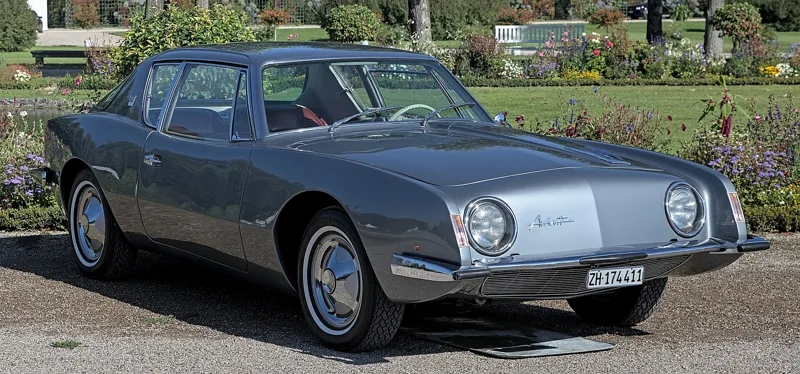
In 1908 Northern merged with the Wayne Automobile Company of Detroit, and in 1909 the combined firm emerged as Everitt-Metzger-Flanders (E-M-F). King had left in 1908 and set up the King Motor Car Company two years later. E-M-F was later taken over by Studebaker, and it formed one of the foundations of the Studebaker car.
The Runabout was the only model the company built in the traditional way.
How was the Northern Runabout built?
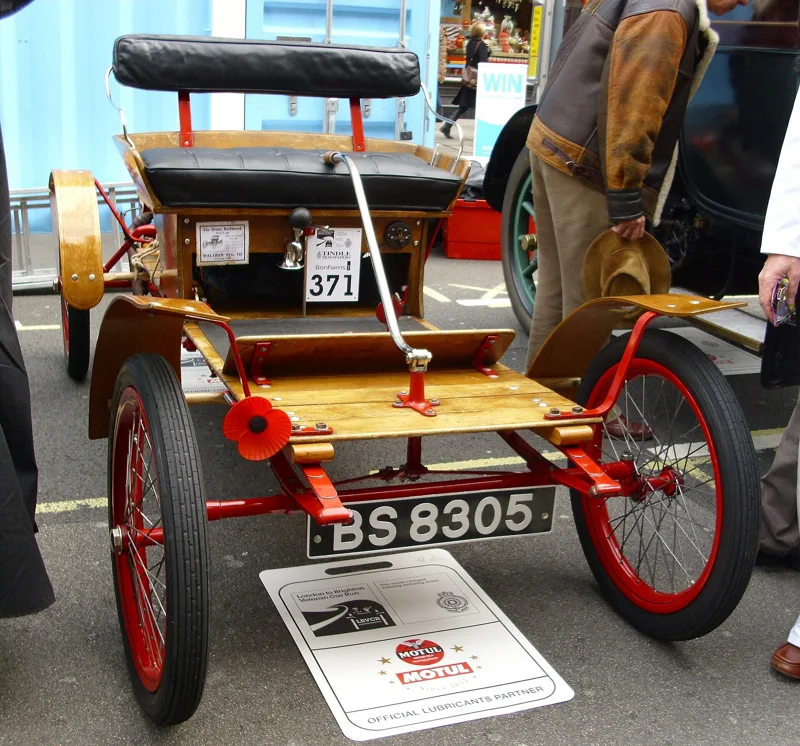
The Runabout had its water-cooled single-cylinder engine mounted sideways under the driver's seat. Its transmission was a planetary unit with two forward ratios and reverse, and one chain carried drive to the centre of the rear axle. Steering was by lever. The body rested on a subframe, and a fixture Northern patented held it to the chassis at just four points. The company hoped the arrangement would make the ride more comfortable.
Long leaf springs, already used on the Curved Dash, ran lengthwise and formed part of the chassis side members, so the oversized springs carried the frame as well as the car. The axles were fixed at the outer ends of the springs in a cantilever arrangement. Between the subframe and the front axle sat a transverse, full-elliptic spring pack whose lower end was fixed to the axle, a layout that also appeared on the Curved Dash.
Northern named the pivot bearings trunnion hangers and regarded them as its own development.
Accounts differ on the frame material. A special January 1904 edition of Frank Leslie's Popular Monthly lists steel tube, while several editions of a gasoline automobile handbook give angle steel. Pictures suggest the subframe was made of angle iron and the main frame's cross members may have been tube, a choice that was common enough for small cars of the era.
What made the Runabout easy to operate?
Northern put real effort into simplifying how the car was driven. Documents from 1905 mention a starter crank operated from the seat, and Maxwell might have adopted the idea sooner. The Runabout was the only model the company built in the traditional way.
Charles King took much more radical routes with the larger models, and the Runabout shows the first early steps in the same direction.
What were the Northern 7 HP engine figures?
The 7 HP rating applies from 1905. Northern's output was worked out from the cylinder bore rather than measured. The final engine displaced 160.3 cu in (1,744 cc), with a bore near 4 3/4 in (121 mm) and a 6 in (152 mm) stroke.
Northern had joined the trade body known as the A.L.A.M. in early summer 1903. The association usually insisted that its members apply its in-house formula, which derived power from the bore. For single-cylinder vehicles such as the Runabout, that method gave passable results.
The first rating was 5 HP at 600 rpm. Ratings of 6 HP and 6 1/2 HP are documented for 1904, and 7 HP from 1905. Working back from the bore, the earlier 5, 6 and 6 1/2 HP models probably measured about 90, 98 and 105 mm, though the displacement of those engines cannot be established.
The 1906 cars used a carburettor that Northern designed itself.
What are the Northern 7 HP specifications?
| Feature | Detail |
|---|---|
| Engine | Water-cooled single-cylinder four-stroke designed by Maxwell |
| Displacement | 1,744 cc (160.3 cu in) on the 7 HP |
| Bore and stroke | About 121 mm (4 3/4 in) by 152 mm (6 in) |
| Output | 5 HP at 600 rpm at first; 7 HP from 1905 |
| Gearbox | Two-speed planetary with reverse, 1904 to 1907 |
| Track | 1,422 mm (56 in) or 1,524 mm (60 in), in 1904 and 1906 |
| Wheelbase | 1,778 mm (70 in) from 1905; 2,286 mm (90 in) on the last cars of 1908 |
| Tyres | 28 x 3 in (1906) |
| Brakes | Drum on the differential until 1904; second drum on the gearbox from 1905 |
| Weight | About 500 kg (1,100 lb) |
| Steering | Lever |
| Drive | Right-hand drive, as far as is known |
How much did the Northern cost?
Starting at US$800, the price came down to US$750 and then to US$650. The Curved Dash, by contrast, cost US$650 in most of its production years, while Northern buyers also had access to what was probably the best dealer network of the period.
Like Ford later, Northern managed to make its car cheaper over time.
How long was the Runabout built?
Production ended in 1907 or 1908, depending on the account. Over its life the car came as a 5 HP, a 6 1/2 HP, a 7 HP and a Model B, and a 6 HP designation can also be documented.
The wheelbase rose from 68 inches (1,727 mm) to 70 inches (1,778 mm) and finally to 88 inches (2,235 mm) as the model was maintained. The Silent Northern name, first given to the single-cylinder car, was occasionally applied to the two-cylinder Northern too.
Did the Runabout come in other body styles?
No other body variant can be documented. Starting in 1905, buyers could specify an extra seat facing backwards, which made the car a dos-a-dos. The Model A remained a two-seater that could take an optional extra bench.
Its bodywork was all wood, which suited the period. Running boards seem to have first been used by Northern.
The 1903 car restored in dark green with red trim counts as accurate, and cars for 1904 to 1906 left the works in carmine red.
What became of the surviving Runabouts?
A small number of Northern vehicles are known to survive. One 1903 Runabout, bearing chassis number 1512, collected a National First Prize during the 1950s, awarded by the Antique Automobile Club of America (AACA). Auction sales followed in 2008, at US$46,200, and in 2016, at US$40,000. The car has since been finished in dark green with red frame and trim, and its output is given as 7 HP, a figure that only applies from 1905.
Another Runabout, a 6 1/2 HP car with chassis number 1801, was certified as a 1904 vehicle by the VCCGB, a British club for veteran cars. Its 2008 auction carried an estimate between US$40,000 and US$50,000, and it sold for US$55,000. Its start numbers at the London to Brighton event were 376 (2009), 425 (2010), 413 (2011), 383 (2012) and 304 (2017).
Chassis number 2181 is a Runabout rated 6 1/2 HP. Its owners rebuilt it by hand, and it has collected several awards since. The original wooden panels and fittings are still present, and it too has joined the London to Brighton event.