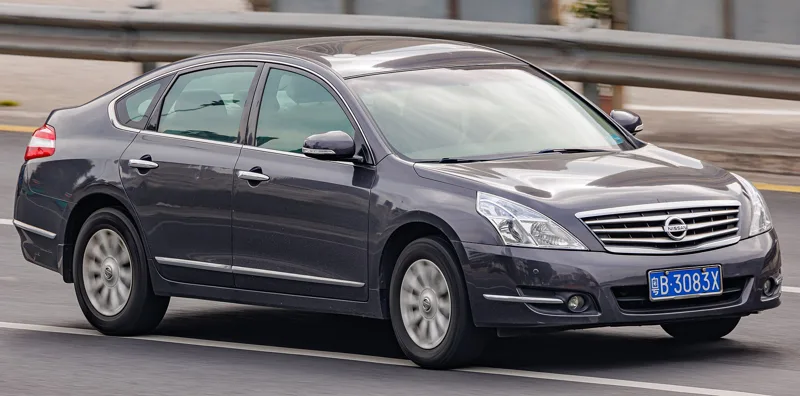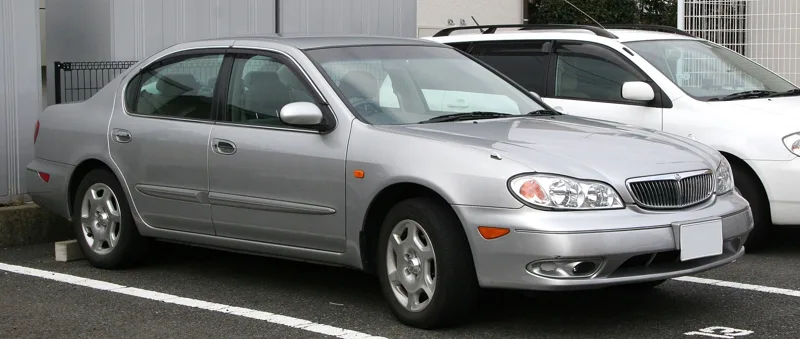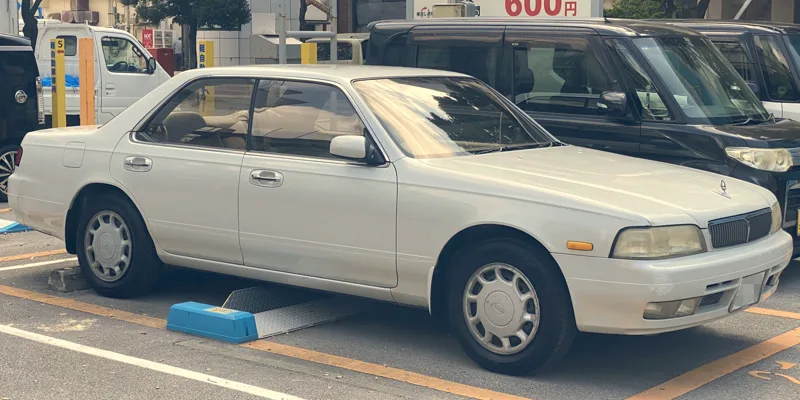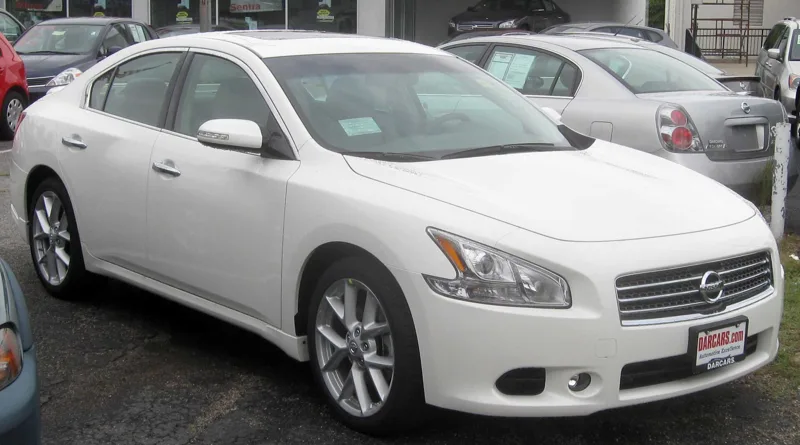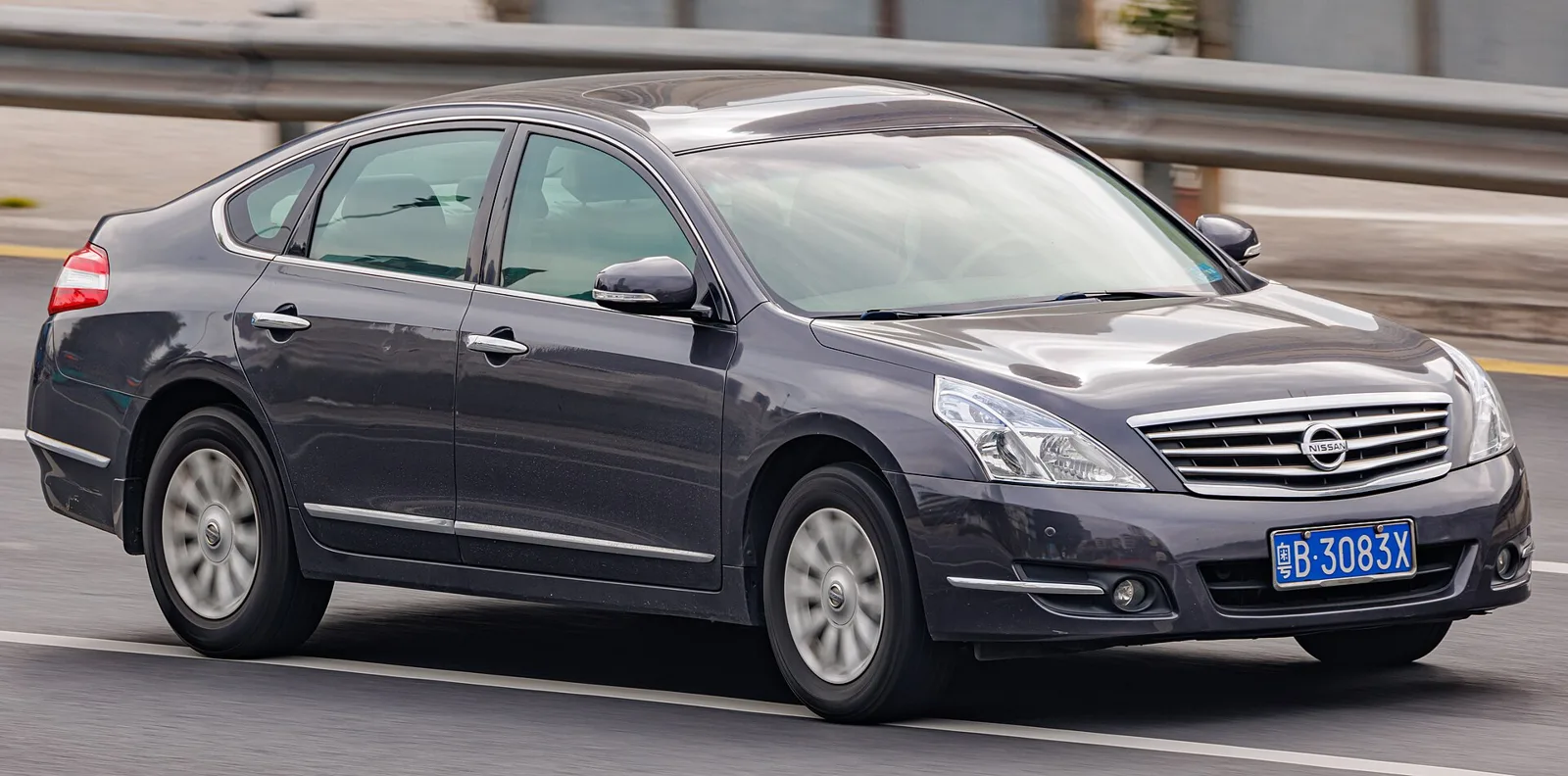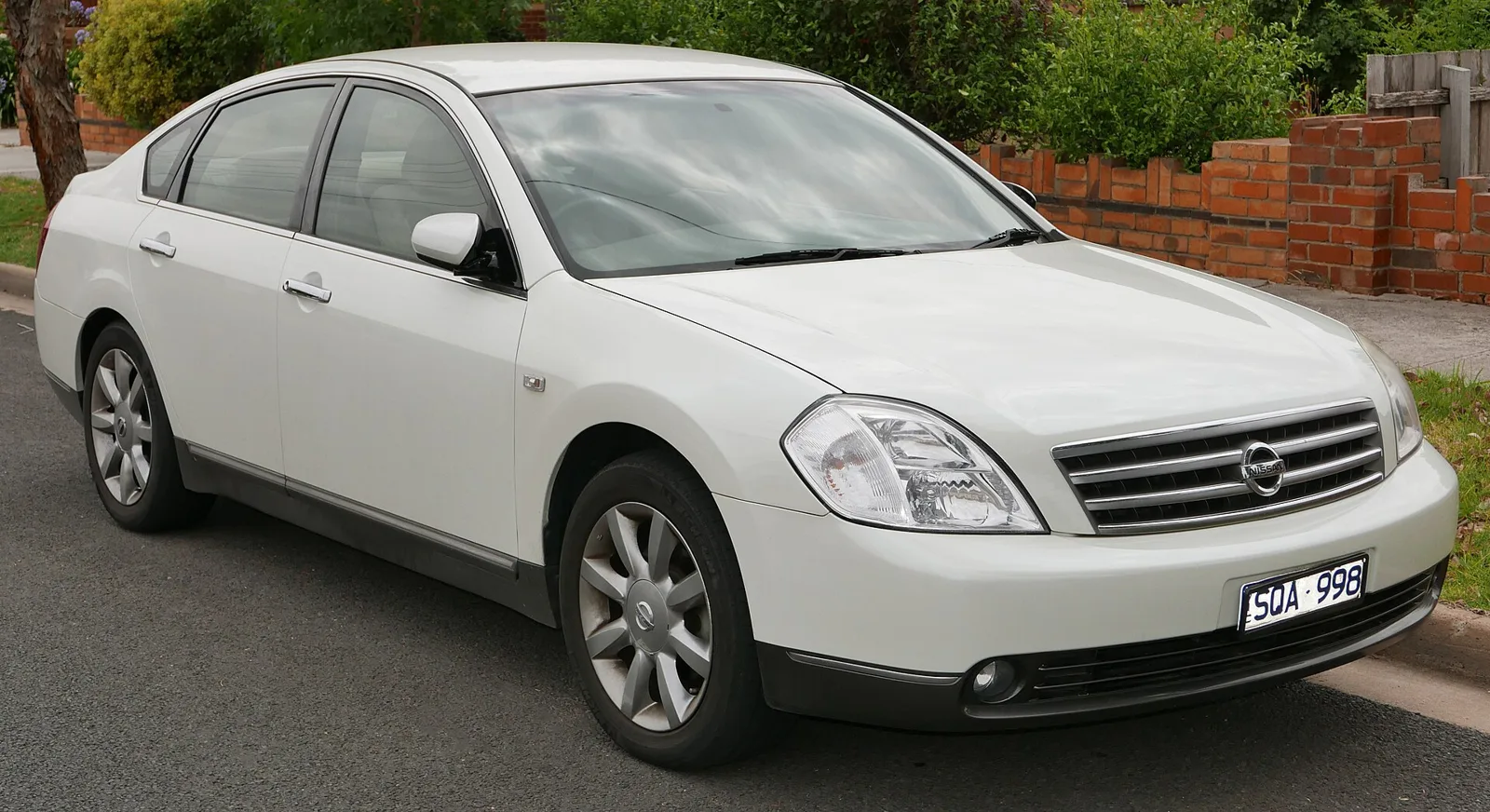
A segment D saloon sold from 2003 to 2008 as the Teana, Maxima and Cefiro, with Renault Samsung versions assembled in Korea.
Nissan sold the Teana as a segment D saloon from 2003 to 2008, under the Maxima name in Australia and the Cefiro name in Singapore. Its engines ran from 136 PS to 245 PS, and the Chinese crash test gave it five stars.
The first-generation Nissan Teana was a segment D saloon that Nissan built from 2003 to 2008 in Japan, China and Thailand. It replaced the Cefiro, Maxima QX and Laurel, and it carried a different name in several countries. Locally built cars in China reached about 180 thousand units over five years.
Where did the Nissan Teana come from, and why that name?
Nissan presented the Teana to the Japanese market on 2 February 2003, and sales began a week later at Nissan Blue Stage dealers only. The name comes from a Native American language and means dawn. Nissan chose it because it meant the dawn of a new saloon, and because the company felt it suited the look of the car.
Launch prices ran from 2,250,000 to 2,960,000 yen. In the Japanese line the Teana took the place of two models, the Laurel and the Cefiro.
A saloon named for dawn, sold in China and Russia and used as the base for the Korean SM5 and SM7.
What did the Driving Helper and Axis versions add?
The firm Autech developed two variants. The Driving Helper was built for drivers with disabilities, with the accelerator operated by the left hand, a reworked control lever unit and a two-wire brake system that cut the delay before the brakes bit. It cost 2,770,000 yen.
The Teana Axis was the tuned version. Its changes included a front bumper, a new radiator grille, side sill trims, door mudguards, rear underbody protectors, an exhaust pipe, 215/55 tyres and 17-inch alloy wheels. Inside were exclusive seats, mats, door trim, a steering wheel, a leather-covered gear lever, wood trim and Plasmacluster ion air conditioning. Four body colours were offered, including two silver shades, beige and black sapphire, and at the end of 2005 the Axis cost between 2,940,000 and 4,110,750 yen.
How did the Teana sell in China and Russia?
In China the Teana was built at the Dongfeng Motor Co. plant in Hubei province, and only one engine was offered there, a 3.5-litre (214 cu in) unit. The Chinese model was shown at the Beijing motor show in June 2004, and sales began in the autumn of that year.
Russian sales started late, on 19 June 2006 with the updated car, which came with 2.0, 2.3 and 3.5-litre engines. Prices ran from 29,900 to 45,000 dollars. The Elegance trim began at 29,990 dollars with a 2.0-litre engine, a four-speed automatic and a four-speaker audio system. The Luxury trim cost from 33,100 dollars and added an electric driver's seat, 16-inch alloy wheels and six speakers. The Premium trim, priced from 36,900 to 44,990 dollars, had leather upholstery, a driver's seat with electric controls, its own headrest design, bi-xenon lamps and a changer holding six CDs.
Exports reached further. From late 2003 the car went to Australia as the Maxima, where sales had some success at first but began to fall by the end of 2006. Assembly in Thailand fed several Asian markets, including Malaysia, where the price started at 230,000 ringgit. In Singapore the model was sold as the Cefiro. Exports also went to Ukraine, and in April 2007 exports to India began at 2,047,000 rupees.
What were the Renault Samsung SM7 and SM5?
Renault Samsung built two Korean variants on the Teana. The SM7, presented on 30 November 2004, could take 2.3 or 3.5-litre engines, while the cheaper SM5, presented on 25 January 2005, had a single 2.0-litre engine. Both were assembled at the Renault Samsung Motors plant in Busan.
The SM7 took 24 months to develop and cost 300 billion won. Its prices ran from 24,400,000 to 35,100,000 won. The SM5 was also developed over 24 months, but with an investment of 100 billion won. It came in four trims, PE, SE, LE and XE, and it was the second car to carry that name, the first having been built from 1998.
Later the SM5 was exported to some markets, for example the GCC states, under the name Renault Safrane, a label that should not be confused with the car of that name sold earlier in Europe.
What engines and gearboxes did the Teana offer?
Buyers could choose from three petrol engines: a 2.0-litre QR20DE inline four producing 136 PS (100 kW; 134 hp), a 2.3-litre VQ23DE V6 with 173 PS (127 kW; 171 hp), and a 3.5-litre VQ35DE with 245 PS (180 kW; 242 hp).
Torque figures were 187 Nm (138 lb ft) at 4,000 rpm for the QR20DE, 220 Nm (162 lb ft) at 4,400 rpm for the VQ23DE, and 330 Nm (243 lb ft) at 3,600 rpm for the VQ35DE.
The gearboxes were split. The four-speed automatic went with the QR20DE and VQ23DE, while a belt-type CVT was available only with the most powerful VQ35DE. Front-wheel drive was standard, and the car used 205/65 tyres on the 2.0 and 2.3-litre versions.
How was the Teana built underneath?
The Teana sat on the Nissan FF-L platform, which it shared with the first-generation Murano, the third-generation Quest and the sixth-generation Maxima. The front suspension was an independent MacPherson strut layout with coil springs, and the rear was an independent multi-link arrangement, also with coil springs.
Brakes were discs at both ends, with the front discs ventilated.
What changed when the Teana was facelifted?
The facelift arrived in December 2005 with a new grille, front and rear bumpers, xenon or halogen projector headlights, LED rear lights and new 16-inch alloy wheels. Sales of the updated car in Japan began on 27 December 2005.
The 350JM trim received more changes, including a longer rear bumper, trim around the exhaust pipe and exclusive 17-inch wheels. Two new body colours were added for every model, misty green and moon blue, and the dashboard instruments and seat and door trim were redesigned. Three new upholstery colours completed the changes: Weimaraner, sand beige and black.
What was the interior like?
The front passenger seat was an ottoman design in the top trim, with an electrically driven leg rest and a massage function that ran a 15-minute cycle. The rear bench was fixed, unlike the Camry's, and the boot held 476 litres, which could not be enlarged.
The driver faced three main dial gauges, for the tachometer, speedometer and fuel level, with a small screen beside them. The steering wheel adjusted only for height, the glovebox had no cooling function, and there was no seat belt reminder. A screen sat on top of the centre console, with the air vents below and the radio under those.
The base version offered two-zone climate control and a CD radio, while higher trims added a rear-view camera and the Nissan Intelligent Key system, which let the driver start the car without a key. For long loads there was a hatch in the middle of the rear seat.
How safe was the Teana?
The base Elegance trim came with ABS and two front airbags. The Luxury trim added front side airbags, and the top Premium trim also had curtain airbags and electronic stability control. The model was tested by the Chinese organisation C-NCAP and earned a five-star rating.
The South Korean organisation K-NCAP also ran crash tests. In 2005 the Renault Samsung SM5 scored five stars in both its frontal and side crash tests.
How did the car magazines rate the Teana?
Russian reviewers were mixed. Avtoreview placed the Teana joint second on 810 points with the Hyundai Grandeur, while the Camry took the top spot on 840 points. Za Rulem gave the Teana 7.7 points out of 10, which was 0.3 points below the Camry.
In its comparison, Avtoreview liked the exterior, which it described as an acquired taste, and found the ottoman seat and the rich equipment to be strengths. It criticised the steering wheel, which does not adjust for reach, and the limited seat travel. It praised the CVT for a quick getaway from traffic lights, but noted sliding in sharp corners, with the stability system arriving late. The suspension and ride comfort came out well.
Za Rulem tested the 2.0-litre car with an automatic and judged its power too modest for real pace. It found the suspension shook on real Russian potholes, but praised the quick steering and comfortable seats. The cabin, it said, was uncomfortable for tall people. Kolesa noted similar problems with the suspension, handling and stability control, while calling the design a clear strength.
In Japan the model won two awards. In 2004 it received the Best Value Award from the Car of the Year Japan jury and the Good Design Award from the Japan Industrial Design Promotion Organization.
Was the Teana ever recalled?
Only one recall is recorded for the first generation. In January 2019 Nissan recalled many models built from January 2004 to November 2012, including the Teana, because of Takata airbag inflators.
The inflators contained ammonium nitrate. In high temperatures and humidity it could cause fragments to wound the driver or passenger when the airbag fired.
How many Teanas were sold?
The figures include about 180 thousand locally built cars in China over five years, 20 thousand in Russia over three years, and 33 thousand in Japan in 2003. A further 11 thousand were sold in Japan in the first six months of 2004.
In Russia the car went on sale rather late, but even so the total reached 20 thousand within three years.
What were the Nissan Teana J31 specifications?
| Specification | Detail |
|---|---|
| Body | Four-door saloon, segment D |
| Engines | 2.0-litre QR20DE, 2.3-litre VQ23DE V6, 3.5-litre VQ35DE |
| Power | 136 PS (100 kW; 134 hp) to 245 PS (180 kW; 242 hp) |
| Torque | 187 Nm (138 lb ft) to 330 Nm (243 lb ft) |
| Drive | Front-wheel drive |
| Transmission | Four-speed automatic or belt-type CVT |
| Boot | 476 litres |
| Length change against the Camry | 30 mm (1.2 in) longer, 55 mm (2.2 in) narrower |
| Production | 2003 to 2008 |