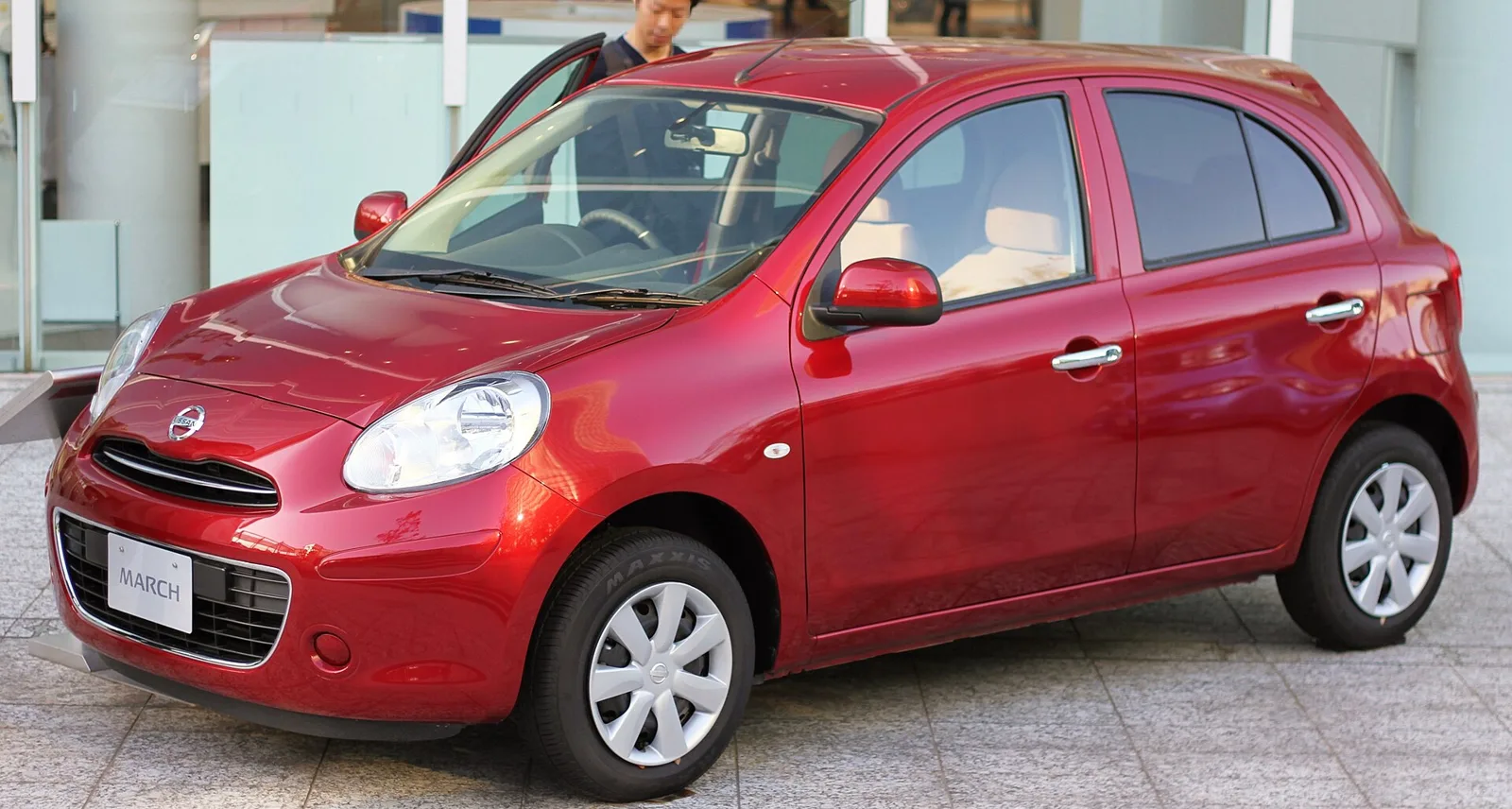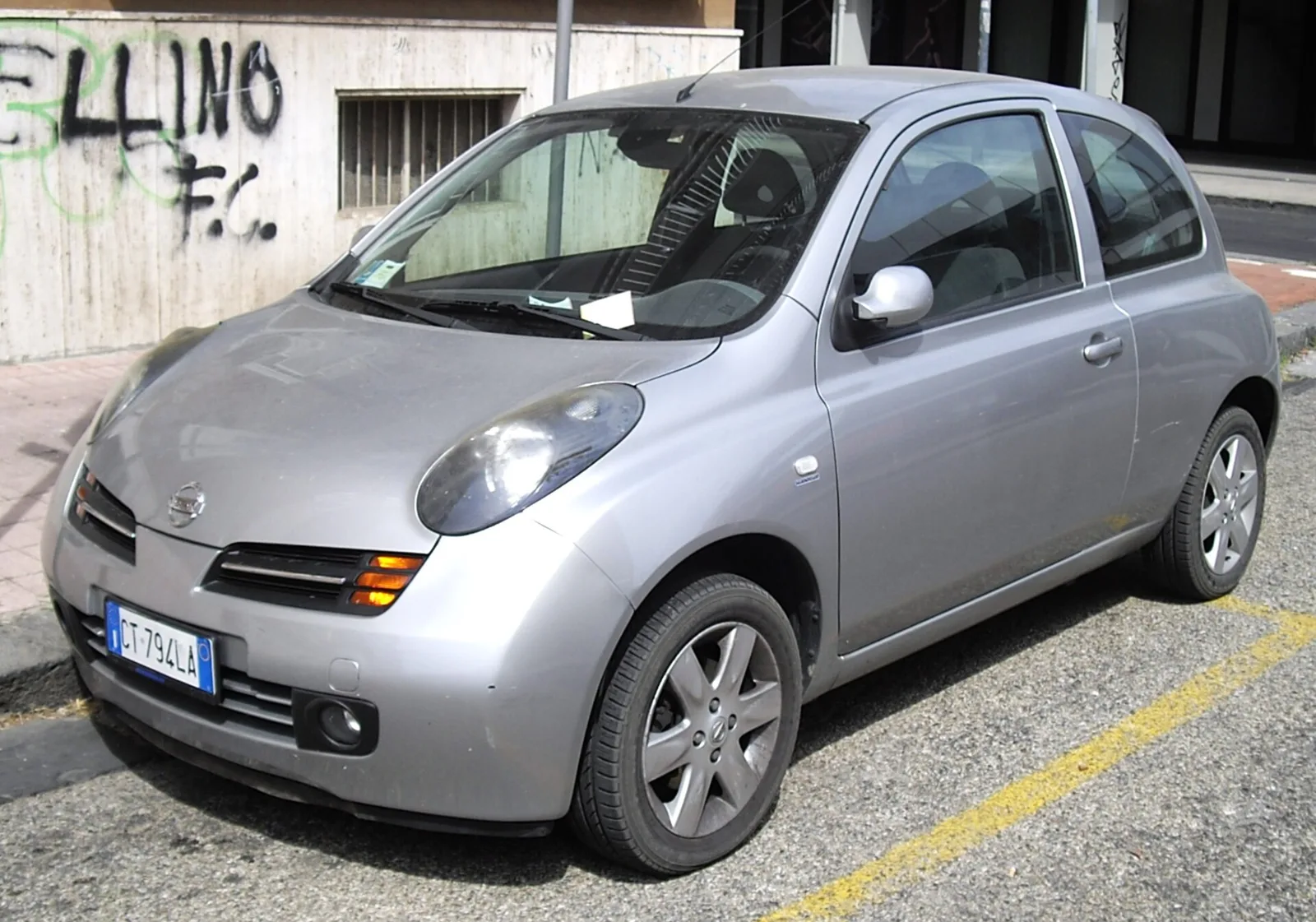
The Alliance B platform, the CVT that returned in 2005, the sporty 12SR and the Micra C+C that carried the Micra name in Japan.
The Nissan Micra K12 was a compact hatchback built from 2002 to 2010, on a platform developed with Renault. Its sporty 12SR version received extra tuning, and the car's first year in Japan drew strong demand.
The Nissan Micra K12, sold in Japan as the March K12, was a compact one-litre-class hatchback that Nissan Motor built from 2002 to 2010. It rode on a platform developed with Renault and came in a sporty 12SR form. In Japan only one version carried the Micra name: the Micra C+C coupe-cabriolet, imported from the UK in 2007.
Was the K12 the first car developed under Carlos Ghosn?
It was the first model developed after Carlos Ghosn took over as chief executive, and its sales drew attention from the start. Production stayed at the Oppama plant, where the K11 had been built before it, and the concept carried over unchanged. Buyers could pick three-door or five-door hatchbacks.
Ghosn's own judgement reached the cabin too. The Cinnamon (orange) interior colour fitted to early cars was judged borderline during development, but his single remark, 'It's good, isn't it!', settled the matter and the colour went on sale.
Europe had its own supply line. Cars for European markets came from Nissan Motor Manufacturing UK, and local production began at the Sunderland plant on 29 November 2002.
A compact one-litre hatchback with a frog-faced front, a Renault-shared platform and a sporty 12SR version.
Which engines and drive systems did the K12 use?
Japanese-market cars carried CR units in 1.0, 1.2 and 1.4 L sizes (61.0, 73.2 and 85.4 cu in), a fresh design, and paired them with a five-speed manual or a four-speed automatic. European buyers could also choose a 1.6 L (97.6 cu in) model. Front-wheel drive was standard, with the electric four-wheel-drive e-4WD as an option.
The K12 was the first car to use the Alliance B platform, which Nissan developed jointly with Renault. The e-4WD rear motor came from a Hitachi commercial washing machine, and that motor was later supplied to Mazda for the Demio and Verisa. Every version had electric power steering to help fuel economy.
Launch cars lacked the CVT, one of the features of the second generation. Fuji Heavy Industries (now SUBARU), the supplier, had left the Nissan group and could no longer provide it. The CVT returned with the 2005 facelift, alongside the 1.5 L (91.5 cu in) HR engine. Both the CR and HR engines used electronically controlled throttles.
What did the K12 look like?
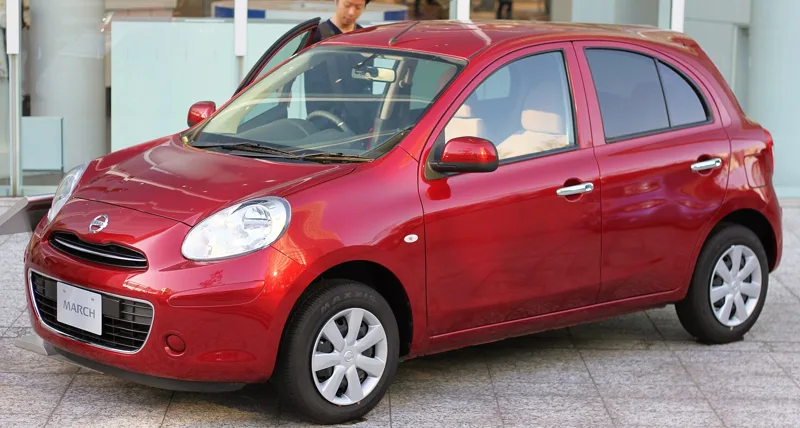
The round headlamps and a face that suggests a frog came from the design department of NTC, with Giichi Saruwatari in charge. The wing-shaped grille was shared with other Nissan models sold in Europe, while the rounded roof, small rear notch and catwalk-style shoulders kept a trace of the second generation.
The short overall length and sloping roofline had a cost. Compared with rivals, rear seat room and luggage space were often a little smaller. Colour options were broad inside and out, and the car's colour schemes won Auto Color Award prizes, including Grand Prix awards.
How well did the K12 sell in Japan?
In its launch year the car averaged 14,000 units a month in Japan, well above a monthly target of 8,000. Sales then slid as rival models from other makers arrived one after another. Other makers kept enlarging their rivals with each model change, while the March stayed comparatively small in width.
In 2006, four years after launch, the March was still selling around 5,000 units a month. Because of the body structure, illuminated-type number plates could no longer be fitted from this model onward.
What was the March 12SR?
The 12SR was the sports version of the K12, tuned by Autech Japan (now Nissan Motorsports and Customizing). Its development lead was Shigeharu Nakajima, and the reported target was to lap Tsukuba Circuit in 1 minute 15 seconds. It stayed in the catalogue for its whole run, from October 2003 to April 2010.
The early version was launched on 15 October 2003 with only a five-speed manual. Its body was reinforced for stiffer torsion, and it gained a dedicated sports suspension, a dedicated exhaust with a Calsonic Kansei main silencer and 15-inch Enkei alloys shod with Bridgestone Potenza RE-01 tyres.
The powerplant started from the CR12DE, whose stroke is shorter than that of the CR14DE, with about 4 to 5% less friction. Autech added a high-revving cam profile, valve springs, high-compression pistons, a lightweight flywheel and a tuning computer. Compression rose from 9.8 to 11.5, and variable valve timing was left out to improve fuel economy and aim for better responsiveness.
The five-door tipped the scales at 940 kg (2,072 lb), the three-door at 910 kg (2,006 lb), so both stayed below one tonne. Inside were black and orange sports seats, a three-spoke steering wheel wrapped in genuine leather and a dedicated leather gear knob.
How did the 12SR change between its versions?
In August 2005 the 12SR gained a revised suspension, brake rotors enlarged to 258 mm (10.2 in), a stainless steel exhaust manifold and a slightly stronger engine rated at 110 PS (81 kW; 108 hp) at 6,900 rpm. Its aero parts and grille were also changed to match the standard car.
The late version, from June 2007, moved the front indicators into the headlamp unit, so the headlamp and indicator became one piece. Its rear seat changed from a 6:4 split to a one-piece design. Other specification matched the middle version, and the price was 1,782,900 yen. Its production is recorded as ending on 19 April 2010.
Key dates in the K12 story
- February 2002: full model change, with sales from 5 March and a monthly target of 8,000 units
- September 2002: e-4WD becomes available on the 1.4 L (85.4 cu in) model, and Autech Japan adds the Lafite
- November 2002: local production starts at the Sunderland plant in the UK
- 1 July 2003: the 1.0 L model is discontinued in Japan and the sporty 14s is added
- October 2003: the 12SR goes on sale in three-door and five-door models
- August 2005: the three-door model is discontinued, and the 1.5 L HR engine with CVT returns
- June 2010: production ends, with sales continuing only from remaining stock
- July 2010: sales end as the fourth generation takes over
What was the March Cup car?
NISMO sold the March Cup car as a complete competition model in 2003 for 1,590,000 yen. Floor and roof trim went, along with the original steering wheel, and NISMO's own steering wheel and roll cage took their place. It also carried competition suspension, exhaust, a reinforced clutch, a limited-slip differential, bucket seats and alloy wheels.
Although it was an entry-class race car, a data logger came as standard. At one stage, Nissan's circuit training course, the Nissan Racing School, used this car for lessons. NISMO also sold a sport tuning menu for the engine and chassis and built a complete car called the NISMO MARCH S-tune COMPLETE.
Did a racing version of the K12 appear in Gran Turismo?
A similar car appeared in the games Gran Turismo Concept 2001 TOKYO and Gran Turismo 4, under the name mm-R Cup Car. It came from a 2001 concept based on the mm prototype and was not a straight copy of the March Cup. The Cup car's own engine was hardly changed.
The mm-R's 1.2 L (73.2 cu in) engine was tuned to make 138 hp (103 kW; 140 PS). It kept a roll cage, while its dashboard area and rear seat interior were left in the Cup car's specification.
What special editions did Nissan offer?
Nissan offered a long run of special editions, including the 70th anniversary 12c 70th and 14c-four 70th in May 2003 and the 25th anniversary 25th Happiness, Plus Safety and KISEKAE in November 2007. Autech Japan also produced the retro-styled Bolero and the Lafite.
- V Selection (August 2004): auto lights and split-folding rear seats
- i Selection (December 2004): seat covers based on the distinctive headlamp shape
- Premium Interior (April 2005): suede-style seat cloth
- Plus Conran (June 2006): a collaboration with the Conran Shop, on sale until September
- Collet series (2008 to 2010): the 2009 Collet # and 2010 Collet f dropped the audio system to keep prices down, with the Collet f 2WD model priced under 1 million yen
The Micra C+C was an electric-hardtop coupe-cabriolet shown at the Paris show in September 2002. The production car was unveiled in the UK in June 2005, developed with the German coachbuilder Karmann. It went on sale in European markets in November 2005. Nissan imported 1,500 units into Japan in July 2007, a limited run that used the Micra name rather than March.
Which other cars were built on the K12?
Other makers used the K12 platform for their own models. Mitsuoka's Viewt, a sedan with an extended rear overhang and a separate boot, changed from the K11 to the K12 base with the model change of September 2005, the first in 13 years. The Cute, positioned as a younger sibling of the Viewt, is part of the family.
Other styling conversions included Beetle-style and Seicento-style models. The Tommy Kaira m13 also followed the K11 onto a K12 base.
What awards did the K12 win?
The K12 won the Good Design Award in 2002 and the German Red Dot Design Award in 2003, and its colour combinations picked up several Auto Color Awards. Three of those were Grand Prix wins, in November 2002, December 2005 and December 2007.
- October 2002: Good Design Award, selected by the Ministry of Economy, Trade and Industry
- November 2002: Paprika Orange x Cinnamon takes the top prize at the 5th Auto Color Award
- July 2003: German Red Dot Design Award
- December 2003: Fashion Colour Award at the 6th Auto Color Award for Chocolat
- December 2005: China Blue x Ice Blue wins again, a second top award in the 7th Auto Color Award
- December 2007: Sakura x Cacao wins a third top prize, at the Auto Color Award 2008
Micra K12 specifications
| Specification | Detail |
|---|---|
| Sales | February 2002 to July 2010 |
| Body | Three-door and five-door hatchback; three-door dropped in 2005 |
| Platform | Alliance B, developed jointly with Renault |
| Engines, Japan | 1.0, 1.2 and 1.4 L CR; 1.5 L HR from 2005 |
| Engine, Europe | 1.6 L (97.6 cu in) |
| Transmission | Five-speed manual; four-speed automatic; CVT from 2005 |
| Drive | Front-wheel drive; e-4WD optional |
| 12SR output (middle version) | 110 PS (81 kW; 108 hp) at 6,900 rpm |
| 12SR compression ratio | 9.8 to 11.5 |
| 12SR fuel tank | 41 L, unleaded premium |
| 12SR weight | 940 kg (2,072 lb) five-door; 910 kg (2,006 lb) three-door |
| Brake rotor (middle version) | 258 mm (10.2 in) |
| Early 12SR price | 1,520,000 yen three-door; 1,545,000 yen five-door |
| Late 12SR price | 1,782,900 yen |