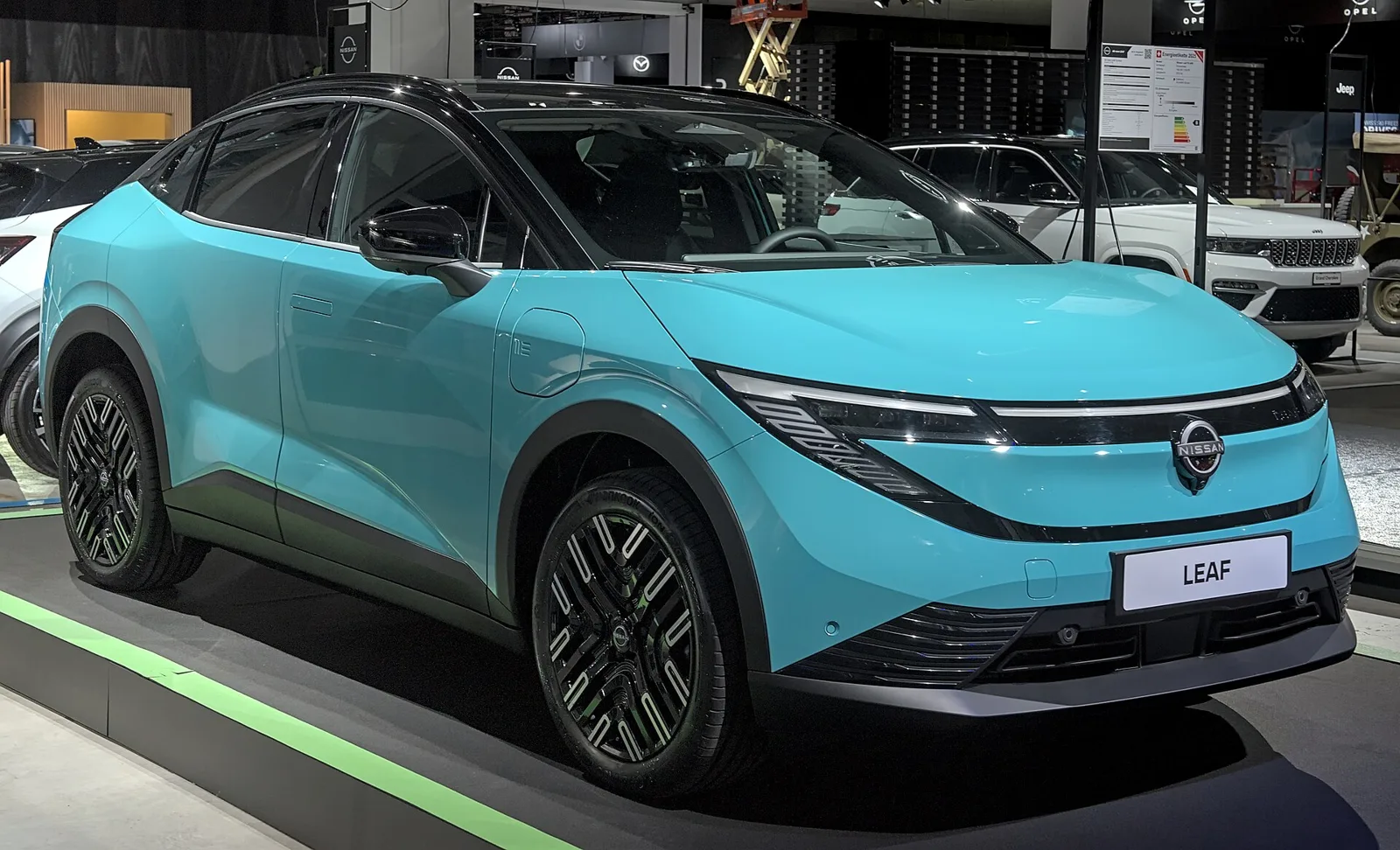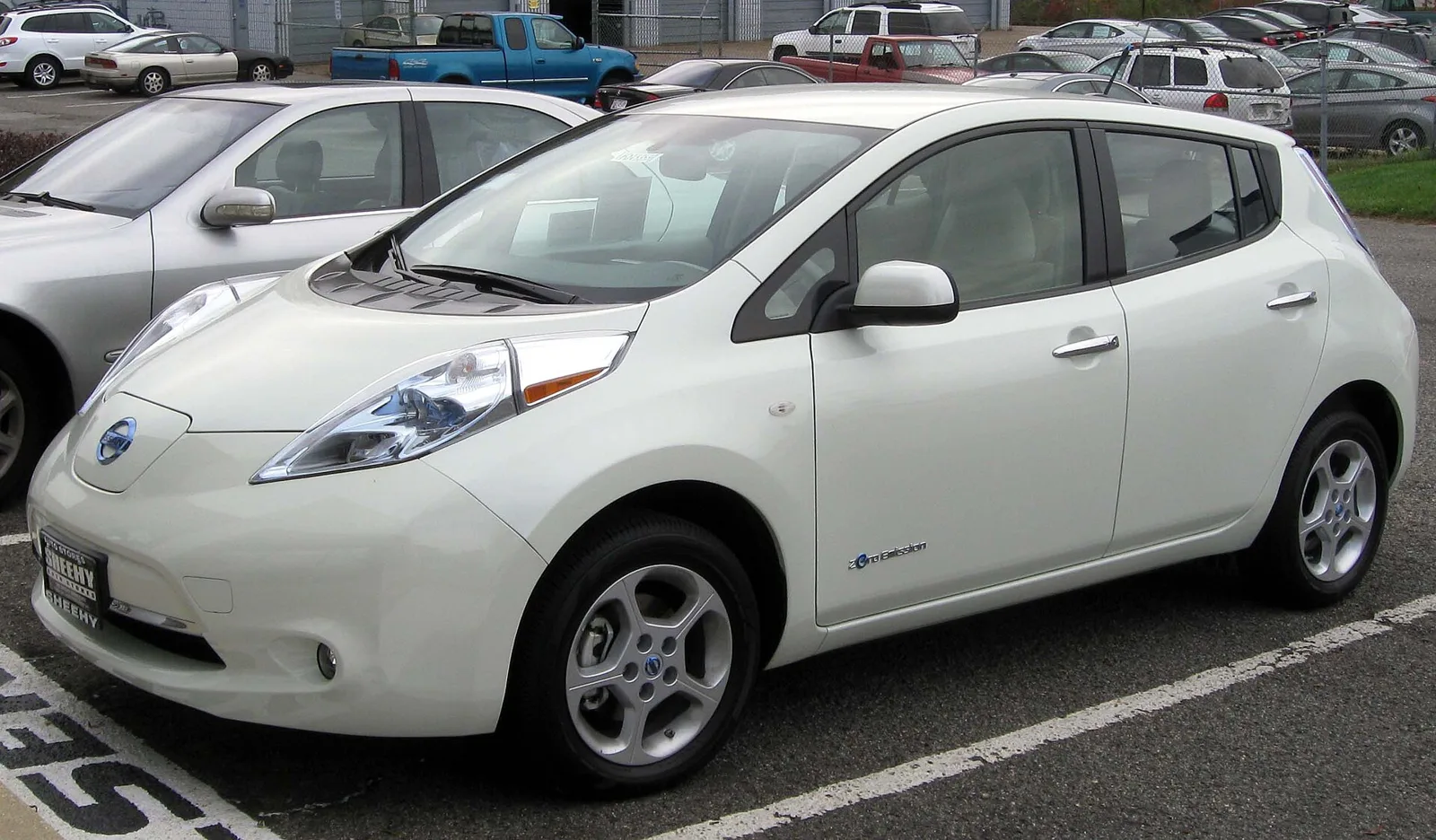
The car that made battery electric motoring mainstream, with a 24 kWh pack, a five-door body and a range debate that never really ended.
Built from 2010 to 2017, the Leaf was a mass-marketed, series-produced battery electric vehicle with an 80 kW motor and a 24 kWh pack. Early cars carried an EPA range of 117 km (73 miles), and later models improved on that figure.
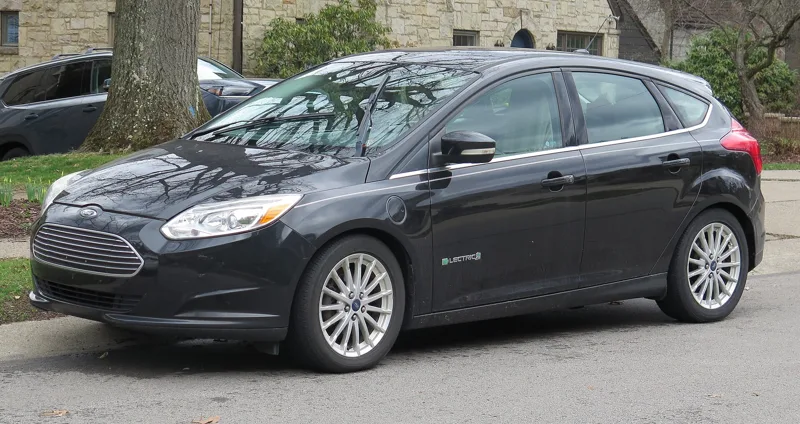
The first-generation Nissan Leaf was a five-door battery electric hatchback built by Nissan from 2010 to 2017. It was the first mass-marketed, series-produced battery electric vehicle, and its name was a backronym for an affordable, environmentally friendly family car. The Leaf showed that a mainstream carmaker could sell a fully electric car at scale.
When did the Leaf go on sale?
Nissan unveiled the Leaf at its Yokohama headquarters on 2 August 2009, and production started in Japan on 22 October 2010. Launches followed in Japan and the United States in December 2010, with Canada and several European countries joining in 2011. The second generation replaced it in 2017.
The Leaf was Nissan's second battery electric car. It followed a series of prototypes, including the EV-01, EV-02 and EV-11, and it came after the Altra, an earlier electric vehicle that did not succeed commercially.
The Leaf made a fully electric hatchback a mainstream car, with a 24 kWh pack, a range debate and a long production run.
How did Nissan's earlier electric cars lead to the Leaf?
Nissan's first battery electric vehicle, the Altra, was shown at the Los Angeles International Auto Show in December 1997. The Altra EV was built from 1998 to 2002, with only about 200 examples, mostly sold as fleet vehicles to companies such as electric utilities.
The Hypermini was another experiment, sold in limited numbers to government and corporate fleets in Japan between 1999 and 2001. A small group of Hyperminis was tested on the roads of several Californian cities between 2001 and 2005.
In 2009 Nissan showed the EV-11 prototype, built on the Tiida hatchback, with an all-electric system in place of a petrol engine. The EV-11 was publicly shown on 26 July 2009, one week before the Leaf was unveiled.
How was the Leaf's battery built?
The Leaf used a pack of 192 flat, laminated lithium-ion cells developed with NEC, and the pack sat under the floor between the wheels. The battery and control module together weighed 218 kg (480 lb), and each cell had a specific energy of 140 Wh/kg.
The battery was developed and engineered by the Automotive Energy Supply Corporation, a joint venture between Nissan, NEC and NEC Energy Devices. It was arranged in 48 modules of four cells each, and the placement lowered the centre of gravity and stiffened the body structure.
How far could the Leaf travel and how fast could it charge?
The 80 kW (110 hp) AC electric motor could take the car up to 100 miles (160 km) on a full charge. Charging from a 120 V socket could take 16 hours, while a 230 V supply cut that to 8 hours, and a dedicated fast charger could restore 80% of the battery in roughly 30 minutes.
The battery's nominal capacity was rated at 24.15 kWh, with a usable capacity assessed at 21.381 kWh. An onboard timer allowed pre-programmed charging during off-peak rates.
What are the Leaf's main specifications?
| Specification | Detail |
|---|---|
| Body | Five-door hatchback |
| Production | 2010 to 2017 |
| Motor | 80 kW (110 hp) AC electric motor |
| Battery cells | 192 flat, laminated lithium-ion cells |
| Nominal capacity | 24.15 kWh (usable 21.381 kWh) |
| Battery and control module | 218 kg (480 lb) |
| Boot with rear seats up | 679.6 L (24 cu ft) |
| Boot with rear seats down | 849.5 L (30 cu ft) |
| Drag coefficient | Cd=0.29 (2011), Cd=0.28 (2013) |
| EPA range, 2011 and 2012 | 117 km (73 miles) |
| EPA range, 2013 | 121 km (75 miles) |
| Home charging | 16 hours on 120 V; 8 hours on 230 V |
| Fast charging | 80% in about 30 minutes |
How much range did the Leaf have?
The EPA rated the 2011 and 2012 Leaf at 117 km (73 miles), well below the 160 km (99 miles) Nissan quoted. The Federal Trade Commission questioned the EPA figure and put the true range between 154 and 177 km (96 and 110 miles).
On the New European Driving Cycle the car was rated at 175 km (109 miles). Third-party drivers found real-world range could vary by as much as 40%, depending on load, traffic, weather and accessory use.
How did real-world range tests compare?
Reported real-world results ranged from about 100 km (62 miles) up to just under 222 km (138 miles). Nissan's own worst-case test gave 76 km (47 miles), and its best case reached 222 km (138 miles).
Consumer Reports tested a loaner in cold weather and averaged 105 km (65 miles) per charge at temperatures between 20 and 30 degrees Fahrenheit. In one trip at 10 degrees Fahrenheit the range indicator started at 32 km (20 miles), and the car slowed to almost walking speed after 13 km (8 miles).
Nissan's own data from 7,500 Leafs suggested the average driver covered 60 km (37 miles) a day, with an average trip of 11 km (7 miles). Owners recharged for about two hours a night in June 2011, and some could cover two days on one charge.
What changed in the 2013 model year?
The 2013 Leaf added a more efficient heat pump heating system that extended cold-weather range by 32 to 40 km (20 to 25 miles). The EPA rating rose from 117 km (73 miles) to 121 km (75 miles), although Nissan warned the figures were not directly comparable because of revised test procedures.
Nissan gave the 2013 car a range of 135 km (84 miles) from a full charge in Long-Distance Mode and 106 km (66 miles) from an 80% charge in Long-Life Mode. The European version was certified at 200 km (120 miles) on the NEDC, up from 175 km (109 miles) for the 2011 and 2012 models.
Where was the Leaf built?
Production was spread across three plants. Oppama in Japan began building the Leaf on 22 October 2010, Smyrna in Tennessee started commercial production on 9 January 2013, and Sunderland in England followed on 28 March 2013.
The installed capacity was 250,000 Leafs a year, split 150,000 at Smyrna, 50,000 at Oppama and 50,000 at Sunderland. The Smyrna plant received a US$1.4 billion loan from the US Department of Energy, and it was expected to make up to 200,000 battery packs a year.
Sunderland was supported by a GBP 20.7 million British government grant and up to GBP 220 million from the European Investment Bank. It was set up to serve the European market, with capacity for 50,000 Leafs a year.
How did the Leaf sell in its early years?
Nissan sold more than 49,000 Leafs by December 2012, but sales rose by only 22% during that year. Chief executive Carlos Ghosn called the result a disappointment and blamed the yen exchange rate for pushing up the car's price.
Nissan responded by cutting the price of the 2013 Leaf by 18%, helped by lower production costs from the Smyrna line. The company also worked on battery costs, since the pack was the most expensive part of the car.
How did the Leaf warn pedestrians?
Because electric cars are very quiet at low speeds, the 2011 Leaf carried digital warning sounds that differed for forward and reverse movement. The system was called Vehicle Sound for Pedestrians, and it stopped at 30 km/h (18.6 mph) and resumed below 25 km/h (16 mph).
The sound was a sine-wave tone that spanned 2.5 kHz to 600 Hz, chosen to be audible across age groups. Drivers could switch it off on the 2011 car, but it reset at the next start, and from the 2012 model onward the option was removed.
The US National Federation of the Blind welcomed the alert but objected to drivers being able to turn it off. In the United Kingdom the sound had to be removed, because the law requires any hazard warning to be disabled between 11:00 pm and 6:00 am and the Leaf could not do that.
What safety ratings did the Leaf earn?
NHTSA gave the 2011 and 2012 model years five stars overall, while the 2013 and 2014 cars received four stars. The IIHS named the 2011 Leaf a Top Safety Pick, with good ratings in front, side, rear and rollover tests.
Euro NCAP tested a right-hand-drive Leaf weighing 1,545 kg (3,406 lb) in 2012, and electronic stability control met its requirements. Front seats carried a seatbelt reminder, and a driver-set speed limiter was fitted as standard.
The battery pack is protected by structural steel reinforcement. A safety system disconnects the high voltage after airbags deploy, and Nissan reported in December 2011 that none of the roughly two dozen Leafs destroyed by the March 2011 tsunami caught fire.
How efficient was the Leaf?
The EPA put the 2011 model's energy consumption at 0.212 kWh/km (34 kWh/100 miles), with a combined rating of 99 MPGe (2.4 L/100 km). For 2013 the EPA recorded a 15% improvement in combined fuel economy, which lifted the car to 115 mpg-e.
The 2014 and 2015 Leafs were rated at 30 kWh/100 miles, or 114 MPGe combined, with 126 MPGe in city driving and 101 MPGe on the highway. The 2016 car with the larger 30 kWh battery was rated at 112 MPGe combined.
Is the Leaf's environmental record good?
In February 2014 the Automotive Science Group studied more than 1,300 cars across nine categories and concluded the Leaf had the smallest life-cycle footprint among 2014 models available in North America with at least four seats. The study said the battery's manufacturing impact was more than offset during driving.
Nissan reported that Leaf owners had driven 1 billion kilometres (625 million miles) by December 2014, avoiding about 180 million kg of CO2 compared with petrol cars. By November 2016 the total had reached 3 billion kilometres (1.9 billion miles).
How did the critics review the Leaf?
Car and Driver criticised the use of inexpensive materials, saying they suited a car half the price. It also criticised the single 12-volt accessory port, but praised the spacious boot and the standard heated seats.
What Car? found the Leaf easy to drive and cheap to run, while raising concerns about the compact boot, long charging times and cold-weather range. Car magazine called the drive both soothing and stressful, and it compared coiling the charging cable to hand cranking an old car.
The Guardian described the styling as quirky, and RAC praised the space and the quality of the materials.
What awards did the Leaf win?
The Leaf won the 2011 European Car of the Year title and the 2011 World Car of the Year award. It also took the 2011 Eco-Friendly Car of the Year from Cars.com and the 2011 Green Fleet Electric Vehicle of the Year.
In Japan it was named Car of the Year for 2011 to 2012 in December 2011. Earlier, the Green Car Journal gave it the Green Car Vision Award at the 2010 Washington Auto Show, and Popular Mechanics gave it a 2010 Breakthrough Award.
Which related cars came from the Leaf?
Several Leaf-based models were built or shown. The Leaf Nismo RC was a racing demonstration car with a full carbon-fibre body, about 40% lighter than the production car, and eight rear-wheel drive examples were built.
The Leaf Nismo Concept was a road-going version shown at the 2011 Tokyo Motor Show. Nissan later said it would be built in limited numbers for Japan only, while the Infiniti LE concept was never produced. The Venucia e30 in China shared the Leaf's bodywork and electric drive.