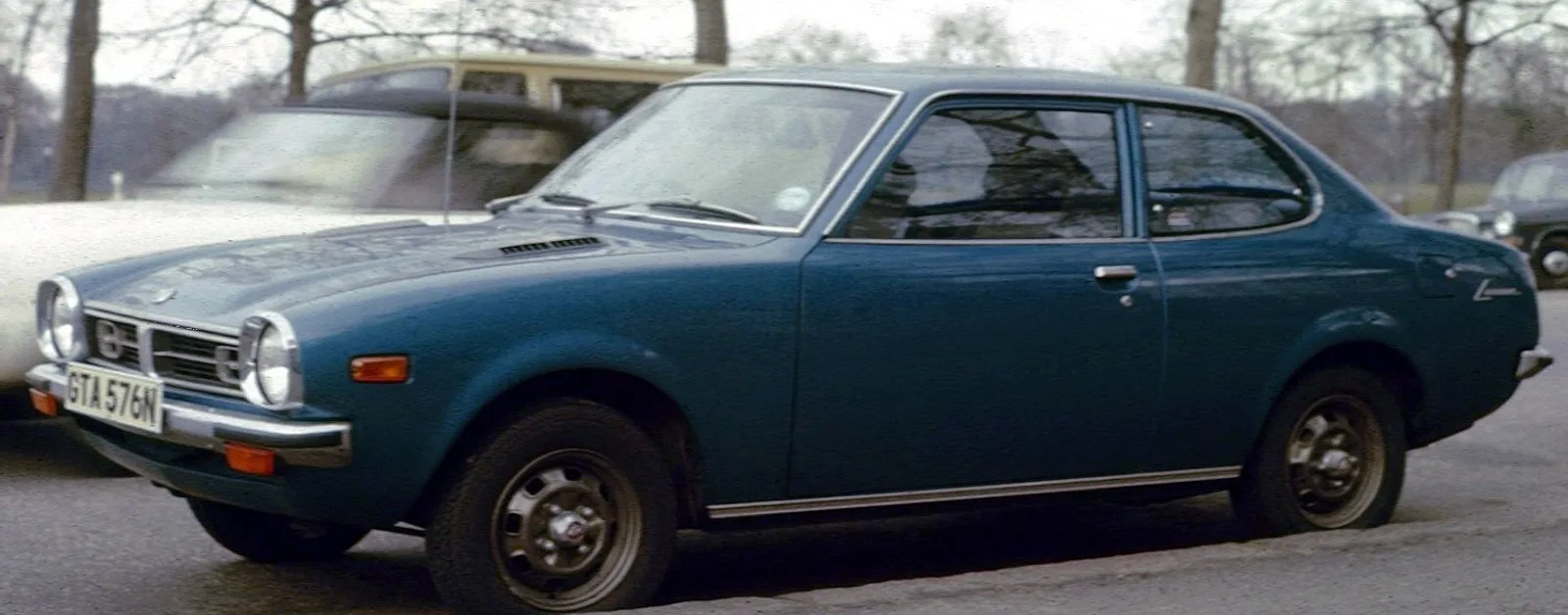
The first generation of Mitsubishi's Lancer nameplate, built as sedans and a wagon from 1973, with a rally pedigree and a hatchback coupe spin-off.
Launched in February 1973, the Lancer A70 opened a nameplate that Mitsubishi would carry for decades. It sold under many names, spawned the Celeste hatchback coupe and built a rally record with the 1600 GSR.
The Mitsubishi Lancer A70 was the first generation of a nameplate that Mitsubishi kept for decades. It arrived in February 1973 as a small sedan that filled a gap in the lineup, and it quickly built a reputation in rallying, which Mitsubishi still highlights today.
Where did the Lancer A70 come from?
Mitsubishi launched the Lancer A70 in February 1973 as a two-door and four-door sedan. It replaced the Colt 1200, which had last been sold in 1970, and it slotted between the Minica kei car and the larger Galant in the Japanese range.
Twelve models launched at the start, running from a basic 1.2-litre sedan up to the 1600 GSR, a performance version built for rallying. A five-door station wagon followed in September 1973, so the range offered three body styles, or four if the Celeste coupe is counted.
Sedan production ended in 1979, but vans carried on until 1985. The Celeste coupe, which shared the platform, went on until 1981.
A small Mitsubishi sedan that became a rally winner in Africa and a hatchback coupe sold under many different names.
What engines did the first Lancer offer?
The original line used three engines: a 1.2-litre Neptune overhead-valve four, a 1.4-litre Saturn overhead-cam four and a 1.6-litre unit. They produced 70 PS (51 kW), 92 PS (68 kW) and 100 PS (74 kW), and the internal model codes were A71, A72 and A73.
The 1600 GSR arrived in September 1973 with two Mikuni-made twin-barrel Solex carburettors, giving 110 PS (81 kW) at 6,700 rpm on the street. The 1.2-litre engine was swapped for another 1.2-litre four with 80 hp in October 1975.
In November 1975 the whole engine range lost roughly eight to nine percent of its power, because stricter emissions standards applied from 1976. The Japanese range then moved on to lean-burn engines, and the 1.2-litre Saturn was replaced in April 1977 by an Orion G11B of 1,244 cc, producing 70 PS (51 kW). Its extra lightness trimmed 10 kg (22 lb) from the 1200 models.
Why was the Lancer so successful in rallying?
The 1600 GSR was developed to tackle the Safari Rally in Kenya, a gruelling event over 6,000 km of harsh terrain. Mitsubishi ran official factory teams from 1974 to 1977 and built a reputation for durability, with only one of thirteen cars failing to finish across those four attempts.
Rally-spec GSR engines produced 165 PS (121 kW) at 7800 rpm and 161 N-m (119 lb-ft) at 5500 rpm. Street versions started at 110 PS (81 kW) but dropped to 100 PS (74 kW) when tighter emissions standards arrived for 1976. Drivers in Africa gave the car the nickname King of Cars.
The high point came in 1976, when the factory team swept the podium at the Safari. The car had shown its pace earlier. Its debut at the 1973 Australian Southern Cross Rally produced a clean sweep of the top four places.
Works driver Andrew Cowan went on to dominate that Australian event, winning five consecutive titles from 1972 to 1976. Cowan and Joginder Singh also took a 1-2 finish for the GSR at the 1977 Rallye Bandama Cote d'Ivoire. Even after production ended, the GSR stayed popular with privateers into the 1980s, until endurance rallying declined and Group B eventually ended its run.
How did the Lancer differ between markets?
The Lancer took different names and specifications around the world. It was sold as the Colt Lancer in the United Kingdom from late 1974, as the Dodge Colt in the United States from the 1977 model year, and as the Chrysler Valiant Lancer in Australia. Engine lists also varied from one market to the next.
The Colt Lancer in Britain and other European countries used 1.2, 1.4 and 1.6-litre Saturn 80 engines, rated at 55 PS (40 kW), 68 PS (50 kW) and 82 PS (60 kW) DIN. The 1.6-litre was reserved for the two-door, while four-door sedans received the 1.4. Top speeds ran from 150 km/h through 155 km/h to 165 km/h.
In Australia the first models arrived in September 1974 as the LA series, sold as the Chrysler Valiant Lancer. Roughly 11,800 units were sold between late 1974 and 1979, in the two-door EL and four-door GL. Its 1,439 cc single-cam engine produced 92 hp (68.6 kW) at 6,300 rpm, paired with a four-speed manual or a three-speed automatic.
The Mitsubishi name itself was avoided in some export markets. Many buyers in those places still remembered the wartime fighting against the Mitsubishi A6M Zero, so the car was sold under other badges. In El Salvador it was known as the Dodge Lancer.
What changed in the 1976 and 1977 updates?
The Japanese models were facelifted in November 1976 with wide rectangular rear lamps, larger rubber bumpers and new grilles. The 1200 Standard was dropped, and the 1200 EL made way for the low-cost 1200 Populaire, which had side moldings and its own grille.
The 1977 changes also brought the lean-burn MCA-Jet system to the older engines. The 4G33 and 4G32 units were updated in June 1977 as the G33B and G32B, with outputs of 82 PS (60 kW) and 86 PS (63 kW). Later that year the entire range adopted the grille first used on the Populaire.
US-market cars gained very large safety bumpers in March 1978 on the GL Extra, GSL and GSR, along with a 1.4-litre Orion engine (G12B) producing 80 PS (59 kW). In Australia the LB series, launched in April 1977, was discontinued in May 1979 after losing most of its market share to the locally built Chrysler Sigma.
What was the Lancer Celeste?
The Lancer Celeste was a hatchback coupe added in February 1975. It shared the A70's 2,340 mm wheelbase, measured 4,115 mm long, and succeeded the Galant FTO, which had struggled on price and suffered from naming confusion with the Galant GTO. Its engines started at 1.4 and 1.6 litres.
A 2.0-litre engine followed in 1975 for export markets, but Japanese buyers had to wait until June 1979 for the 2000 GT, which used a version of the 2-litre Astron engine producing 105 PS (77 kW). The export engine was claimed at 115 PS SAE (85 kW), although period testing measured 60 PS (44 kW) at the wheels.
The Celeste went under many names. Some markets knew it as the Colt Celeste or Mitsubishi Celeste, while Australia sold a Chrysler Lancer Hatchback, El Salvador used Dodge Lancer Celeste badging, America got the Plymouth Arrow and Canada the Dodge Arrow.
Production of the Lancer Celeste ended in July 1981, and the front-wheel drive Cordia replaced it in early 1982.
How was the Plymouth Arrow built and styled?
In January 1976 Chrysler brought in the Plymouth Arrow, a captive import of the Celeste that extended the Dodge Colt range. It was a rear-wheel drive car with a solid rear axle and leaf springs, MacPherson struts at the front, and four or five-speed manual or three-speed automatic transmissions.
A 1.6-litre inline-four was standard, with an optional 2.0-litre. Trims included the 160, GS and GT. In 1979 the Fire Arrow arrived with a 2.6-litre four, four-wheel disc brakes and a sporty interior, and it had one of the best horsepower-to-weight ratios among US production cars of the time.
Styling details helped identify each year. The 1976 cars had two louvre slats on the quarter-window, changed to three on later cars, and a single windscreen washer nozzle that became dual nozzles for 1977. The Arrow Jet package from 1978 used spit-fire orange with a flat black lower half and Arrow Jet lettering cut into the doors.
How did the Arrow body serve racing?
The Arrow's long, narrow and lightweight body, combined with a rugged suspension, made it popular in SCCA road racing, rallying and drag racing. Pro stock and funny car competitors of the late 1970s, including Ray Godman, Don Prudhomme, Bob Glidden and Raymond Beadle, used the Arrow body design.
The Arrow coupe was discontinued after the 1980 model year. A pickup version sharing very few parts with the coupe was released in 1979, powered by the 2.6-litre engine, and it was discontinued after 1982. The coupe's styling shaped the Plymouth Arrow Truck, whose relatives included the Dodge D-50 and the Mitsubishi Mighty Max pickups.
What were the Lancer Van and wagon?
The first generation Lancer Van, a wagon, kept production for the home and select export markets until February 1985. The domestic vans came as Standard (1200 only), EL and GL trims, and the domestic vans received another update in October 1981 for cleaner emissions.
The van was replaced by the front-wheel drive Mirage, which brought a Lancer Wagon and Van in February 1985. By then the rear-drive design was conspicuously outdated, but it had served the company through a long run of small-car production.
Lancer A70 specifications and timeline
| Specification | Detail |
|---|---|
| Launch | February 1973, two- and four-door sedans |
| Wagon | Five-door, introduced September 1973 |
| Original engines | 1.2-litre 70 PS (51 kW), 1.4-litre 92 PS (68 kW), 1.6-litre 100 PS (74 kW) |
| 1600 GSR street | 110 PS (81 kW) at 6,700 rpm with twin Solex carburettors |
| 1600 GSR rally | 165 PS (121 kW) at 7800 rpm; 161 N-m (119 lb-ft) at 5500 rpm |
| Celeste wheelbase | 2,340 mm |
| Celeste length | 4,115 mm |
| Celeste 2000 GT | 105 PS (77 kW), June 1979 |
| Australian LA engine | 1,439 cc, 92 hp (68.6 kW) at 6,300 rpm |
| Sedan production | Ended in 1979 |
| Van production | Ended February 1985 |
| Celeste production | Ended July 1981 |