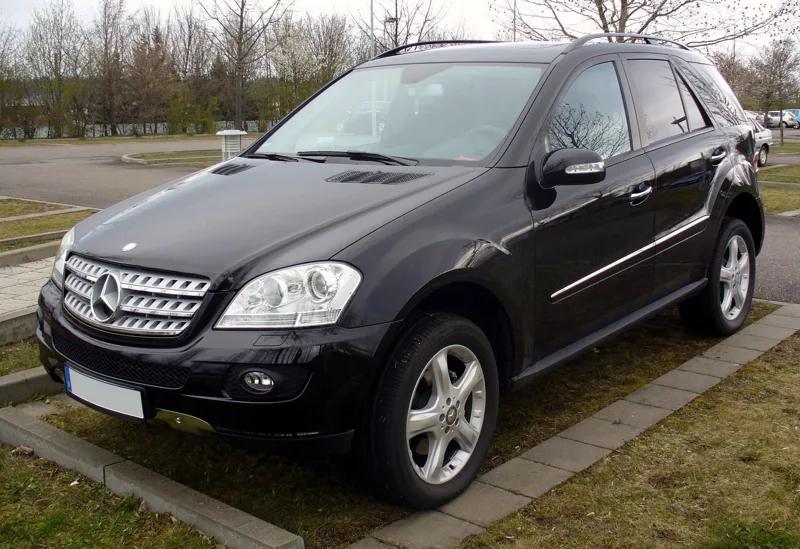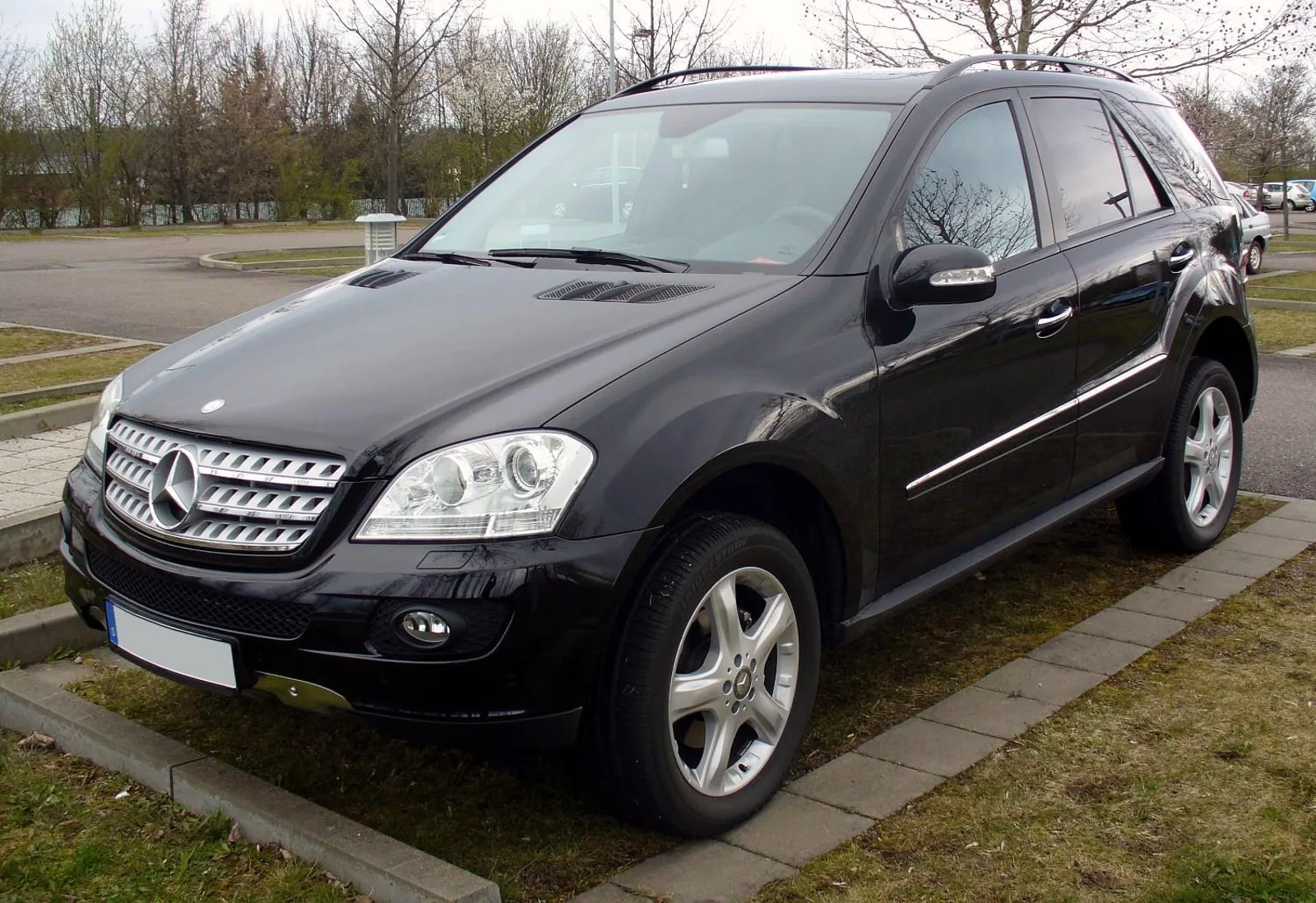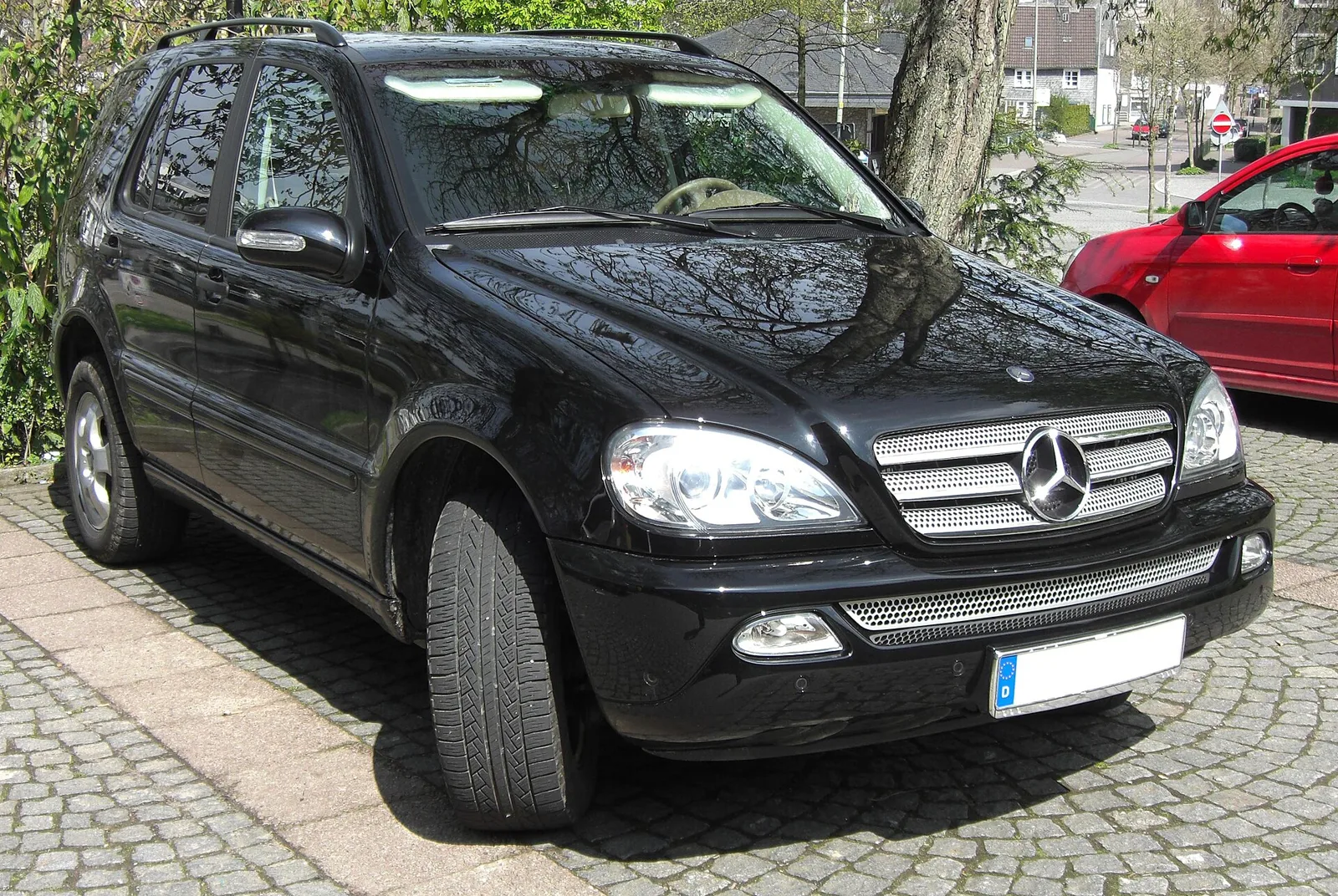
Launched in the United States in 1997, the first M-Class was built at Tuscaloosa, Alabama, and from 1999 also at Graz in Austria, until the W164 replaced it in 2005.
The Mercedes-Benz W163 was the first generation of the M-Class, a luxury SUV built from 1997 to 2005. It came from the AAV concept shown in Detroit in 1996, was first assembled in Alabama, and began production in Austria in 1999.
Mercedes-Benz's first SUV went on sale in North America in September 1997 and reached Europe in March 1998. Its rounded body caused a stir when the AAV concept was shown in Detroit, and the production car kept much of that character.
The W163 opened a new class, marked by the letter M, in the company's range, although every model in that class would later carry the ML prefix. It was not a replacement for the older G-Class. It was presented as something different, although Germany still grouped it with the Gelandewagen off-roaders.
Why was the W163 aimed at American buyers?
The W163 was aimed at overseas markets, above all the United States, where local brands dominated large SUVs. The company said production would take place at the new plant in Tuscaloosa, Alabama. Europe still had room for the car, although commercial dominance there was limited to a few models, such as the Range Rover.
The AAV concept, shown at the Detroit Motor Show in early 1996, was a clear preview of the production car. Its name stood for All Activity Vehicle, the term Americans used for SUVs. The finished W163 lost some of the concept's aggression, but its spirit was not missing.
The company also declared early on that the future SUV would be built in the USA and would have all-wheel drive of an intelligent type, managed by the electronic control unit. The production car kept both promises.
Built for American buyers, the W163 still had to earn its place in Europe.
Design and interior
The rounded body gave the W163 a drag coefficient of 0.39, a record for this type of vehicle at the time. Quarter-ellipse headlamps narrowed towards a large grille carrying the three-pointed star. Compared with the concept, the rear pillar was less inclined, the tail was less sloped and the wings were narrower.
The tailgate opened upwards, but it caused problems for shorter people. Inside, the cabin offered plenty of room, especially with the rear seat folded, and the rear bench split into three separate backrests.
The materials and finish were the real weakness. They were chosen to compete in the United States, but in Europe they did not justify the high list prices.
What was the W163 all-wheel drive?
The W163 had permanent all-wheel drive using three differentials, one for each axle plus a central unit that split torque between the axles. Electronics managed the system, with several control units linked over a CAN data bus. The traction system, called 4-ETS, braked wheels that lost grip on slippery or rough ground.
The chassis paired a ladder frame, separate from the body, with independent suspension on both axles. The rear had two additional arms, and the brakes were discs on all four wheels, with ventilated discs at the front.
Safety and structure
Safety had been built into the design from the start, which mattered because it had long been a thorn in the side of this kind of vehicle. The engineers reached a high-impact-absorbing body despite the traditional chassis.
Despite its traditional frame, the body was designed to absorb impact. Two front airbags, two side airbags and ABS were part of the equipment, and the W163 achieved four stars in the EuroNCAP rating.
Which engines did the W163 launch with?
At launch, in both the United States and Europe, the W163 came with two engines. The ML230 had a 2.3-litre (140.4 cu in) unit rated at 150 PS (110 kW; 148 hp) and a five-speed manual. The ML320 used a 3.2-litre (195.3 cu in) V6 rated at 218 PS (160 kW; 215 hp) with a five-speed automatic.
Both the manual and the automatic transmissions were fitted with a transfer case.
Engine line-up over time
| Model | Engine | Power | Introduced |
|---|---|---|---|
| ML230 | 2.3-litre (140.4 cu in) four-cylinder | 150 PS (110 kW; 148 hp) | 1997 |
| ML320 | 3.2-litre (195.3 cu in) V6 | 218 PS (160 kW; 215 hp) | 1997 |
| ML430 | 4.3-litre (262.4 cu in) M113 V8 | - | January 1998 |
| ML270 CDI | 2.7-litre (164.8 cu in) five-cylinder turbodiesel | 163 PS (120 kW; 161 hp) | End of 1999 |
| ML55 AMG | 5.4-litre (329.5 cu in) V8 | 347 PS (255 kW; 342 hp) | End of 1999 |
| ML400 CDI | 4-litre (244.1 cu in) twin-turbo diesel V8 | 250 PS (184 kW; 247 hp) | After the 2001 facelift |
| ML500 | 5-litre (305.1 cu in) petrol V8 | 292 PS (215 kW; 288 hp) | After the 2001 facelift |
| ML350 | 3.7-litre (225.8 cu in) V6 | 235 PS (173 kW; 232 hp) in German-built cars | 2002 |
How fast did the W163 sell in its first years?
Sales began in North America in September 1997, and about 50,000 units were sold in the United States and Canada by August 1998. A further 3,000 were destined for Europe. Demand led Mercedes-Benz to raise the Tuscaloosa plant's capacity from 65,000 to 80,000 cars a year.
To build anticipation, one of the first examples was used in Steven Spielberg's film The Lost World: Jurassic Park, released in 1997 and a worldwide hit like the director's other films.
Production also started in 1999 at a plant in Graz, Austria, which was planned to add a further 30,000 units a year as demand kept rising.
Expanding the range from 1998 to 2000
The ML430 arrived in January 1998 with the 4.3-litre V8, and it also came with electronic stability control and emergency brake assist, features the other two models did not have as standard. In its first year and a half on sale it was meant only for North America, and it reached European price lists in May 1999.
In March 2000 the ML230 was dropped, because its power-to-weight ratio was inadequate. From then on the W163 range had no four-cylinder engines.
Two very different models arrived at the end of 1999. The ML270 CDI was the relatively affordable option, while the ML55 AMG was far from cheap and aimed at a much smaller group of buyers. It was the first model in the range to carry the AMG signature.
What did the 2001 facelift change?
The July 2001 facelift came after about 300,000 units had been sold in under four years. Changes included new bumpers with grilles, fog lights integrated into the bumper, transparent front light clusters prepared for xenon low beams, and smaller mirrors with integrated indicators. Window airbags were added for passive safety.
The facelift also brought new alloy wheels and slightly lower-profile tyres. The 275/55/17 size did not suit those wheels well, which made the steering stiff and could cause play in the steering column and faults in the ESP sensor.
The mechanical news after the facelift was a 4-litre twin-turbo diesel V8 of 250 PS (184 kW; 247 hp) and a 5-litre petrol V8 of 292 PS (215 kW; 288 hp), the latter replacing the ML430 on the price list.
Seven-seat versions and special models
Seven-seat versions had two occasional seats in the third row, which folded sideways to leave the boot free. They were not suited to heavy passengers and were awkward to reach, although one second-row seat tipped to help access. The occasional seats could be removed completely from the boot.
In 2002 the ML350 replaced the ML320 only in some markets, Italy among them, with its 3.7-litre V6 tuned to 235 PS (173 kW; 232 hp) in German-built cars and 245 PS (180 kW; 242 hp) elsewhere. The Inspiration special edition was also sold that year.
A closed Popemobile was built for the Vatican in 2002, using the older 430 engine. Volkswagen had unsuccessfully proposed a new car based on the Touareg to the Holy See.
How did production end?
The range received no major update until early 2005. In its final months a Final Edition brought together the most refined finishes and equipment, which until then had mostly been offered as options.
Production of the W163 ended in April 2005 after a decidedly successful career. The W164 replaced it as the new generation of the large German SUV.