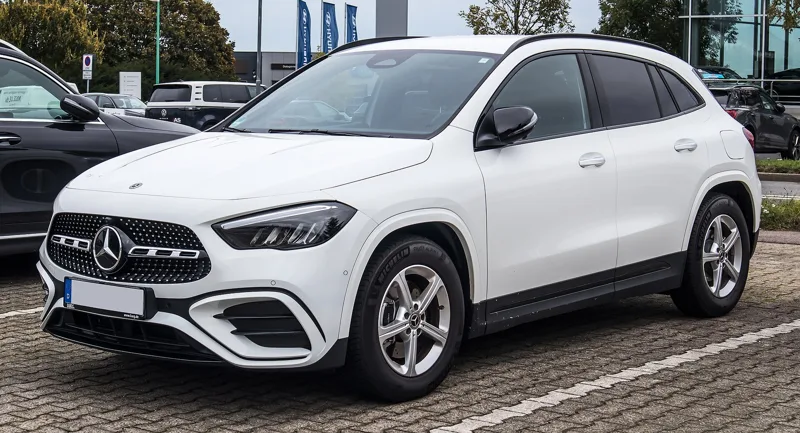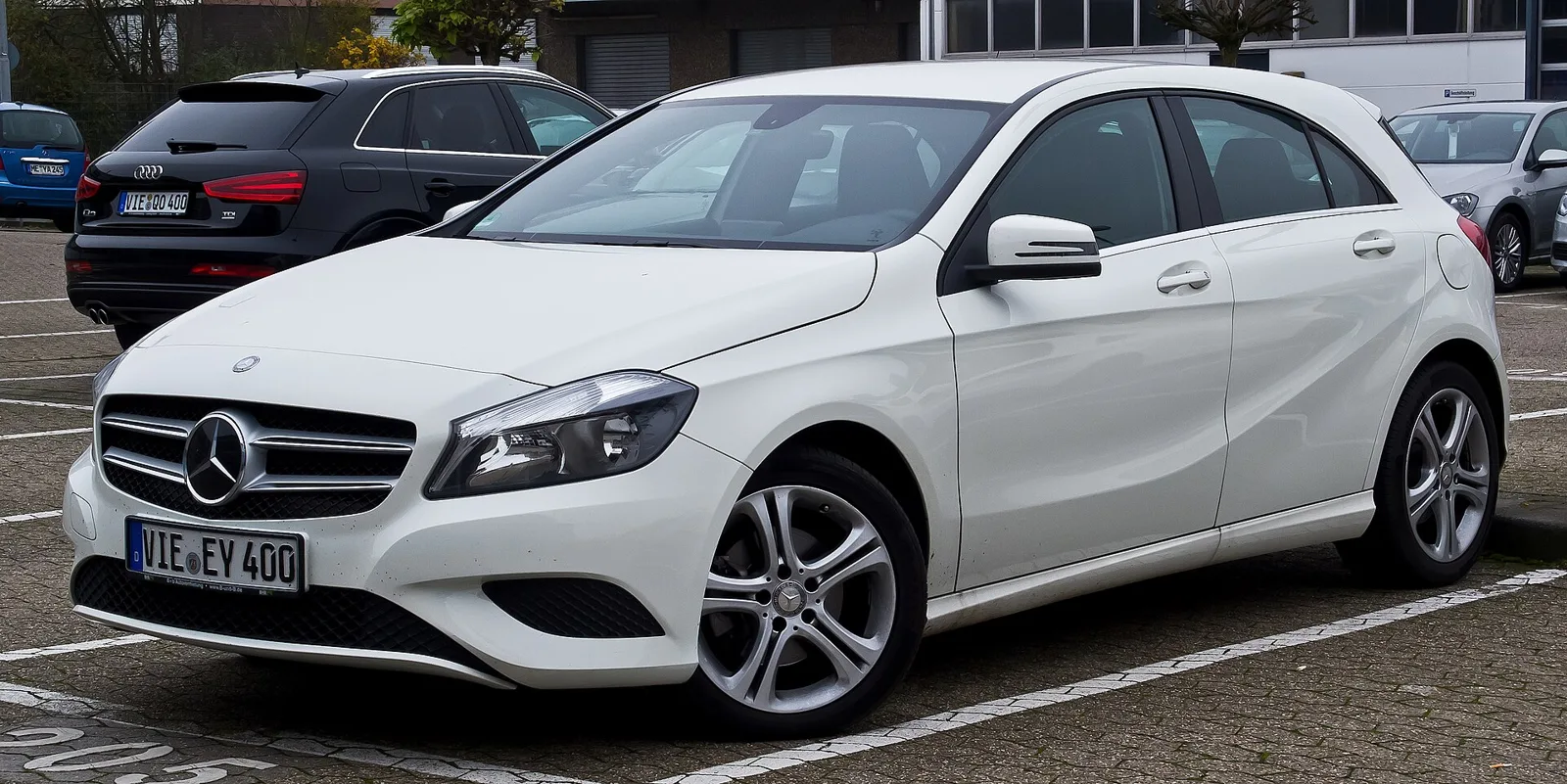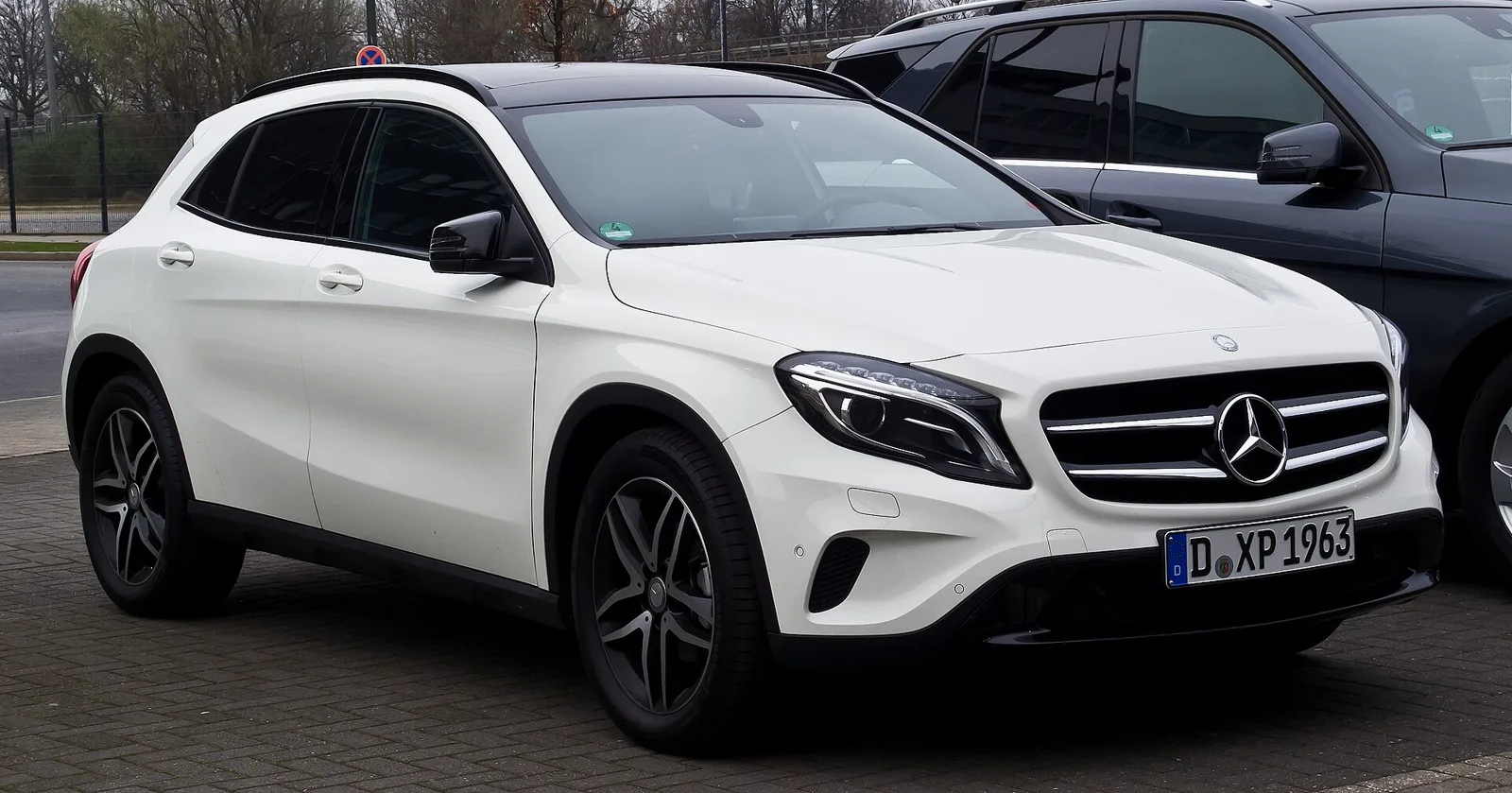
The first GLA-Class, sold from late 2013, with a 381 PS (376 hp) AMG flagship, a 2017 facelift and a line-up that stretched from the 1.6 petrol to the 2-litre turbo.
The Mercedes-Benz GLA-Class X156 was a compact crossover built from 2013 to 2019 on the MFA platform. Its engines ran from a 109 PS GLA 180 CDI to the 381 PS GLA 45 AMG, and Mercedes called it an SAV.
The Mercedes-Benz X156 was the first GLA-Class, a compact crossover that Mercedes-Benz built from 2013 to 2019. It sat on the MFA platform shared with the A-Class, B-Class and CLA, and the company described it as an SAV rather than an SUV.
The line-up ran from the 109 PS (108 hp) GLA 180 CDI up to the 381 PS (376 hp) GLA 45 AMG, with petrol and diesel versions in between. Much of the car's story is about position: a compact model with a raised stance, placed beneath the larger models in the range.
Where did the GLA idea come from?
Rumours of a compact crossover built on the new A-Class emerged shortly before the third-generation A-Class launch. A near-production car was unveiled at the Shanghai show in late spring 2013, with the Concept GLA on the Mercedes-Benz stand. The production version followed at the Frankfurt show later that summer.
The Stuttgart firm wanted to carry its all-terrain know-how towards the bottom of the range. It was not meant as a genuine off-roader in the G-Class mould, nor as an SUV in the style of the ML, GL and GLK. It was closer to a compact car, with a raised stance and optional all-wheel drive, while the larger models came with four-wheel drive as standard.
Mercedes-Benz did not call its compact crossover an SUV, but an SAV.
How did the GLA look from the outside?
The GLA used fairly rounded lines that gave it a drag coefficient of 0.29. Its grille, three-pointed star and light units were close in design to the A-Class and CLA, while its ground clearance sat well above those cars and above the B-Class.
The side view showed a raw plastic profile around the wheel arches, which continued into the sill, and a steeply raked, thick rear pillar that tied the car to the W176 A-Class. A massive rear bumper carried a striking skid plate.
The CLA, a four-door coupe on the same platform, shared many of these lines, so the GLA looked related to it as well as to the A-Class. The designers wanted the family link between the GLA, CLA, A and B to show, without producing photocopies.
How did the GLA compare with the A-Class and B-Class?
The GLA sat higher than the A-Class and CLA, and above the contemporary B-Class, while sharing their architecture and much of their design language. Ground clearance was the clearest visible difference between them.
The designers emphasised the technical kinship between these models without copying one design onto another. The GLA's rear lights differ from those of the W176 A-Class, but they are not out of place beside it.
What was inside the GLA?
The front seats had a sporty look and integrated headrests, while the dashboard was taken from related models. Aeronautical-style air vents came from the SLS AMG, where they had first appeared in 2010.
The centre console was dominated by a display mounted on top of it, rather than one that retracted. The display served as the interface to a multimedia system with many applications, including satellite navigation and connections to social networks.
Why did the GLA share the A-Class platform?
The GLA was built on the MFA platform, the same base as the contemporary A-Class, B-Class and new CLA. Its layout was the all-forward type, with the engine at the front and the front wheels driven in the basic versions.
The structure included reinforcements for more intensive off-road use, fitted to the shock towers, the underbody and the centre pillars. These stiffened the body for the harder work the car was built to face.
The mechanical base used independent wheels, MacPherson struts up front and a multi-link arrangement at the back. The suspension arms and wheel carriers were all aluminium alloy, and the braking system used four discs.
What engines did the GLA launch with?
The launch plan covered four engines, split evenly between petrol and diesel. The petrols were the GLA 200 and the GLA 250, and the diesels were the GLA 200 CDI and the GLA 220 CDI.
All four launch engines used forced induction, so none of them was naturally aspirated. The two diesels shared a 2,143 cc displacement, with 136 PS (134 hp) in the GLA 200 CDI and 170 PS (168 hp) in the GLA 220 CDI.
| Model | Engine | Displacement | Maximum power |
|---|---|---|---|
| GLA 200 | M270DE16AL | 1,595 cc (97.3 cu in) | 156 PS (154 hp) |
| GLA 250 | M270DE20AL | 1,991 cc (121.5 cu in) | 211 PS (208 hp) |
| GLA 200 CDI | OM651DE22LA | 2,143 cc (130.8 cu in) | 136 PS (134 hp) |
| GLA 220 CDI | OM651DE20LA | 2,143 cc (130.8 cu in) | 170 PS (168 hp) |
How were the gearboxes and drive set up?
On the launch line-up, the GLA 200 and GLA 200 CDI had six-speed manual gearboxes, while the other versions used a seven-speed dual-clutch unit. Every launch version except the petrol GLA 200 could be ordered with front-wheel or all-wheel drive.
The petrol GLA 200 had no all-wheel option at all.
When did sales of the GLA begin?
Production began at the end of summer 2013, and sales started in December of that year. The launch trims were Style, Urban, AMG and Exclusive, with a separate SUV Style Package that emphasised the car's SUV character.
In 2015 the trims were revised to Executive, Business, Sport and Premium. Italy received a special version called the Enduro. Standard kit included brown leather upholstery, front fog lamps and a panoramic roof, plus a suspension lifted by about 60 mm over the comfort setting. The Enduro was available for every engine and transmission except the GLA 45 AMG.
Which GLA was the performance flagship?
The GLA 45 AMG was the top model. It was announced in late 2013 and unveiled in January 2014, and it appeared in European price lists only from late spring 2014.
It used the same engine as the contemporary A 45 AMG: a 2-litre turbo rated at 360 PS (355 hp) at launch.
How did the GLA 45 AMG gain power?
A 2015 upgrade lifted the M133 engine of the GLA 45 AMG to 381 PS (376 hp) at 6,000 rpm. Torque climbed to 475 Nm (350 lb ft), and the car needed only 4.4 seconds to reach 100 km/h from rest.
The torque curve was flat between 2,250 and 5,000 rpm, so the peak figure was available across a wide band of engine speeds.
What cheaper GLA versions were added?
In autumn 2014 the range extended downwards with the GLA 180 CDI, an economical version with the OM607 engine. That unit is a 1.5-litre of Renault origin, producing 109 PS (108 hp). In early 2015 a GLA 180 petrol followed.
The GLA 180 petrol used the same 1.6 engine as the GLA 200, but its power fell from 156 PS (154 hp) to 122 PS (120 hp). It was the new arrival at the base of the range, which widened the choice for buyers at that end of the line-up.
What changed with the 2017 facelift?
The January 2017 facelift, shown at the Detroit show, mainly changed the front. The bumper gained extra lights, the grille and light units were revised, and full LED lights became available on request, where bi-xenon had been the option before.
The headlights kept much the same shape, so the change lay mainly in the technology inside them. Inside, the dashboard graphics were updated, and a 360-degree camera system helped the driver with manoeuvres and off-road routes.
The GLA 220 4MATIC arrived with a 2-litre turbo producing up to 184 PS (181 hp), and it sat between the GLA 200 and GLA 250.
When did production of the X156 end?
The X156 left production in December 2019, as the second generation was revealed. That newer car reached European showrooms only from April of the year after.