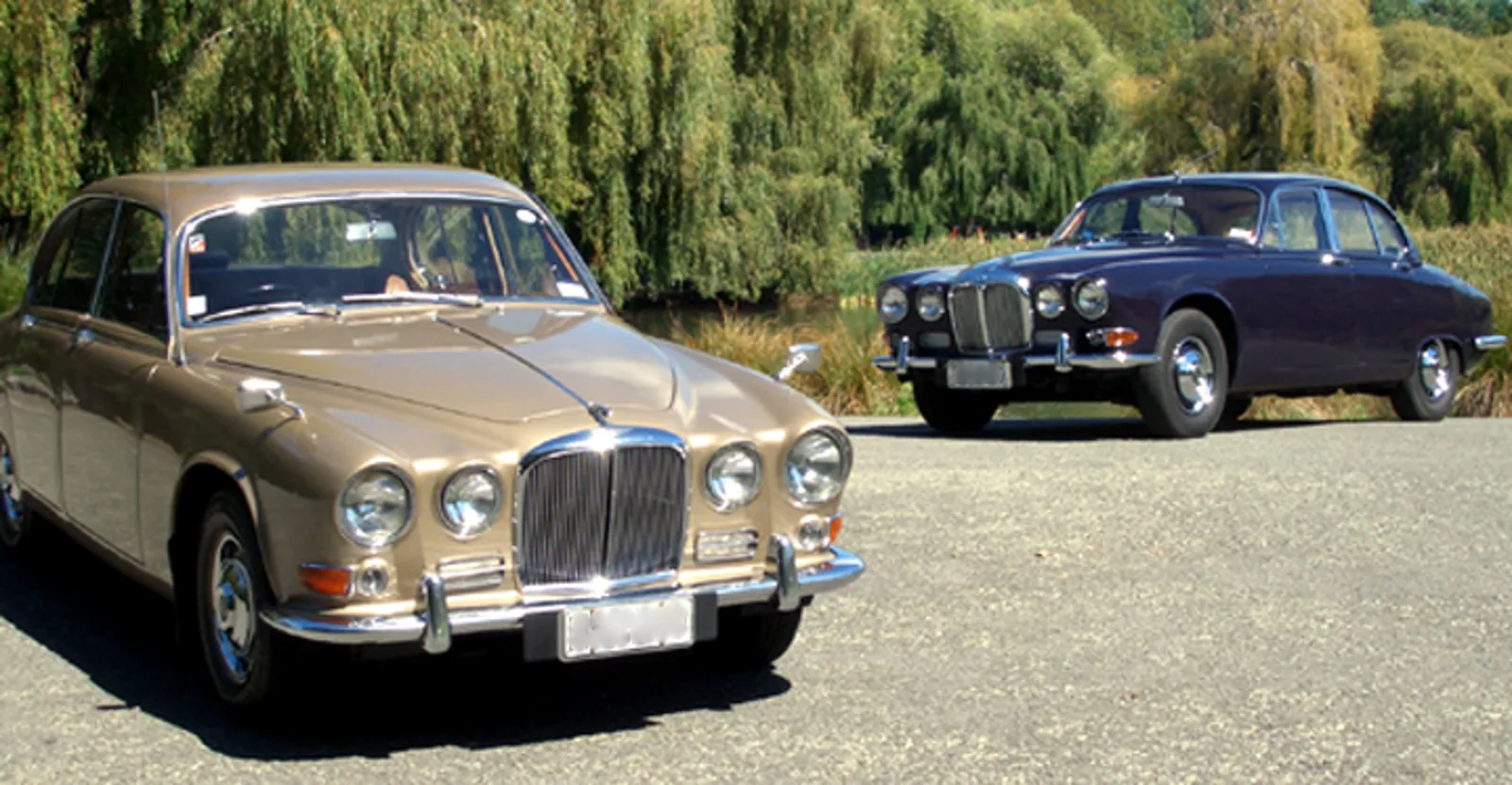
Badge-engineered 4.2-litre saloons from Browns Lane that outsold the other Jaguars in 1967 and became the basis for the XJ6.
The Jaguar 420 and its Daimler Sovereign equivalent were 4.2-litre compact saloons released in 1966. They were developed from the S-Type and cost about 200 pounds more than that model. Production ran until 1968 for the Jaguar and 1969 for the Daimler, and the XJ6 that came next borrowed their engine and suspension.
The Jaguar 420 and its Daimler Sovereign twin were compact sporting saloons from 1966, built at Browns Lane in Coventry. Both took the S-Type as their starting point and used the 4.2-litre XK engine in twin-carburettor form. The pair outsold the other Jaguar saloons in their first full year, and the XJ6 that followed was built on their engine and suspension.
Where did the 420 and Sovereign come from?
The 420 traces its origins to the Mark 2 of 1959, which had the XK six and a live rear axle. The S-Type of 1963 added independent rear suspension, and the 420 was developed from that car with a 4.2-litre twin-carburettor engine and new frontal styling.
In 1961 Jaguar launched the Mark X saloon and the E-Type sports car. Both used independent rear suspension and the 3.8-litre XK with triple carburettors, and in 1965 both were updated with a 4.2-litre version of the engine.
The historian James Taylor suggests four reasons why Sir William Lyons added another model. Mark X sales were disappointing, the Mark X was seen as too big, luxury equipment would add weight, and the controversially styled S-Type was harming sales.
Lyons initiated a new saloon based on the S-Type. It kept the 54-inch independent rear suspension, added a twin-carburettor 4.2-litre engine and used frontal styling closer to the Mark X. Both models were released in August 1966.
A compact sporting saloon that outsold its Jaguar stablemates in 1967, then gave the XJ6 its engine and suspension.
How did the styling differ from the S-Type?
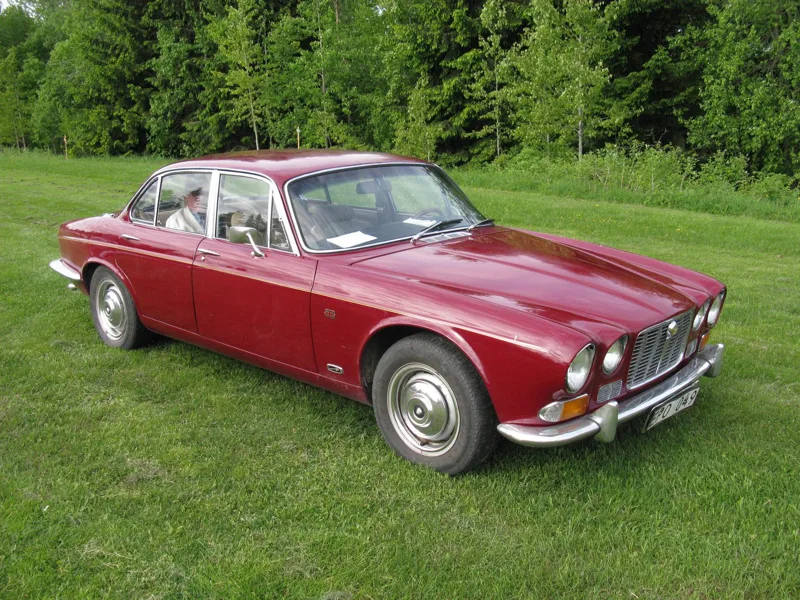
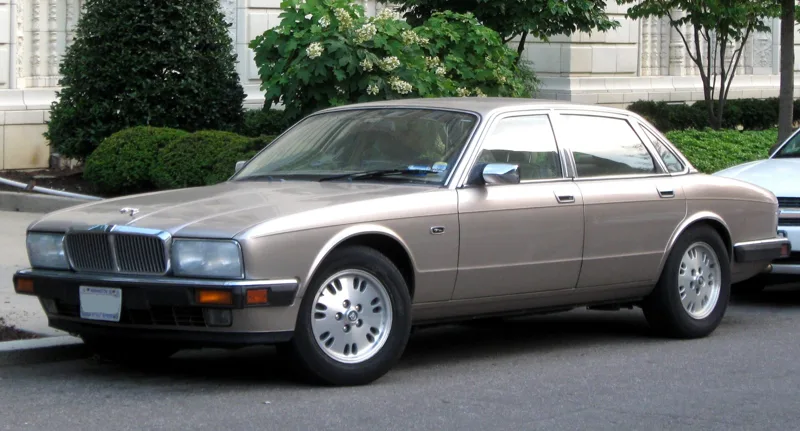
The 420 was essentially an S-Type with a more linear nose, while the rear styling was left alone. The square grille with its central divider matched the 420G, which was the new name for the Mark X at the time of the 420's release. The inner headlamps and slimline bumpers gave the car a family look with its larger siblings.
Dummy horn grilles were added below each inner headlamp, and the tops of the front wheel arches were flattened to match the squarer nose. The bonnet stayed rear-hinged, unlike the front-hinged bonnet of the Mark X and 420G, and the inner lamps lit on main beam only.
Interior changes were driven mainly by safety. The wood cappings on the doors and dashboard gave way to padded Rexine, and the clock moved to the centre of the dashboard top rail with its own battery.
The S-Type's pull-out map tray below the instrument panel was not carried over, but the 420 kept the same central console and under-dash parcel tray. Seat proportions differed slightly from the S-Type, although the seats looked very similar.
What engine and steering did the 420 use?
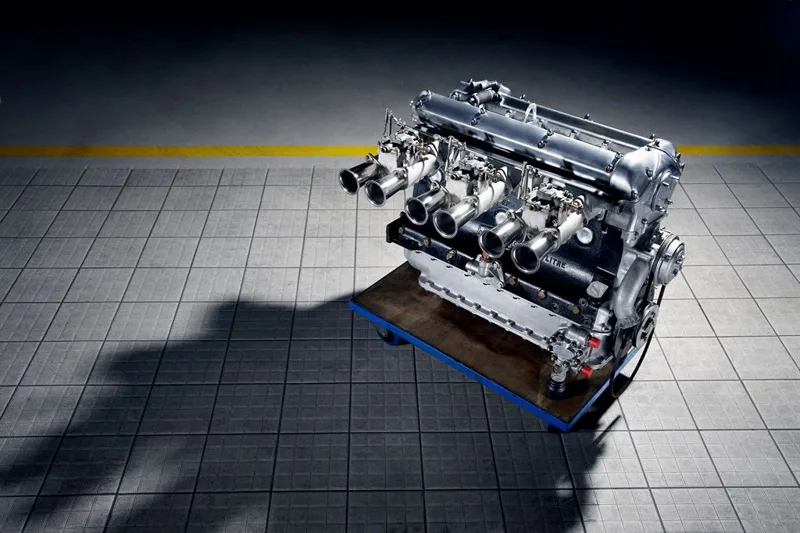
The 4.2-litre XK engine had two SU carburettors and produced a claimed 245 bhp at 5,500 rpm, which was 20 bhp less than the triple-carburettor 420G and E-Type. Peak torque was 283 lb ft (384 Nm) at 3,750 rpm, almost identical to the triple-carburettor car but reached lower in the rev range.
Compression ratios of 7:1, 8:1 and 9:1 could be specified according to local fuel quality, and the difference came from the crown design of the pistons. The engine used a straight port cylinder head and lift cams.
Marles Varamatic power steering was standard on the Sovereign and optional on the 420. Its variable ratio ran from 21.6:1 at the straight ahead to 13:1, with most of the change in the first half turn of the wheel.
The advertised power used the SAE gross system current in the United States at the time. The DIN rating of the 1977 Series II XJ6 was 180 bhp, which suggests that the SAE net figure for the 420 lay somewhere between 180 bhp and 245 bhp.
What mechanical changes separated the 420 from the S-Type?
The 420 used a stronger Model 8 automatic in place of the S-Type's Type 35 unit, and a cross-flow radiator replaced the smaller vertical flow type. A dual-line hydraulic brake system replaced the single line, and the car had twin 2-inch HD8 SU carburettors in place of the S-Type's 1.75-inch units.
Brake discs gained a cast-iron anti-squeal ring, and a Holset viscous coupled fan cooled the engine. The car switched to negative earth, used a pre-engaged starter and had an alternator in place of the dynamo.
How did the 420 perform on the road?
Contemporary tests rated the cars highly. Performance was 0 to 60 mph in under 10 seconds with a top speed of more than 125 mph (201 km/h), but fuel use of 15 to 16 mpg limited the touring range to around 250 miles (403 km).
Road & Track's December 1967 report priced the 420 at $5900 and praised its braking, handling and finish. The publication concluded that it was easy to manoeuvre in heavy traffic.
Two fuel tanks of 7 Imperial gallons (31.75 litre) each gave the car its modest range, and the fuel tanks were the reason for the touring figure.
How did the Daimler Sovereign differ from the 420?
The Daimler had no engine of its own, unlike the earlier Daimler V8 of 1962. The differences were mostly badging and trim, including a flying D mascot, a fluted grille with a stylised D badge and a plastic Daimler insert on the number plate housing.
In October 1966 UK prices were 1615 pounds for a manual Jaguar and 1678 pounds for an automatic Jaguar. The Daimler cost about 6.5 percent more, and in return it came with the 420 extras as standard, such as a heated rear window and power steering.
Buyers were paying largely for the Daimler name. The Daimler attracted people who disliked the Jaguar's racier image, and the marque was positioned as luxury motoring for a more mature customer.
What did the road testers conclude?
Motor's May 1967 test judged the saloon as good as any in the world for its combination of speed, comfort and safety, regardless of cost. The reviewers felt that the medium price standards they normally applied did not fit a car of this calibre.
Wheels magazine in Australia reviewed the car in August 1967 and concluded that a car this good gave hope to anyone who cared about motoring. Testers in general took exception to fuel use of 15 to 16 mpg, which was high even for the late 1960s.
Performance figures were superior to many of the 4.2-litre XJ6 models that came later, which made the 420 a difficult act to follow even within the Jaguar range.
What did the 420G and DS420 share with the 420?
The 420G was the renamed Mark X, and it kept the square grille with a centre bar that the 420 used too. Its styling was so close that a casual observer might confuse the two cars, and Motor's October 1966 report praised the 420G's looks.
From late 1969 the Series I XJ6-based successor kept the Sovereign name until 1983, when the name moved to a high-specification Jaguar. The 1968 Daimler DS420 limousine, meanwhile, used the 4.2-litre engine in twin-carburettor form on a modified 420G floorpan.
How many were built and why did production end?
Jaguar built 10,236 420s, and the Daimler Sovereign sold 5,824 cars until 1969. Production at Browns Lane stopped for the 420 in September 1968, after the XJ6 arrived late that year and took over the range.
Demand also faded before the end. In 1968 sales were again well ahead of the S-Type and 420G, but the resurgent Mark 2 and Daimler 250 outsold the 420, and many potential buyers were holding off for the new XJ6.
The XJ6 was slightly larger than the 420 and replaced the Mark 2 and S-Type as well. The Daimler 250 stayed in production into 1969, and the 420G lasted until 1970.
Sir William Lyons based the XJ6 on the engine, suspension and approximate dimensions of the 420 and Sovereign. The 420 was thus a victim of its own success, as the formula became the basis for the whole saloon range.
Completely knocked down kits were supplied to Jaguar Cars South Africa as late as November 1968.
Are there model kits and scale replicas?
Airfix produced a 1/32 scale plastic kit of the 420 in 1968, and the kit was reissued in 2021. Neo Scale Models make a 1:43 resin model of the 420 and a Sovereign version, and no diecast model of either car has been produced.
Why is the 420 so little known?
The 420 and Sovereign are less well known than other Browns Lane products of the period. The car was easy to confuse with its Jaguar and Daimler siblings, so even some Jaguar enthusiasts are unsure where and when it fitted into the range.
The Daimler name is a further source of confusion, and the 420G shares so much of the 420's frontal styling that the two are easily mistaken for each other. A third Jaguar-built model, the Daimler DS420, adds yet another layer, which is why the series is often overlooked. The DS420 limousine was also assembled at Jaguar's Browns Lane factory in Coventry, alongside the 420.
Specifications at a glance
| Specification | Detail |
|---|---|
| Launch | August 1966; shown at the October 1966 London Motor Show |
| Engine | 4.2-litre XK six with two SU carburettors |
| Power | 245 bhp (183 kW; 248 PS) gross at 5,500 rpm |
| Torque | 283 lb ft (384 Nm) at 3,750 rpm |
| Steering | Marles Varamatic; standard on the Sovereign, optional on the 420 |
| Compression ratios | 7:1, 8:1 and 9:1 by local fuel quality |
| Top speed | More than 125 mph (201 km/h) |
| Fuel use | 15 to 16 mpg; touring range around 250 miles (403 km) |
| Production | Jaguar 10,236; Daimler Sovereign 5,824 |
| Ended | September 1968 (Jaguar); July 1969 (Daimler) |
| Successor | Jaguar XJ6, introduced late 1968 |