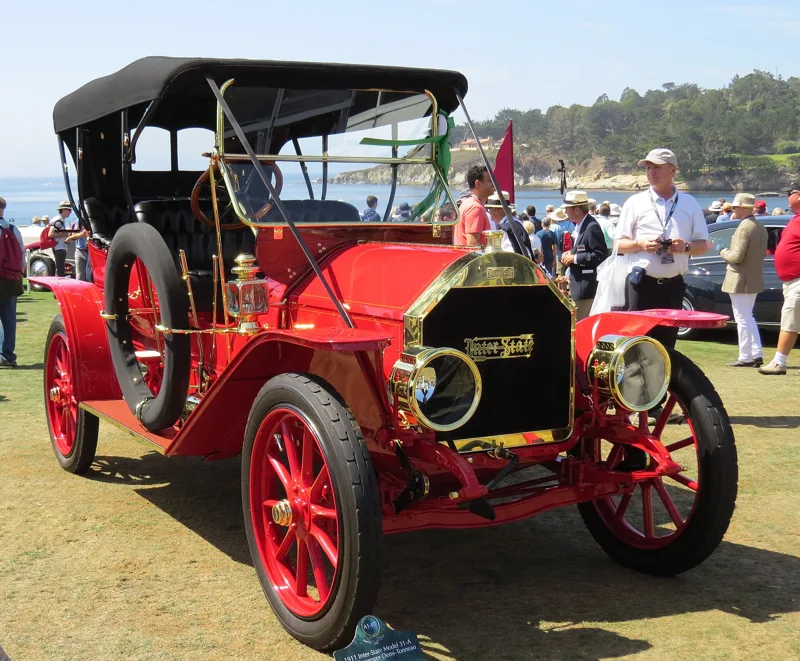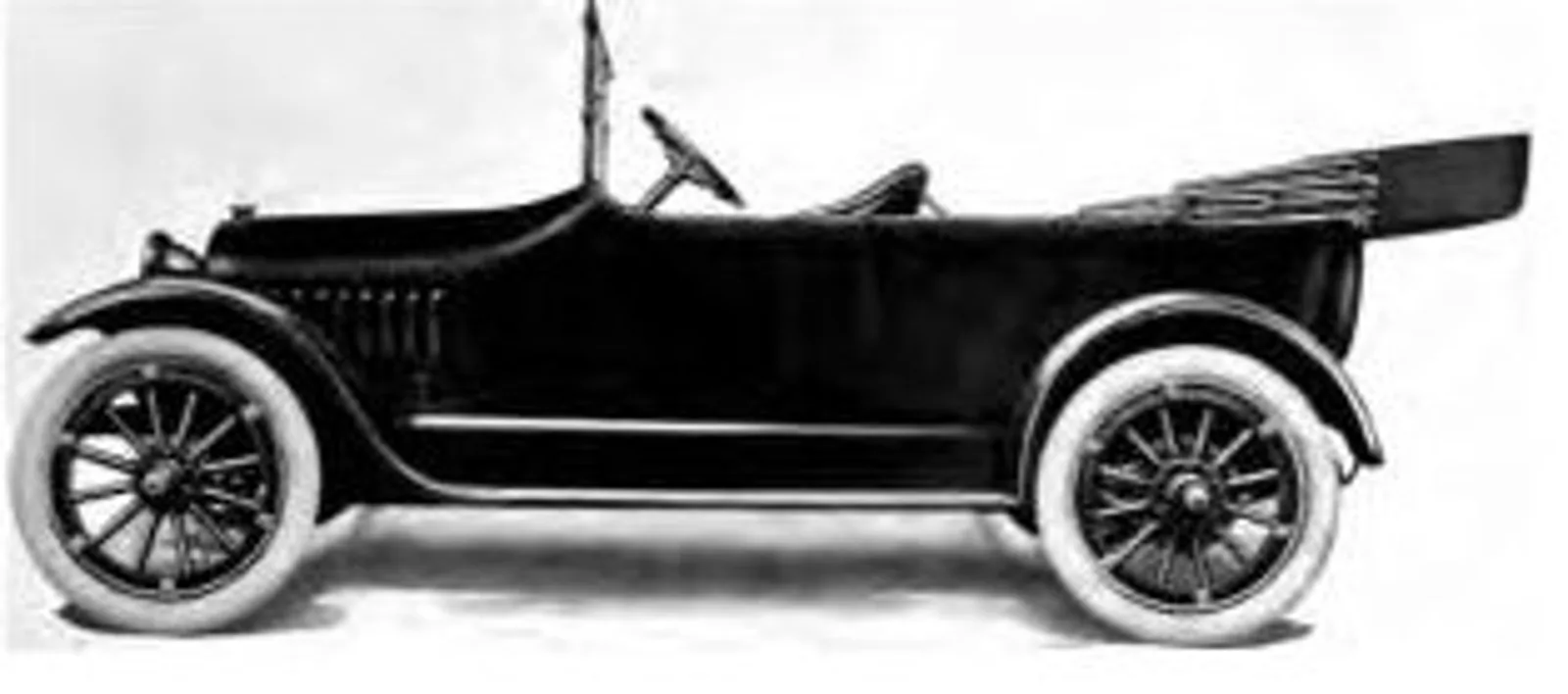
A small Muncie car from 1915 to 1918, with bought-in four-cylinder engines, a 110 in wheelbase and a price about half that of the maker's earlier cars.
Made at Muncie, Indiana, between 1915 and 1918, the Inter-State Model T was a lower-middle-class car with bought-in engines. It cost about half the price of the maker's earlier models, and more than half of the company's 8,182 cars were Model Ts.
The Inter-State Model T was a small American car built in Muncie, Indiana, from 1915 to 1918. It was the only model of the Inter-State Motor Company. It used bought-in four-cylinder engines and a three-speed gearbox, and it cost roughly half what the company's older cars had cost. Its name invites comparison with the Ford, but the record shows no licence deal.
Where did the Inter-State Model T come from?
The Model T came out of the bankrupt Inter-State Automobile Company, whose upper-middle-class cars had four and six cylinders. Frank C. Ball, who co-founded and partnered the Ball Corporation, took over the works and set up the Inter-State Motor Company on the same site.
The new Model T was smaller and cheaper than the earlier cars, so it sat in a class below them. Ball's aim appears to have been protecting his earlier investment rather than becoming a car maker himself. That did not stop the car being seriously designed and solidly built, and it was priced mid-range among its rivals.
The car always struggled with low recognition and, probably, with thin finances as well.
Ball appears to have cared more about saving his investments than about becoming a car maker.
Was the Model T a Ford licence build?
Almost certainly not. The "T" name has led some to call it a licence build, but Henry Ford rejected outside influence on his company, and no other licensees are recorded. Inter-State may have used Ford patents, but a complete licence build can be ruled out.
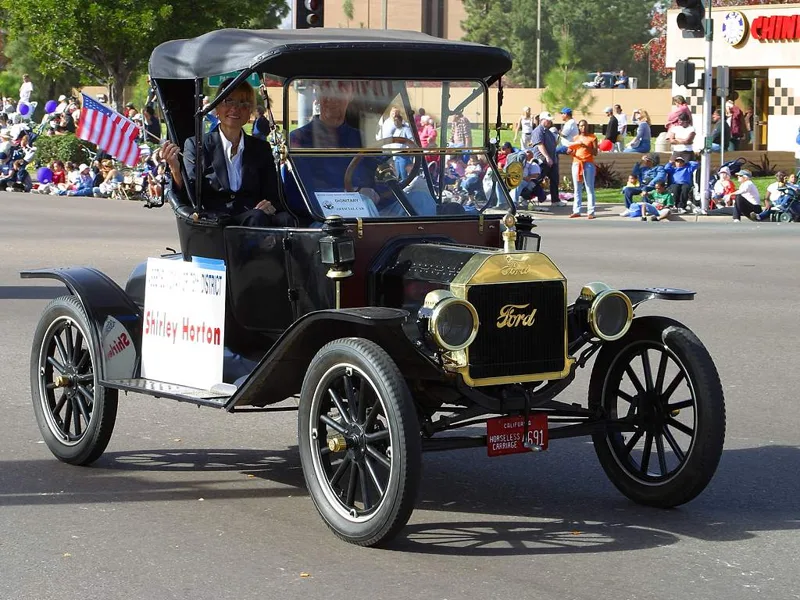
The two cars differed in almost every chassis detail. The Ford Model T had a planetary transmission, a hand throttle and a pedal each for the clutch, reverse and foot brake. Its chassis had a 100 in (2540 mm) wheelbase and tiller axles with transverse leaf springs, and its handbrake acted on the gearbox.
The Ford Touring had no driver's door, a cost-saving choice, and the gear and handbrake levers sat to the driver's left. Most accounts describe the Inter-State's drive shafts as three-quarter floating and the Ford's as semi-floating. In the former, the shaft has to absorb more lateral forces.
A price comparison favours the Ford by a wide margin: the Inter-State, described as somewhat more luxurious, cost about double the Ford for most of the four years it was built.
What engines did the Model T use?
The Model T used four-cylinder engines bought in from outside makers. Two versions followed one another, nearly identical in bore, stroke and output. The first ran in the 1915 and 1916 cars, possibly into early 1917, and the second in the 1917 and 1918 models.
The first engine had four cylinders in line and used side valves. Its bore was 3 1/2 in (88.9 mm) and its stroke 5 in (127 mm), giving 192.42 cu in (3153 cc). Inter-State rated its output at 30 bhp (22.4 kW), while the N.A.C.C. formula gave 19.6. The block was cast in one piece.
Cooling was by thermosiphon, lubrication was by splash, and ignition came from a simple battery system, although a period account refers to twin ignition in 1916. From 1916 a pumped oil circuit was added. The car carried a 6-volt electrical system from an outside maker.
The second engine was almost identical in size, at 192.408 cu in (3,153 cc) and 31 bhp (23.1 kW), though its N.A.C.C. rating stayed at 19.6. Thermosiphon cooling was kept. The main change was the valve gear, which most accounts describe as valve-in-head, while a few call it OHV. One account seems to have mistakenly mentioned side valves.
Nobody can say how the first engine's maker, Rutenberg & Beaver, came about. A misspelling of Rutenber is conceivable, in which case the engine would have been a joint effort of Beaver and Rutenber or built with Rutenber patents.
Model T specifications
| Specification | Inter-State Model T |
|---|---|
| Engine | Four-cylinder in-line, bought in |
| Bore and stroke | 3 1/2 in (88.9 mm) by 5 in (127 mm), first engine |
| Displacement | 192.42 cu in (3153 cc) or 192.408 cu in (3,153 cc) |
| Output | 30 bhp (22.4 kW) first engine; 31 bhp (23.1 kW) second |
| Transmission | Three-speed sliding gear, cone clutch |
| Final drive | Bevel gear, 4.00:1 |
| Wheelbase | 110 in (2794 mm) |
| Track | 56 in (1422 mm) |
| Tyres | 33 x 4 in on detachable rims |
| Steering | Worm |
| Brakes | Drums at the rear, with a foot brake and a handbrake |
| Chassis number | Four-digit production number, 7100 to 11503 |
The gear and handbrake levers moved from the left of the driver's seat to the middle of the car in the later cars.
The frame was a ladder type that bulged from the front third and was open towards the front, like a U. Its side members met the rear cross member in a sharp 90 degree bend. A cross member in the middle and another one carried the gearbox and the rear of the engine. Struts cast into the front of the engine block fed into the side members, a layout that recalls early Hispano-Suiza cars.
Both axles were rigid. Front springs were semi-elliptic leaf units, and the rear pair was three-quarter elliptic. Fuel was fed by gravity from a tank mounted higher than the carburettor. Tanks of this kind normally sat under the scuttle ahead of the windscreen.
Which bodies and colours were offered?
Only a five-seat touring car was offered in 1915. A five-seat sedan joined it in 1916, along with two-seat roadsters and coupes. The 1918 model year, which was shortened, brought two- and four-seat roadsters, a touring sedan and the touring car.
Whether Inter-State made its own bodies or handed the work to a specialist is unknown. Period bodies were typically timber frames covered with metal panels.
Colour choice seems to have been narrow. Only blue is recorded for the touring car between 1916 and 1918. It is possible that blue was the only colour on offer, but each body variant may have had its own shade, which is the likelier answer.
The van was available solely in the 1917 and 1918 model years. The Deluxe Delivery of 1917 was an enclosed box van on a practically unchanged car chassis, with a payload of 850 lbs (385 kg). Prices started at US$850, and it suited small traders and shops that delivered to the door. The 1918 Delivery Wagon sold for US$875, and its total output is unknown.
What equipment came as standard?
Standard fittings in 1915 were electric starting, a speedometer, a charge gauge, demountable rims and a windscreen on open cars. Electric starters were costly, and the starter is no longer mentioned in the equipment list from 1916 onwards.
A hood and its weather cover came in 1916. Neither a fuel gauge nor a water temperature gauge came as standard. Owners could buy aftermarket thermometers that fitted in place of the radiator cap and were readable from the seat.
The 1918 basic price covered a clock, a pump for tyres and a horn, which made the Model T one of the first cars to carry a clock as standard.
How was the Model T assembled?
Smaller makers often relied on assembly, buying in major components and fitting them together. In a harsh market with stiff competition, that was often the only practical way to make a small run pay. Few such firms lasted long, and the public tended to see their cars as inferior.
The list of examples includes Biddle, Cole, Daniels, Handley-Knight and Stephens, which show how unfair that view often was. The Model T itself was seriously designed and solidly built.
How many Inter-State Model Ts were built?
Apart from the shortened 1918 model year, the Model T reached between 1,100 and 1,400 cars a year. That beat the best year of the predecessor brand, which managed 1,012 units in 1912. Over half of the 8,182 Inter-State cars built by the two companies were Model Ts.
The figures include the delivery vans. Whether production of a car designed for bigger numbers paid off is not something the record shows. The annual figures come from a standard catalogue of American cars.
Where did the Model T sell?
Sales of just over 1,000 cars a year were unlikely to be called satisfactory, and the export share was probably tiny, which helps explain why the brand is barely known in Europe.
Inter-State had been among the smaller regional makers before 1915, with an annual output almost always in three figures. The Model T improved matters somewhat, but it did not transform them.
Ford, meanwhile, built its Model T on the assembly line from 1915. Its list prices fell steadily while sales exploded, and by the early 1920s the market was dominated by that car in an unprecedented way.
Who else competed for buyers?
Inter-State had tentatively entered the luxury market with the Fifty and the Model 45. That segment was shared by others, including Pierce-Arrow, Packard and Lincoln. Many small makers, among them Du Pont, Locomobile, Peerless, Lozier, Mercer and Simplex, tried to fill it too. Most had disappeared by the late 1920s. The Model T sold for roughly half the earlier models' price.
Which slogans sold the Model T?
The Model T was promoted with a few short lines. One called it "The 1000 Dollar Car." Another invited buyers to "Suggest your own test." A third promised "Extra Value."
Is any Inter-State Model T still around?
In 2010, at least six cars were still known to exist. Owners of the marque share information through the Inter-State Motor Car Registry, which exists for exactly that purpose.