A Muncie passenger car sold in five body styles, with a four-cylinder engine that grew in 1912 before the company collapsed.
The Inter-State Forty was an American upper-middle-class passenger car built in Muncie, Indiana, from 1910 to 1912. It had a water-cooled four-cylinder engine rated at 40 bhp (29.8 kW), and its maker, the Inter-State Automobile Company, filed for insolvency in October 1913.
Built in Muncie, Indiana, for three model years from 1910, the Inter-State Forty sold in five body styles. Four of those cost US$1,750 each, and the company behind it filed for insolvency in October 1913.
Where did the Inter-State Forty come from?
The Forty came from the Inter-State Automobile Company, which Thomas F. Hart founded at the end of 1908 with several investors. Its name was chosen through a contest Hart held in Muncie, and the Forty was the second model the company offered, after the 35/40 hp.
The firm's seat was at 142, Willard street. The Forty was built on the 35/40 hp of 1909, which made it the backbone of a small maker. It was conventionally designed, with a strong, large-capacity side-valve engine, and it was offered in a broad choice of bodies for a company of its size. In 1911 the line grew with the Fifty, an entry-level car for the upper class of the day.
Five body styles, a side-valve four-cylinder that grew in 1912 and a maker that filed for insolvency in 1913.
How powerful was the Forty engine?
The 1910 and 1911 Forty ran a water-cooled, side-valve four-cylinder of 318.1 cubic inches (5,212 cc). It was rated at 40 bhp (29.8 kW), and the 1912 engine grew to 349.9 cubic inches (5,734 cc) through a longer stroke while the bore stayed at 4 1/2 inch (114 mm).
The crankshaft ran in three bearings. Ignition began as high-tension magneto with a dry battery, and dual ignition arrived in 1912. A Stromberg carburettor supplied the mixture from 1912, though the car may have used one earlier.
Lubrication changed during production: an advanced oil pump from 1910 gave way to splash lubrication. Cooling relied on a honeycomb radiator and, certainly from 1911 onward, a centrifugal water pump.
The A.L.A.M. rating of 32.4 hp came from the cylinder bore, a common but very imprecise yardstick for power at the time. The bore stayed at 4 1/2 inch (114 mm) for 1912, so the rating did not move even though the engine did.
Inter-State Forty specifications
| Specification | Detail |
|---|---|
| Maker | Inter-State Automobile Company, Muncie, Indiana |
| Model years | Forty 1910 to 1912; Fifty 1911 to 1912; Thirty 1912 |
| Engine, 1910 and 1911 | Water-cooled side-valve four-cylinder, 4 1/2 x 5 inch (114 x 127 mm) |
| Displacement, 1910 and 1911 | 318.1 cubic inches (5,212 cc) |
| Engine, 1912 | 4 1/2 x 5 1/2 inch (114 x 140 mm); 349.9 cubic inches (5,734 cc) |
| Output, Forty | 40 bhp (29.8 kW); A.L.A.M. rating 32.4 hp |
| Output, Thirty | 30 bhp (22.4 kW) as stated by the maker |
| Gearbox | Three-speed manual, multi-plate clutch |
| Wheelbase | 118 inches (2,997 mm) |
| Track | 56.5 inches (1,435 mm); 56 inches (1,422 mm) in 1912 |
| Tyres | 34 x 4 inches |
| Fuel tank | Thirty 16 US gallons (60.6 litres); Forty 18 US gallons (68.2 litres) |
| Touring weight | 2,700 lb (1,225 kg) to 2,900 lb (1,315 kg) |
| Production | 627 (1910); 839 (1911); 1,012 (1912) |
How did the Forty's chassis and brakes work?
The Forty shared its 118-inch (2,997 mm) wheelbase with the Thirty and sat on a conventional ladder frame. Rigid axles at both ends were suspended on half-elliptic springs at the front and three-quarter-elliptic springs at the rear. Every Inter-State built from 1909 to 1912 was right-hand drive.
Track width was 56.5 inches (1,435 mm) at first and 56 inches (1,422 mm) by 1912. A three-speed manual gearbox with a multi-plate clutch fed a propeller shaft to the rear axle. That axle was a floating design, which kept lateral forces away from the drive half-shafts.
Service brakes were internal-shoe drums on the rear axle. The handbrake worked an external-shoe brake mounted on the rear axle, the gearbox or the differential.
The wheels were wooden artillery types with 10 spokes at the front and 12 at the rear, shod with 34 x 4 inch tyres. Where spare tyres show in period photographs, they appear to sit on removable rim rings, so an owner could take a punctured tyre off and repair it at home or hand it to a specialist.
The fuel tank held 16 US gallons (60.6 litres) in the Thirty and 18 US gallons (68.2 litres) in the Forty. A 1912 car carries its chassis number just ahead of the driver's seat. The number is four digits long, running between 4104 and 6000, and it gives no clue to the model.
What bodies did the Forty come in?
In 1910 and 1911 the Forty was offered in five body variants, and the touring car was the most common and probably the most often ordered. Four of the bodies cost US$1,750 each, and the torpedo cost US$2,000. The range was broad for a small maker, and buyers could pick from five bodies.
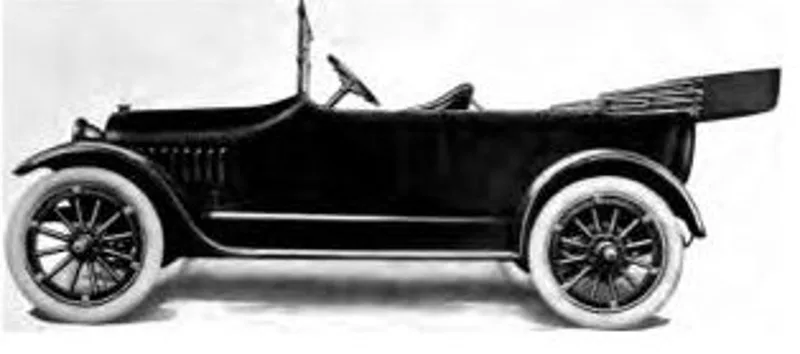
The touring was an open five-seater, usually with two rows of seats and an emergency hood. Bigger versions had emergency seats that folded from the front seatbacks or the floor, or they carried three rows altogether. In Europe the same body was called a double phaeton.
Once front doors began to appear, cars with them were called fore-door touring for a short spell, to set them apart from the older style. The same treatment went to the tonneau, and even to the roadster, although a roadster had no front doors in the first place.
The roadster began life as a two-seat motor buggy, and an extra rear seat or bench often turned it into a four-passenger model, known as a tourabout. Inter-State sold the Forty roadster with either three or four seats.
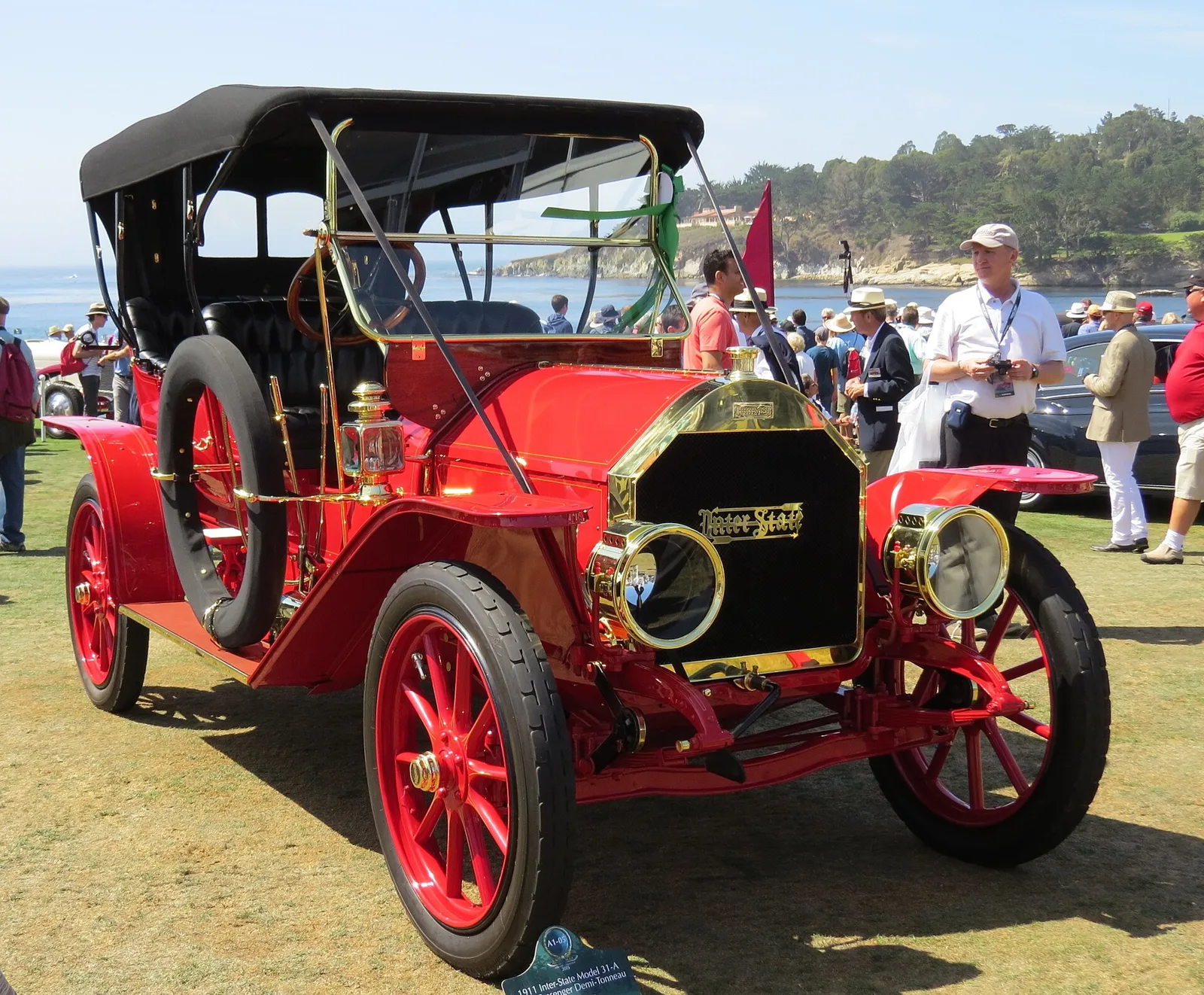
The torpedo was usually a four-seat body with four doors and a smooth sweep from bonnet to body. The demi-tonneau shortened the rear compartment and moved the back seat forward, which gave a sportier look.
A touring Forty weighed at least 2,700 lb (1,225 kg), and another source gave 2,900 lb (1,315 kg).
How did the range change in 1912?
For 1912 Inter-State redesigned every body, added the Thirty and gave the Forty a larger engine. The Thirty kept the 1911 Forty's engine, and the maker rated it at 30 bhp (22.4 kW), although it is unclear whether any engineering change lay behind that figure.
The new bodies looked more massive, and apart from the Thirty roadster they had doors to every seat. The Thirty came in two versions, the Forty in four and the Fifty in three.
The fore-door bodies were presumably the reason the Forty's weight climbed to 2,500 lb (1,135 kg). The new base models may also have been a way of using up bodies already in stock.
How did the Thirty differ from the Forty?
The Thirty was a 1912 model that used the 1911 Forty's engine, chassis and 118-inch wheelbase. Its maker quoted 30 bhp (22.4 kW), and the range offered it as a touring car and as a roadster, with the roadster as the entry-level model.
The Thirty roadster carried the body of the 1911 Forty, so the two cars were close relatives on paper. The Thirty touring car was no lighter than the Forty touring car, and the number of seats for the Thirty roadster was never recorded.
Whether the extra power rating reflected real engineering work is uncertain. Dual ignition and a Stromberg carburettor did arrive on the Thirty, and because the cylinder bore decides the A.L.A.M. rating, its figure stayed at 32.4 hp.
How many Inter-State Fortys were built?
According to the Standard Catalogue of American Cars 1805-1942, Inter-State built 627 vehicles for model year 1910, 839 for 1911 and 1,012 for 1912. Those totals cover the Thirty, Forty and Fifty together, so the Forty's share cannot be separated out.
It is unclear whether those totals include leftover 35/40 hp cars, early Model 45s or prototypes. A breakdown by model or body variant is not possible.
Why did Inter-State fail in 1913?
Financial strain was probably visible by 1912, and Inter-State filed for voluntary insolvency in October 1913. Bankruptcy proceedings followed before the year was out. The business was then taken over and reorganised under new management, which built the Model 45 for one more production year.
For 1913 the Thirty, Forty and Fifty were dropped without replacement. One six-cylinder model remained, offered only as a touring car and named the Model 45. Its position between the Forty and Fifty suggests it was meant to replace both.
The Model 45 had one more production year before a completely new lower-middle-class series, the Inter-State Model T, took its place. The company closed at the end of 1918.
Does any Inter-State Forty survive?
At least one Inter-State Forty has survived, a 1911 Forty Model 31-A demi-tonneau, which shows one of the body styles still in existence. The Inter-State Motor Car Registry serves the few remaining owners as a channel for exchanging information. Few owners remain, and the registry brings them together.