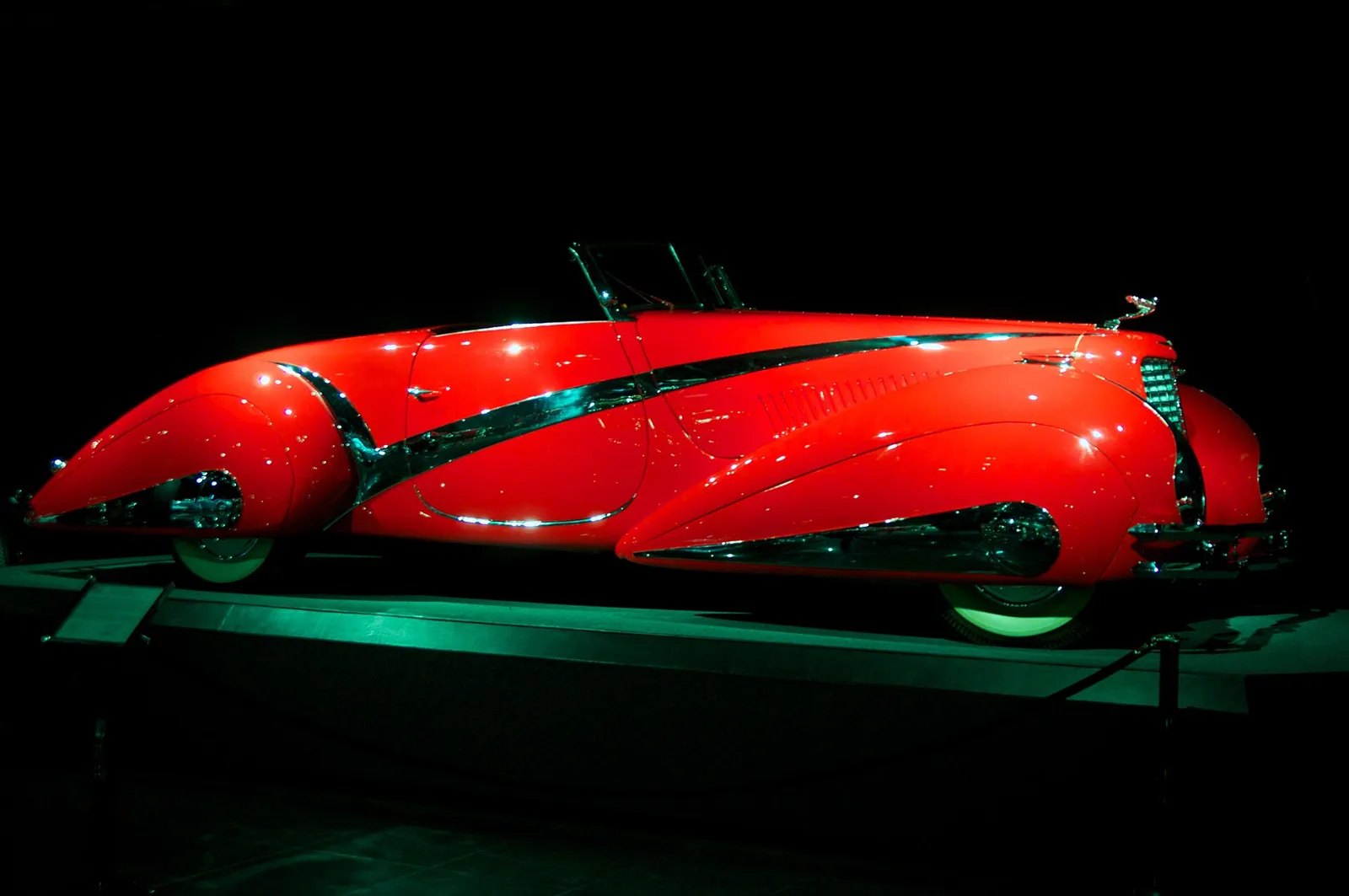
A 1937 Swiss-bodied sixteen-cylinder open car, styled after a Figoni and Falaschi show car and surrounded by myths.
Built in 1937 in Lausanne, the Cadillac V16 Hartmann Cabriolet is a one-off open car on a Cadillac Series 90 chassis. Its 7,407 cc sixteen-cylinder engine gave 185 bhp, and its Art Deco body by the small firm Hartmann was inspired by a Figoni and Falaschi design.
Built in Lausanne in 1937, the Cadillac V16 Hartmann Cabriolet is a single open car on an American Cadillac Series 90 chassis. Its two-seat body, by the little-known firm Hartmann, borrowed the look of a Figoni and Falaschi design from 1936, and the car, almost seven metres long, still survives.
Its history is only partly documented, and sellers and auction houses have added stories that the record does not support. What follows keeps to the documented record.
Who ordered the Hartmann Cadillac?
Philippe Barraud, whose father owned a brickworks in Bussigny on Lake Geneva, commissioned the car. An automobile enthusiast with money, he had seen a Figoni and Falaschi show car in Paris in October 1936, but he bought neither it nor any replica, and so he decided to build his own.
The show car, whose unusual body traced back to a drawing by Geo Ham, went to the Pakistani Prince Aly Khan. Figoni and Falaschi then built ten replicas by the summer of 1937, marketed as the Delahaye 135M Phaeton Grand Sport. Barraud's car was a free reading of that design, placed on a Cadillac chassis instead of the smaller six-cylinder Delahaye.
A one-off Cadillac V16 dressed in a Figoni-style body, built in Lausanne in 1937.
How did the chassis reach Lausanne?
Barraud ordered the chassis from the Edelweiss garage, the local Cadillac dealer in Lausanne. It was shipped through the European headquarters of General Motors in Antwerp and reached Lausanne in April 1937.
Cadillac's Series 90 was the company's largest model and was meant mainly for prestige vehicles. In the 1937 model year Cadillac built only 49 of them. Forty-seven went out with factory bodies by Fleetwood, and two were running chassis without bodies. Barraud took one of those bodyless chassis, number 5030328, for his project.
The bodywork went to Carrosserie Hartmann, a small firm that was also based in Bussigny. Until then it had mostly reproduced other people's designs. It finished the car in August 1937, and Barraud then drove it around the Lake Geneva area for several years before the car went into storage.
How was the body styled?
The body is a steel two-seater with a fabric roof, and some writers call its shape a torpedo. Teardrop-shaped front and rear wings fully enclose the wheels, and every wing carries a wave-like curve. The design takes many cues from the Delahaye, though it is not an exact copy.
The headlamps sit just above the bumper, set into the front ends of the wings. Their chrome surrounds taper upward like eyelashes. Small auxiliary lamps flank the grille, and contrasting accent stripes run from the bonnet into the flanks. There are no running boards linking the wings.
Two differences separate it from the French model. The Cadillac's beltline runs level, where the Delahaye's dips slightly at the doors, and the French car's passenger compartment sits further back.
What engine did the Hartmann Cadillac carry?
The car kept the engine of the Series 90 exactly as Cadillac offered it, known as the 452. Hartmann made no changes to it. It displaced 7,407 cc (452 cu in) and had its cylinder banks set at 45 degrees, with an overhead camshaft per bank and two Stromberg carburettors. In 1937, the final year of the engine, the factory quoted 185 bhp (138 kW).
The design was developed from 1926 under the direction of Owen Nacker, and it was sold from 1930. Among road cars it was the first V16 built in series, and by the late 1930s it was the sole engine on the market with that layout.
Some publications give the capacity as 7.7 litres, which is wrong. Each cylinder had two valves with hydraulic tappets, and the compression ratio was 5.3:1.
How did it compare with the Delahaye?
The Cadillac's engine far outgunned the Delahaye's. The factory put the French car's six-cylinder at 130 PS (96 kW; 128 bhp), against 185 bhp (138 kW) for the sixteen-cylinder Cadillac. Its wheelbase was also a metre longer than that of the car that inspired it.
How large was the car?
The wheelbase measures 3,912 mm (154.0 in), and the car is almost seven metres long. Some accounts give the overall length as 22 ft (6,706 mm). Kerb weight varies between accounts, with figures running from 2,800 kg (6,173 lb) up to 3,300 kg (7,275 lb).
The frame was a steel ladder type derived from the 353-series eight-cylinder Cadillacs. Hartmann kept its dimensions unchanged but reinforced it in several places, because the weight of the new body demanded it.
Several sources report that its size caused trouble with the authorities in 1937. The Swiss considered registering the car as a lorry, and only some modifications averted that decision.
Specifications
| Item | Detail |
|---|---|
| Body | Two-seat open cabriolet, steel body, fabric roof |
| Chassis | Cadillac Series 90, steel ladder frame |
| Engine | 7,407 cc (452 cu in) V16, 45-degree banks |
| Output, 1937 | 185 bhp (138 kW) |
| Carburettors | Two Stromberg, one per bank |
| Compression ratio | 5.3:1 |
| Wheelbase | 3,912 mm (154.0 in) |
| Overall length | 22 ft (6,706 mm) in some accounts |
| Kerb weight | 2,800 to 3,300 kg (6,173 to 7,275 lb), varying by account |
How did the paint change over time?
The car was delivered in August 1937 in white, with orange accent stripes on the bonnet and flanks. Barraud later altered the stripe colour, going first to light blue and afterwards to brown, so the car's look shifted during its early life.
Who owned the car after Barraud?
Ownership changed many times. By 1969 the car no longer ran and was held in a storage facility. The owner of the storage facility sold it that year, without Barraud's knowledge, to a Swiss collector. Three years later a French buyer from Macon took it on, and a collector from Lyon held it from 1977.
Between 1969 and 2013 the car passed through a Swiss collector, a Frenchman, a Lyon collector, an American owner and the Blackhawk Museum before its most recent buyer took it.
In the 1980s the car travelled through European shows. It joined the Veedol Star Parade touring exhibition in several West German cities in 1982, then appeared at Retro Lyon in 1983 and Retromobile in Paris in 1985. Afterwards it went to the United States and was offered at several auctions without a sale.
Some of the dates and stories told at those events were badly wrong. Then, in 1990, the car was repainted cinnabar red, with silver accent stripes, and went to the Blackhawk Museum in Danville, California.
What happened to the car after 2013?
In 2013 the car went to an American collector, who had it restored in Canada to roughly its original condition, and the car is white again. It has since appeared at American shows, including the Pebble Beach Concours d'Elegance.
Why do myths surround the car?
In a number of adverts and auctions, mostly in North America, the body was wrongly credited to Figoni and Falaschi, probably to lift the price. In 1985 the established American auction house Barrett-Jackson fitted a metal Figoni and Falaschi badge to the dashboard to support that claim.
Other stories named the wrong person. A 1982 article credited an unnamed Zurich banker. Still later, Simon I. Patino, a Bolivian tin magnate and among the wealthiest figures of the years between the wars, was frequently named as both the originator and the customer. In the 1930s Patino represented Bolivia in France as its ambassador, yet the car was no concern of his.
How is the Hartmann Cadillac regarded today?
Writers attach a run of superlatives to it. It is called the craziest Cadillac ever built and the most extreme cabriolet ever built.