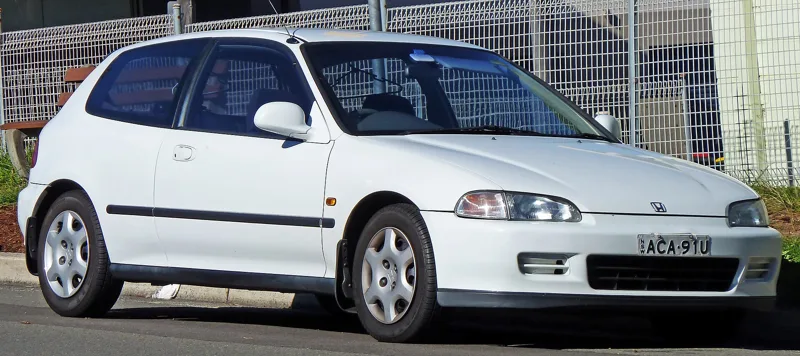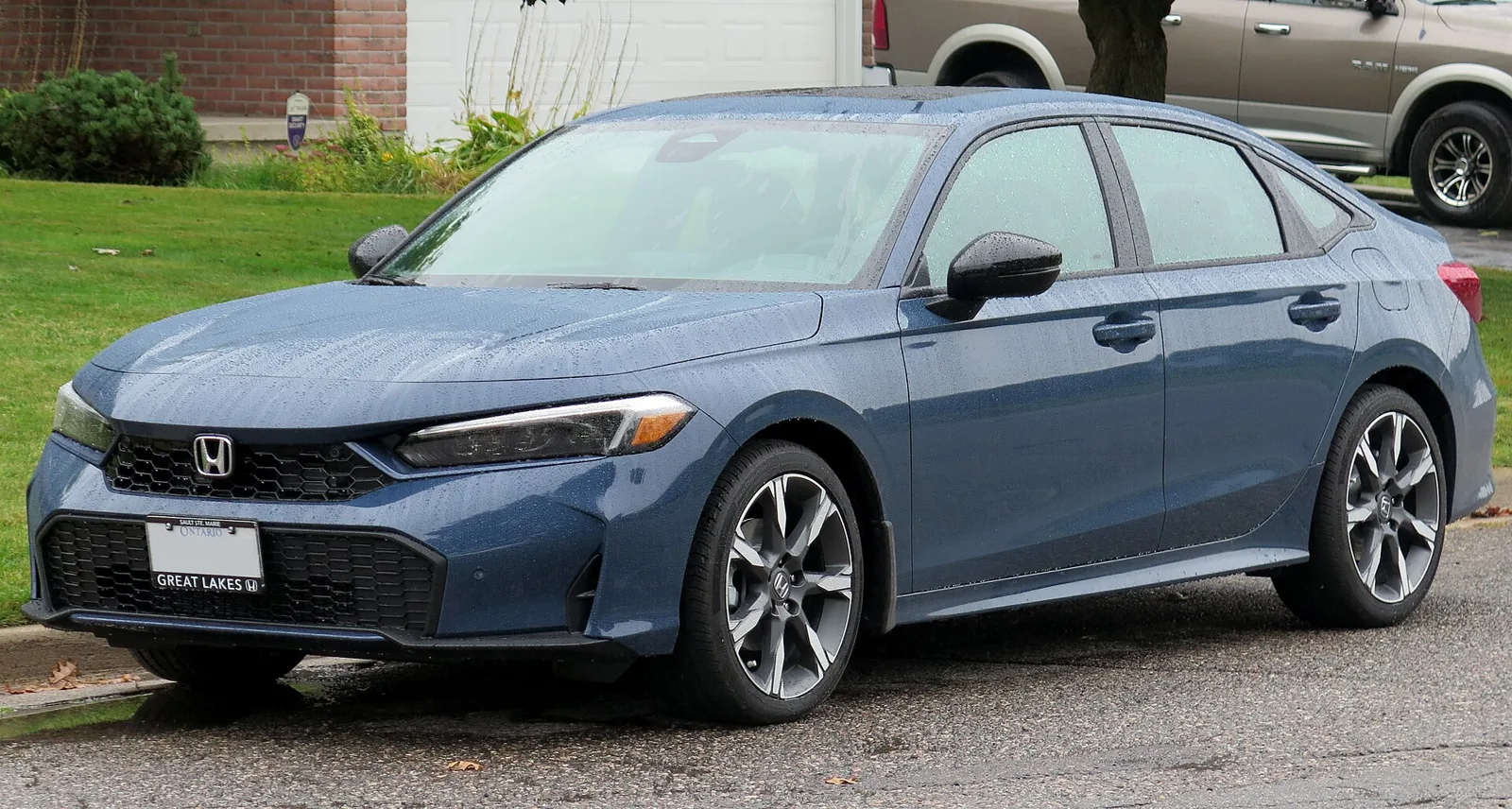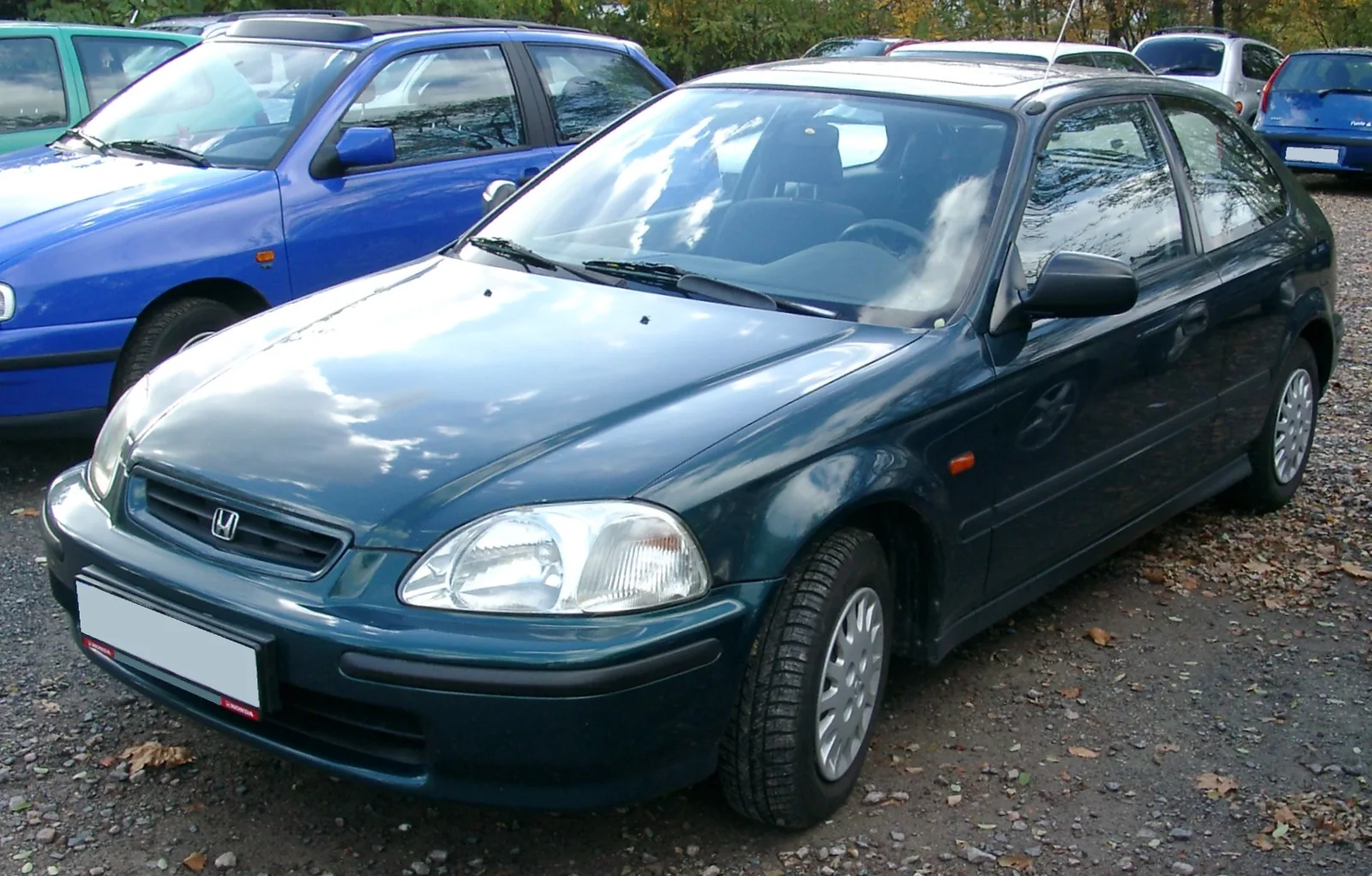
Three body styles at launch, a continuously variable transmission on the HX, a VTEC Si that became a US badge and a Japan-only Type R.
The sixth-generation Honda Civic was built from 1995 to 2000 as a hatchback, sedan and coupe. It introduced a CVT on the HX, a VTEC-powered Si coupe and a Japan-only Type R, and it earned the Japanese Car of the Year prize in its launch year.
The sixth-generation Honda Civic was produced from 1995 until 2000, arriving with hatchback, sedan and coupe bodies much like its predecessor's. Two new 1.6-litre engines and a continuously variable transmission on the HX set this car apart, and a Si coupe, a Type R and European variants gave the family its sporting and niche sides.
When did the sixth-generation Civic arrive?
Honda launched the sixth-generation Civic in 1995 offering hatchback, sedan and coupe bodies, the same trio as before. The coupe and sedan were 2.3 in (58 mm) longer than the previous-generation Civic, and the hatchback was 4.3 in (109 mm) longer.
The generation introduced two new 1.6-litre four-cylinder engines and a CVT option on the HX model. It was also the last Civic generation with front double-wishbone suspension, as the seventh generation brought MacPherson struts.
A 1995 Civic that brought a CVT to the HX and a VTEC Si to the coupe lineup, with a Japan-only Type R to follow.
What was different about the European hatchback and wagons?
A 5-door hatchback was offered in Europe, replacing the Honda Concerto hatchback. It was a hatchback derived from the Domani and built on the same platform, and it was sold as the Civic Aerodeck. Neither wagon was offered in North America.
The Domani replaced the Concerto sedan in Japan, while in other markets the Civic sedan took over from the Concerto sedan. The JDM Orthia was a wagon based on the sedan and 3-door hatchback, and the Aerodeck was the European estate version.
The five-door was also the starting point for the 1995 Rover 400, though the Rover saloon looked quite different from the Domani. This was the first Civic generation for which Honda built a version aimed purely at Europe.
Which North American trims were offered?
The North American range ran from the bare CX hatchback to the DX, LX, HX, EX, VP, GX and Si. The HX was the economy coupe with the CVT option, while the Si returned in 1999 as a US-specific badge, called SiR in Canada.
CX, DX and LX
The CX was the base hatchback, with no radio or power steering, but it included 13-inch wheels, four-wheel double-wishbone suspension, dual airbags and a split, folding rear seat for five. It moved to 14-inch wheels in 1997, and tilt steering became standard in 2000.
The DX came as a hatchback, coupe or sedan and added tilt steering and a 4 x 20-watt AM/FM stereo with clock. Sedans had power steering as standard, as did coupes with automatic. The LX, sedan only, added 14-inch wheels, power windows and locks, cruise control and a tachometer, and it gained air conditioning as standard in 1997.
What made the HX different?
The HX was a coupe tuned for fuel efficiency, with a 115 hp (86 kW) VTEC-E engine and a choice of five-speed manual or a CVT at a $1,000 option. It was the only trim with the CVT, which offered D, S and L driving ranges.
D gave standard ratios for normal driving, S gave higher engine speeds for spirited use, and L gave the lowest ratios, for strong engine braking and peak output. The conventional four-speed automatic was not offered on the HX.
What did the EX and the VP add?
The EX added a 127 hp (95 kW) VTEC 1.6-litre D16Y8 engine, a power moonroof, air conditioning, cruise control and a remote entry system on top of the LX equipment. Body-coloured mirrors and side mouldings were also fitted, and ABS was standard on the sedan.
The VP, a sedan introduced in 1998, was a value package above the DX, with an automatic gearbox, power locks, a CD player, air conditioning and keyless entry. For 1999 the EX gained a CD player as standard equipment.
Why did the Si become a cult coupe?
The Civic Si returned in 1999 as a coupe with a 1.6-litre DOHC VTEC B16A2 engine making 160 hp (119 kW), peaking at 8,000 rpm. It took 7.1 seconds from 0-60 mph (97 km/h), and fuel economy was 27/31 mpg city and highway, which helped build a loyal following.
The Si engine shared its basics with the del Sol's VTEC unit but gained a bigger throttle body, a revised intake manifold, beefed-up connecting rods, low-friction pistons, a fully counterweighted crankshaft and larger exhaust piping. Torque peaked at 150 N-m (111 lb-ft) at 7,000 rpm.
The Si had a lower, wider 15-inch wheel and tyre package, a chin spoiler, painted side sills and Si badges. Stiffer progressive-rate springs, stiffer anti-roll bars and a tower brace flattened its cornering. Only a five-speed manual was offered, the exhaust pipe grew to 2 1/4 inches, and four-wheel disc brakes were standard.
The Si came in Electron Blue, Flamenco Black and Milano Red. Inside, it offered a leather steering wheel, keyless entry by remote, and instrument faces in red with Si branding.
What were the Japanese and Asian Civics?
Japan's Civic Ferio Si used a 170 PS (125 kW; 168 hp) B16A engine, while the Civic Type R arrived in 1997 as a Japan-only hatchback. The Type R's hand-built 1.6-litre B16B was rated at 185 PS (136 kW; 182 hp), peaking at 8,200 rpm, and carried the EK9 chassis code.
The Type R had a helical limited-slip differential, a five-speed manual, larger brakes, Recaro seats, a MOMO steering wheel and a titanium shift knob. Its chassis was based on the JDM EK4 SiR, reinforced and stripped of weight for a lightweight racing feel.
The Civic Ferio Vi-RS, a 1.5-litre four-door sold only in Japan, used a three-stage VTEC D15B four-cylinder with a CVT or five-speed manual. A three-way switch on the steering wheel selected D, S1 or S2, changing the cam, the air-fuel mapping and CVT behaviour, with S2 the sportiest.
The SiR-II, sold in Asian markets from 1996 until 2000, used the B16A, B16A5 and B16A6 engines. It made 160 PS (118 kW; 158 hp), peaking at 7,800 rpm, with a 1,595 cc version making 175 PS (129 kW; 173 hp).
How did the Civic sell in Australia?
Australia received the Civic in 1996 with 1.6-litre engines: the 127 hp D16Y8 in the VTi coupe and the 118 hp D16Y4 across the GLi and CXi range. The high-output VTi-R hatchback used the 158 hp B16A2 DOHC VTEC engine.
The VTi coupe carried the EJ8 code, while the GLi and CXi were EK1. A four-speed automatic was optional on the CXi and GLi, and a CVT was offered on the VTi. In 2000 the VTi-R gave way to a two-door coupe, the EM1.
A yellow special edition called the Indy Special was also sold, inspired by Indy car racing.
How did the Civic sell in South Africa?
South Africa sold the three-door hatchback as the Civic Coupe and later the Civic, and the four-door sedan as the Ballade. The Type R and the two-door Si were not offered there. The VTEC Civic and Ballade were the highest grades, with leather seats and electric windows.
Honda was then built and distributed by Mercedes-Benz South Africa, so many models borrowed Mercedes trim such as leather and an alarm system. An AMG option followed, and a later Sport Ballade added a performance exhaust, a Type R style gearknob and AMG badges.
What was the European Domani-based Civic?
The Domani-based Civic in Europe was sold as the MA, MB and MC Civic and the Civic Aerodeck, in five-door hatchback and estate forms. Engines ran from 1.4 litres to a 1.8-litre B18C4 petrol unit.
Petrol engines included 1.4 L units (D14A2, D14A5, D14A7 and D14Z4 in the Sport), 1.5 L (D15Z8 and D15Z6), 1.6 L and the 1.8 L B18C4. The five-door body came with a fifty-five-litre fuel tank, ABS, dual airbags, power steering and electric mirrors, with air conditioning standard on later cars.
Rover developed its own 400 and 45, and later the MG ZS, from the Domani-based shell. It used its own engines and mostly cosmetic changes to the front, the bonnet, the lights and the cabin materials. Honda's long partnership with Rover made the arrangement possible.
Which VTi models were built in Europe?
The VTi badge marked Honda's VTEC technology in Europe. Models came as a 1.6 DOHC hatchback and sedan with the B16A2, or a 1.8 five-door fitted with the bigger B18C4. The 1.6 was slightly faster from a standstill because of its gear ratios.
The 1.6 had a lighter engine in a lighter body, which cut the 0-60 mph (97 km/h) time by about 0.3 seconds. Five-door VTi versions had a Torsen limited-slip differential, which helped them accelerate out of corners better than the three-door.
The 1.8 VTi also had an electric sunroof, a rear spoiler with a built-in brake light, washers for the headlights, front fog lights, Speedline alloy wheels, half-leather sports seats and heated side mirrors.
Were there limited editions in the UK?
Yes. The MB6 VTi-S 5-door came in a run of 500 for each body type, in Pirates Black, with a more pronounced front lip and different side skirts. The 3-door EK4 VTi-S was built in 1998 in a run of 200, all on R registration plates.
The Civic Jordan of 1999 to 2000 marked the Honda Mugen Jordan F1 team. It was based on the EK4 VTi, with Sunlight Yellow paint, yellow-and-black leather, Jordan decals and a numbered plaque in the centre console. Only 500 units were made.
What awards did the Civic win?
The Civic won Japan's Car of the Year award at its 1995 introduction, the third such win for the nameplate. In 1996 Car & Driver included the Civic in its 10Best list, a recognition of the range as a whole.
How did the 1999 facelift change the Civic?
The 1999 model year brought a facelift with a new grille, headlights, front bumper, fenders, bonnet and redesigned taillights. Inside, rotary climate knobs replaced the sliding controls, which freed room for a larger radio.
On pre-facelift sedans the brake lights sat above the reverse lights and indicators. After the update the reverse lights and indicators sat above the brake lights. Coupes and hatchbacks kept their layouts, but their rear indicator lenses became clear.
What engines were fitted in the United States?
Four trims, the CX, DX, VP and LX, used a 106 hp (79 kW) 1.6-litre SOHC D16Y7 with a 9.6:1 compression ratio. The HX ran the VTEC-E D16Y5 at 115 hp (86 kW), and the EX and Canadian Si used the 127 hp (95 kW) D16Y8.
Torque ran from 103 lb-ft (140 N-m) at 4,600 rpm for the base engine to 107 lb-ft (145 N-m) at 5,500 rpm for the D16Y8. The HX produced 104 lb-ft (141 N-m) at 5,400 rpm, with a 9.4:1 compression ratio.
The GX ran a D16B5 engine built for compressed natural gas, with a 12.5:1 compression ratio.
How were the transmissions set up?
Most trims (DX, LX and EX) came with a five-speed manual with hydraulic clutch or an optional four-speed automatic. The Si was manual only, and the HX was the only trim offered with the CVT.
A JDM variant called the Civic RTi used manual or automatic transmissions with Honda's real-time all-wheel-drive layout.
What colours were offered?
Up to ten exterior colours were offered on the sixth generation, and the choice changed at the 1999 refresh. Trim and interior were tied to the paint and package chosen, and some models had as few as three colours.
The 1996 range included Cyclone Blue Metallic, Cypress Green Pearl, Midori Green Pearl, Granada Black Pearl, Frost White, New Vogue Silver Metallic, Milano Red, Island Coral Pearl and Roma Red, each tied to particular body styles.
The 2000 range added Vintage Plum Pearl and Titanium Metallic for sedans, and kept Electron Blue Pearl for the Si coupe.
What is the Civic Type R's engine story?
The Type R's 1.6-litre B16B was, in effect, a shrunken B18C from the Integra Type R. It had a hand-polished head, a lighter flywheel, reworked cam profiles, high-compression pistons and a balanced crank.
The Type R's bodywork added larger brakes, five-stud wheel hubs, a quicker steering ratio, a specially tuned suspension, a front lip spoiler, a rear wing and smoked headlights.
| Specification | Detail |
|---|---|
| Production | 1995 to 2000 |
| Launch body styles | 3-door hatchback, 4-door sedan, 2-door coupe |
| Length change | Coupe and sedan 2.3 in (58 mm) longer; hatchback 4.3 in (109 mm) longer |
| HX engine | 1.6-litre SOHC VTEC-E D16Y5, 115 hp (86 kW) |
| EX engine | 1.6-litre SOHC VTEC D16Y8, 127 hp (95 kW) |
| Si engine | 1.6-litre DOHC VTEC B16A2, 160 hp (119 kW) |
| Si torque | 111 lb-ft (150 N-m) at 7,000 rpm |
| Si 0-60 mph (97 km/h) | 7.1 seconds |
| Si fuel economy | 27/31 mpg city/hwy |
| Japanese Type R (1997) | 1.6-litre B16B, 185 PS (136 kW; 182 hp), peaking at 8,200 rpm |
| Australian VTi-R | B16A2, 118 kW (158 hp) |
| Civic Jordan (UK) | 500 units, 1999 to 2000 |