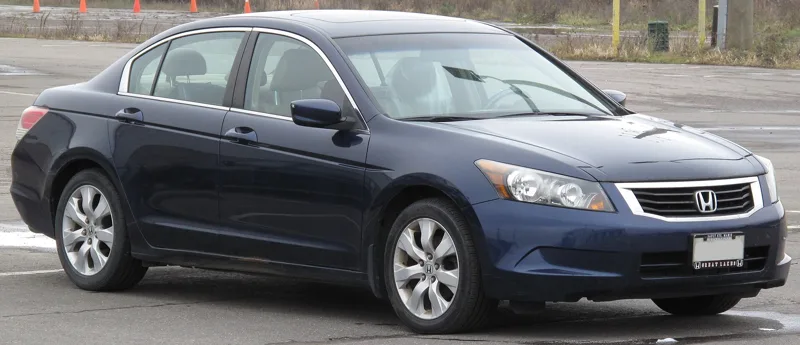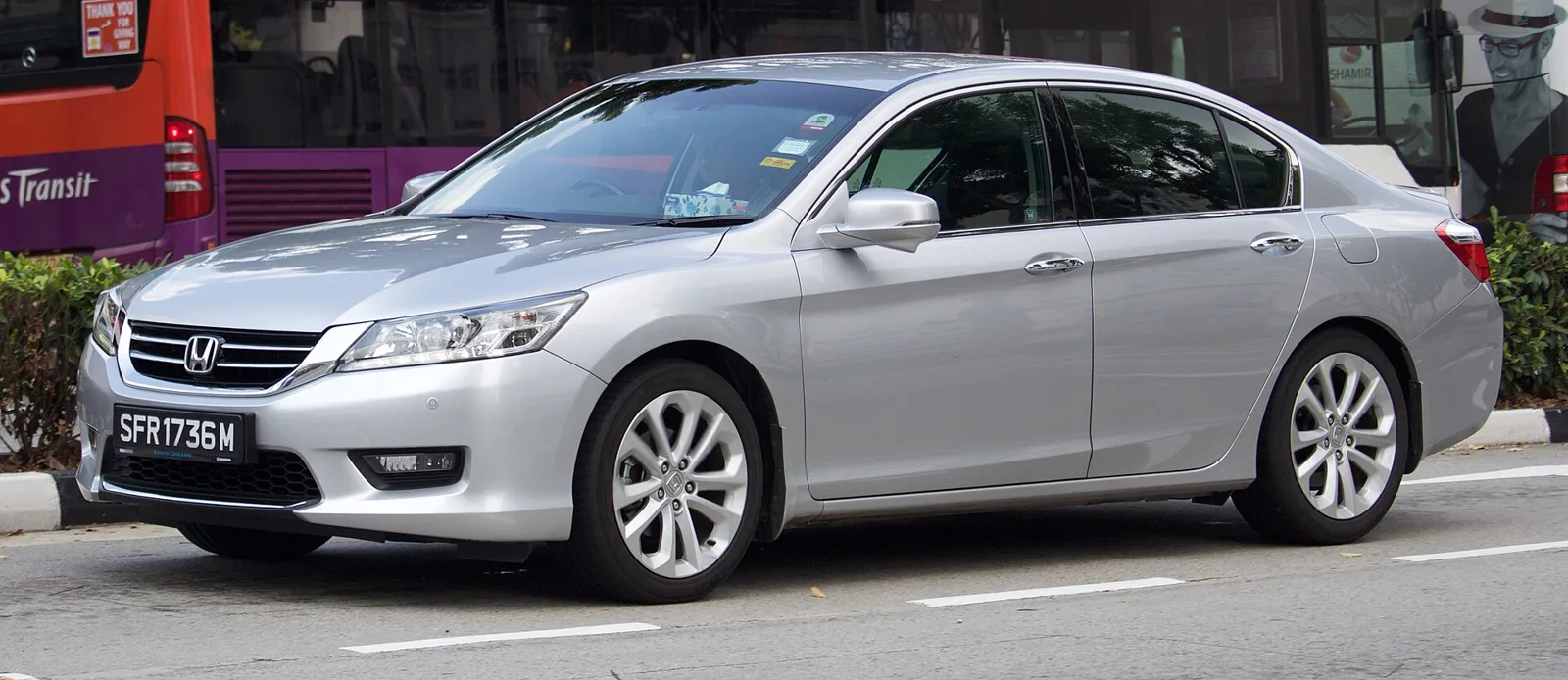
The mid-size Honda that arrived as a sedan and coupe in 2012, then added hybrid and plug-in versions and a refreshed look for 2016.
Honda's ninth generation Accord is a mid-size car launched in 2012. It came as a sedan and coupe in North America, with hybrid and plug-in versions added later, and it received a facelift for 2016.
The Honda Accord ninth generation is a mid-size family car that Honda introduced in 2012 for the 2013 model year. It was sold as a sedan and a coupe in North America, gained hybrid and plug-in hybrid versions, and received a refreshed front end for 2016.
Where did the ninth generation Accord come from?
Honda appointed Shoji Matsui as lead project manager for the ninth generation. Matsui had been an engineer on the Accord platform from 1985 to 1996. The car was the first Honda vehicle completely developed under chief executive Takanobu Ito, and it was introduced in 2012 as a mid-size model.
The Accord Coupe Concept was first shown in January 2012 at the Detroit show. Initial details of the 2013 Accord sedan followed in August 2012, and production versions of both the sedan and the coupe were unveiled in early September 2012.
One mid-size platform, from the 2013 sedan and coupe to the hybrid and plug-in versions that followed.
When did the ninth generation Accord go on sale?
The 2013 model year car was released on 5 September 2012. US sedans reached dealers on 19 September 2012 and coupes on 15 October 2012, while Canada followed on 24 September 2012 for the sedan and 1 November 2012 for the coupe.
Russia was scheduled to receive the car in February 2013. Japan received the hybrid and plug-in hybrid in June 2013, where they replaced the Honda Inspire, the large sedan that sat one level below the Honda Legend.
How did the Accord differ between markets?
Markets received different engines and gearboxes. Australia offered a 2.4 L four-cylinder and a 3.5 L V6 without a CVT, China added a larger V6 without a manual gearbox, and Indonesia, Malaysia and the Philippines each received their own trim lists.
Australia went on sale in June 2013. Its four-cylinder paired with a five-speed automatic and the V6 took a six-speed automatic. The Australian four-cylinder produced 129 kW (173 hp), while the V6 made 206 kW (276 hp).
China began sales in September 2013 as a 2014 model, with 2.0 L or 2.4 L four-cylinder engines or a V6 exclusive to that market producing 192 kW (257 hp) and 297 Nm. Chinese cars used a different grille, a bumper with more chrome, round fog lamps and trapezoidal exhausts at the rear.
Indonesia launched on 25 April 2013 with 2.4 VTi and 2.4 VTi-L trims, both on a five-speed automatic. Malaysia followed in September 2013 with 2.0 VTi, 2.0 VTi-L and 2.4 VTi-L models. In the Philippines, a 2.4 S with a five-speed automatic and a 3.5 SV with a six-speed automatic arrived in 2014, the latter imported from Thailand.
What technology did the ninth generation Accord offer?
Every Accord came with an 8-inch WQVGA screen, a single-angle reversing camera, Honda's i-MID system with Bluetooth hands-free calling and streaming audio, dual-zone climate control and alloy wheels. Navigation added a 6-inch touchscreen and a higher resolution display.
The navigation system added the 6-inch touchscreen, and the 8-inch display moved to an 800x480 pixel WVGA resolution. Optional safety equipment included a forward collision warning system, a lane departure warning system and a blind spot monitor.
A tri-angle reversing camera offering normal, wide and top views could be specified, along with a wide-angle passenger blind spot camera. From EX trim upward, buyers got a Smart Key, LED daytime running lamps and LED head and tail lamps, plus adaptive cruise control.
Engines, suspension and bodywork
The new direct-injected 2.4-litre four-cylinder used 16 valves and a DOHC layout, rated 138 kW (185 hp) and 245 Nm (181 lb-ft). Sport trim lifted that to 141 kW (189 hp) and 247 Nm (182 lb-ft), and the four-cylinder paired with either a six-speed manual or a continuously variable transmission.
The 3.5-litre V6 had a 24-valve SOHC layout and produced 207 kW (278 hp) with 342 Nm (252 lb-ft), available with a six-speed manual or automatic. The continuously variable transmission was Honda's first use of a CVT in the Accord, and it went with the four-cylinder in North America.
The suspension changed as well. The double-wishbone front arrangement used since the second generation gave way to a simpler MacPherson strut, while the rear kept an independent multi-link layout. Only the top-tier Acura RLX kept the costlier front design, and the Touring trim used double-piston Amplitude Reactive Dampers already seen on several Acura models.
Lightweighting was a major theme. High-strength steel made up 55.8% of the body, and 17.2% of the body used grades rated at 780, 980 or 1,500 MPa yield strength that the previous car had not used. The front subframe was 6.4 kg (14 lb) lighter than before, and the body shed 25 kg (55 lb) overall.
How did the Accord Hybrid work?
The Accord Hybrid arrived in Japan in June 2013 and in the United States in October 2013 for the 2014 model year. It paired a 2.0-litre Atkinson cycle engine with a dual-motor system and a 1.3 kWh lithium-ion battery, and Honda's electronic continuously variable transmission gave it a combined 196 hp.
Economy was the main draw, with ratings of 50 mpg-US city, 45 mpg-US highway and 47 mpg-US combined. Car and Driver timed the hybrid to 60 mph in 7.2 seconds. Honda used an all-aluminium front subframe and rear bumper beam to save weight.
The hybrid is easy to tell apart. It had blue accents on the headlights, grille trim and tail lamps, and 17-inch alloy wheels available only on the non-plug-in version. Its battery sat in the boot, so cargo space fell from 15.8 cu ft to 12.7 cu ft.
Honda built no hybrid for the 2016 model year while it moved production from Ohio to Japan. The model returned for 2017 with revised running gear that raised combined output to 160 kW (214 hp), up from 146 kW (196 hp) in the 2014 and 2015 cars.
What was the Accord Plug-in Hybrid?
The Accord Plug-in Hybrid was a plug-in version that went on sale in the United States in January 2013, with a 21 km (13 mi) EPA all-electric range and a combined rating of 115 MPG-e. Production started on 21 December 2012, and sales were limited to California and New York at launch.
The platform had been shown at the 2010 Los Angeles Auto Show with a 7 kWh lithium-ion pack and a 120 kW motor. In all-electric mode the car could travel roughly 16 to 24 km (10 to 15 mi) in city driving, and its top speed was 100 km/h (62 mph). A 120-volt outlet took 2 to 2.5 hours to recharge the battery, and a 240-volt outlet took 1 to 1.5 hours.
The production sedan was built in Sayama, Japan, as a single trim based on the Touring. It used a 6.7 kWh lithium-ion battery with a 124 kW motor and a 2.0-litre Atkinson cycle engine producing 102 kW (137 hp) at 6200 rpm, for a total system output of 146 kW (196 hp). Honda compared that with the Prius plug-in at 134 hp, the Volt at 149 hp and the Fusion Energi at 195 hp.
Before launch Honda expected up to 24 km (15 mi) of electric range and a total range of more than 800 km (500 mi). The official EPA figures were a 21 km (13 mi) electric range, 115 MPG-e combined and a hybrid-mode rating of 46 mpg-US (5.1 L/100 km) combined, with 47 mpg-US (5.0 L/100 km) in the city and 46 mpg-US (5.1 L/100 km) on the highway.
The car emitted 20 milligrams of combined smog-forming emissions per mile and became the first US car to meet LEV3/SULEV20 standards. It was also expected to win single-occupant carpool access in California.
What trims and updates came to the North American Accord?
North American buyers could choose LX, Sport, EX, EX-L and Touring trims. The 2016 facelift changed the front fascia, grille, headlights, rear lights and alloy wheel designs on every trim, and it also made the Accord the first mass-market car with Apple CarPlay.
The Sport trim sat between the LX and EX, with 189 hp, 18-inch wheels, dual exhaust, a decklid spoiler and paddle shifters on CVT cars. From 2016 it also gained LED daytime running lights, upgraded LED fog lamps, 19-inch alloy wheels on 235/40 R19 96V tyres, and the larger front brake rotors of the Touring.
The Touring trim came with the V6 as standard in the United States, while Canadian buyers could choose either the four-cylinder or the V6. The V6 was no longer offered on non-leather trims, and the 2016 car was the second to offer Android Auto alongside Apple CarPlay.
Why did the plug-in model disappear?
The Accord Plug-in Hybrid was discontinued after the 2014 model year, along with the Civic Hybrid and the natural gas Civic GX. Part of the reason was Honda's ability to improve fuel economy through conventional engine technology.
A total of 1,039 Accord plug-in hybrids sold in the US through 2015. In Japan the car was leased mainly to corporations and government agencies, and it ranked third among plug-in hybrids there as of December 2013. Honda later offered the Clarity plug-in hybrid in 2017, and the 2018 Honda Clarity PHEV replaced the Accord version.
Ninth generation Accord specifications
| Specification | Detail |
|---|---|
| Launch | Model year 2013; sedan released 5 September 2012 |
| Body | Mid-size sedan and coupe in North America |
| Four-cylinder | 2.4-litre direct-injected DOHC, 138 kW (185 hp), 245 Nm (181 lb-ft) |
| V6 | 3.5-litre SOHC 24-valve, 207 kW (278 hp), 342 Nm (252 lb-ft) |
| Hybrid | 2.0-litre Atkinson plus motor, 146 kW (196 hp), 306 Nm (226 lb-ft), 1.3 kWh battery |
| Hybrid economy | 50 mpg-US city, 45 mpg-US highway, 47 mpg-US combined |
| Plug-in battery | 6.7 kWh lithium-ion, 124 kW motor |
| Plug-in range | 21 km (13 mi) all-electric, EPA |
| Plug-in rating | 115 MPG-e combined |
| Body weight saving | 25 kg (55 lb) overall |
| Front subframe | 6.4 kg (14 lb) lighter than before |