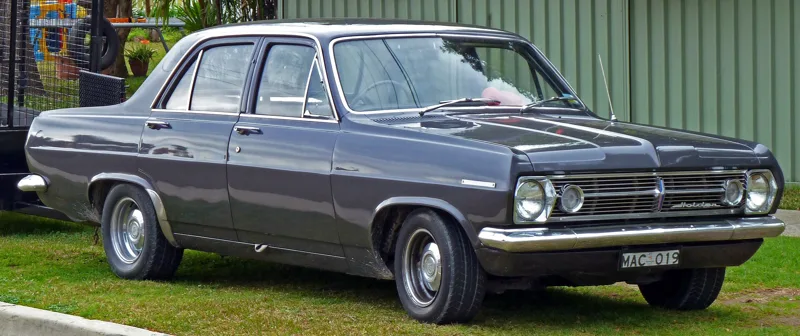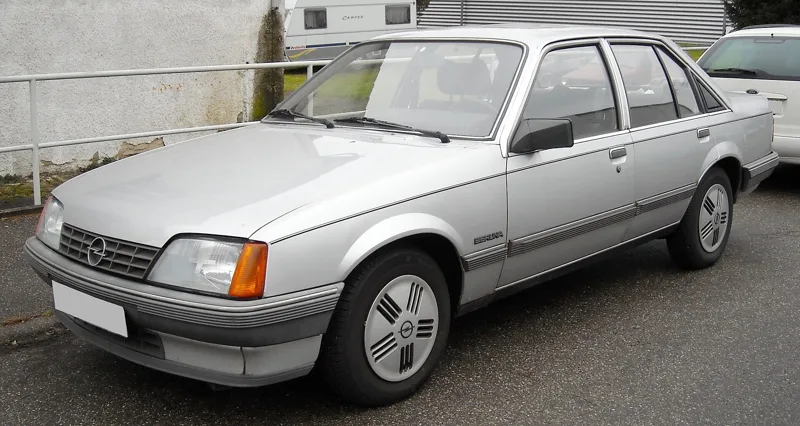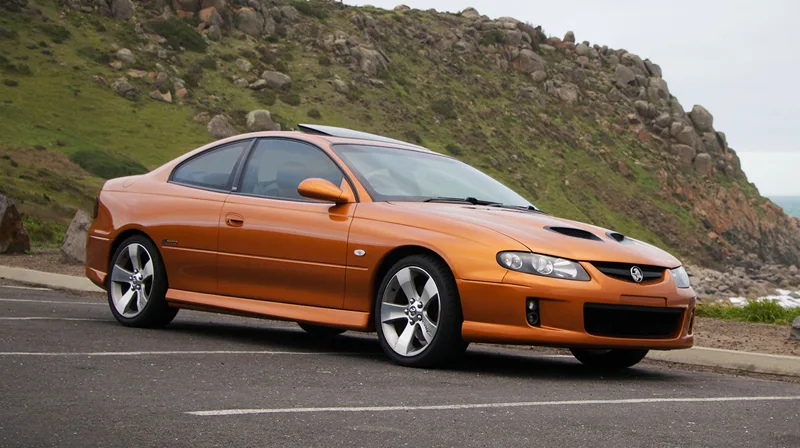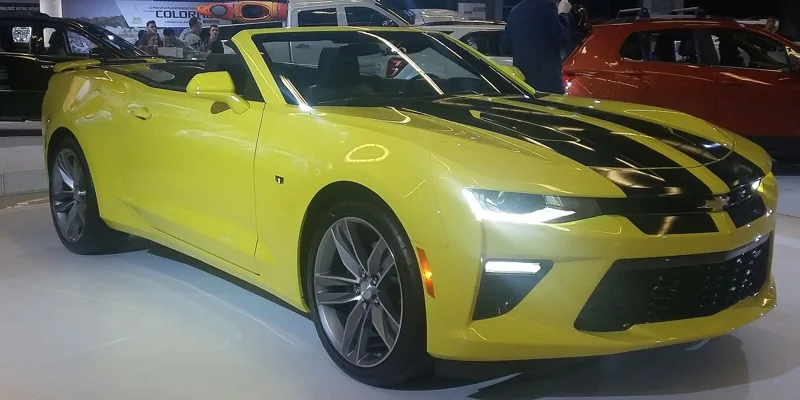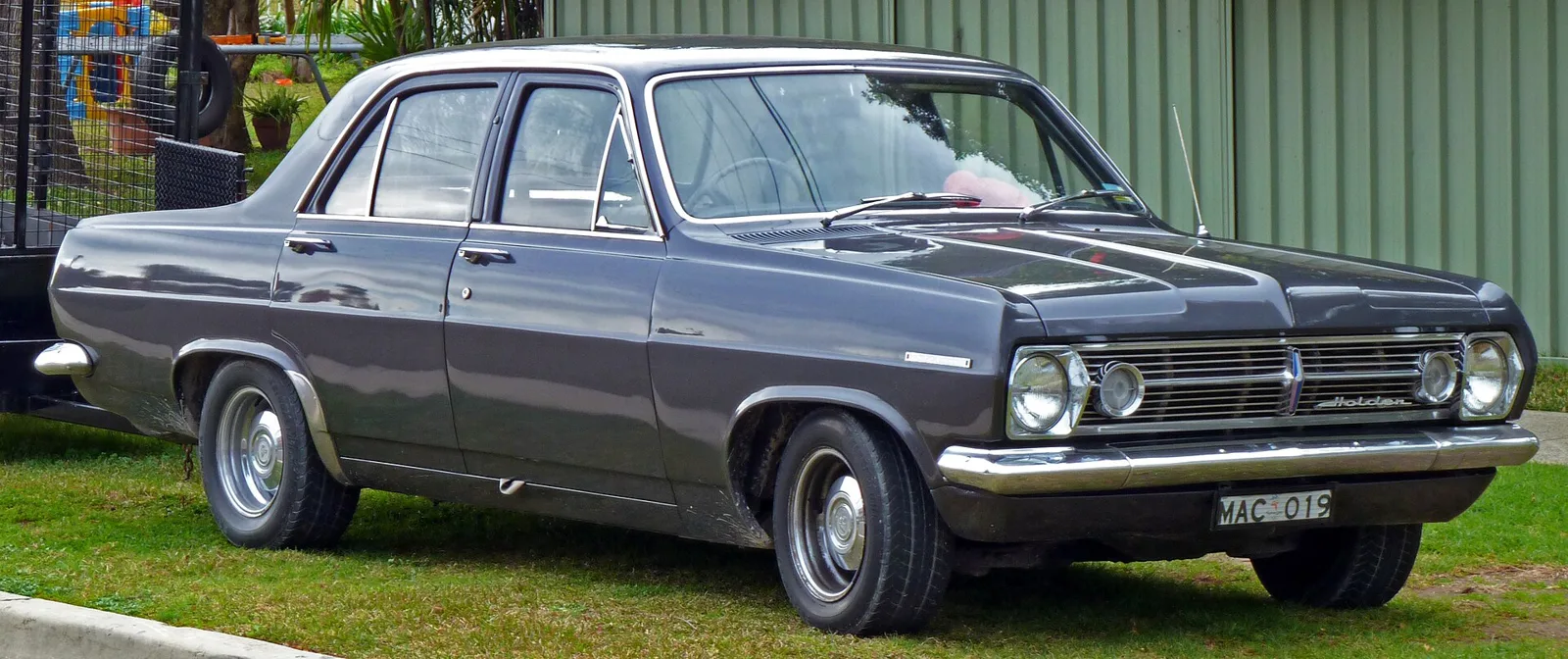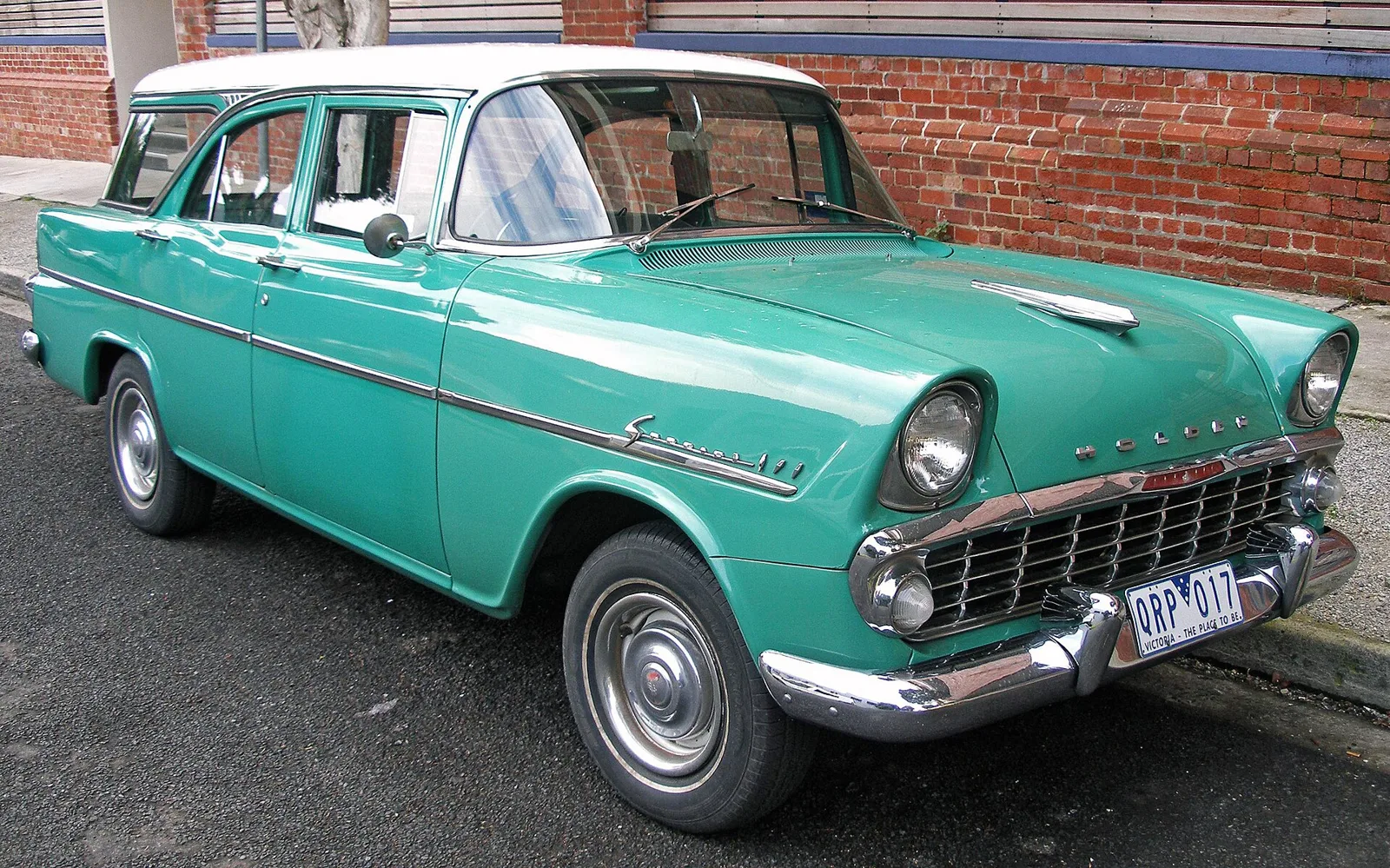
A mid-size Holden built in Australia from 1948 to 1968, drawn in Detroit for rough roads and sold beside the Special from 1954.
The Holden Standard was a mid-size car built by Holden in Australia for the 1948 to 1968 model years, and the first complete car the brand made. From 1954 the better-equipped Holden Special joined it. Its first form had a six-cylinder engine of 2,171 cc (132.5 cu in) producing 60 bhp (44 kW).
The Holden Standard was the first complete car that Holden built in Australia, and it was made for the 1948 to 1968 model years. Its six-cylinder engine and monocoque body were developed partly in Detroit, shaped for Australian conditions and sold simply as the Holden.
Why did Holden need its own car?
Holden needed a car of its own because monocoque bodies were making it harder to fit local bodywork to imported chassis, and importers of complete vehicles threatened its market share. Before the war, Holden had built bodies on chassis from GM, Ford and Chrysler, and after the GM takeover the parent company supplied most of those chassis.
Holden (GMH) had fitted bodies to chassis imported from the USA before the war. By the end of the 1930s monocoque construction was spreading, and the local company feared losing customers to importers of complete cars. An attempt to bring in the Olympia from sister company Opel failed. Australia was judged to need a larger vehicle than that, and the political climate in Hitler's Germany added doubt.
From 1940 the Australian arm pushed its case in Detroit, where Alfred P. Sloan and other top executives had to be won over to a locally built car suited to local conditions. Larry Hartnett, the head of GMH, was the keenest advocate and produced designs of his own. Detroit did not take to them.
A car for Australian roads, with the ground clearance to match.
What kind of car was it meant to be?
Planners wanted something cheaper to buy and to run than the US cars, which swelled with every model change, yet roomier than European mid-size models. Extra ground clearance was needed for Australia's poor roads. The reference point was the Opel Kapitan, reimagined as a plain everyday car rather than a luxury model.
American cars of the day were growing at each change, so a smaller model was a clear break from that pattern. Holden's aim was a cheap everyday car for everyone rather than an upmarket machine like the Kapitan that German buyers knew. Holden was not after a luxury product.
Which prototypes did the design start from?
Two pre-war prototypes had been built for a planned small car under a new brand that would sit below Chevrolet in the USA. The idea was dropped, but the cars were kept rather than scrapped, so they were available when the Australian request arrived. The Detroit team then reworked the six-cylinder example into the car that became the Holden.
The 195-Y-13 used a four-cylinder unit, and its twin, the 195-Y-15, used a six. The six won out because the four was weaker and noisier, and it would not have noticeably reduced production costs. Detroit developed the car further as the 195Y25, which Prime Minister Ben Chifley unveiled in Melbourne on 29 November 1948 as model 48-215.
How the Holden Standard changed year by year
FX and FJ years, 1948-1956
The launch car went into production in November 1948 as a four-door saloon with the model number 48-215. Its six-cylinder engine displaced 2,171 cc (132.5 cu in) and developed 60 bhp (44 kW). Drive passed through a single-plate dry clutch, then a three-speed gearbox that was only partly synchronised and shifted from the steering column, before reaching a rear live axle on leaf springs. The front wheels had unequal-length double wishbones and coil springs, and every wheel had a hydraulically operated drum brake.
Body and chassis formed a monocoque that recalled the large Morris cars of the period, such as the Oxford MO. The glass was flat, the split windscreen included, and four exterior colours were offered: Convoy Grey, Seine Blue, Gawler Cream and black.
A utility, an open pick-up with two seats, arrived in January 1951 under model number 50-2106 with the same running gear. The Business Sedan, model 48-217, followed in July 1953 as a reinforced saloon with a stronger battery, firmer springs, leather upholstery and rubber floor mats. It was mostly used as a taxi or fleet car. Later, and unofficially, the three types became known as the FX Holden.
The FJ Standard arrived in September 1953 with a facelift that made it one and a half inches longer and gave the radiator grille a wide chrome bar bearing ten chrome teeth. December 1953 brought a three-door panel van, and in January 1954 the better-equipped FJ Special came as a four-door saloon only. The FJ itself reached 169,969 cars, and across both series output had passed 250,000 by June 1956.
FE and FC years, 1956-1959
A completely new Holden, the FE Standard and FE Special, was presented in July 1956. Its wheelbase grew by two inches, its bodies adopted the modern pontoon shape and its radiator grille was a rectangular chrome lattice. Power rose to 70 bhp (51 kW). A five-door estate car joined the Standard and Special in March 1957.
The FC facelift of May 1958 brought a larger radiator grille, all-round flashing indicators in place of the old winkers, and small tail fins. Production stood at 155,161 FE and 191,724 FC by the end of 1959.
FB and EK years, 1960-1962
In January 1960 the FB arrived on the same floor pan with new bodies inspired by late-1950s Chevrolets. The FB sported panoramic windscreens and enormous tail fins, with visors fitted above the headlights. Inside, designers gave it a fresh dashboard and a bowl-shaped wheel, and the engine was enlarged, reaching 2,261 cc (138.0 cu in). Output was 75 bhp (55 kW).
The EK of May 1961 was another facelift, distinguished mainly by a different radiator grille. Its main technical advance was a two-stage Hydramatic automatic from the parent company in Detroit. Production of the FB reached 174,747, and the EK tally by late 1962 stood at 150,214.
EJ and EH years, 1962-1965
The EJ, introduced in July 1962, had a plainer look in keeping with the 1960s. Tail fins had gone, but small round rear lights from the EK carried over. A radiator grille ran across the full width of the car, with the headlights set into its ends. The wheelbase and drivetrain carried over from the predecessor, and so did the model range. The hydraulic brakes became a dual-circuit system, and the wipers, which had worked against each other, now moved in parallel.
The EH of August 1963 had oblong tail lamps and new engines. Two bored-out versions of the predecessor's engine, at 2,442 cc (149.0 cu in), gave 95 bhp (70 kW) at a compression ratio of 7.7:1, or 100 bhp (74 kW) at 8.8:1. A new 2,933 cc (179.0 cu in) six produced 115 bhp (85 kW) at high compression. Production came to 154,811 EJ and, up to June 1965, 256,959 EH, and Premier models are counted in both figures.
HD and HR years, 1965-1968
The HD of February 1965 looked a lot like its predecessor, but it had grown larger and wider, and it now resembled the Opel Rekord A from Germany. At last it had room for six, not just on paper as its predecessors did. Its wheelbase grew by one inch, and it kept the engines of the predecessor. The larger car also came in a high-output X2 form, rated 140 bhp (103 kW).
The HR that followed had square chrome frames around its headlights, new bumpers and different tail lamps. Its engines were the biggest change. A 2,638 cc (161.0 cu in) V6 replaced the 2.45-litre unit and was rated at 108 bhp (79 kW) at an 8.2:1 ratio, or 114 bhp (84 kW) with the ratio raised to 9.2:1. The 2.9-litre engine gave way to a 3,048 cc (186.0 cu in) V6 rated at 126 bhp (93 kW), while the X2 and S variants reached 145 bhp (107 kW). Three speeds came as standard, and a four-speed manual from Opel was optional, as was the two-stage Powerglide automatic.
What was the Premier model?
The Premier was the top trim of the EJ and EH ranges. It arrived as a saloon in 1962, above the Standard and Special, and in 1963 a five-door estate was added as a further Premier model. The production totals for the EJ, EH and HR include the Premier models.
Holden Standard models and output
| Series | Years | Power | Built |
|---|---|---|---|
| FX and FJ | 1948-1956 | 60 bhp (44 kW) at launch | 169,969 FJ |
| FE and FC | 1956-1959 | 70 bhp (51 kW) for the FE | 155,161 FE; 191,724 FC |
| FB and EK | 1960-1962 | 75 bhp (55 kW) for the FB | 174,747 FB; 150,214 EK |
| EJ and EH | 1962-1965 | 95 to 115 bhp (70 to 85 kW) for the EH | 154,811 EJ; 256,959 EH, both including Premier |
| HD and HR | 1965-1968 | 140 bhp (103 kW) for the X2 HD; 108 to 145 bhp (79 to 107 kW) for the HR | 178,927 HD; 252,352 HR, including Premier |
What replaced the HR in 1968?
In January 1968 the HR was replaced by the Belmont and the Kingswood. The Belmont succeeded the Standard, and the Kingswood succeeded the Special. By then 252,352 of the HR had been built, counting Premier models. The HR had been a popular car.