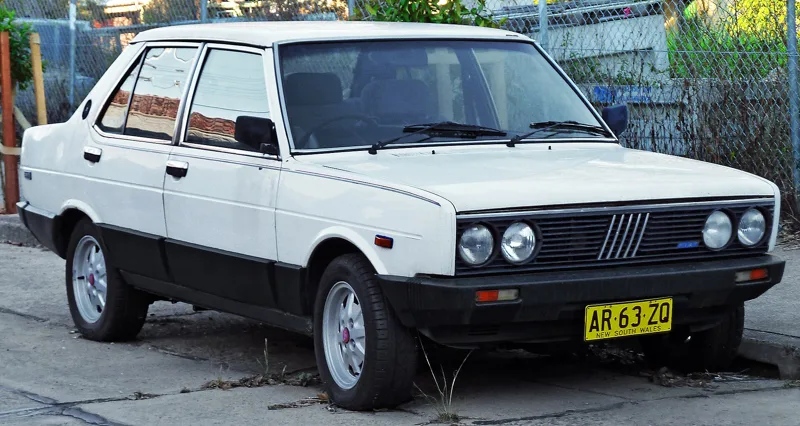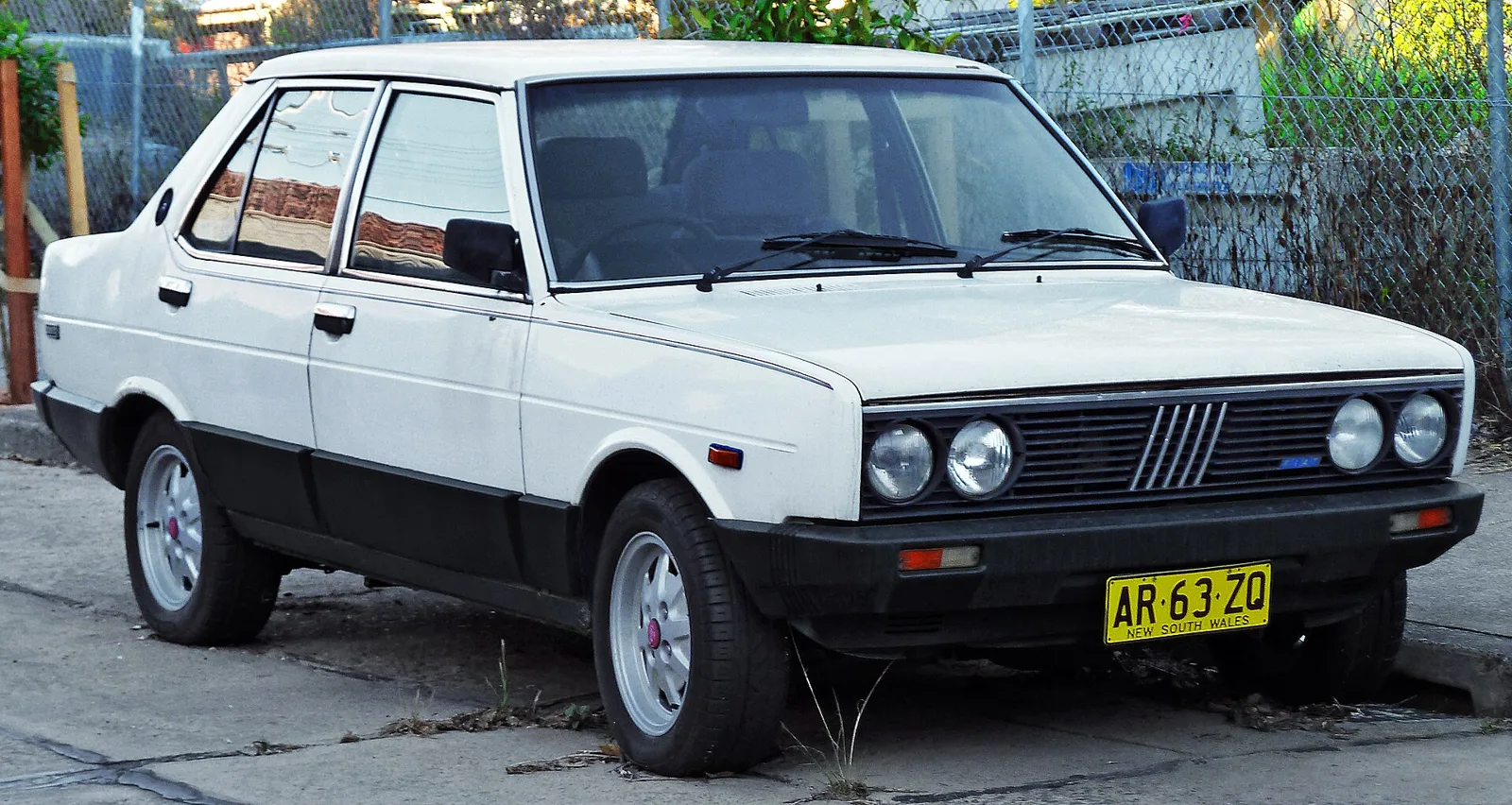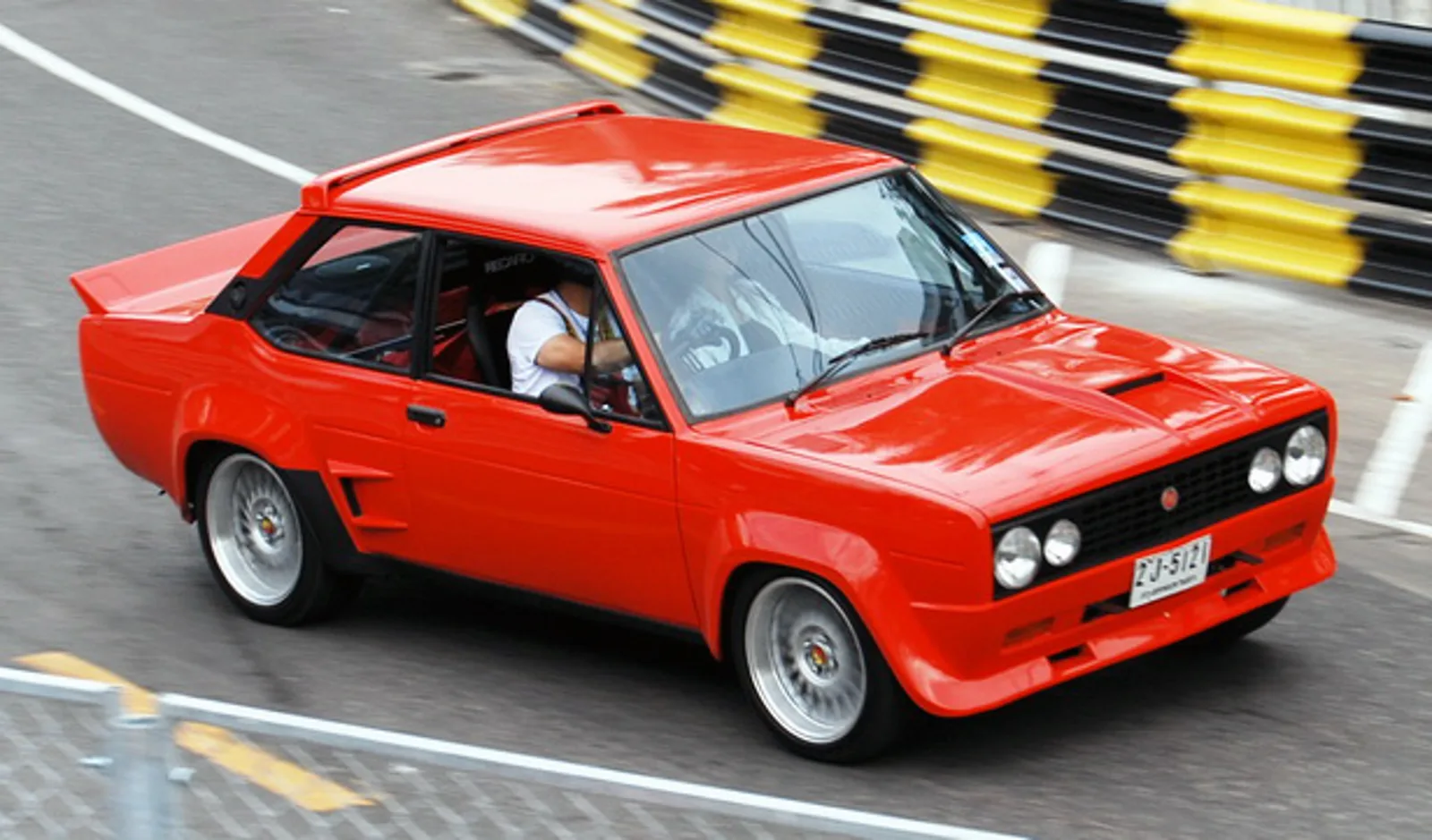
Abarth's Group 4 rally car, built from the Fiat 131 saloon, with 18 Group 4 wins and three world constructors' titles.
The Fiat 131 Abarth Rally was a two-door rally car built by Abarth on the Fiat 131 saloon. It was homologated in Group 4 with 400 production examples, and between 1977 and 1980 it took three world constructors' titles for Fiat.
Built by Abarth on the Fiat 131 saloon, this two-door was a homologation special for Group 4 rallying. Between 1977 and 1980 it helped Fiat collect three world constructors' titles.
It was built to replace two cars at once: the Fiat 124 Abarth Rally and the Lancia Stratos, which had dominated rallying since 1973 and was starting to struggle against new competition.
Where did the 131 Abarth Rally come from?
Abarth had first developed a project based on the Fiat X1/9 Spyder. When Fiat's management ordered that project stopped, a coachbuilder had already begun producing the 500 series cars needed for Group 4 homologation. The 131 then became the new base.
Abarth had long been tied to the Turin carmaker and had been fully integrated into the Fiat group in 1971. Fiat's competitions department therefore handed the new project to its young subsidiary.
The first test prototype, the Abarth 031, was officially presented in 1975 on a two-door 131 body. It shared little with the production car beyond its general body lines. Its engine was the 3.2 V6 of the Fiat 130, enlarged to 3.481 litres (212.4 cu in) and fed by three carburettors, producing 270 PS (199 kW; 266 hp) at 6,800 rpm. It reached 260 km/h (162 mph), and an outside styling house refined its aerodynamics.
Driven by Giorgio Pianta, the prototype won the 1975 Tour of Italy. That race gave the Fiat and Abarth engineers the experience that later shaped the definitive rally car.
Fiat's rally crown rested on a two-door saloon with a racing engine and 400 road-going cars behind it.
What changed on the civilian car?
The civilian car was the two-door first-series Fiat 131, put through a weight-reduction programme that brought it under one tonne. Both bumpers were removed, saving 65 kg (143 lb), while the wings, boot and wheel arches were moulded in resin. The doors and roof were aluminium, and the side windows were Plexiglas.
The widened wings covered light-alloy wheels, and two spoilers were added to improve the drag figure. Inside, the car was luxurious rather than sporty, with velvet seats and a full dashboard. Only the wheelbase of the basic car was kept; otherwise the rally car was shorter, lower and much wider.
The engine was a 2.0-litre Fiat four with twin overhead camshafts, also used in the Fiat 132 and Lancia Beta. Reworked with the experience gained on the Fiat 124 Abarth Rally, it produced 140 PS. It was the first Fiat twin-cam engine with four valves per cylinder fitted to a production car, and it went from 0 to 100 km/h in 8.2 seconds.
Fiat also offered three engine conversion kits, raising power to 165, 190 or 215 PS, and one of them included the racing suspension.
How did the racing version differ from the showroom car?
The racer was far removed from the showroom car. Its first outing, only eight months after the study began, was still a prototype, running a 1.8-litre 16-valve unit taken from the Fiat 124 Spider and giving barely over 200 PS. The definitive Corsa version, first entered in 1976, used a reworked 2.0-litre engine producing 215 PS at 7,000 rpm.
For Group 1 the engine received larger valves, new camshafts and pistons, lifting the compression ratio to 10.7:1. Its intake was a guillotine type, and mechanical fuel injection plus a dedicated ignition system completed the changes. The suspension used harder springs and dampers with more oil capacity.
The differential turned self-locking, with discs, and the fuel tank was relocated to spread the weight more evenly. The racer was built to the rule that its production base needed at least 400 examples, so the civilian run was a regulatory necessity as well as a sales model.
Rally wins, 1976 to 1980
The car's World Championship career began in 1976 at the Rally of Morocco, where it was competitive from the start. Earlier, in 1975, a few outings in the Italian championship had used a 3.5-litre V6 of 270 PS.
In 1976, racing for Olio Fiat against the Lancia Stratos HF, Alen and Kivimaki won the 1000 Lakes Rally in Finland. The engine gained 15 PS for 1977, and that year the car won the constructors' crown ahead of the Ford Escort RS and Opel Ascona SR. The Rally of Corsica produced a standout result, with five Fiat 131 Abarths among the top eight finishers.
In 1978 Markku Alen took the drivers' title with great consistency, and Fiat won the constructors' title with five wins in eleven rallies, again against the Ford Escort RS. Walter Rohrl then won the drivers' title in 1980, with five wins for a third constructors' crown.
The 1979 season was a transitional year. Fiat cut its competition budget and the number of teams, and entered only three events for a new world title. Ford snatched it at the last moment.
How many world titles did the 131 Abarth win?
The car won three constructors' titles, in 1977, 1978 and 1980, and two drivers' titles, for Markku Alen in 1978 and Walter Rohrl in 1980. Across its competition career it won 18 Group 4 competition wins, and no manufacturer did better.
The Fiat 131 Abarth then began to lose its place at the front. Fiat's works team was in decline by 1981 and 1982, and the car stayed in the sport through private teams.
Fiat's exit and the Lancia handover
Fiat stepped back from the works effort in 1981 and 1982, having already banked its big results, and with the 131 nearing the end of its production run. It did not leave rallying altogether. The Lancia brand took up entries, and Abarth began preparing a future special model for the group.
Private teams kept the 131 Abarth going. They took a dazzling win at the Rally of Portugal in 1981, along with other results, and a seventh place at the Acropolis Rally in 1982. The new FISA regulations for 1982 then turned Abarth's attention to the Lancia Rally 037 for the future Group B.
What were the Fiat 131 Abarth Rally specifications?
The civilian car produced 140 PS (103 kW; 138 hp) from 1,995 cc and reached 190 km/h (118 mph). The racer's output rose to 220 PS (162 kW; 217 hp) at 7,500 rpm, while the civilian car's kerb weight was 980 kg (2,161 lb).
| Specification | Detail |
|---|---|
| Bodywork | Two-door saloon, rear-wheel drive |
| Engine | 1,995 cc (121.8 cu in), four cylinders, twin overhead camshafts |
| Power, civilian | 140 PS (103 kW; 138 hp) at 6,400 rpm |
| Power, racer | 220 PS (162 kW; 217 hp) at 7,500 rpm |
| Torque, civilian | 176.6 Nm (130.3 lb ft) at 3,800 rpm |
| Length | 4,190 mm (165.0 in) |
| Width | 1,720 mm (67.7 in); 1,820 mm (71.7 in) for the racer |
| Wheelbase | 2,490 mm (98.0 in) |
| Kerb weight | 980 kg (2,161 lb); 950 to 1,020 kg for the racer |
| Top speed | 190 km/h (118 mph) |
| Fuel use | 9.5 L/100 km (24.8 mpg-imp; 29.7 mpg-US) |
| Homologation | Group 4 |
The 131 Volumex models
In 1978, when all 400 civilian cars had been sold, the Fiat 131 Abarth Rally left the Fiat catalogue. The scorpion badge returned in 1981 on two limited-series cars. One was the two-door Racing Volumex Abarth, built on the second-series Racing 2000/TC; the other was the four-door Supermirafiori Volumex Abarth, from the third series.
Both used a supercharger, a solution Fiat had long preferred to the turbocharger. Abarth also sold a complementary tuning kit. Compared with the rally car, the Racing Volumex had a more sober look, with different rear lettering and light-alloy wheels bearing the Abarth logo. Neither was ever homologated for competition, and their production ended at the end of 1983.
Appearances in video games
The Fiat 131 Abarth Rally appears in several Forza Motorsport titles, from the third to the seventh, as well as in the Colin McRae Dirt and Dirt Rally series. It also features in Forza Horizon 2, Forza Horizon 3 and Forza Horizon 4.