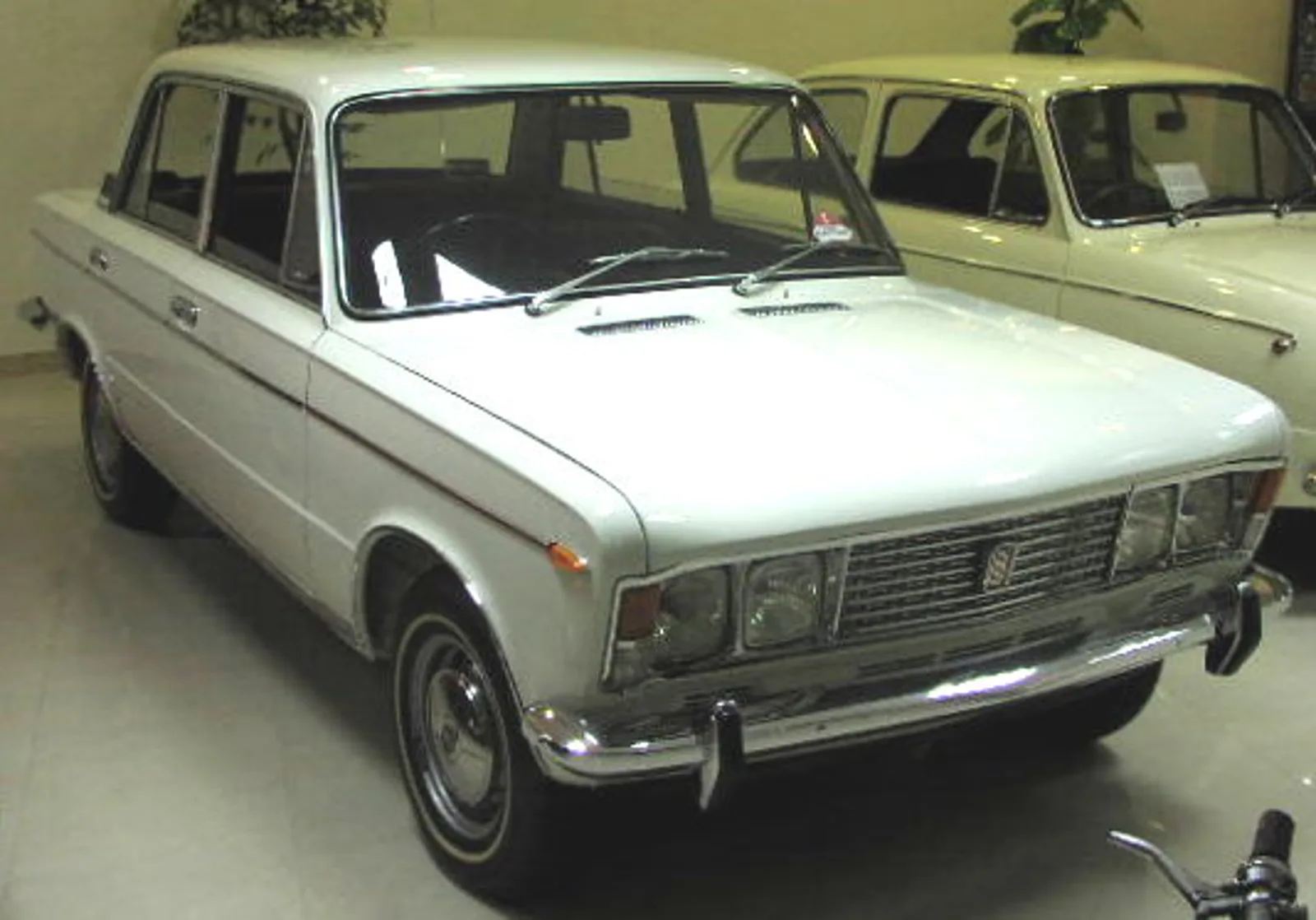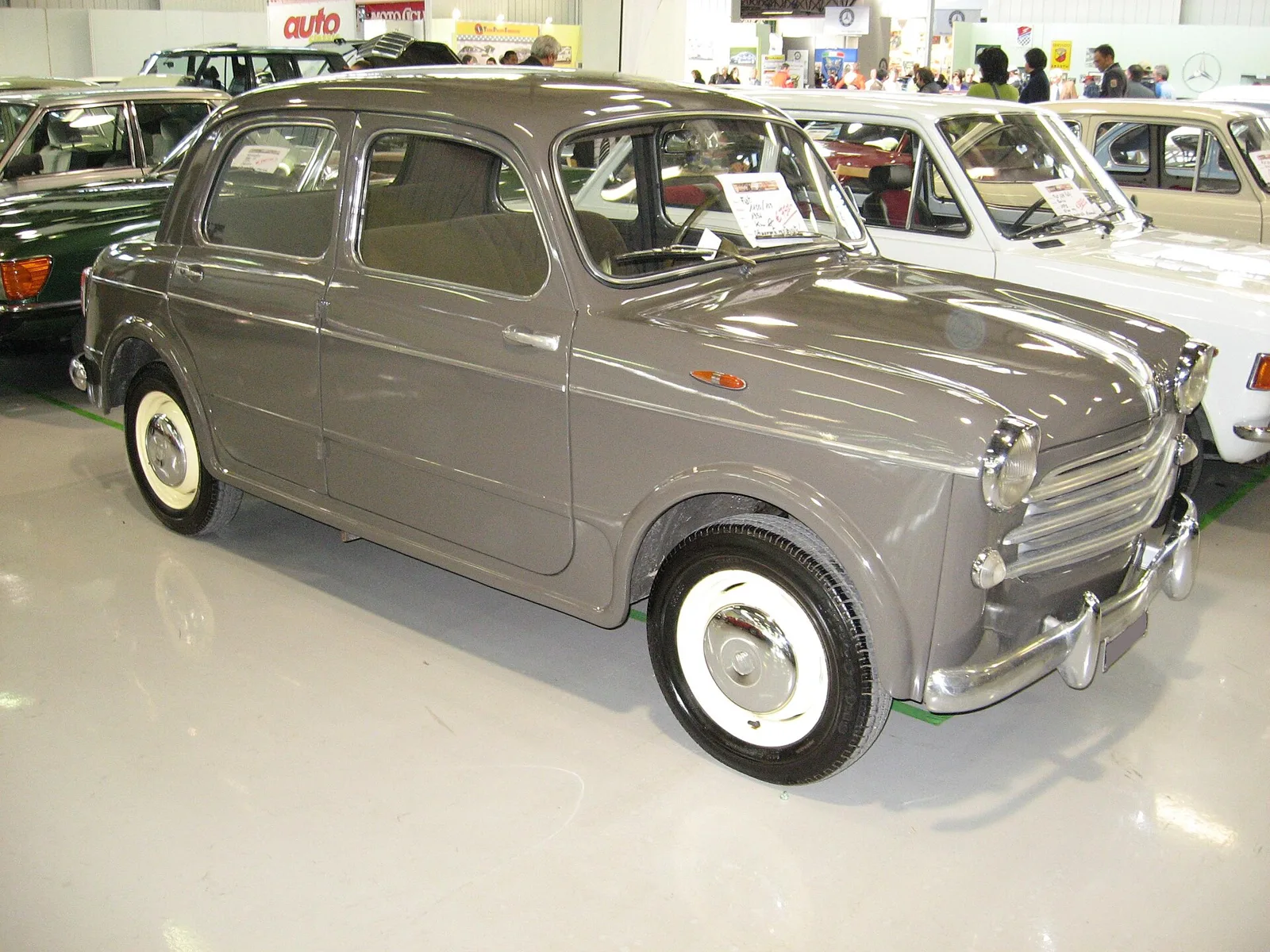
A 1953 saloon with a self-supporting body and an old 1,089 cc engine, built in Italy and by licensees and subsidiaries from Argentina to India.
The FIAT 1100-103 was a medium family saloon that FIAT presented at the Geneva show in March 1953. It carried a 1,089 cc (66.5 cu in) unit with 36 PS (26 kW; 36 hp) on a self-supporting body, and more than 3,800,000 examples were made worldwide.
FIAT kept almost nothing of its predecessor when it built the 1100-103. The engine was carried over from the Balilla 1100 it replaced, and the rest was a rebuild, starting with a self-supporting body in place of the conventional chassis of the period.
The car then spread far beyond Italy. Subsidiaries and licensees built it in Argentina, Germany, Austria, Belgium, India, Egypt and Morocco, and in Argentina many were still in service in 2010.
How did the 1100-103 differ from its predecessor?
The 1100-103 was a new project rather than a facelift. FIAT abandoned the conventional chassis of the period in favour of a self-supporting body, keeping only the engine of the car it succeeded. The original body was very round, with two volumes and a boot that barely showed.
That engine had earned its reputation. Its celebrated reliability and great flexibility won over the company's engineers, and the same unit was fitted to many Simca models, including the Simca 8, Aronde and P60 series.
The engine was the only part of the old car that survived the rebuild.
What engines did the 1100-103 get?
The first series used a 1,089 cc (66.5 cu in) engine rated 36 PS (26 kW; 36 hp) in CUNA form. In September 1953 the 103 TV raised that to 50 PS (37 kW; 49 hp), and by October the TV had a twin-barrel carburettor, richer trim and a fog lamp set in the centre of the grille.
Later engines grew in steps. The second series raised the saloon and estate to 40 PS (29 kW; 39 hp) in CUNA form, and the TV and Spyder to 53 PS (39 kW; 52 hp). The 1957 third series had a 1,089 cc unit developing 43 PS (32 kW; 42 hp) DIN.
The 1962 1100 D brought a 1,221 cc (74.5 cu in) engine from the FIAT 1200, producing 55 DIN horsepower (40 kW; 54 hp). The same unit later powered the Autobianchi Primula, the first front-wheel-drive car of the FIAT group.
Fuel quality shaped what these engines could do. Several countries had standardised Super petrol before France did, and France only did so in 1962, with a standard octane rating of 97. Until its ban in 2000, many French cars therefore ran on leaded normal petrol rated 89, and higher-grade fuel allowed much more output through higher compression and twin carburation.
Key specifications
| Item | Figure |
|---|---|
| Engine, first series | 1,089 cc (66.5 cu in) |
| Power, first series saloon | 36 PS (26 kW; 36 hp) in CUNA form |
| Power, 103 TV | 50 PS (37 kW; 49 hp) |
| Engine, 1100 D | 1,221 cc (74.5 cu in) |
| Power, 1100 D | 55 DIN horsepower (40 kW; 54 hp) |
| Pick-up wheelbase | 2,520 mm (99.2 in) |
| 1100 T top speed | 90 km/h (56 mph) |
| 1100 T payload | 1,100 kg (2,425 lb) |
How did the Industriale pick-up and the 1100 T work?
The 1100-103 Industriale pick-up arrived in spring 1954 to replace the 1100 ELR. It was based on the 1100 E saloon with its wheelbase stretched by 10 cm to 2,520 mm (99.2 in), and its load bed measured 1.7 m x 1.4 m for a payload of 800/1,000 kg plus the driver.
The Industriale was more powerful than its predecessor, at 36 PS (26 kW; 36 hp) in CUNA form or 34 PS (25 kW; 34 hp) DIN at 4,400 rpm, and it proved much more economical on fuel. The sheet-metal van could take an optional tailgate divided horizontally in two, a trend later seen on American estate cars.
The 1100 T, presented in 1957, replaced the Industriale. Built on a reinforced chassis, it came as a tilt-covered pick-up or a closed van, with a 1,100 kg (2,425 lb) payload and a top speed of 90 km/h (56 mph). It went through 7 series until 1971, when the FIAT 238 van and 241 pick-up took over.
Where was the 1100-103 built?
Italy was the main home, but the car was also made by subsidiaries and licensees abroad. Overall output exceeded 3,800,000 examples, and more than 1,437,100 came from Italian plants.
In Argentina, FIAT Concord built 23,152 examples at its Cordoba plant between 1960 and 1963. By 1962 the Argentine cars were 75% locally made, with 25% of parts from Italy, and the Millecento proved so robust that many were still running in 2010, after 50 years.
The Special and Familiare versions were imported in small quantities. Today they are collector cars with considerable historical value.
In Germany, the subsidiary NSU-FIAT Neckar built the car at its Heilbronn plant between 1953 and 1969, with FIAT 1,100 and 1,200 cc engines. It produced 159,731 examples under the NSU-FIAT and later FIAT-Neckar names until 1970.
The Heilbronn company had taken over from the NSU-FIAT 1100 Musone of the 1930s. Its last 1100 R series was sold under the name Neckar 1100 Europa.
Egypt and Morocco also assembled FIAT models locally in CKD form. El Nasr in Egypt, created in 1960, assembled the 103 D and then, from 1967, the 1100 R, while SOMACA in Morocco built the 1100 D from 1962 and the 1100 R from 1967.
In India, Premier (PAL) built the car under licence from 1954 until 1965, then bought a licence and an Italian production line capable of 40,000 examples a year. As the Padmini it stayed in production until 2000, and more than 1,000,000 FIAT 1100 D and Padmini cars were built for the local market alone.
Austria began building FIAT vehicles under licence at Steyr as early as late 1948. Production of the 1100-103 there began in 1954 and stopped in 1958, after which the model was imported from Italy until 1969. In Belgium, the FIAT-SAMAF subsidiary, founded on 26 June 1957, assembled a hybrid sold as the FIAT 1100 Urania.
Demand was so strong that the Italian and German plants struggled to keep up, which is why the Belgian assembly was set up with parts from both countries. The same approach was later used for the FIAT 1200, sold as the Nettunia, which was built until 1966.
Which coachbuilders made special 1100-103 bodies?
FIAT left niche bodies to outside specialists. Its Mirafiori and Lingotto plants were built for very large series, so sporting coupes, cabriolets and ambulances came from coachbuilders around Turin. The 1956 Trasformabile was a Spyder designed by FIAT's own special-bodies section in Turin.
No fewer than twenty or so Italian coachbuilders competed to produce elegant fuoriserie bodies. Names included Accossato, Allemano, Bertone, Boneschi, Fissore, Colli, Zagato, Frua, Viotti, Moretti, Monviso, Pininfarina, Savio, Vignale, Ghia and Sebastiano Canta.
Some moved quickly. A few showed their derivatives just 8 weeks after the base model was presented, and the Monviso went further with a plexiglass bubble canopy on its open car.
Bertone's cabriolet was named Derby and recalled some drawings by Raymond Loewy. Boneschi's Spring name was later taken up by Siata for a retro-styled cabriolet built on the FIAT 850. Vignale offered two derivatives, Charmant and Desiree, both drawn by Michelotti, while Ghia offered the supergioello, literally a super-jewel.
What did the later series change?
In autumn 1960 the basic 1100-103 was replaced by the 1100 Export, which took the body of the 103 H luxury version. The new top-of-range 1100 Special used the body of the FIAT 1200 Granluce, and from this series the name dropped the project number 103.
The second series, from 1956, had more angular lines and a true, more pronounced rear trunk. The third series, shown at the Turin show in spring 1957, received body revisions, notably front doors that open against the wind.
The 1959 103 H was a luxury version of the 103 D that stayed in the catalogue and occupied the niche below the FIAT 1200 Granluce.
In November 1962 the FIAT 1100 D replaced every 1100-103 version, with a restyled grille, lamps and cabin. Its production was later moved in part to India, where it was sold as the Premier Padmini until 2000.
The FIAT 1100 R, presented in February 1966, was the last version. It had tauter lines in keeping with Italian style, kept the 1,089 cc engine and gained front disc brakes. It stayed in the catalogue until 1969, when the FIAT 128 took over.
Did the 1100-103 leave a legacy?
The car left a long tail of working vehicles. In Argentina the Millecento was valued for exceptional robustness and reliability, and in India the Padmini was highly prized by taxi operators until 2000.
The 1100 R was first planned for production in India and Pakistan. Only the 1100 D was built there in very large numbers, and FIAT never obtained permission to build a factory in Pakistan at that time.