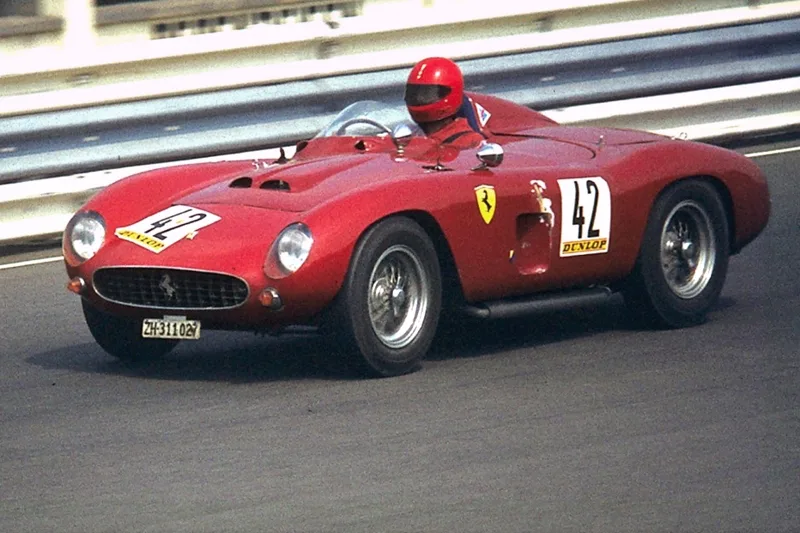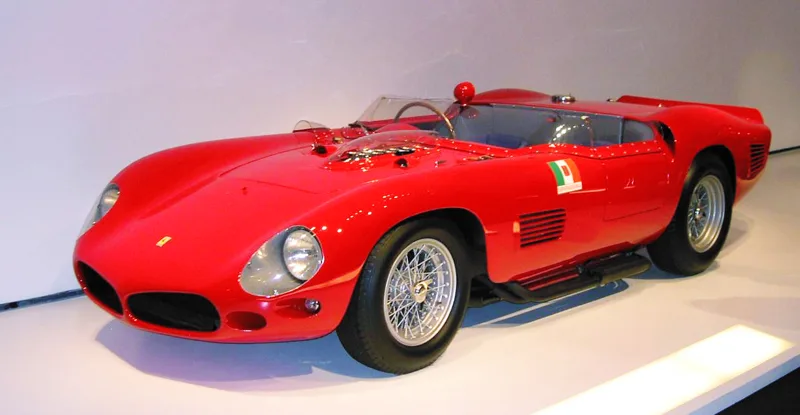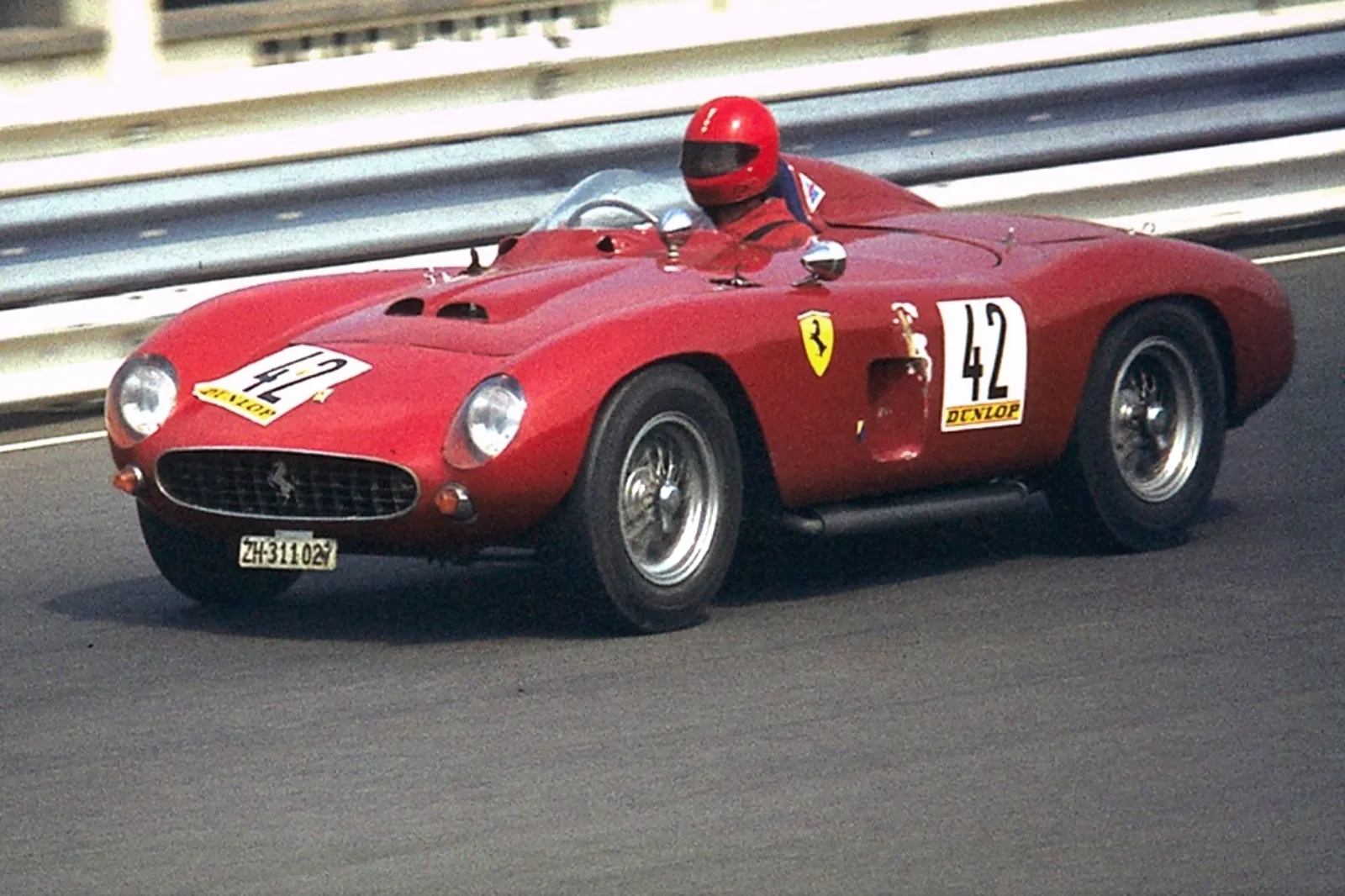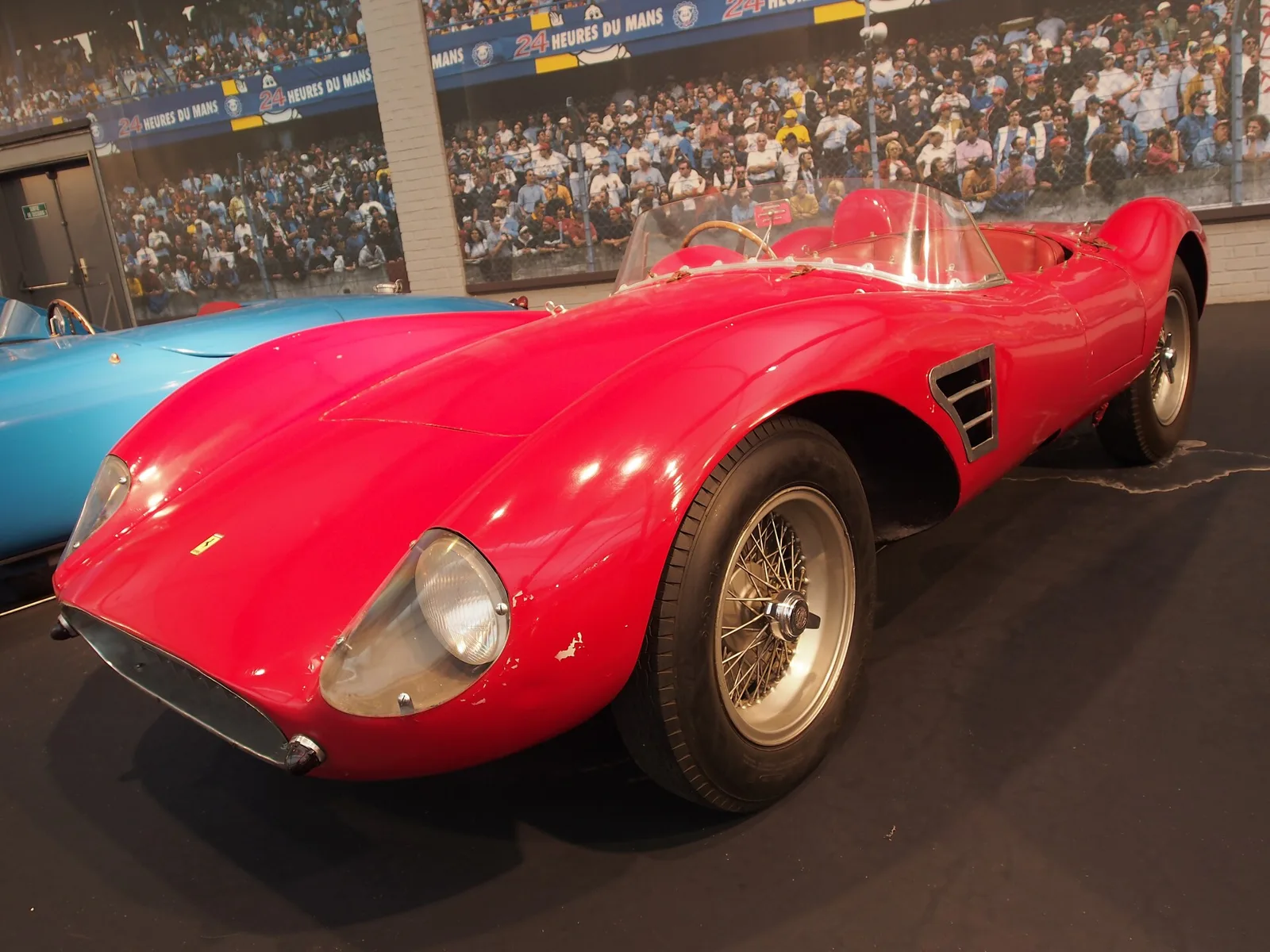
A 2.0-litre open sports racer built for small teams and privateers in 1957, with a light alloy body shaped by new FIA rules.
The Ferrari 500 TRC Scaglietti Spider was a 1957 open racing sports car with a 1,984.86 cc four-cylinder engine producing 180 PS (132 kW; 178 hp). It replaced the 500 TR and was Ferrari's last four-cylinder car to date.
The Ferrari 500 TRC was a two-seat open racing sports car with a 2.0-litre four-cylinder engine, built only in 1957. Ferrari made it for smaller teams and privately run drivers to race in the 2.0-litre class. Between 17 and 20 cars were built, depending on how three special racers are counted.
Why did Ferrari build the 500 TRC?
Ferrari built the 500 TRC for the 1957 season to serve smaller racing teams and private drivers in the 2.0-litre class. Works cars had moved on to larger and faster machines, and the small category had lost importance during the year.
New FIA rules were the trigger for the change. Appendix C asked for a passenger seat, a door on the passenger side, and a windscreen at least 100 centimetres wide and 15 centimetres high. A hood was also required, though it could be removable and did not even have to be carried during a race.
Ferrari's works V12 cars had been developed through the season, from the 290MM through the 290S into the 315S and 335S. The effort turned into an elaborate arms race, with Maserati's 450S, Jaguar's D-Type and the Aston Martin DBR1 as rivals.
Ferrari had won the 1956 manufacturers' title narrowly ahead of Maserati and clearly ahead of Jaguar. Mercedes-Benz, the 1955 winner, had withdrawn its works team from the sports car World Championship.
A light, open four-cylinder racer, built for customers, that closed a chapter at Ferrari.
What engine did the 500 TRC use?
The 500 TRC used a 1,984.86 cc (121.1 cu in) inline four with two overhead camshafts and gear drive, developed by Aurelio Lampredi. It made 180 PS (132 kW; 178 hp) at 7,000 rpm with an 8.5:1 compression ratio.
The engine traces back to the 2.0-litre four that Lampredi first designed for Grand Prix racing under Formula Two rules. Ferrari built that engine family between 1951 and 1957, and other versions displaced 2.5, 3.0 and 3.5 litres.
Each cylinder had two valves hanging in a V. Two camshafts operated them, one for the inlet valves and one for the exhaust valves. Gears at the front of the engine drove the camshafts instead of a chain, a technique the four-cylinder engines had used since 1951.
Two Weber 40DCO/3 twin-barrel carburettors fed the engine. Two distributors and two spark plugs per cylinder gave dual ignition, and dry-sump lubrication kept oil reaching every critical part under strong lateral acceleration.
The 500 TRC's engine, Tipo 131C, was a derivative of the 500 TR's Tipo 131 unit. The only difference lay in changed mounting points, which allowed a lower installation and a slightly lower centre of gravity than on the 500 TR.
Specifications at a glance
| Specification | Detail |
|---|---|
| Type | Two-seat open front-engined racing sports car |
| Engine | 1,984.86 cc (121.1 cu in) inline four, DOHC |
| Bore and stroke | 90.0 mm and 78.0 mm |
| Output | 180 PS (132 kW; 178 hp) at 7,000 rpm |
| Compression ratio | 8.5:1 |
| Gearbox | Synchronised four-speed manual |
| Length | 3,937 mm (155.0 in) |
| Width | 1,638 mm (64.5 in) |
| Height | 965 mm (38.0 in) |
| Wheelbase | 2.25 m |
| Dry weight | 680 kg (1,499 lb) |
| Top speed | 260 km/h (162 mph), depending on gearing |
| Fuel tank | 150 litres |
How did the 500 TRC body differ from the 500 TR?
The body was the main change. It was a light alloy shell shaped by the new Appendix C rules, with a lower overall profile, a more sharply sloping bonnet and a mandatory passenger door. The lower body and bonnet cut drag and added downforce at the front axle.
The passenger space kept a simple light racing seat that could no longer be covered. The passenger door was as minimalist as the driver's door. The windscreen rule threatened to enlarge the frontal area, so Ferrari lowered the whole body shape, especially between the axles.
The front wheel cut-outs grew rounder and ran further back, recalling the 625 LM Touring Spider. The side air outlets in the wings became much longer and lower than before, and on some cars they were divided horizontally rather than vertically.
The bonnet had no air scoop over the carburettors, so the nose reads as either elegant or plain, depending on the viewer. Scaglietti designed a two-tone paint scheme with a contrasting lower body and a broad central stripe, and many 500 TRCs wore it.
Authors disagree on who styled the car. Sergio Scaglietti built the body, and Battista 'Pinin' Farina is also a possibility, as he had been for the 500 TR.
How was the 500 TRC chassis built?
The chassis used an oval-tube frame with double wishbones and coil springs at the front, and a rear solid axle with coil springs. Drum brakes and 16-inch wheels remained the Ferrari standard, and the frame was modified only at the front so the engine could sit lower.
The rear suspension was lighter and cheaper to make than the De Dion axle of the more powerful V12 cars. Disc brakes did not arrive until the new racing sports cars of the 1959 season.
Rims and tyres measured 5.50 x 16 in, with 6.00 x 16 in optional at the rear depending on the purpose. The 500 TR probably received the wider rear tyres as standard from the factory, so the two models matched in this respect too.
All 500 TRCs were right-hand drive, in keeping with the marque's tradition. That promised advantages on circuits that are mostly driven clockwise.
Where did the 500 series come from?
The 500 TRC belonged to the Ferrari 500 family, which included the Grand Prix 500 F2. Ferrari drivers dominated the 1952 and 1953 world championships with that 2.0-litre car, the only two years the title was run to Formula Two rules.
The sports car line began in 1954 with the 500 Mondial Series I. Of it, 13 Pinin Farina Spiders, two Pinin Farina Berlinettas and some Scaglietti Spiders were built. The 500 Mondial Series II, bodied solely as a Scaglietti Spider, followed for the 1955 racing season.
For the 1956 season came the 500 TR, 'Testa Rossa', of which 16 Scaglietti Spiders were built. Three Touring Spiders were added through the later conversion of a Ferrari 625 LM.
The 2.0-litre engine was the common thread of the 500 family, which also covered the Grand Prix car and the sports cars.
Aurelio Lampredi left Ferrari at the end of 1955 for Fiat, after a disappointing racing year. That left privateers either to run the 500 TR in the smaller category or to buy used larger cars from the previous year.
What was the 500 TRC's name based on?
The 500 stands for the rounded displacement per cylinder, a convention Ferrari's V12 cars also used at the time. TR stands for Testa Rossa, meaning red head, after the cylinder head covered in red shrink lacquer that was introduced with the 500 TR the year before.
Readers can take the added C two ways: as a link to the new Appendix C of the FIA rules, or as 'clienti', the Italian word for customers. Either reading points to a car developed for small racing teams and private drivers.
How did the 500 TRC compete in racing?
The 500 TRC was built for the 2.0-litre category, where it competed mainly with the further developed Maserati 200SI. Smaller racing teams and private drivers used it with success.
Works drivers had won the 1956 title with the 860 Monza, an inline four of just under 3.5 litres, and with the 290MM, a V12 of 3.5 litres.
Privateers had already used the 500 TR in 1956 for class wins in the category up to 2.0 litres and for titles in national sports car championships. In 1957 the 500 TRC replaced the 500 TR as Ferrari's entry-level racing sports car.
Ferrari gave up the 2.0-litre category at the end of 1957. The FIA had cut the displacement limit for sports cars to 3.0 litres for 1958, which reduced the importance of the smaller classes.
Was the 500 TRC sold to private drivers?
The 500 TRC was designed primarily for well-funded smaller customer teams and private drivers. Each car carried full road-going lighting and essential instruments, so it could be registered for public roads under the legislation of the time.
What came after the 500 TRC?
Opinions differ. Some name the 250 Testa Rossa Scaglietti Spider, built from mid-1957, while a series of Dino models from 1958 to 1967 matched the engine capacity, though most stayed prototypes.
The 250 Testa Rossa had a 3.0-litre V12 and sat in a higher category. Its chronology and availability to smaller teams still make it a serious candidate for the successor.
The Dino 206 Sport Scaglietti Spider, chassis 0740 from 1958, and the Dino 196 Sport Fantuzzi Spider, chassis 0776 for the 1960 season, were 2.0-litre racers. So were the two Dino 196SP Fantuzzi Spiders, with chassis numbers between 0790 and 0804. They never got beyond test cars and works prototypes, so private drivers could not buy them.
The Dino 206S, of which 34 cars were built between 1965 and 1967, was available to smaller racing teams and private drivers. Against it stood the gap of roughly eight years from the 500 TRC.
Which chassis numbers and production dates are known?
The 500 TRC debuted in early 1957, in good time for that year's racing season, and most of the cars were built by spring.
The first chassis of the small series is 0658MDTR and the last is 0708MDTR. Every 500 TRC has an even chassis number, as was normal for Ferrari racing sports cars of the period.
Production of the 500 TR had ended with chassis 0654MDTR. A 290 Sport Scaglietti Spider with a V12 engine and chassis 0656 came next, before the 500 TRC series began. Scaglietti and his staff built the bodies in Modena, and Ferrari's racing department completed the cars.
Ferrari slotted some special racers among the production cars. Two 625 TRC models used the normal 500 TRC chassis and body, and chassis 0704TR was a second 250 TR prototype on an adapted 500 TRC chassis. Individual cars were delivered during the season, so chassis 0698MDTR was completed in May 1957 and 0708MDTR in September 1957.
Other special racers used numbers within the same run. Chassis 0674 and 0676 were a 315S and a 335S, each a Scaglietti Spider with a DOHC V12, and 0684 was another 315S. Chassis 0688M was reserved for a 860 Monza of which only the 3.5-litre four-cylinder engine was built, and 0700 became another 335 S Scaglietti Spider.
Why did the 500 TRC matter as Ferrari's last four-cylinder?
The 500 TRC is the last four-cylinder car from Ferrari to date. Ferrari gave up the four-cylinder concept at the end of 1957, reasoning that only V12 engines could sustain the brand's exclusive image.
Lampredi, the driving force behind the four-cylinder project, was no longer at the company, and that removed the most ardent advocate of the concept. The car therefore closed a line of front-engined four-cylinder racers that had started with the 1954 500 Mondial.