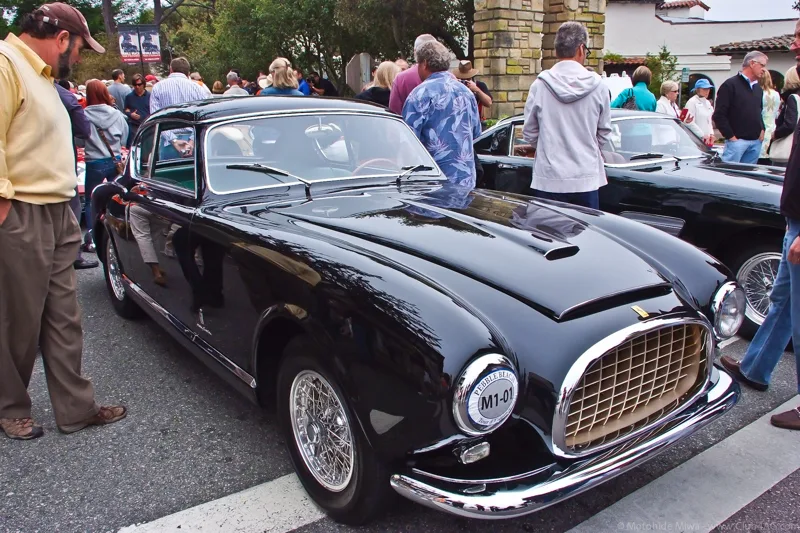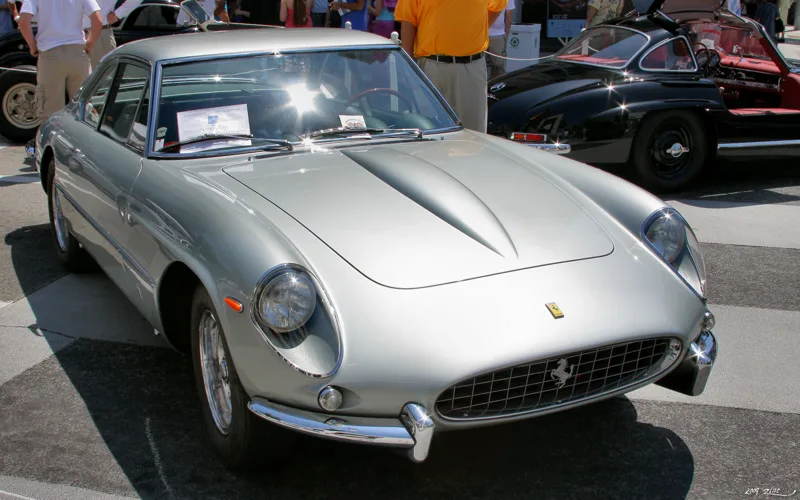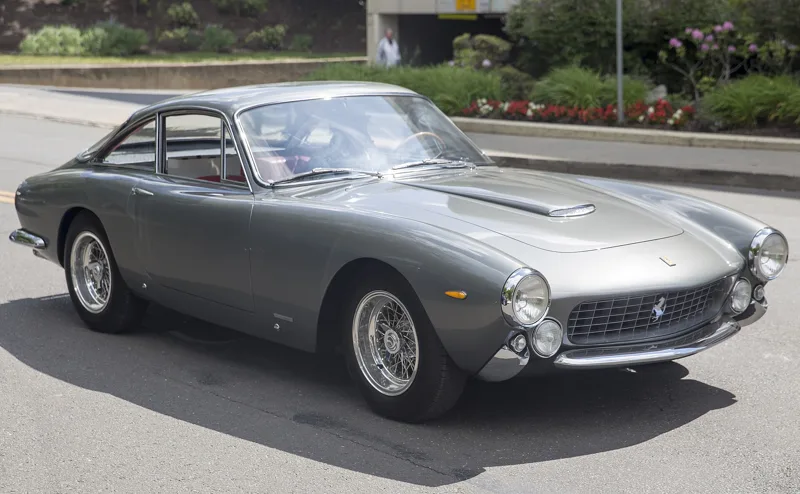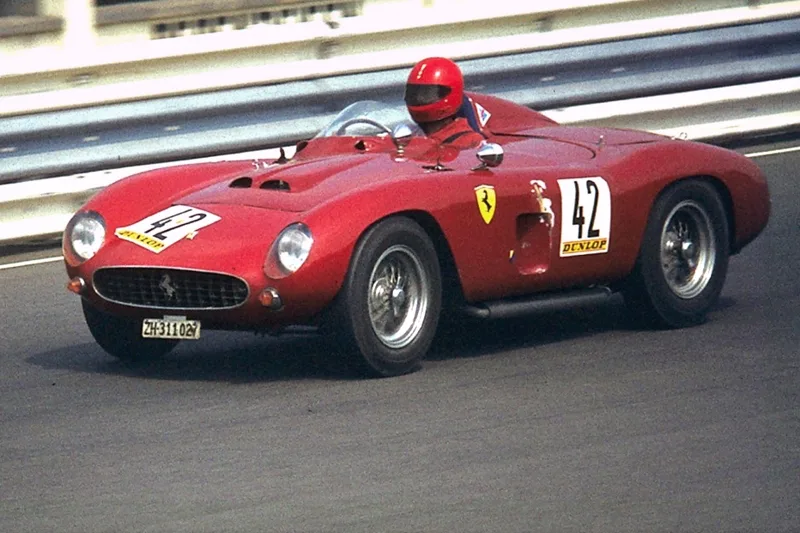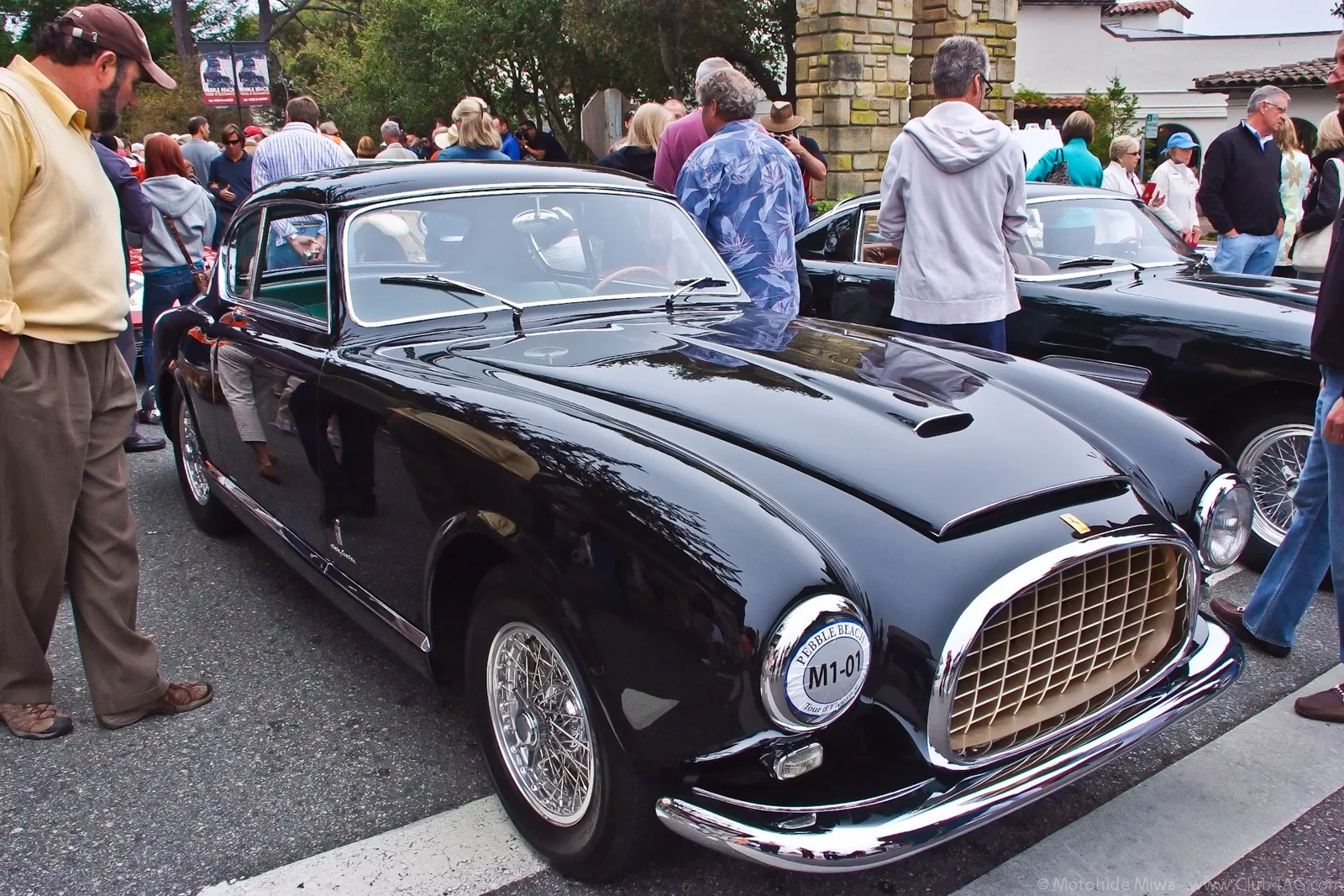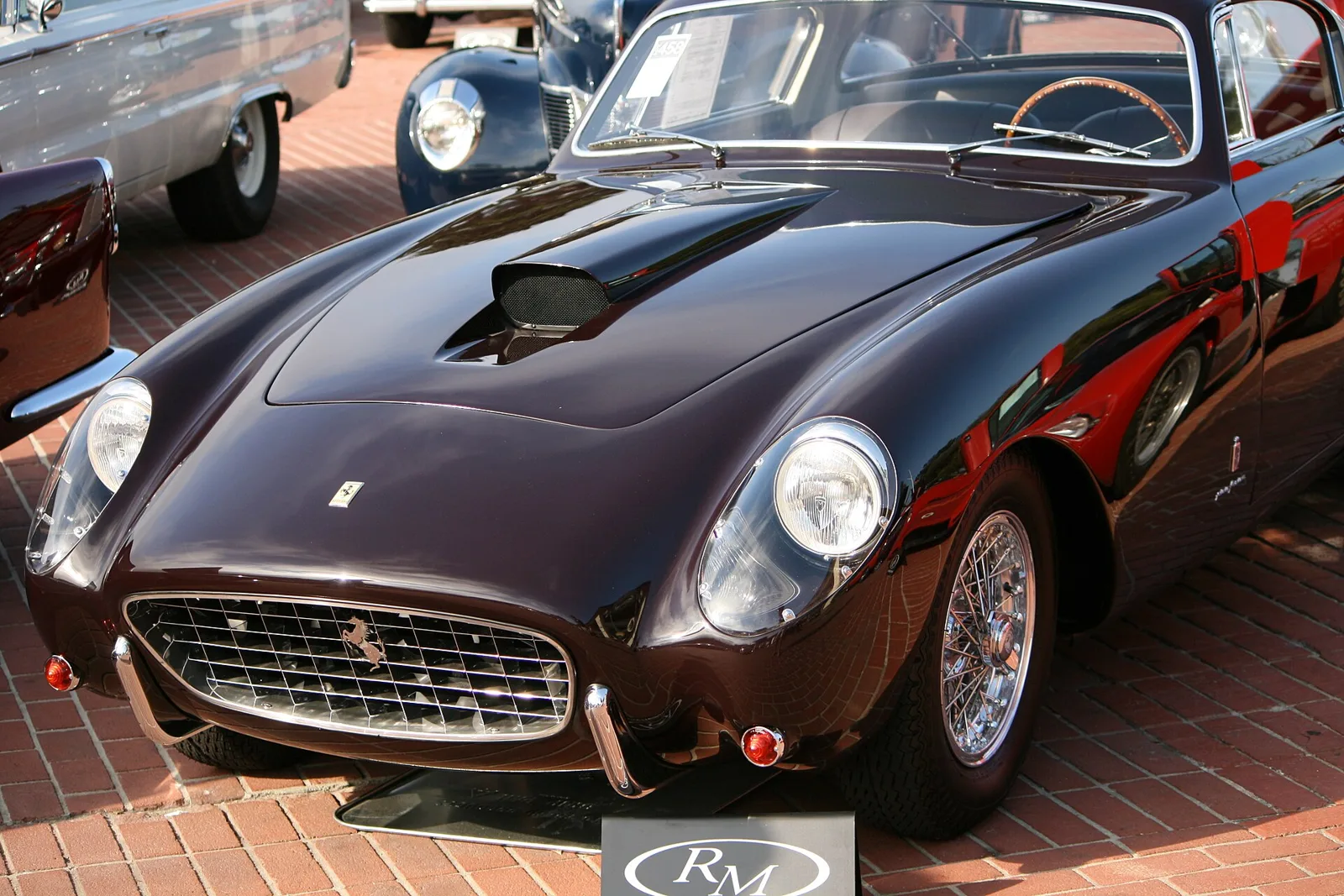
A large-engined Ferrari road car from the early 1950s, aimed at the American market, with bodies by Pininfarina and Vignale and only twelve cars built.
The Ferrari 375 America was a 1953 to 1954 road car with a 4,523 cc V12 producing 296 hp, a 2,800 mm wheelbase and bodies by Pininfarina and Vignale. Only twelve were built, and its successor was the 410 Superamerica.
The Ferrari 375 America was a road sports car built in 1953 and 1954, and the third model in Ferrari's America range. Its 4,523 cc Lampredi V12 produced 221 kW (296 hp; 300 PS), and only twelve cars were made, with bodies from Pininfarina and Vignale. Apart from its engine, it was very closely related to the 250 Europa built at the same time.
Where did the 375 America come from?
Ferrari's first road cars, the 166, 195 and 212, came from a racing company. These appeared from 1948, but each was made in only a few examples. Larger numbers arrived with the 250 family, introduced in 1952, and with them Ferrari became a series maker. Almost all of those early cars used a V12 designed by Gioacchino Colombo, with capacities between 2.0 and 3.0 litres.
Those small, highly tuned engines found little favour in North America, where buyers wanted large, high-displacement engines. Ferrari answered this from 1951 with a range of coupes and convertibles fitted with the larger long-block engines designed by Aurelio Lampredi. The 340 America came first, and in 1952 the 342 America replaced it, though only six were built. A year later the 375 America replaced it with a larger engine and twelve cars made.
Most of the cars were exported to the United States, as Ferrari expected. The clearly more powerful 375MM and 375 Plus were technically related racing sports cars, and they were built as road cars only occasionally. Just over a year after the 375 America appeared, its successor, the 410 Superamerica, arrived.
Twelve cars, two coachbuilders and a 4,523 cc V12 built for the American market.
How did Ferrari name the 375 America?
The name followed Ferrari's usual practice. The number 375 referred to the cubic capacity of a single cylinder, 375 cc, rather than to the whole engine. The word America had been used on the earlier cars too, and it described the main sales market for the range.
Ferrari's chassis numbers followed a rule. In the first decades even numbers went to competition cars and odd numbers to road sports cars. The 340 America and 342 America broke that pattern by taking even numbers, which tied them to their racing relatives. The 375 America was the first large sports car to take an odd number, and its chassis carry the suffix AL, for America Lungo.
How did the 375 America compare with the 250 Europa?
The two models shared a frame, a wheelbase and much of their body design, and the main difference was the larger Lampredi engine of the America. Some cars that started as 250 Europa were later given the bigger unit.
Both models used a 2,800 mm (110 in) wheelbase and matching chassis dimensions, and the standard coupe bodies were made for both. A car could therefore be built as one model and become the other later, as chassis 0315AL and 0353AL show.
What engine did the 375 America use?
Its engine was the Lampredi long-block, here in a 4,523 cc (276 cu in) form and known in the works as Tipo 104. Each cylinder had one inlet and one exhaust valve, and a single overhead camshaft controlled each bank. The compression ratio was 8.4:1, and three twin-barrel carburettors, type DCZ/3, mixed the fuel.
| Item | Ferrari 375 America |
|---|---|
| Years built | 1953 and 1954 |
| Engine | 4,523 cc (276 cu in) V12, Tipo 104 |
| Bore and stroke | 84 x 68 mm |
| Compression | 8.4:1 |
| Carburation | Three twin-barrel carburettors (DCZ/3) |
| Output | 221 kW (296 hp; 300 PS) at 6,500 rpm |
| Gearbox | Manual four-speed |
| Wheelbase | 2,800 mm (110 in) |
| Cars built | Twelve |
Was there a larger engine option?
A single car, 0355AL, received a 4.9-litre enlargement of the same unit, designated Tipo 108. The engine is quoted at over 300 PS, and the car is described in the Pininfarina section below.
The car's 221 kW output, at 6,500 rpm, placed it among the most powerful road cars Ferrari built in its day. The engine sat at the front, longitudinally, and sent its drive to the rear wheels. Power went through a manual four-speed gearbox for which various ratios were available.
How was the chassis built?
The car had a frame of welded steel tubes. Its chassis matched the 250 Europa in both dimensions and construction, and both models had a wheelbase of 2,800 mm (110 in). The front wheels were independently suspended on double wishbones, with a transverse leaf spring. At the rear sat a rigid axle, located by longitudinal leaf springs. Houdaille lever-arm shock absorbers were fitted at both ends.
Which coachbuilders made the bodies?
Pininfarina and Vignale designed and built the bodies, and in every case the body was made of aluminium sheet. Pininfarina clothed eight of the chassis, including the standard coupes, the special 0315AL and the 0355AL Berlinetta, while Vignale built four. Ten were built as 375 America from the start, and two began life as 250 Europa before being fitted with the 375 America engine.
Some have suggested a further chassis carried a Ghia body, though nothing confirms it.
What did the Pininfarina coupes look like?
Six chassis, 0293AL, 0307AL, 0317AL, 0319AL, 0329AL and 0339AL, received essentially similar two-seat coupes. These bodies were also offered on the less powerful 250 Europa, and from outside they are hard to tell apart from the 250 Europa cars.
They are notchback coupes with a very long bonnet and a passenger compartment set close to the rear axle. The roof starts to slope down behind the B-pillar, and the rear window is in three parts, so the outer sections give the impression of a panoramic window. The front wings flow into round headlamps, and the cooling opening carries a chrome grille. Most have a one-piece front bumper, but chassis 0339 had two small bumpers at the sides and a deeper cooling opening. The size of the cooling opening varies from car to car.
Commentators have praised the Pininfarina styling consistently. One source calls it strikingly harmonious, and another author argues that its lines suit a luxury car far better than a racing car.
What happened to chassis 0315AL?
It was built in 1954 as a 250 Europa with a small engine and standard body, and in that form it was shown at the New York Auto Show that year. At the end of 1954 Ferrari sold it to a businessman from the Marche region, who had Ferrari fit an engine of 375 America specification in 1955.
The body stayed the same for a while. In 1959 the car received a new front end that sloped forward, with covered headlamps and bumper horns in place of ordinary bumpers. That design followed the 375MM built by Scaglietti for Roberto Rossellini. The car went to a collector in the USA in the early 1960s, and it remains there after a series of changes of ownership.
What is the 375 America Berlinetta Speciale P.F.?
The Berlinetta Speciale P.F. is the last Pininfarina car in the series, chassis 0355AL, which was finished in early 1955. It was painted in dark green and dark red and shown at the Turin motor show in April 1955. Its styling has little in common with the other Pininfarina coupes, apart from broadly similar proportions.
The car has a rectangular, upright cooling opening that breaks through the bumper line in the middle, a panoramic windscreen, and an acrylic roof insert above the seats. Its B-pillars run into fins that taper towards the back, and the rear window is set back and can be lowered. Pininfarina designer Aldo Brovarone developed the side fins, which became typical of Ferrari's mid-engined cars of the 1960s, such as the Dino 206 and 246.
Chassis 0355AL also differs technically. It is powered by an enlarged 4,954 cc version of the Lampredi engine, Tipo 108, which is quoted at over 300 PS. Gianni Agnelli took over the car after Turin and kept it for some years. Luigi Chinetti, the importer for North America, moved it to the United States in 1959, and it is still there after many owners.
How did the Vignale cars differ?
Vignale, the Turin coachbuilder, produced four 375 America bodies: three coupes and one convertible. The designs contributed by Giovanni Michelotti differed a good deal from one another. Between them, the four Vignale cars show how far one coachbuilder could vary the same basic car, from a notchback with four windows to a convertible that began life as a 250 Europa.
Chassis 0301AL is a notchback coupe with four side windows, a big grille, two low round headlamps and bumper horns mounted high on the front wings. The actor Steve McQueen owned the car for several years, before losing it to a poker wager in 1964. By 1989 it had been seized in the Netherlands and later auctioned. It was originally painted red and now wears gold.
Chassis 0327AL is a fastback coupe with a broad B-pillar and a big panoramic glass area at the back. It was shown at the Geneva salon in 1954, and it went to the USA afterwards. Chassis 0337AL is also a fastback, with a simpler front end than 0327AL. Its headlamps are set into the upper ends of the wings, where 0327AL has low-mounted headlamps and small indicators. It was shown in yellow at the 1954 Turin show and then sold in the USA. In the 1960s it received an engine and gearbox from General Motors, and in 2007 it came back to Europe, where it was restored with Ferrari drivetrain parts.
Chassis 0353AL is the only convertible in the series. It began in 1954 as a 250 Europa with a custom Vignale body, carrying the number 0353EU. In 1955 Ferrari fitted a 4.0-litre engine from the 375 America range, and the car was renumbered 0353AL. Its first owner was a daughter of the Italian film director Giuseppe Colizzi, and it has been in the USA since 1958.
What replaced the 375 America?
The 410 Superamerica arrived a little over a year after the 375 America, and it was the next model in the America line. The 375MM and 375 Plus were technically related to the 375 America, but they were mainly racing sports cars and were built as road cars only occasionally.
What do the cars sell for today?
The cars are high-priced classics, and in the 21st century they reach seven-figure sums. Two of them have passed through auction in recent decades, the 0301AL in the Netherlands and the 0353AL in 2022. The convertible 0353AL sold at auction in 2022 for almost US$7.6 million, which illustrates the price level of the type.